
Wearable Technology Market Report 2026
Global Outlook – By Product Type (Smartwatches, Fitness And Activity Trackers, Smart Clothing Or E-Textiles, Augmented Reality And Virtual Reality Headsets Or Smart Glasses, Medical And Clinical Wearables, Hearables Or Smart Earbuds, Other Wearable Accessories), By Connectivity (Bluetooth, Wi-Fi, Cellular Or LTE Or 5G, Near Field Communication (NFC), Other Internet Of Things Low-Power Networks), By Distribution Channel (Online Retail Or E-Commerce, Brand Stores Or OEM Stores, Consumer Electronics Retailers, Healthcare And Medical Distribution Networks, Enterprise Or Institutional Sales), By End-Users (Individual Consumers, Healthcare Providers And Patients, Enterprise And Industrial Users, Athletes And Sports Organizations) – Market Size, Trends, Strategies, and Forecast to 2030
Wearable Technology Market Overview
• Wearable Technology market size has reached to $97.21 billion in 2025 • Expected to grow to $222.63 billion in 2030 at a compound annual growth rate (CAGR) of 18% • Growth Driver: Rising Consumer Awareness About Health And Fitness Monitoring Fueling Market Growth Due To Increasing Adoption Of Wearable Devices • Market Trend: Advancing Neural Gesture Control Interfaces To Enable Intuitive Touchless Interaction • North America was the largest region in 2025 and Asia-Pacific is the fastest growing region.Market Gains By 2030 – Top Opportunities By Segment
Market Gain identifies the most promising market opportunities by highlighting the segments or products expected to generate the highest incremental revenue growth over the next five years.
What Is Covered Under Wearable Technology Market?
Wearable technology refers to electronic devices embedded with sensors, software, and connectivity features that can be worn on the body to collect and exchange data. Its purpose is to enhance user convenience, health monitoring, productivity, and real-time access to information by seamlessly integrating technology into daily activities. The main product types of wearable technology include smartwatches, fitness and activity trackers, smart clothing or e-textiles, augmented reality and virtual reality headsets or smart glasses, medical and clinical wearables, hearables or smart earbuds, and others. Smartwatches refer to wearable devices designed to be worn on the wrist that provide digital functionality, connectivity, and interactive features beyond traditional timekeeping. The various connectivity options, including bluetooth, wi-fi; cellular or lte or 5g, near field communication (nfc) and others. The distribution channels as given online retail or e-commerce, brand stores or oem stores, consumer electronics retailers, healthcare and medical distribution networks and enterprise or institutional sales. The applications or use-case such as health and fitness monitoring, medical diagnostics and remote patient monitoring, sports and performance analytics, gaming, virtual reality, entertainment and immersive training, workplace safety and productivity, lifestyle and personal assistance and defense and tactical operations. The end-users such as healthcare providers and patients; enterprise and industrial users; athletes and sports organizations.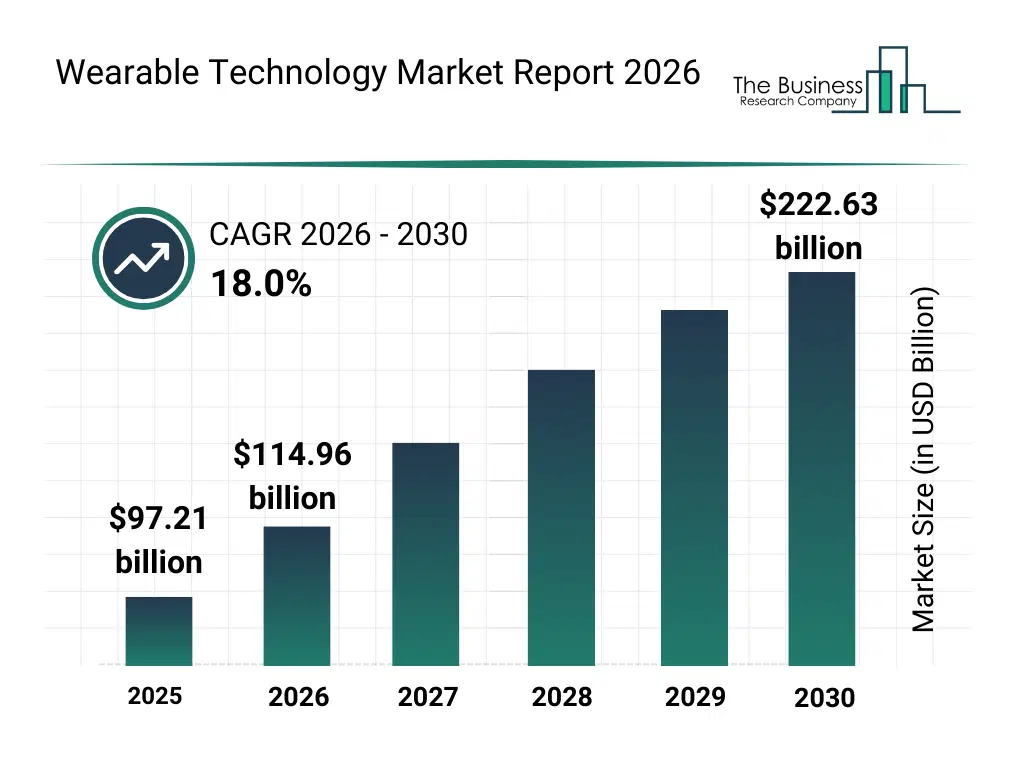
What Is The Wearable Technology Market Size and Share 2026?
The wearable technology market size has grown exponentially in recent years. It will grow from $97.21 billion in 2025 to $114.96 billion in 2026 at a compound annual growth rate (CAGR) of 18.3%. The growth in the historic period can be attributed to increasing consumer focus on fitness and wellness, growing adoption of smartwatches and fitness bands, rising usage of wearables in sports performance tracking, expansion of remote patient monitoring in healthcare, and increasing integration of Bluetooth and smartphone connectivity in wearables.What Is The Wearable Technology Market Growth Forecast?
The wearable technology market size is expected to see exponential growth in the next few years. It will grow to $222.63 billion in 2030 at a compound annual growth rate (CAGR) of 18.0%. The growth in the forecast period can be attributed to growing demand for personalized health insights and predictive analytics, rising adoption of clinical-grade medical wearables, increasing corporate investment in employee wellness and safety programs, expansion of augmented reality and virtual reality (AR/VR) wearables in enterprise and entertainment, and increasing subscription revenue from premium digital coaching and cloud services. Major trends in the forecast period include technology advancements in artificial intelligence (AI)-based health analytics, innovations in smart clothing and e-textiles, developments in multimodal biometrics and non-invasive medical sensing, research and developments in battery efficiency and ultra-low-power chips, and advancements in AR/VR wearables for immersive metaverse-based applications.
Global Wearable Technology Market Segmentation
1) By Product Type: Smartwatches, Fitness And Activity Trackers, Smart Clothing Or E-Textiles, Augmented Reality And Virtual Reality Headsets Or Smart Glasses, Medical And Clinical Wearables, Hearables Or Smart Earbuds, Other Wearable Accessories 2) By Connectivity: Bluetooth, Wi-Fi, Cellular Or LTE Or 5G, Near Field Communication (NFC), Other Internet Of Things Low-Power Networks 3) By Distribution Channel: Online Retail Or E-Commerce, Brand Stores Or OEM Stores, Consumer Electronics Retailers, Healthcare And Medical Distribution Networks, Enterprise Or Institutional Sales 4) By Application Or Use-Case: Health And Fitness Monitoring, Medical Diagnostics And Remote Patient Monitoring, Sports And Performance Analytics, Gaming, Virtual Reality, Entertainment And Immersive Training, Workplace Safety And Productivity, Lifestyle And Personal Assistance, Defense And Tactical Operations 5) By End-Users: Individual Consumers, Healthcare Providers And Patients, Enterprise And Industrial Users, Athletes And Sports Organizations Subsegments: 1) By Smartwatches: Fitness Tracking Smartwatches, Health Monitoring Smartwatches, Communication Smartwatches, Kids Smartwatches, Luxury Smartwatches 2) By Fitness And Activity Trackers: Daily Activity Trackers, Sports Performance Trackers, Sleep Tracking Bands, Heart Rate Monitoring Bands, Posture And Movement Trackers 3) By Smart Clothing Or E-Textiles: Smart Sportswear, Smart Workwear, Smart Military Apparel, Smart Fashion Wear, Smart Thermal Regulating Clothing 4) By Augmented Reality And Virtual Reality Headsets Or Smart Glasses: Augmented Reality Smart Glasses, Virtual Reality Headsets, Mixed Reality Wearables, Industrial Smart Glasses, Consumer Entertainment Smart Glasses 5) By Medical And Clinical Wearables: Remote Patient Monitoring Wearables, Cardiac Monitoring Wearables, Glucose Monitoring Wearables, Vital Signs Tracking Wearables, Rehabilitation And Therapy Wearables 6) By Hearables Or Smart Earbuds: Health Monitoring Earbuds, Noise Cancellation Earbuds, Language Translation Earbuds, Fitness Tracking Earbuds, Gaming And Entertainment Earbuds 7) By Other Wearable Accessories: Smart Rings, Smart Belts, Smart Helmets, Smart Jewelry, Smart Insoles The top segments in the wearable technology market will be: • Smartwatches will reach $78.26 Billion by 2030. • Smart Clothing or E-Textiles will reach $45.6 Billion by 2030. • Fitness and Activity Trackers will reach $44.22 Billion by 2030. • Augmented Reality and Virtual Reality Headsets or Smart Glasses will reach $24.57 Billion by 2030. • Medical and Clinical Wearables will reach $18.71 Billion by 2030.What Is The Driver Of The Wearable Technology Market?
The rising consumer awareness about health and fitness monitoring is expected to propel the growth of the wearable technology market going forward. Consumer awareness about health and fitness monitoring refers to the understanding and active engagement of individuals in tracking and managing their physiological and wellness data using technologies that measure health metrics such as heart rate, activity, and sleep, and it is increasingly shaping lifestyle and wellness decisions worldwide. The rise in consumer awareness about health and fitness monitoring is due to greater emphasis on preventive health and proactive wellness management, leading more people to adopt devices that help monitor their health. Wearable technology helps in health and fitness monitoring by providing real-time insights into activity, sleep, and vital signs, enabling users to make informed lifestyle and fitness choices. For instance, in January 2025, according to the China Internet Network Information Center, a China-based research organization, as of December 2024, China had 418 million users of internet healthcare services, an increase of 3.72 million from December 2023, representing 37.7% of the total online population. Therefore, the rising consumer awareness about health and fitness monitoring is driving the growth of the wearable technology industry.
Infographic Chart Showing Key Market Drivers Analysis And Restraints For Wearable Technology Market
The chart presents an impact analysis of key drivers and restraints, quantifying their relative influence on the market's growth rate and helping assess the balance between growth enablers and limiting factors. This chart offers a high-level perspective; the full report contains more detailed insights.
How Will The Drivers Impact Growth In The Global Wearable Technology Market?
• Innovations In Flexible OLED And Micro LED Displays (High) – During the forecast period, the innovations in flexible OLED and micro-LED displays are expected to become a key growth driver for the wearable technology market by 2030. Innovations in flexible OLED and micro LED display technologies are accelerating the wearable technology market by improving device comfort, durability, and visual performance. These advanced displays allow manufacturers to design slimmer and lighter products that are easier to wear throughout the day. Enhanced brightness, lower power consumption, and better color accuracy improve the overall user experience while extending battery life. Flexible displays also enable curved and foldable designs that expand product innovation across smartwatches, fitness trackers, and smart glasses. Improved durability reduces the risk of damage from daily use, increasing consumer confidence in wearable devices. • Increasing Awareness Of Personal Health, Fitness, And Wellness (Medium) – During the forecast period, the increasing awareness of personal health, fitness, and wellness is expected to emerge as a major factor driving the expansion of the wearable technology market by 2030. Increasing awareness of health, fitness, and preventive wellness is a major driver of the wearable technology market as consumers seek continuous monitoring of their physical condition. Wearable devices provide real-time tracking of heart rate, sleep quality, physical activity, calorie expenditure, and other health metrics that support healthier lifestyles. Rising interest in preventive healthcare encourages individuals to use wearable technology for early detection of potential health concerns. Growing participation in fitness programs and sports activities further strengthens demand for smart fitness devices. Employers, insurers, and wellness programs are also promoting wearable adoption to encourage healthier behaviors. • Growing Integration Of Wearables With Smartphones, IoT Devices, And Cloud Platforms (High) – During the forecast period, the growing integration of wearables with smartphones, IoT devices, and cloud platforms is expected to act as a key growth catalyst for the wearable technology market by 2030. Growing integration of wearable devices with smartphones, IoT ecosystems, and cloud platforms is driving market expansion by delivering seamless connectivity and enhanced digital experiences. Connected wearables synchronize health records, notifications, communication, and activity data across multiple devices, improving convenience for users. Cloud-based storage enables secure access to historical information and advanced analytics from virtually anywhere. Integration with smart home devices and connected applications further expands the practical use of wearable technology in everyday life. Real-time data sharing supports personalized recommendations and automated services that improve user engagement.How Will The Restraints Impact Growth In The Global Wearable Technology Market?
• High Cost Of Wearable Devices (High) – During the forecast period, the high cost of wearable devices acts as a significant restraint on the wearable technology market by limiting affordability for a large portion of potential consumers. Advanced components such as high-performance sensors, flexible displays, processors, and premium materials increase manufacturing expenses, resulting in higher retail prices. Cost-sensitive buyers, particularly in emerging economies, often delay or avoid purchasing wearable products due to budget constraints. Premium pricing also reduces replacement and upgrade frequency, slowing overall market expansion. Small businesses and healthcare providers may hesitate to deploy wearable solutions on a large scale because of high investment requirements. As a result, elevated device costs restrict broader market penetration and moderate the pace of adoption. • Slower Acceptance Of Products By Consumers (Medium) – During the forecast period, the slower acceptance of wearable products by consumers restrains the wearable technology market by delaying widespread adoption across different user groups. Many potential buyers remain uncertain about the long-term value, practical benefits, or necessity of wearable devices in their daily lives. Concerns related to ease of use, data privacy, battery performance, and device reliability can discourage purchasing decisions. Limited awareness of advanced features and healthcare capabilities also reduces consumer confidence in adopting new products. Resistance to changing existing habits further slows demand, especially among less technology-oriented populations. This gradual adoption cycle limits sales growth and delays the expansion of the wearable technology market. • Limited Battery Life And Charging Challenges (High) – During the forecast period, the limited battery life and charging challenges act as a significant restraint on the wearable technology market because many wearable devices rely on compact batteries that must balance size, weight, and performance requirements. Advanced features such as continuous health monitoring, GPS tracking, and real-time connectivity consume substantial power, reducing device operating time between charges. Frequent charging requirements can negatively affect user convenience and overall experience. Battery limitations also restrict the integration of additional features that require higher energy consumption. Manufacturers must invest in advanced battery technologies, which can increase product development costs. As a result, battery performance limitations can slow consumer adoption and restrict the expansion of the wearable technology market.Key Players In The Global Wearable Technology Market
Major companies operating in the wearable technology market are Google LLC, Samsung Electronics Co. Ltd., Huawei Technologies Co. Ltd., Sony Corporation, LG Electronics Inc., Nike Inc., Xiaomi Corporation, Adidas AG, ASUSTeK Computer Inc., OPPO Mobile Telecommunications Corp. Ltd., Garmin Ltd., Michael Kors Holdings Limited, Casio America Inc., OnePlus Technology Co. Ltd., Fossil Group Inc., Withings SA, Vuzix Corporation, Fitbit Inc., hDrop Technologies Inc., Bearmind AG
This chart is for illustrative purposes; the full report includes a detailed competitor analysis and comprehensive overview of the top 10 companies in the market.
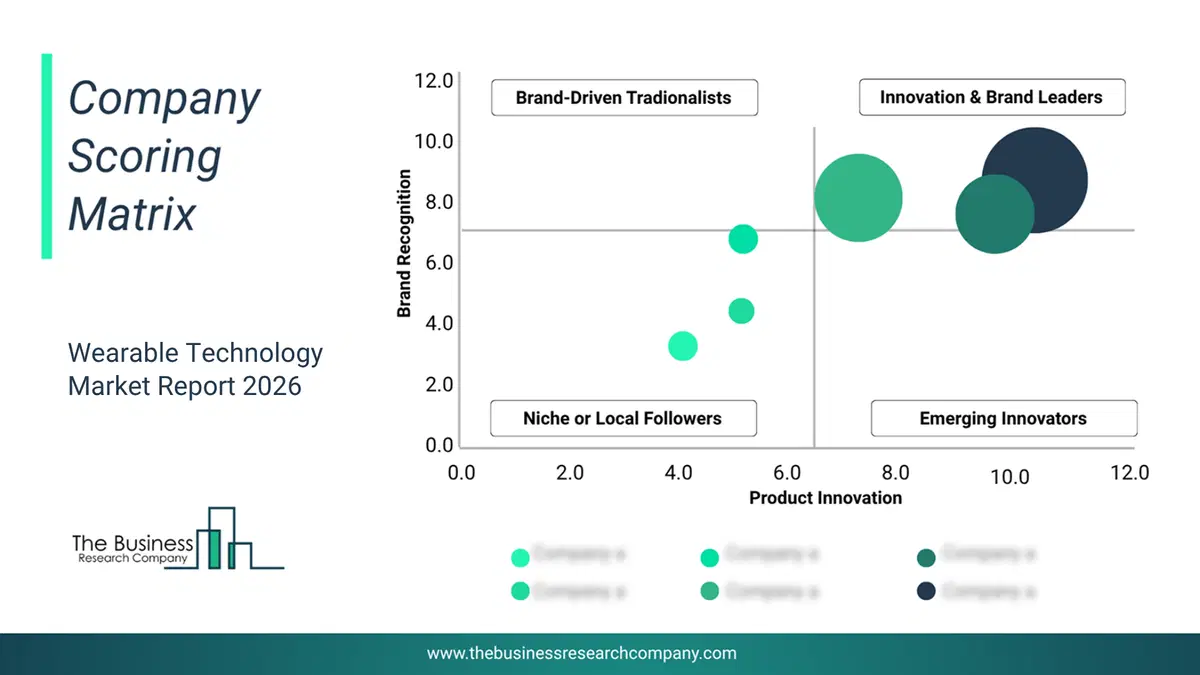
This chart maps companies by product innovation and brand strength, with bubble size indicating relative revenue, helping identify market leaders, challengers, and niche players. This is an illustrative chart; the full report provides a complete and accurate competitive analysis.
Global Wearable Technology Market Trends and Insights
Major companies operating in the wearable technology market are focusing on developing advanced wearables, such as AI-enabled neural interface wristbands, to accelerate human-computer interaction, broaden device applicability, and improve accessibility across digital ecosystems. AI-enabled neural interface wristbands refer to wearable devices designed to read, interpret, or interact with neural signals (brain or nerve activity) and provide real-time feedback, control, or insights using artificial intelligence. For instance, in January 2025, Wearable Devices Ltd., an Israel-based technology company, launched the Mudra Link neural gesture-control wristband, the first neural wristband compatible with Android, macOS, and Windows platforms, featuring advanced gesture recognition via surface nerve conductance sensors, cross-platform compatibility for seamless control of smart devices, and customizable gesture mapping for user-specific interaction patterns, enabling intuitive hands-free control across augmented reality systems and smart environments, representing a significant evolution in wearable interaction by replacing traditional input methods with neural gesture-based command execution.What Are Latest Mergers And Acquisitions In The Wearable Technology Market?
In June 2025, TDK Corporation, a Japan‑based electronics and components manufacturer, acquired SoftEye Inc. for an undisclosed amount. Through this acquisition, TDK Corporation aims to accelerate its presence in the wearable technology market by integrating SoftEye Inc.’s advanced smart eyewear hardware, software integration, and augmented reality capabilities, enabling more seamless, intuitive, and connected wearable experiences across consumer and enterprise applications. SoftEye Inc. is a US‑based wearable technology company focused on developing innovative smart glasses solutions.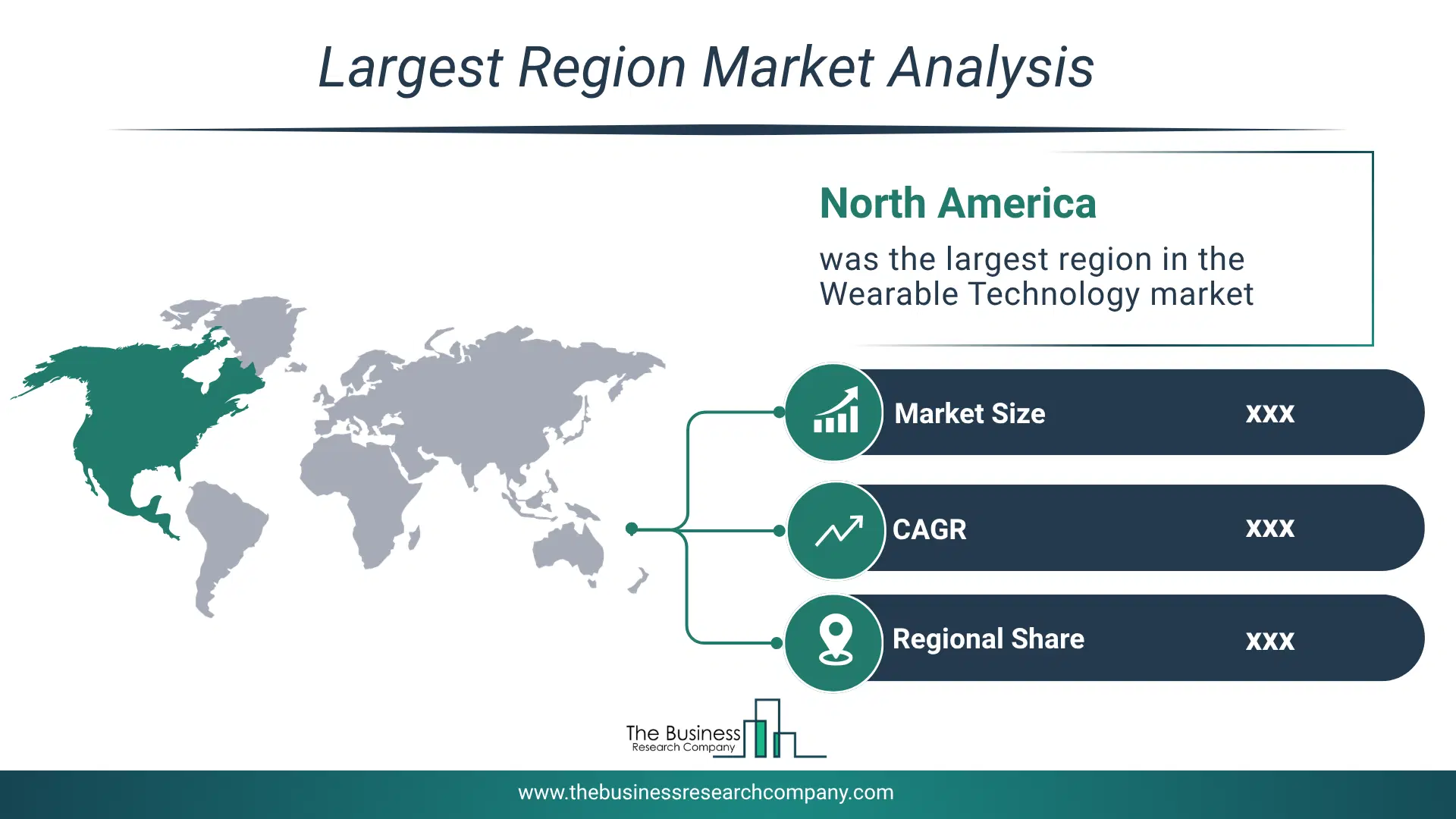
Regional Insights
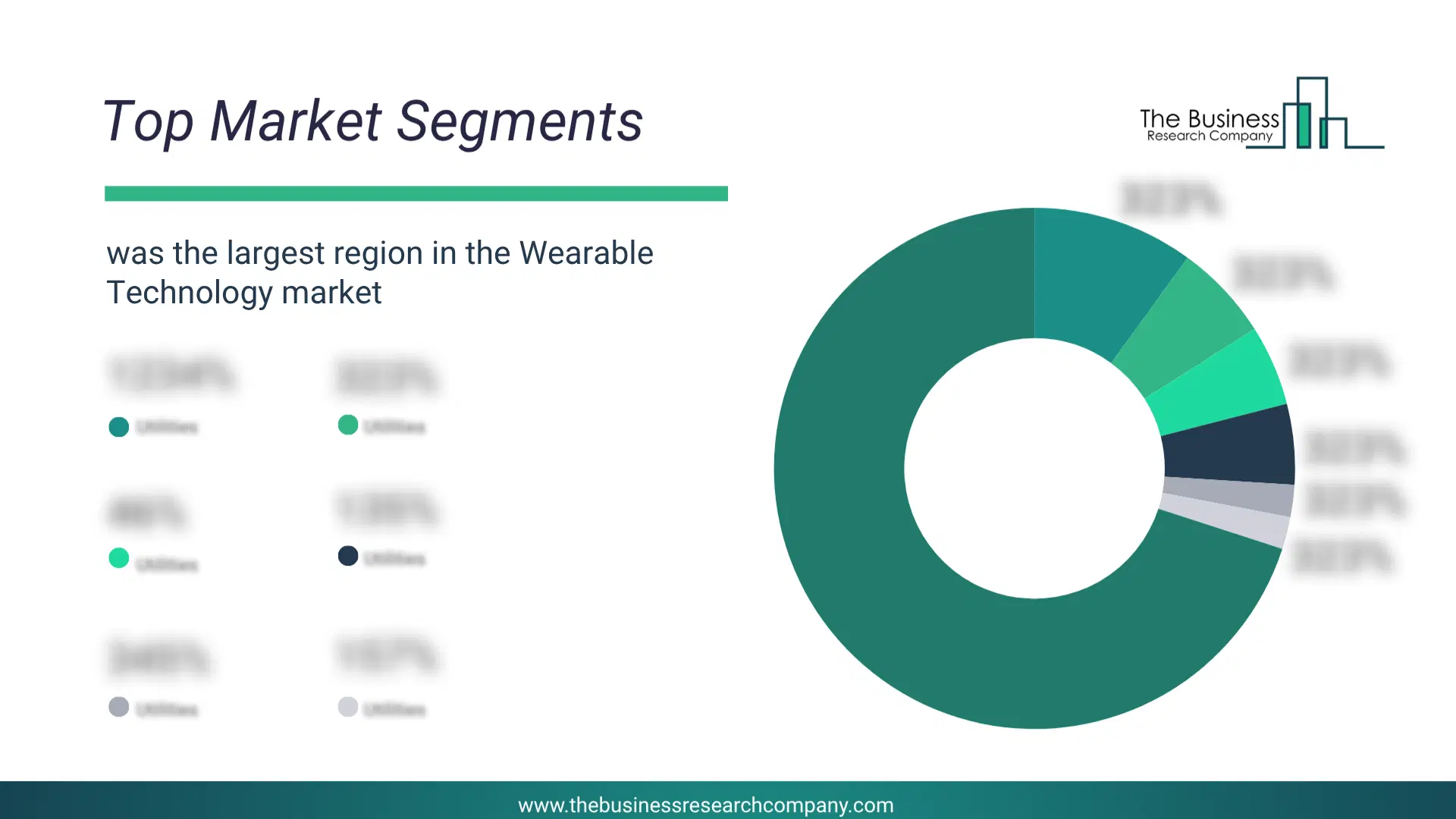
North America was the largest region in the wearable technology market in 2025. Asia-Pacific is expected to be the fastest-growing region in the forecast period. The regions covered in this market report are Asia-Pacific, South East Asia, Western Europe, Eastern Europe, North America, South America, Middle East, Africa. The countries covered in this market report are Australia, Brazil, China, France, Germany, India, Indonesia, Japan, Taiwan, Russia, South Korea, UK, USA, Canada, Italy, Spain.What Defines the Wearable Technology Market?
The wearable technology market consists of revenues earned by entities by providing services such as wearable device integration services, wearable health monitoring services, wearable data analytics services, wearable device connectivity services, and wearable-based fitness and wellness tracking services. The market value includes the value of related goods sold by the service provider or included within the service offering. The wearable technology market also includes sales of smartwatches, fitness trackers, smart clothing, smart glasses, and wearable health monitoring devices. Values in this market are ‘factory gate’ values, that is, the value of goods sold by the manufacturers or creators of the goods, whether to other entities (including downstream manufacturers, wholesalers, distributors, and retailers) or directly to end customers. The value of goods in this market includes related services sold by the creators of the goods.How is Market Value Defined and Measured?
The market value is defined as the revenues that enterprises gain from the sale of goods and/or services within the specified market and geography through sales, grants, or donations in terms of the currency (in USD unless otherwise specified). The revenues for a specified geography are consumption values that are revenues generated by organizations in the specified geography within the market, irrespective of where they are produced. It does not include revenues from resales along the supply chain, either further along the supply chain or as part of other products.
This chart presents market attractiveness based on a quantitative evaluation of growth, competition, strategic alignment, and risk, offering a clear view of opportunity areas for decision-making. This chart is for illustrative purposes; the full report contains the complete analysis.

This chart highlights the Total Addressable Market (TAM) by estimating the maximum revenue opportunity using an assumption-driven approach, supporting strategic planning and opportunity sizing across markets. The chart is illustrative; the full report provides a more comprehensive analysis.
What Key Data and Analysis Are Included in the Wearable Technology Market Report 2026?
The wearable technology market research report is one of a series of new reports from The Business Research Company that provides market statistics, including industry global market size, regional shares, competitors with the market share, detailed market segments, market trends and opportunities, and any further data you may need to thrive in the wearable technology industry. The market research report delivers a complete perspective of everything you need, with an in-depth analysis of the current and future state of the industry.Wearable Technology Market Report Forecast Analysis
| Report Attribute | Details |
|---|---|
| Market Size Value In 2026 | $114.96 billion |
| Revenue Forecast In 2030 | $222.63 billion |
| Growth Rate | CAGR of 18.3% from 2026 to 2030 |
| Base Year For Estimation | 2025 |
| Actual Estimates/Historical Data | 2020-2025 |
| Forecast Period | 2026 - 2030 |
| Market Representation | Revenue in USD Billion and CAGR from 2026 to 2030 |
| Segments Covered | Product Type, Connectivity, Distribution Channel, Application Or Use-Case, End-Users |
| Regional Scope | Asia-Pacific, Western Europe, Eastern Europe, North America, South America, Middle East, Africa |
| Country Scope | The countries covered in the report are Australia, Brazil, China, France, Germany, India, ... |
| Key Companies Profiled | Google LLC, Samsung Electronics Co. Ltd., Huawei Technologies Co. Ltd., Sony Corporation, LG Electronics Inc., Nike Inc., Xiaomi Corporation, Adidas AG, ASUSTeK Computer Inc., OPPO Mobile Telecommunications Corp. Ltd., Garmin Ltd., Michael Kors Holdings Limited, Casio America Inc., OnePlus Technology Co. Ltd., Fossil Group Inc., Withings SA, Vuzix Corporation, Fitbit Inc., hDrop Technologies Inc., Bearmind AG |
| Customization Scope | Request for Customization |
| Pricing And Purchase Options | Explore Purchase Options |