
Weather Forecasting Systems Market Report 2026
Global Outlook – By Type ( Short-Range, Medium-Range, Long-Range), By Component ( Data Loggers, Software, Sensors And Hardware), By Equipment ( Barometer, Anemometer, Hygrometer, Rain Gauge, Thermometer, Sling Psychrometer, Weather Balloons), By End User ( Aviation, Military, Energy, Agriculture, Marine, Transportation) – Market Size, Trends, Strategies, and Forecast to 2035
Weather Forecasting Systems Market Overview
• Weather Forecasting Systems market size has reached to $2.66 billion in 2025 • Expected to grow to $3.19 billion in 2030 at a compound annual growth rate (CAGR) of 3.7% • Growth Driver: Renewable Energy Adoption Boosts Weather Forecasting Systems Market • Market Trend: Innovations With Sophisticated Weather Monitoring Systems To Drive Market Growth • North America was the largest region in 2025 and Asia-Pacific is the fastest growing region.What Is Covered Under Weather Forecasting Systems Market?
The weather forecasting systems combine technology and science to anticipate the state of the atmosphere for a specific time and location in the future. Weather forecasts are developed by gathering as much information as possible regarding the current atmospheric conditions (like humidity, temperature, and wind) and applying knowledge of atmospheric processes (through meteorology) to predict how the atmosphere will evolve in the future. The main types of weather forecasting systems include short-range, medium-range, and long-range. Short-range weather forecasting systems are used to forecast for a short period, ranging from 1 day to seven days. The different weather forecasting systems' components include data loggers, software, sensors, and hardware. Barometers, anemometers, hygrometers, rain gauges, thermometers, sling psychrometers, and weather balloons are among the various weather forecasting system equipment used by end-users such as aviation, military, energy, agriculture, marine, and transportation.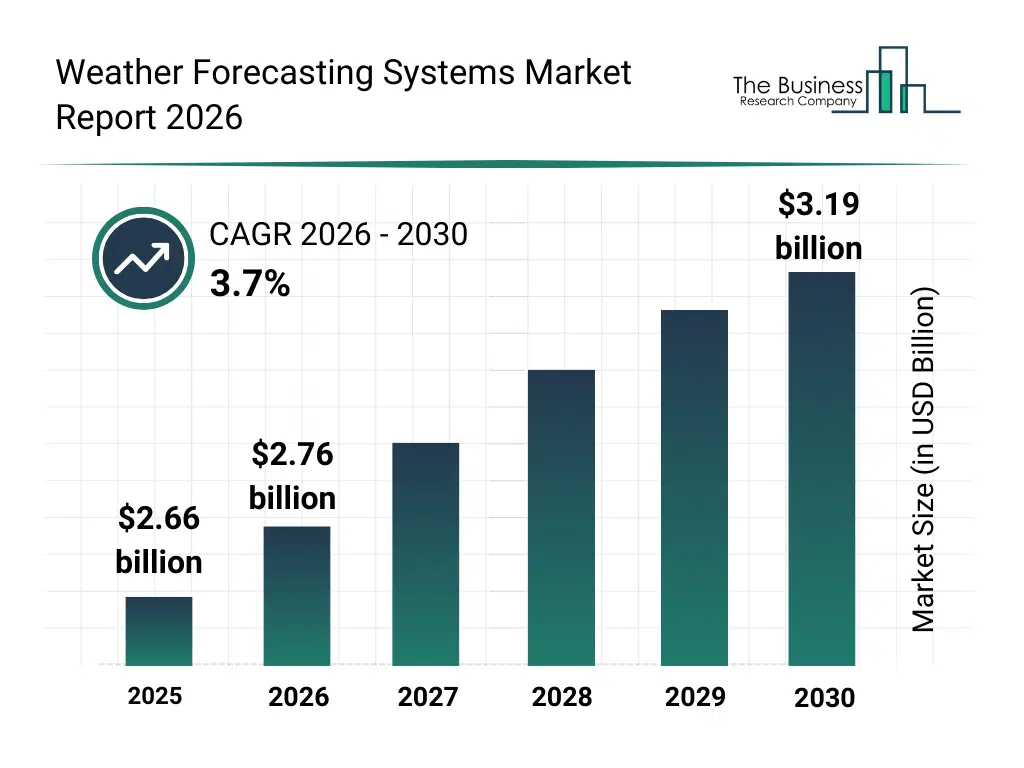
What Is The Weather Forecasting Systems Market Size 2026 And Growth Rate?
The weather forecasting systems market size has grown steadily in recent years. It will grow from $2.66 billion in 2025 to $2.76 billion in 2026 at a compound annual growth rate (CAGR) of 3.8%. The growth in the historic period can be attributed to early development of manual weather stations, increasing deployment of radar-based forecasting, growth of aviation weather monitoring, adoption of satellite-based observation tools, reliance on basic atmospheric modeling.What Is The Weather Forecasting Systems Market Growth Forecast?
The weather forecasting systems market size is expected to see steady growth in the next few years. It will grow to $3.19 billion in 2030 at a compound annual growth rate (CAGR) of 3.7%. The growth in the forecast period can be attributed to increasing need for climate resilience planning, rising adoption of renewable energy forecasting, development of hyperlocal weather prediction tools, expansion of smart agriculture insights, growth of advanced environmental monitoring infrastructures. Major trends in the forecast period include expansion of AI-enhanced atmospheric modeling, development of cloud-based weather prediction platforms, integration of IoT-connected environmental sensors, adoption of sustainable weather monitoring technologies, growth of autonomous weather observation systems.
Global Weather Forecasting Systems Market Segmentation
1) By Type: Short-Range, Medium-Range, Long-Range 2) By Component: Data Loggers, Software, Sensors And Hardware 3) By Equipment: Barometer, Anemometer, Hygrometer, Rain Gauge, Thermometer, Sling Psychrometer, Weather Balloons 4) By End User: Aviation, Military, Energy, Agriculture, Marine, Transportation Subsegments: 1) By Short-Range Forecasting: Nowcasting, Up To 3 days 2) By Medium-Range Forecasting: 3 To 10 days 3) By Long-Range Forecasting: 10 days To Several Months, Seasonal ForecastingWhat Is The Driver Of The Weather Forecasting Systems Market?
The increasing adoption of renewable energy sources is significantly driving the growth of the weather forecasting systems market. Renewable energy generation, particularly wind and solar power, is volatile due to its reliance on weather, necessitating the use of proper forecasting systems to avoid downtime and improve efficiency. For instance, In April 2024, according to Climate Central, US-based Nonprofit news organization. In 2023, the U.S. produced 238,121 gigawatt-hours (GWh) of electricity from solar energy, with California and Texas being the top generators. A significant majority of Americans expressed a desire for increased solar and wind energy, alongside a reduction in carbon emissions. By the end of 2023, the country's total solar capacity reached approximately 139 gigawatts (GW) from both utility-scale and small-scale installations, marking a growth of over 26 GW or 23% compared to 2022. As a result, the growing use of renewable energy sources is expected to drive the growth of the weather forecasting systems industry in the coming years.Key Players In The Global Weather Forecasting Systems Market
Major companies operating in the weather forecasting systems market are The Weather Company, Sutron Corporation, Campbell Scientific Inc., Airmar Technology Corporation, All Weather Co., Morcom International, Columbia Weather Systems, G. Lufft Mess-und Regeltechnik, Vaisala Oyj, Skye Instruments Ltd., AccuWeather Inc., StormGeo AS, Spire Global Inc., Earth Networks Inc., Skymet Weather Services, DTN Inc., MeteoGroup, Raytheon Company, Tomorrow.io, OTT HydroMet Ltd., Athenium Analytics, WeatherOps, The Weather Network, Met Office, WeatherBug Org., Weatherzone Org., WeatherBell Analytics Org., Meteoblue AG, Meteo-France SAGlobal Weather Forecasting Systems Market Trends and Insights
Major companies operating in the weather forecasting systems market are focusing on developing advanced weather monitoring solutions to enhance environmental observation, improve forecasting accuracy, and support disaster management efforts. Sophisticated weather monitoring systems refer to the use of multispectral imaging, atmospheric sounders, data relay technologies, and search-and-rescue transponders to collect, analyze, and transmit comprehensive meteorological data. For instance, in February 2024, India successfully launched the INSAT-3DS meteorological satellite aboard the GSLV-F14 rocket from the Satish Dhawan Space Centre in Sriharikota. INSAT-3DS, the sixth satellite in the INSAT series with a liftoff mass of 2,274 kilograms, is equipped with a six-channel multispectral imager, a 19-channel sounder, a Data Relay Transponder (DRT), and a Satellite Aided Search & Rescue (SAS&R) transponder. These capabilities enable improved understanding of environmental dynamics, enhanced weather forecasting, optimized data utilization, and support for emergency response through advanced satellite technology.What Are Latest Mergers And Acquisitions In The Weather Forecasting Systems Market?
In February 2024, Francisco Partners, a US-based private equity company, acquired The Weather Company for an undisclosed amount. With this acquisition, Francisco Partners aims to strengthen its portfolio in data-driven and technology-enabled businesses, enhance the delivery of advanced weather intelligence solutions, and support The Weather Company’s growth in providing accurate, real-time weather forecasting and analytics. The Weather Company is a US-based weather data and technology company that offers forecasting, analytics, and decision-support solutions for enterprises and consumers.Regional Outlook
North America was the largest region in the weather forecasting systems market share in 2025. Asia-Pacific is expected to be the fastest-growing region in the forecast period. The regions covered in this market report are Asia-Pacific, South East Asia, Western Europe, Eastern Europe, North America, South America, Middle East, Africa. The countries covered in this market report are Australia, Brazil, China, France, Germany, India, Indonesia, Japan, Taiwan, Russia, South Korea, UK, USA, Canada, Italy, Spain.What Defines the Weather Forecasting Systems Market?
The weather forecasting systems market consists of sales of doppler radar, satellite data capturing device, radiosondes, automated surface-observing. Values in this market are ‘factory gate’ values, that is the value of goods sold by the manufacturers or creators of the goods, whether to other entities (including downstream manufacturers, wholesalers, distributors and retailers) or directly to end customers. The value of goods in this market includes related services sold by the creators of the goods.How is Market Value Defined and Measured?
The market value is defined as the revenues that enterprises gain from the sale of goods and/or services within the specified market and geography through sales, grants, or donations in terms of the currency (in USD unless otherwise specified). The revenues for a specified geography are consumption values that are revenues generated by organizations in the specified geography within the market, irrespective of where they are produced. It does not include revenues from resales along the supply chain, either further along the supply chain or as part of other products.What Key Data and Analysis Are Included in the Weather Forecasting Systems Market Report 2026?
The weather forecasting systems market research report is one of a series of new reports from The Business Research Company that provides market statistics, including industry global market size, regional shares, competitors with the market share, detailed market segments, market trends and opportunities, and any further data you may need to thrive in the weather forecasting systems industry. The market research report delivers a complete perspective of everything you need, with an in-depth analysis of the current and future state of the industry.Weather Forecasting Systems Market Report 2026 Market Report Forecast Analysis
| Report Attribute | Details |
|---|---|
| Market Size Value In 2026 | $2.76 billion |
| Revenue Forecast In 2035 | $3.19 billion |
| Growth Rate | CAGR of 3.8% from 2026 to 2035 |
| Base Year For Estimation | 2025 |
| Actual Estimates/Historical Data | 2020-2025 |
| Forecast Period | 2026 - 2030 - 2035 |
| Market Representation | Revenue in USD Billion and CAGR from 2026 to 2035 |
| Segments Covered | Type, Component, Equipment, End User |
| Regional Scope | Asia-Pacific, Western Europe, Eastern Europe, North America, South America, Middle East, Africa |
| Country Scope | The countries covered in the report are Australia, Brazil, China, France, Germany, India, ... |
| Key Companies Profiled | The Weather Company, Sutron Corporation, Campbell Scientific Inc., Airmar Technology Corporation, All Weather Co., Morcom International, Columbia Weather Systems, G. Lufft Mess-und Regeltechnik, Vaisala Oyj, Skye Instruments Ltd., AccuWeather Inc., StormGeo AS, Spire Global Inc., Earth Networks Inc., Skymet Weather Services, DTN Inc., MeteoGroup, Raytheon Company, Tomorrow.io, OTT HydroMet Ltd., Athenium Analytics, WeatherOps, The Weather Network, Met Office, WeatherBug Org., Weatherzone Org., WeatherBell Analytics Org., Meteoblue AG, Meteo-France SA |
| Customization Scope | Request for Customization |
| Pricing And Purchase Options | Explore Purchase Options |