
Wheel Balancing Market Report 2026
Global Outlook – By Product Type (Static Wheel Balancing Machines, Dynamic Wheel Balancing Machines, Bubble Wheel Balancing Machines, Other Product Types), By Distribution Channel (Online, Offline, Direct Sales), By Operation Type (Automatic, Semi-Automatic, Manual), By Application (Commercial Vehicle, Passenger Vehicle) – Market Size, Trends, Strategies, and Forecast to 2030
Wheel Balancing Market Overview
• Wheel Balancing market size has reached to $2.92 billion in 2025 • Expected to grow to $3.92 billion in 2030 at a compound annual growth rate (CAGR) of 6% • Growth Driver: Surging Demand For Electric Vehicles Driving Growth In The Market Due To Enhanced Performance And Efficiency • Market Trend: Advancements In Heavy-Duty Wheel Balancers Driving Precision And Efficiency In Vehicle Maintenance • North America was the largest region in 2025.What Is Covered Under Wheel Balancing Market?
Wheel balancing is the process of equalizing the weight distribution of a tire and wheel assembly to ensure smooth rotation at high speeds. It involves mounting the wheel on a balancing machine, which detects imbalances and indicates where counterweights should be added to correct uneven weight distribution. Proper wheel balancing reduces vibrations, enhances driving comfort, improves tire lifespan, and prevents premature wear on suspension components. The main wheel balancing products are static wheel balancing machines, dynamic wheel balancing machines, bubble wheel balancing machines, and others. Static wheel balancing machines refer to equipment that detects weight distribution imbalances in a stationary wheel without rotation. It is distributed through online, offline, and direct sales channels, and it can be automatic, semi-automatic, and manual. It is applied to commercial and passenger vehicles.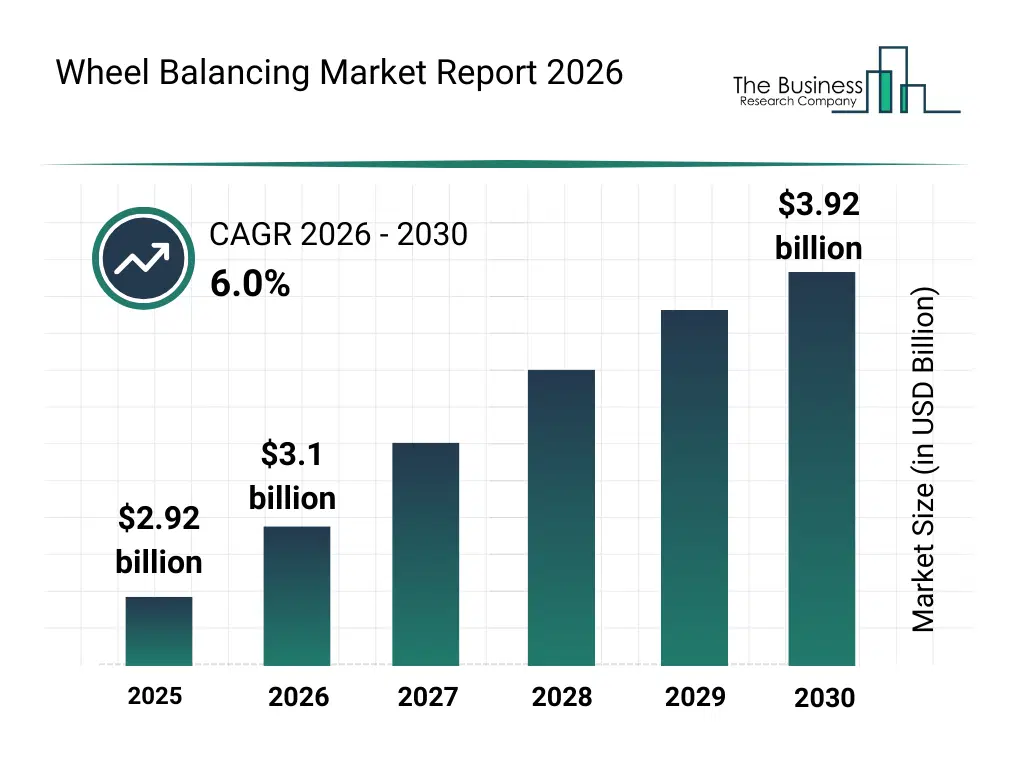
What Is The Wheel Balancing Market Size and Share 2026?
The wheel balancing market size has grown strongly in recent years. It will grow from $2.92 billion in 2025 to $3.1 billion in 2026 at a compound annual growth rate (CAGR) of 6.1%. The growth in the historic period can be attributed to expansion of automotive service networks, growth in passenger vehicles, tire replacement demand, adoption of dynamic balancing, workshop equipment upgrades.What Is The Wheel Balancing Market Growth Forecast?
The wheel balancing market size is expected to see strong growth in the next few years. It will grow to $3.92 billion in 2030 at a compound annual growth rate (CAGR) of 6.0%. The growth in the forecast period can be attributed to electric vehicle adoption, demand for precision balancing, smart workshop integration, growth of commercial transport fleets, automation in vehicle servicing. Major trends in the forecast period include shift toward automated balancing machines, growth of high-speed balancing systems, integration with digital displays, demand from commercial fleets, focus on vibration reduction.
Global Wheel Balancing Market Segmentation
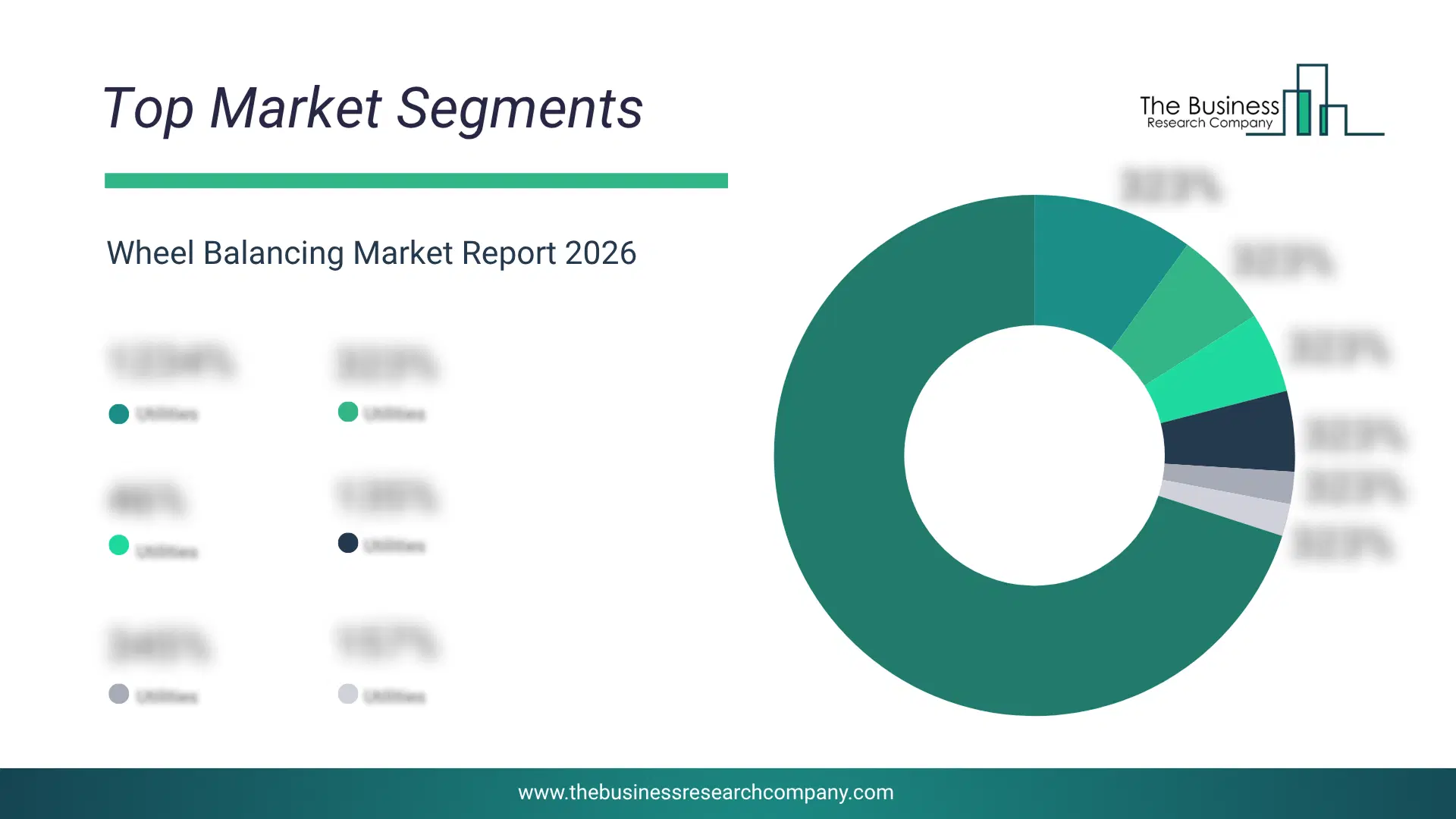
1) By Product Type: Static Wheel Balancing Machines, Dynamic Wheel Balancing Machines, Bubble Wheel Balancing Machines, Other Product Types 2) By Distribution Channel: Online, Offline, Direct Sales 3) By Operation Type: Automatic, Semi-Automatic, Manual 4) By Application: Commercial Vehicle, Passenger Vehicle Subsegments: 1) By Static Wheel Balancing Machines: Manual Static Wheel Balancers, Electronic Static Wheel Balancers, Portable Static Wheel Balancers 2) By Dynamic Wheel Balancing Machines: Computerized Dynamic Wheel Balancers, High-Speed Dynamic Wheel Balancers, Low-Speed Dynamic Wheel Balancers 3) By Bubble Wheel Balancing Machines: Handheld Bubble Balancers, Floor-Standing Bubble Balancers, Compact Bubble Balancers 4) By Other Product Types: Hybrid Wheel Balancing Machines, Laser-Guided Wheel Balancers, Specialty Wheel Balancing MachinesWhat Is The Driver Of The Wheel Balancing Market?
The rising demand for electric vehicles is expected to propel the growth of the wheel balancing market going forward. Electric vehicles (EVs) are vehicles powered entirely or partially by electricity, using batteries or fuel cells instead of internal combustion engines. The demand for electric vehicles is expanding due to rising environmental concerns, government incentives, and advancements in battery technology, leading to improved efficiency and affordability. Wheel balancing enhances the performance and efficiency of electric vehicles by reducing tire wear, minimizing energy loss, and improving driving stability, making EVs more reliable and cost-effective, which further drives their growing demand. For instance, in April 2023, according to the International Energy Agency, a France-based intergovernmental organization, global EV sales reached 10 million in 2022, with China accounting for 60%, Europe increasing by 15%, and the U.S. by 55%. By the end of 2023, sales reached 14 million, marking a 35% increase, driven by China's dominance and continued growth in Europe and the U.S. through policy support. Therefore, rising demand for electric vehicles is driving the growth of the wheel balancing industry.Key Players In The Global Wheel Balancing Market
Major companies operating in the wheel balancing market report include Hunter Engineering Company, Ravaglioli S.p.A., Corghi Pty Ltd., Snap-on Incorporated, ATS Elgi Limited, Shanghai Balance Automotive Equipment Co., Ltd., Beissbarth GmbH, CEMB S.p.A., Icon Autocraft Pvt Ltd., Tecalemit Garage Equipment Company Limited, Atlas Auto Equipment, Hofmann, Giuliano Industrial S.p.A., Delta Equipment, BendPak Holdings LLC, Sice Srl, Mayflower Equipment Co. Inc., The Coats Company, Naman Automotive Solutions, Hi-tech Pneumatics, and Techfanatics Equipment Limited.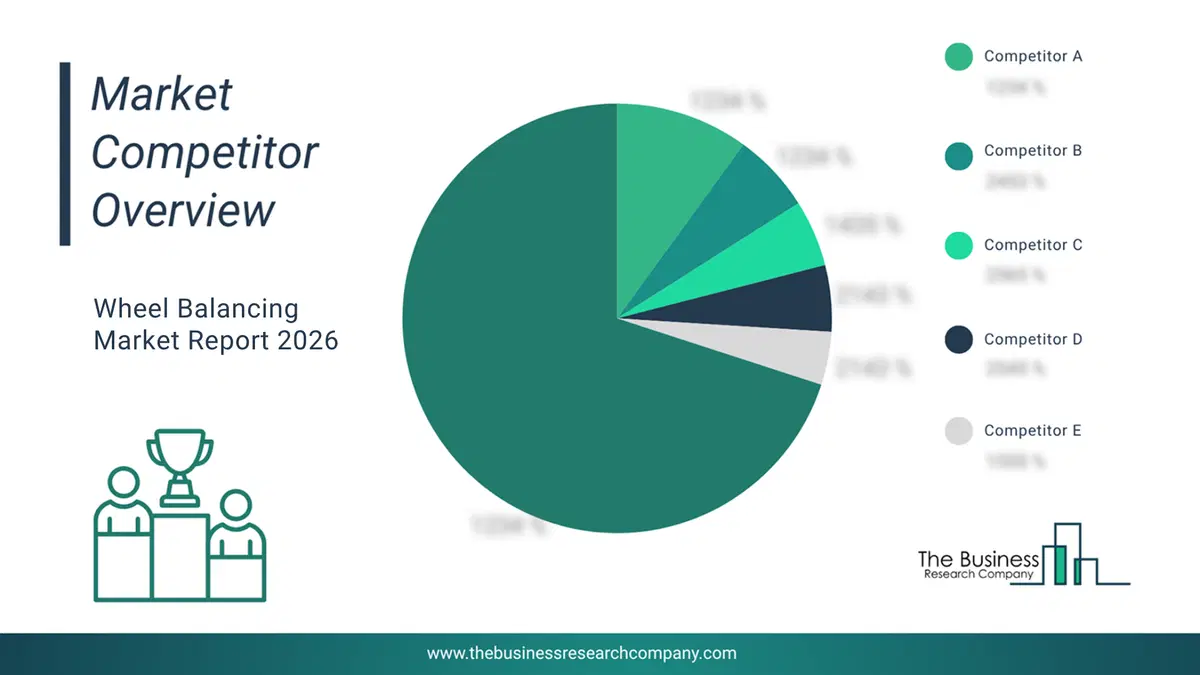
This chart is for illustrative purposes; the full report includes a detailed competitor analysis and comprehensive overview of the top 10 companies in the market.
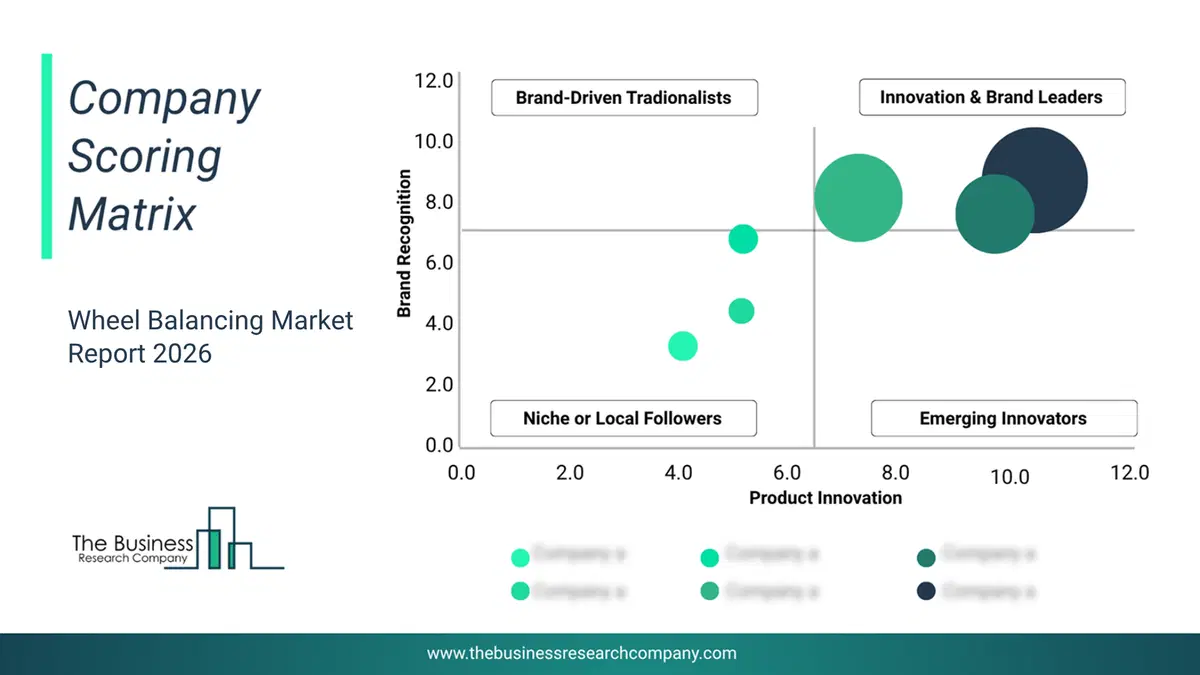
This chart maps companies by product innovation and brand strength, with bubble size indicating relative revenue, helping identify market leaders, challengers, and niche players. This is an illustrative chart; the full report provides a complete and accurate competitive analysis.
Global Wheel Balancing Market Trends and Insights
Major companies operating in the wheel balancing market are focusing on developing technologically advanced products, such as heavy-duty wheel balancers, to handle larger, heavier wheels with greater precision. Heavy-duty wheel balancers are specialized machines designed to accurately balance the large and heavy wheels of commercial trucks, buses, and industrial vehicles, ensuring smooth operation and reduced tire wear. For instance, in January 2025, ARI-HETRA, a US-based manufacturer of transportation maintenance equipment, launched the WS-25WB50, WS-25WB30, and WS-25WB10 heavy-duty wheel balancers. The WS-25WB series offers advanced wheel balancing solutions tailored to different needs. The Premium Model (WS-25WB50) features a 19-inch LCD display, an online management console, and a built-in wheel lift for effortless handling. The Advanced Model (WS-25WB30) includes a digital display, the same online management system, and a built-in wheel lift for smooth operation. For portability, the Compact Model (WS-25WB10) runs on a battery-powered display, includes an online console, and features a hand-crank wheel lift. All models support tires up to 50 inches in diameter, 440 lbs weight, and rim sizes from 8 to 26 inches, requiring an air supply for operation.What Are Latest Mergers And Acquisitions In The Wheel Balancing Market?
In January 2025, Martins Industries, a Canada-based tire equipment manufacturer, acquired ABC American Balancing Corp. for an undisclosed amount. With this acquisition, Martins Industries expands its tire balancing portfolio by integrating ABC American Balancing Corp’s bead-based balancing technology, strengthening its presence in the wheel balancing market and enabling it to serve a broader range of vehicles, including motorcycles, with efficient and precise solutions. ABC American Balancing Corp. is a Canada-based wheel balancing company that specializes in tire balancing beads.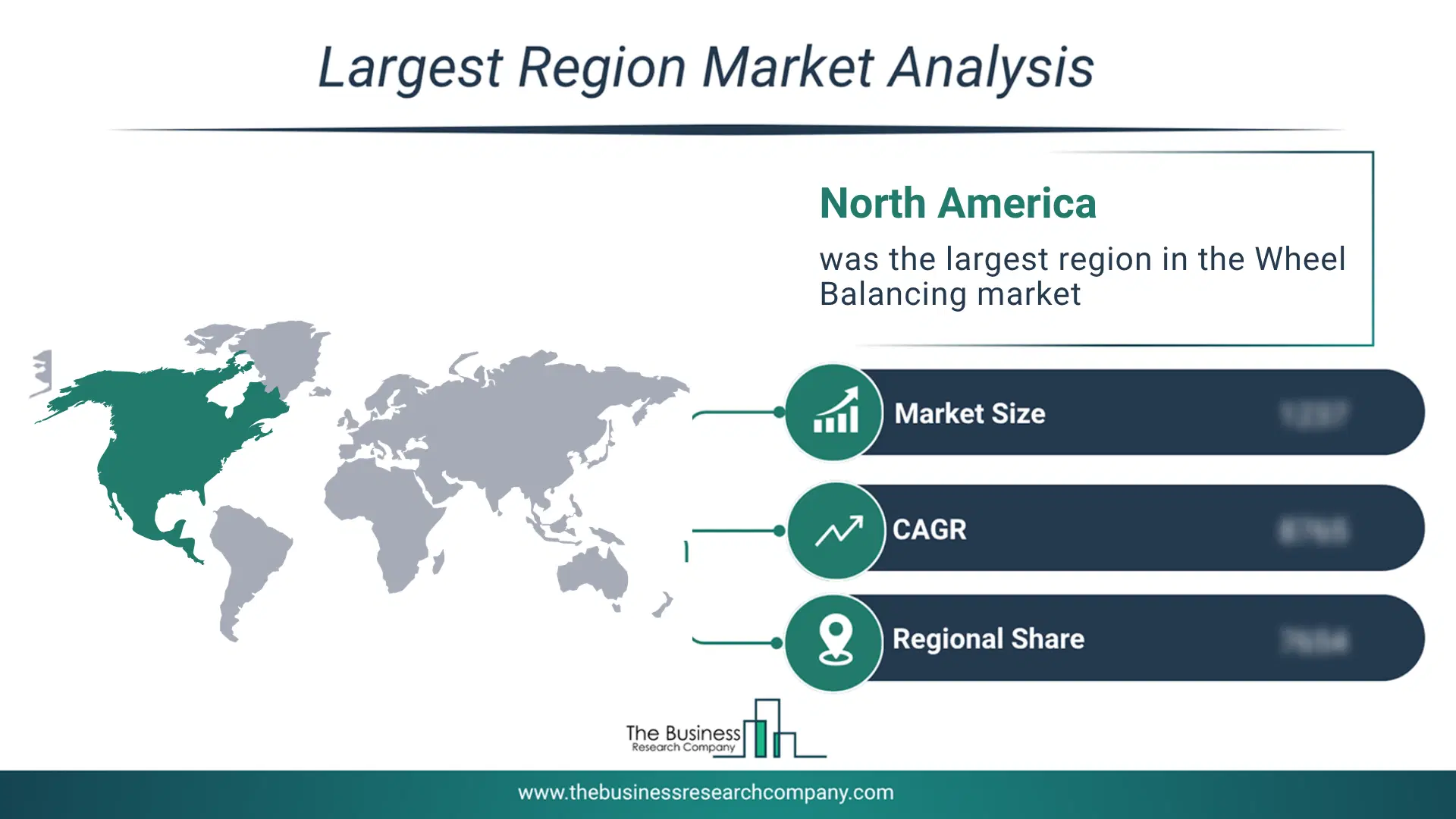
Regional Outlook
North America was the largest region in the wheel balancing market in 2025. The regions covered in this market report include Asia-Pacific, South East Asia, Western Europe, Eastern Europe, North America, South America, Middle East, Africa. The countries covered in this market report include Australia, Brazil, China, France, Germany, India, Indonesia, Japan, Taiwan, Russia, South Korea, UK, USA, Canada, Italy, SpainWhat Defines the Wheel Balancing Market?
The wheel balancing market consists of revenues earned by entities by providing services such as wheel alignment, custom wheel installation, tire mounting, and dismounting. The market value includes the value of related goods sold by the service provider or included within the service offering. The wheel balancing market also includes sales of wheel weights, tire changers, wheel alignment systems, air compressors, balancing beads, and powders. Values in this market are ‘factory gate’ values, that is the value of goods sold by the manufacturers or creators of the goods, whether to other entities (including downstream manufacturers, wholesalers, distributors and retailers) or directly to end customers. The value of goods in this market includes related services sold by the creators of the goods.How is Market Value Defined and Measured?
The market value is defined as the revenues that enterprises gain from the sale of goods and/or services within the specified market and geography through sales, grants, or donations in terms of the currency (in USD unless otherwise specified). The revenues for a specified geography are consumption values that are revenues generated by organizations in the specified geography within the market, irrespective of where they are produced. It does not include revenues from resales along the supply chain, either further along the supply chain or as part of other products.
This chart presents market attractiveness based on a quantitative evaluation of growth, competition, strategic alignment, and risk, offering a clear view of opportunity areas for decision-making. This chart is for illustrative purposes; the full report contains the complete analysis.

This chart highlights the Total Addressable Market (TAM) by estimating the maximum revenue opportunity using an assumption-driven approach, supporting strategic planning and opportunity sizing across markets. The chart is illustrative; the full report provides a more comprehensive analysis.
What Key Data and Analysis Are Included in the Wheel Balancing Market Report 2026?
The wheel balancing market research report is one of a series of new reports from The Business Research Company that provides market statistics, including industry global market size, regional shares, competitors with the market share, detailed market segments, market trends and opportunities, and any further data you may need to thrive in the wheel balancing industry. The market research report delivers a complete perspective of everything you need, with an in-depth analysis of the current and future state of the industry.Wheel Balancing Market Report Forecast Analysis
| Report Attribute | Details |
|---|---|
| Market Size Value In 2026 | $3.1 billion |
| Revenue Forecast In 2030 | $3.92 billion |
| Growth Rate | CAGR of 6.1% from 2026 to 2030 |
| Base Year For Estimation | 2025 |
| Actual Estimates/Historical Data | 2020-2025 |
| Forecast Period | 2026 - 2030 - 2030 |
| Market Representation | Revenue in USD Billion and CAGR from 2026 to 2030 |
| Segments Covered | Product Type, Distribution Channel, Operation Type, Application |
| Regional Scope | Asia-Pacific, Western Europe, Eastern Europe, North America, South America, Middle East, Africa |
| Country Scope | The countries covered in the report are Australia, Brazil, China, France, Germany, India, Indonesia, Japan, Taiwan, Russia, South Korea, UK, USA, Canada, Italy, Spain. |
| Key Companies Profiled | Hunter Engineering Company, Ravaglioli S.p.A., Corghi Pty Ltd., Snap-on Incorporated, ATS Elgi Limited, Shanghai Balance Automotive Equipment Co., Ltd., Beissbarth GmbH, CEMB S.p.A., Icon Autocraft Pvt Ltd., Tecalemit Garage Equipment Company Limited, Atlas Auto Equipment, Hofmann, Giuliano Industrial S.p.A., Delta Equipment, BendPak Holdings LLC, Sice Srl, Mayflower Equipment Co. Inc., The Coats Company, Naman Automotive Solutions, Hi-tech Pneumatics, and Techfanatics Equipment Limited. |
| Customization Scope | Request for Customization |
| Pricing And Purchase Options | Explore Purchase Options |