

Wide-Body Aircraft Market Report 2026
Global Outlook – By Type (Passenger Wide Body Aircraft, Freighter Wide Body Aircraft), By Range (Short Range, Medium Range, Long Range), By Material (Aluminum Alloy Aircraft, Composite Material Aircraft, Advanced Lightweight Material Aircraft), By Application (Commercial, Military, Private), By End User (Airlines, Leasing Companies, Government And Defense, Other End Users) – Market Size, Trends, Strategies, and Forecast to 2030
Wide-Body Aircraft Market Overview
• Wide-Body Aircraft market size has reached to $110.38 billion in 2025 • Expected to grow to $147.27 billion in 2030 at a compound annual growth rate (CAGR) of 5.9% • Growth Driver: The Rising Air Passenger Traffic Driving The Growth Of The Market Due To Higher Disposable Incomes • Market Trend: High-Thrust Turbofan Engine Innovations Driving Fuel Efficiency And Long-Haul Fleet Expansion • Asia-Pacific was the largest region and fastest growing region.What Is Covered Under Wide-Body Aircraft Market?
Wide-body aircraft are large commercial airplanes designed with a twin-aisle cabin configuration, allowing them to carry a high number of passengers or large volumes of cargo over medium- to long-haul distances. They are characterized by their greater fuselage width, increased seating capacity, and extended range compared to narrow-body aircraft. The main types of wide-body aircraft include passenger wide-body aircraft and freighter wide-body aircraft. Passenger wide-body aircraft refer to aircraft with two passenger aisles and a broad fuselage designed to accommodate a large number of passengers, typically for medium- and long-distance flights. These aircraft are available in short-range, medium-range, and long-range configurations and are constructed using aluminum alloy aircraft, composite material aircraft, and advanced lightweight material aircraft. The various applications involved are commercial, military, and private, and they are used by several end users such as airlines, leasing companies, government and defense, and others.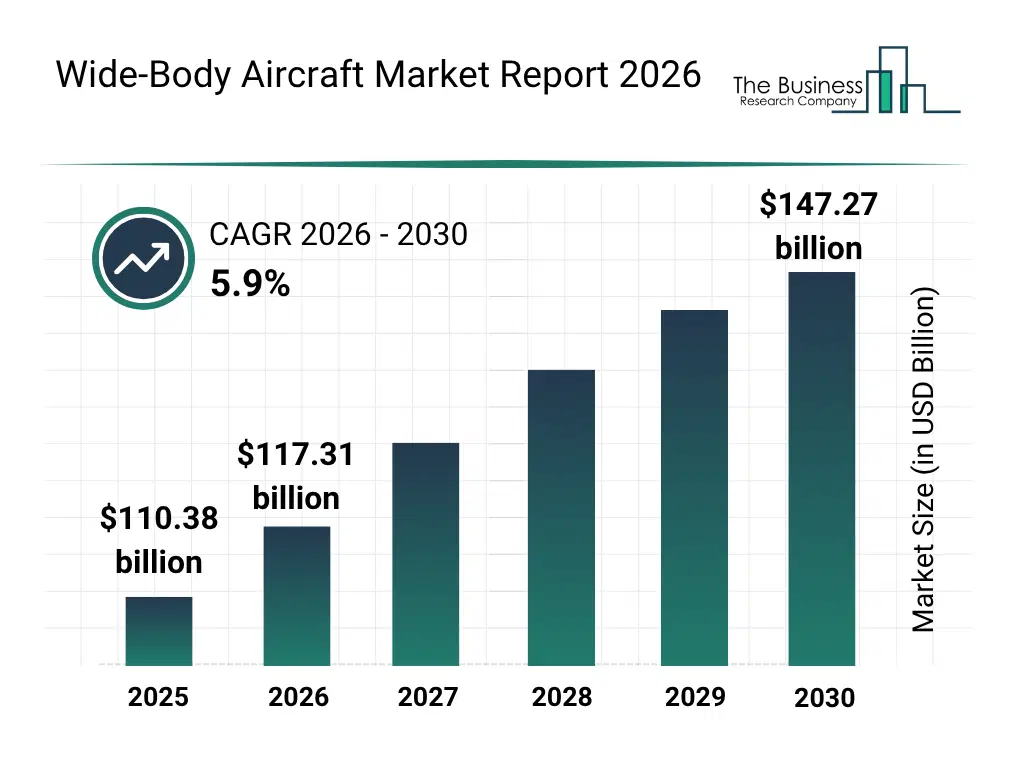
What Is The Wide-Body Aircraft Market Size and Share 2026?
The wide-body aircraft market size has grown strongly in recent years. It will grow from $110.38 billion in 2025 to $117.31 billion in 2026 at a compound annual growth rate (CAGR) of 6.3%. The growth in the historic period can be attributed to increasing long-haul passenger traffic, rising demand for international air travel, growing airline fleet expansion, increasing air cargo transportation, rising replacement of aging wide-body aircraft.What Is The Wide-Body Aircraft Market Growth Forecast?
The wide-body aircraft market size is expected to see strong growth in the next few years. It will grow to $147.27 billion in 2030 at a compound annual growth rate (CAGR) of 5.9%. The growth in the forecast period can be attributed to rising demand for long-haul connectivity, increasing adoption of next-generation wide-body aircraft, growing demand for higher passenger capacity, expanding international air cargo networks, increasing fleet modernization investments. Major trends in the forecast period include increasing adoption of fuel-efficient wide-body aircraft, growing development of lightweight aircraft structures, rising demand for extended-range wide-body aircraft, increasing adoption of advanced composite materials, growing deployment of high-capacity wide-body aircraft.
Global Wide-Body Aircraft Market Segmentation
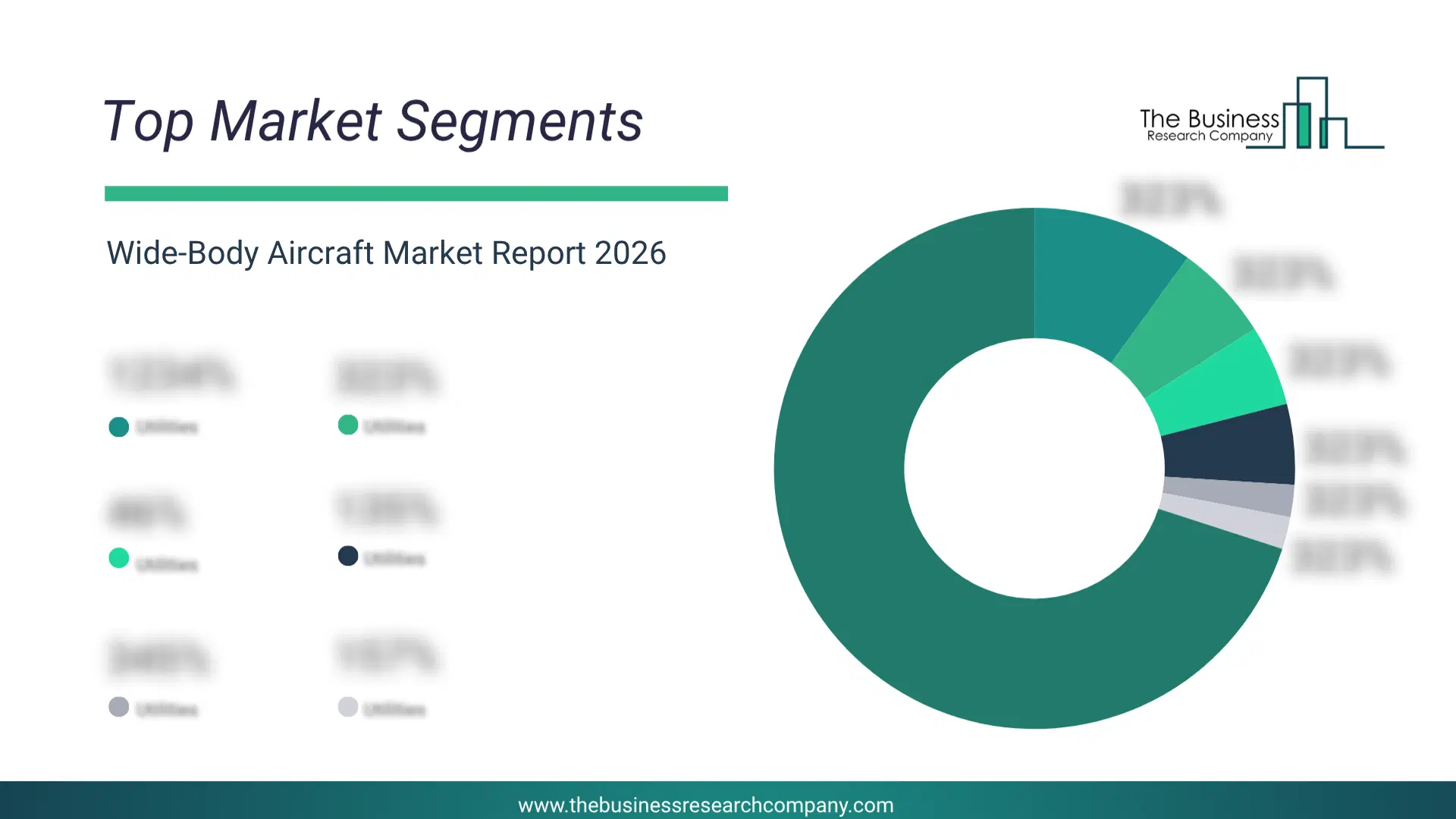
1) By Type: Passenger Wide Body Aircraft, Freighter Wide Body Aircraft 2) By Range: Short Range, Medium Range, Long Range 3) By Material: Aluminum Alloy Aircraft, Composite Material Aircraft, Advanced Lightweight Material Aircraft 4) By Application: Commercial, Military, Private 5) By End User: Airlines, Leasing Companies, Government And Defense, Other End Users Subsegments: 1) By Passenger Wide Body Aircraft: Twin Aisle Passenger Aircraft, Long Range Passenger Aircraft, Ultra Long Range Passenger Aircraft, High Capacity Passenger Aircraft 2) By Freighter Wide Body Aircraft: Production Freighter Aircraft, Converted Freighter Aircraft, Long Range Freighter Aircraft, Express Cargo Freighter AircraftWhat Is The Driver Of The Wide-Body Aircraft Market?
The rising air passenger traffic is expected to propel the growth of the wide-body aircraft market going forward. Air passenger traffic refers to the total number of passengers transported by airlines through domestic and international air services over a specific period and serves as a key indicator of air travel demand. Air passenger traffic is rising due to higher disposable incomes, as more people can afford air travel for business and leisure. The rising air passenger traffic drives demand for wide-body aircraft by increasing demand for long-haul and high-capacity air travel, encouraging airlines to expand fleets with fuel-efficient wide-body aircraft that improve passenger capacity and operational efficiency. For instance, in July 2025, according to the Airports Council International (ACI) World, a Canada-based global nonprofit organization representing airports worldwide, global passenger traffic in 2024 surpassed 9.4 billion travelers, up 8.4% from 2023. Therefore, the rising air passenger traffic is driving the growth of the wide-body aircraft industry.Key Players In The Global Wide-Body Aircraft Market
Major companies operating in the wide-body aircraft market are The Boeing Company, Airbus SE, United Aircraft Corporation PJSC, Commercial Aircraft Corporation of China Ltd, Aviation Complex Ilyushin PJSC, Antonov Company, AVIC Xi'an Aircraft Industry Group Co Ltd, Natilus Inc, Lockheed Martin Corporation, Embraer SA, JetZero Inc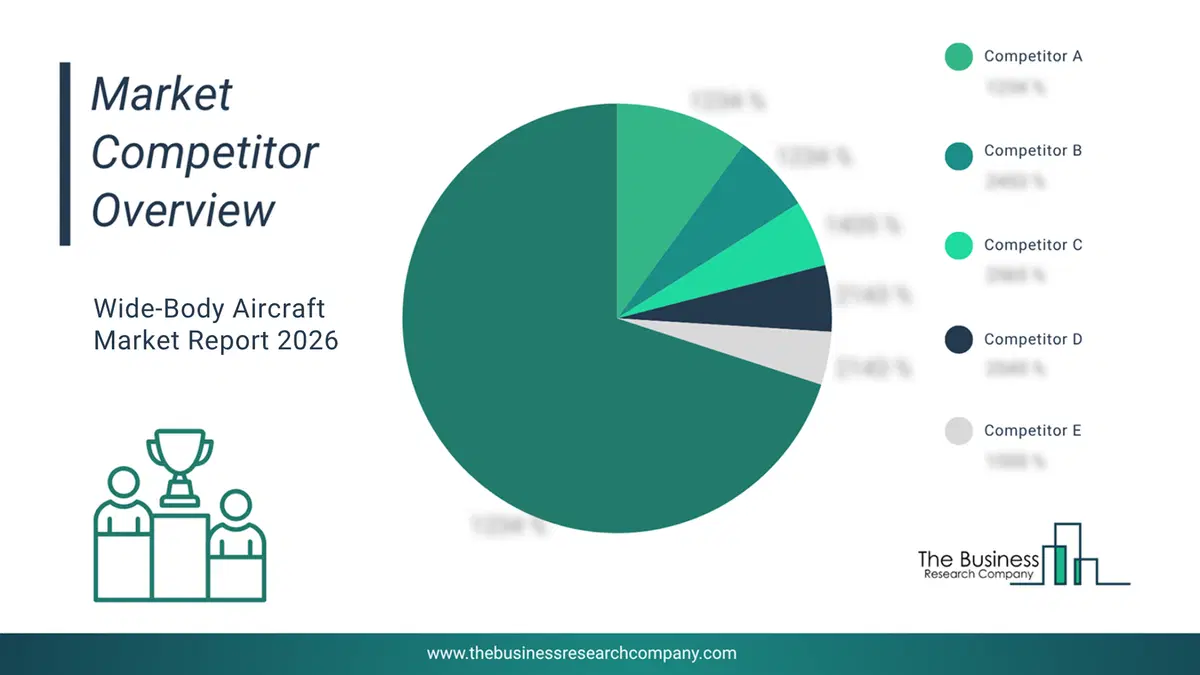
This chart is for illustrative purposes; the full report includes a detailed competitor analysis and comprehensive overview of the top 10 companies in the market.
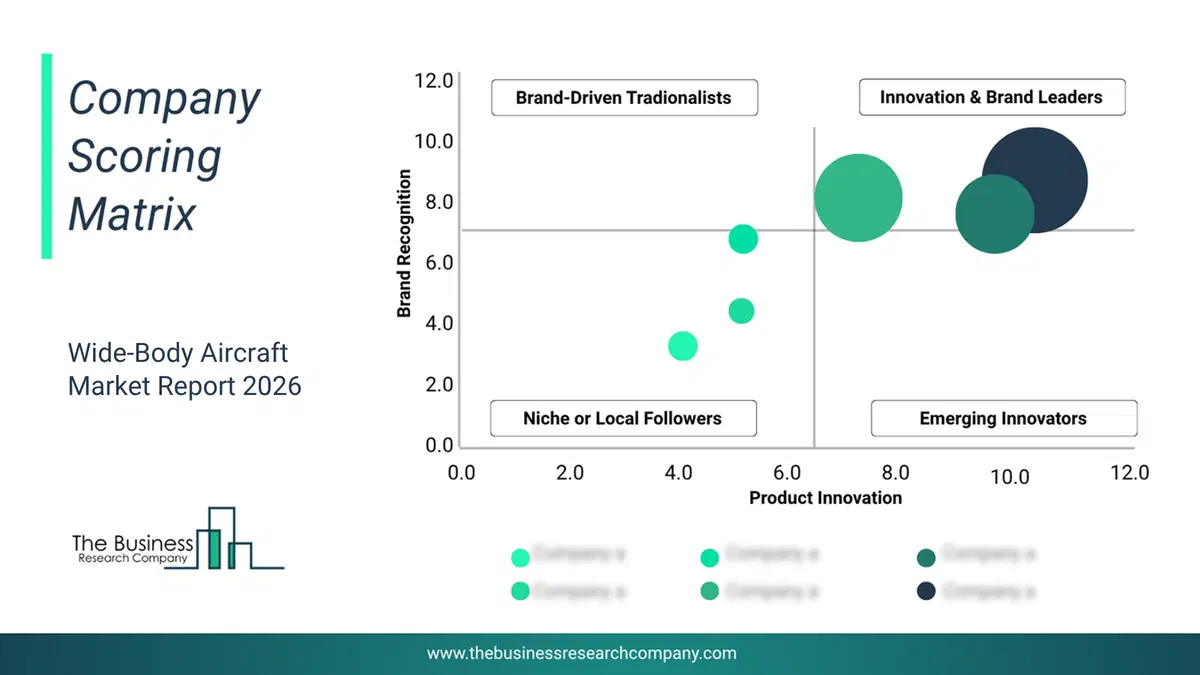
This chart maps companies by product innovation and brand strength, with bubble size indicating relative revenue, helping identify market leaders, challengers, and niche players. This is an illustrative chart; the full report provides a complete and accurate competitive analysis.
Global Wide-Body Aircraft Market Trends and Insights
Major companies operating in the wide-body aircraft market are focusing on developing innovative solutions such as next-generation wide-body aircraft to improve fuel efficiency, expand long-haul connectivity, enhance passenger comfort, and reduce operating costs. Next-generation wide-body aircraft refers to advanced twin-aisle aircraft incorporating lightweight composite materials, fuel-efficient engines, and modern avionics to deliver improved operational performance and lower environmental impact. For instance, in July 2026, Emirates, a UAE-based airline, launched the Airbus A350-900 on its additional Dubai–Cape Town route. The aircraft is designed to provide efficient long-haul passenger transportation. It offers benefits such as lower fuel consumption, enhanced passenger comfort with next-generation cabin interiors, and extended operational range. The launch aims to help customers enjoy more travel options and a superior onboard experience while supporting the aviation industry's transition toward more sustainable and fuel-efficient long-haul operations.What Are Latest Mergers And Acquisitions In The Wide-Body Aircraft Market?
In January 2026, Rolls-Royce Holdings plc, a UK-based aerospace and defense company, partnered with Delta Air Lines Inc. to supply 62 Trent engines for Delta's new Airbus A350-900 and Airbus A330-900neo wide-body aircraft, supporting fleet modernization and improving long-haul operational efficiency. With this partnership, the companies aim to enhance Delta's wide-body fleet efficiency, support long-haul network expansion, improve fuel efficiency, and strengthen Rolls-Royce's position in the global wide-body aircraft engine market. Delta Air Lines Inc. is a US-based airline that offers and operates a massive fleet of wide-body aircraft for long-haul international routes.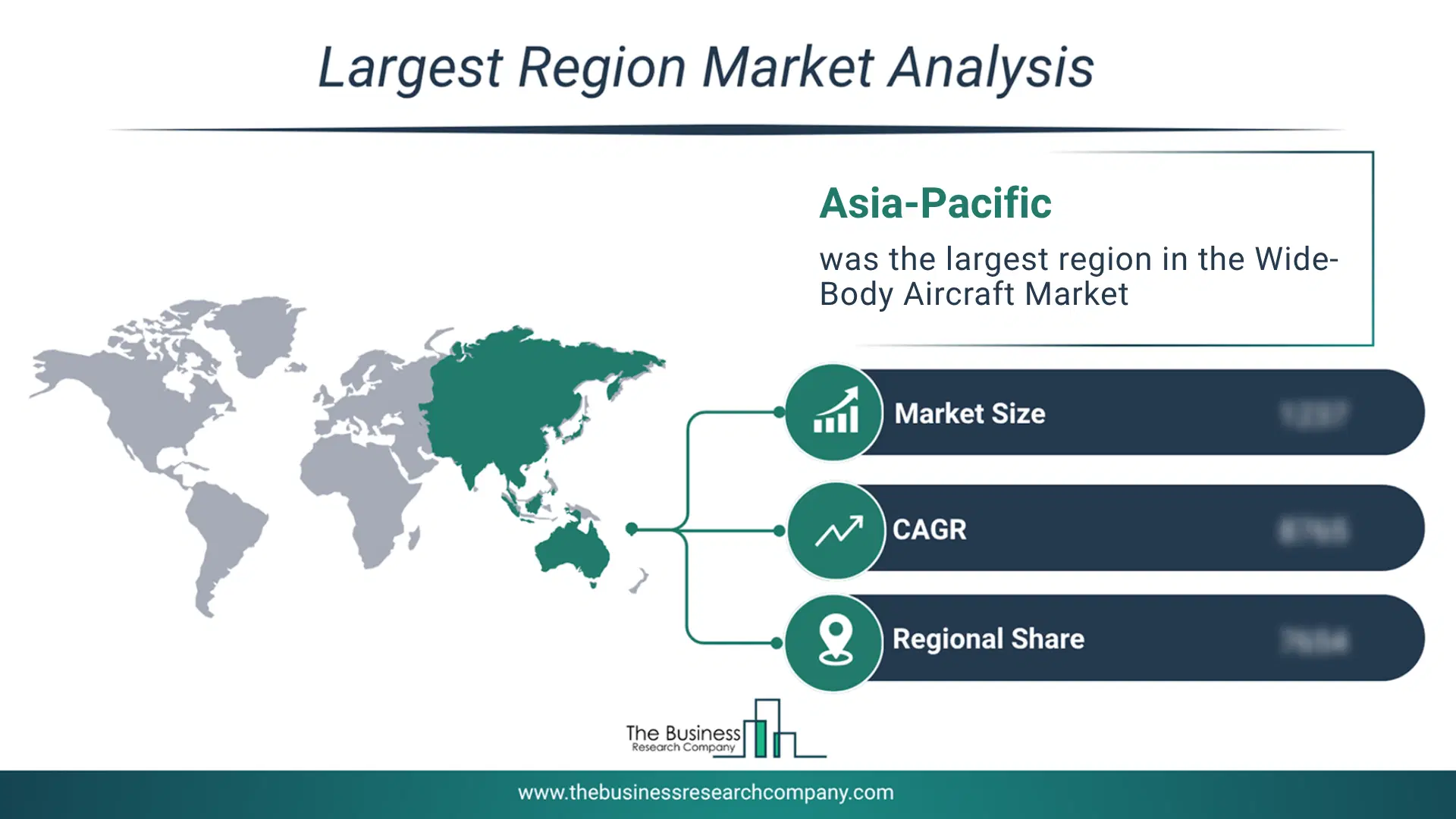
Regional Outlook
Asia-Pacific was the largest region in the wide-body aircraft market in 2025. Asia-Pacific is expected to be the fastest-growing region in the forecast period. The regions covered in this market report are Asia-Pacific, South East Asia, Western Europe, Eastern Europe, North America, South America, Middle East, Africa. The countries covered in this market report are Australia, Brazil, China, France, Germany, India, Indonesia, Japan, Taiwan, Russia, South Korea, UK, USA, Canada, Italy, Spain.What Defines the Wide-Body Aircraft Market?
The wide-body aircraft market consists of sales of military transport aircraft, aerial refueling tanker aircraft, airborne early warning and control (AEW&C) aircraft, and maritime patrol aircraft. Values in this market are ‘factory gate’ values, that is, the value of goods sold by the manufacturers or creators of the goods, whether to other entities (including downstream manufacturers, wholesalers, distributors, and retailers) or directly to end customers. The value of goods in this market includes related services sold by the creators of the goods.How is Market Value Defined and Measured?
The market value is defined as the revenues that enterprises gain from the sale of goods and/or services within the specified market and geography through sales, grants, or donations in terms of the currency (in USD unless otherwise specified). The revenues for a specified geography are consumption values that are revenues generated by organizations in the specified geography within the market, irrespective of where they are produced. It does not include revenues from resales along the supply chain, either further along the supply chain or as part of other products.
This chart presents market attractiveness based on a quantitative evaluation of growth, competition, strategic alignment, and risk, offering a clear view of opportunity areas for decision-making. This chart is for illustrative purposes; the full report contains the complete analysis.

This chart highlights the Total Addressable Market (TAM) by estimating the maximum revenue opportunity using an assumption-driven approach, supporting strategic planning and opportunity sizing across markets. The chart is illustrative; the full report provides a more comprehensive analysis.
What Key Data and Analysis Are Included in the Wide-Body Aircraft Market Report 2026?
The wide-body aircraft market research report is one of a series of new reports from The Business Research Company that provides market statistics, including industry global market size, regional shares, competitors with the market share, detailed market segments, market trends and opportunities, and any further data you may need to thrive in the wide-body aircraft industry. The market research report delivers a complete perspective of everything you need, with an in-depth analysis of the current and future state of the industry.Wide-Body Aircraft Market Report Forecast Analysis
| Report Attribute | Details |
|---|---|
| Market Size Value In 2026 | $117.31 billion |
| Revenue Forecast In 2030 | $147.27 billion |
| Growth Rate | CAGR of 5.9% from 2026 to 2030 |
| Base Year For Estimation | 2025 |
| Actual Estimates/Historical Data | 2020-2025 |
| Forecast Period | 2026 - 2030 |
| Market Representation | Revenue in USD Billion and CAGR from 2026 to 2030 |
| Segments Covered | Type, Range, Material, Application, End User |
| Regional Scope | Asia-Pacific, Western Europe, Eastern Europe, North America, South America, Middle East, Africa |
| Country Scope | The countries covered in the report are Australia, Brazil, China, France, Germany, India, Indonesia, Japan, Taiwan, Russia, South Korea, UK, USA, Canada, Italy, Spain. |
| Key Companies Profiled | The Boeing Company, Airbus SE, United Aircraft Corporation PJSC, Commercial Aircraft Corporation of China Ltd, Aviation Complex Ilyushin PJSC, Antonov Company, AVIC Xi'an Aircraft Industry Group Co Ltd, Natilus Inc, Lockheed Martin Corporation, Embraer SA, JetZero Inc |
| Customization Scope | Request for Customization |
| Pricing And Purchase Options | Explore Purchase Options |