
Wildfire Defense System Market Report 2026
Global Outlook – By Product Type (Automated Sprinkler Systems, Fire Retardants, Fire-Resistant Materials, Advanced Monitoring And Detection Systems, Other Types), By Technology Type (Internet Of Things (IoT)-Enabled Solutions, Artificial Intelligence (AI) And Machine Learning Solutions, Drone-Based Solutions, Mobile Applications, Cloud-Based Solutions), By Fire Detection Systems (Optical Sensors, Heat Sensors, Smoke Detectors, Thermal Imag as, Integrated Systems), By Fire Management Services (Water-Based Systems, Foam-Based Systems, Chemical Suppression Systems, Aerosol Suppression Systems, Hybrid Systems), By End User (Homeowners, Commercial Properties, Government Agencies, Forest And Wildlife Management Organizations, Other End Users) – Market Size, Trends, Strategies, and Forecast to 2030
Wildfire Defense System Market Overview
• Wildfire Defense System market size has reached to $1.14 billion in 2025 • Expected to grow to $1.7 billion in 2030 at a compound annual growth rate (CAGR) of 8.3% • Growth Driver: Increasing Wildfire Frequency And Severity Fueling the Growth of the Market Due To Climate Change • Market Trend: Artificial Intelligence-Powered Innovations Enhancing Wildfire Defense Capabilities • North America was the largest region in 2025 and Asia-Pacific is the fastest growing region.What Is Covered Under Wildfire Defense System Market?
A wildfire defense system is an integrated network of technologies, equipment, and protocols designed to detect, prevent, and mitigate the spread of wildfires through automated responses, real-time data analysis, and strategic resource deployment. It is used to protect residential, commercial, and forested areas by enabling early warning alerts, guiding evacuation efforts, and activating fire suppression measures to reduce damage and enhance safety. The main product types of wildfire defense systems are automated sprinkler systems, fire retardants, fire-resistant materials, advanced monitoring and detection systems, and others. Automated sprinkler systems automatically spray water to control or stop wildfires by activating when heat or smoke is detected. The technology type includes internet of things (IoT)-enabled solutions, artificial intelligence (AI) and machine learning solutions, drone-based solutions, mobile applications, and cloud-based solutions. The fire detection system includes optical sensors, heat sensors, smoke detectors, thermal imaging cameras, and integrated systems with the fire management services, such as water-based systems, foam-based systems, chemical suppression systems, aerosol suppression systems, and hybrid systems used by end users such as homeowners, commercial properties, government agencies, forest and wildlife management organizations, and others.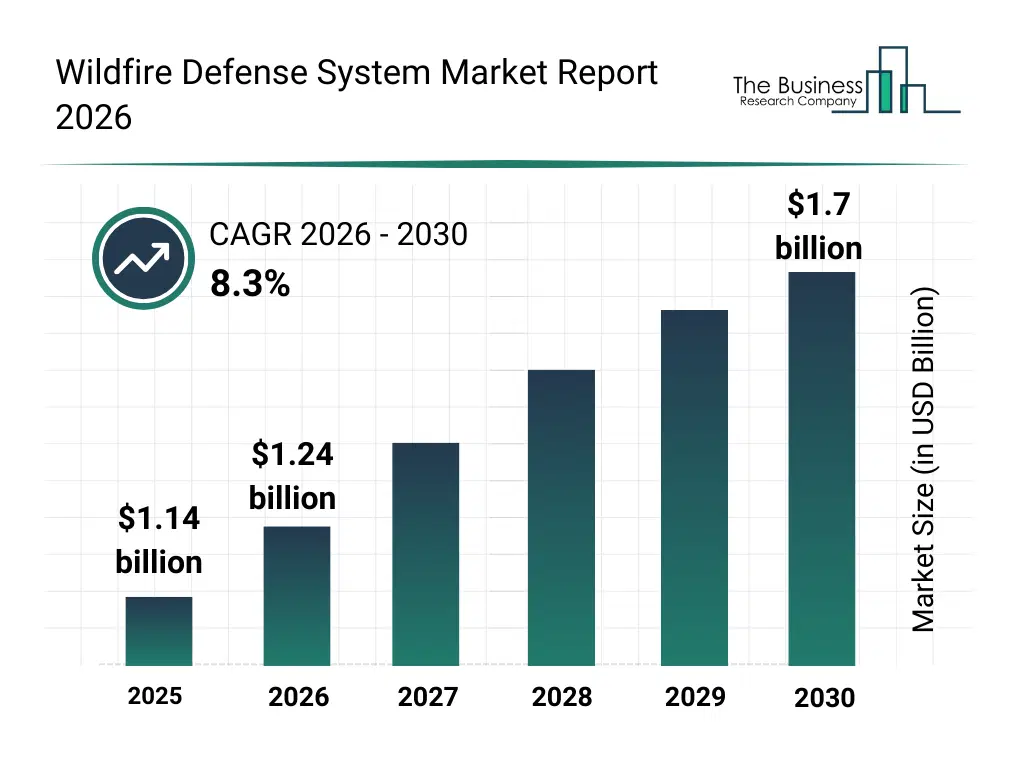
What Is The Wildfire Defense System Market Size and Share 2026?
The wildfire defense system market size has grown strongly in recent years. It will grow from $1.14 billion in 2025 to $1.24 billion in 2026 at a compound annual growth rate (CAGR) of 8.7%. The growth in the historic period can be attributed to increasing frequency and intensity of wildfires globally, adoption of early warning and detection technologies, rising investment in fire suppression infrastructure, government initiatives and regulations for wildfire risk management, collaborations between technology providers and emergency services.What Is The Wildfire Defense System Market Growth Forecast?
The wildfire defense system market size is expected to see strong growth in the next few years. It will grow to $1.7 billion in 2030 at a compound annual growth rate (CAGR) of 8.3%. The growth in the forecast period can be attributed to growing integration of ai and iot for real-time wildfire monitoring, expansion of commercial and residential wildfire defense solutions, rising demand for eco-friendly fire retardants and materials, development of automated and drone-based fire suppression systems, increased focus on community preparedness and emergency response planning. Major trends in the forecast period include enhanced fire retardant formulations, integration of real-time satellite and drone surveillance, community-based wildfire risk management programs, expansion of ember defense technologies, development of eco-friendly fire suppression systems.
Global Wildfire Defense System Market Segmentation
1) By Product Type: Automated Sprinkler Systems, Fire Retardants, Fire-Resistant Materials, Advanced Monitoring And Detection Systems, Other Types 2) By Technology Type: Internet Of Things (IoT)-Enabled Solutions, Artificial Intelligence (AI) And Machine Learning Solutions, Drone-Based Solutions, Mobile Applications, Cloud-Based Solutions 3) By Fire Detection Systems: Optical Sensors, Heat Sensors, Smoke Detectors, Thermal Imaging Cameras, Integrated Systems 4) By Fire Management Services: Water-Based Systems, Foam-Based Systems, Chemical Suppression Systems, Aerosol Suppression Systems, Hybrid Systems 5) By End User: Homeowners, Commercial Properties, Government Agencies, Forest And Wildlife Management Organizations, Other End Users Subsegments: 1) By Fire Suppression Systems: Wet Pipe Systems, Dry Pipe Systems, Pre-Action Systems, Deluge Systems, Water Mist Systems 2) By Fire Retardants: Long-Term Retardants, Short-Term Retardants, Foam-Based Retardants, Gel-Based Retardants 3) By Fire-Resistant Materials: Fire-Resistant Coatings, Fire-Resistant Fabrics, Intumescent Materials, Fire-Resistant Panels 4) By Advanced Monitoring And Detection Systems: Satellite-Based Monitoring, Ground-Based Sensors, Aerial Surveillance Drones, Artificial Intelligence-Powered Detection Systems, Thermal Imaging Cameras 5) By Other Types: Firebreak Tools, Controlled Burn Equipment, Emergency Communication Systems, Protective GearWhat Is Driver Of The Wildfire Defense System Market?
The increasing wildfire frequency and severity are expected to propel the growth of the wildfire defense system market going forward. Wildfire severity refers to the degree of environmental change or damage caused by a wildfire, including its impact on vegetation, soil, and ecosystems. The increasing wildfire frequency and severity are due to climate change, as rising temperatures, prolonged droughts, and shifting weather patterns create drier landscapes and more extreme fire conditions. Wildfire defense systems are used to proactively protect properties by creating defensible spaces and applying fire-resistant materials to reduce ignition risk during wildfires. For instance, in August 2024, according to the National Interagency Fire Center (NIFC), a US-based government organization, reported that In 2024, over 28,000 wildfire incidents have been recorded, burning approximately 4.5 million acres. Although the number of fires is about half that of 2023, the total area burned is greater, indicating a rise in large and harder-to-control wildfires. Therefore, the increasing wildfire frequency and severity are driving the growth of the wildfire defense system industry.Key Players In The Global Wildfire Defense System Market
Major companies operating in the wildfire defense system market are Honeywell International Inc., Viking Group Inc., Chubb Fire & Security, Firetrol Protection Systems Inc., Wildfire Defense Systems Inc., National Fire Fighter Corp., Dafo Vehicle Fire Protection AB, Frontline Wildfire Defense Inc., FireDome Inc., Ammor Fire, Ember Defense, Blazequel, Consumer Fire Products Inc., Flame Seal Products Inc., FlameSniffer LLC, EarthClean Corporation, Colorado Firebreak LLC, Firebreak Protection Systems Inc., WASP Manufacturing Ltd, FireBozz International Ltd.
This chart is for illustrative purposes; the full report includes a detailed competitor analysis and comprehensive overview of the top 10 companies in the market.
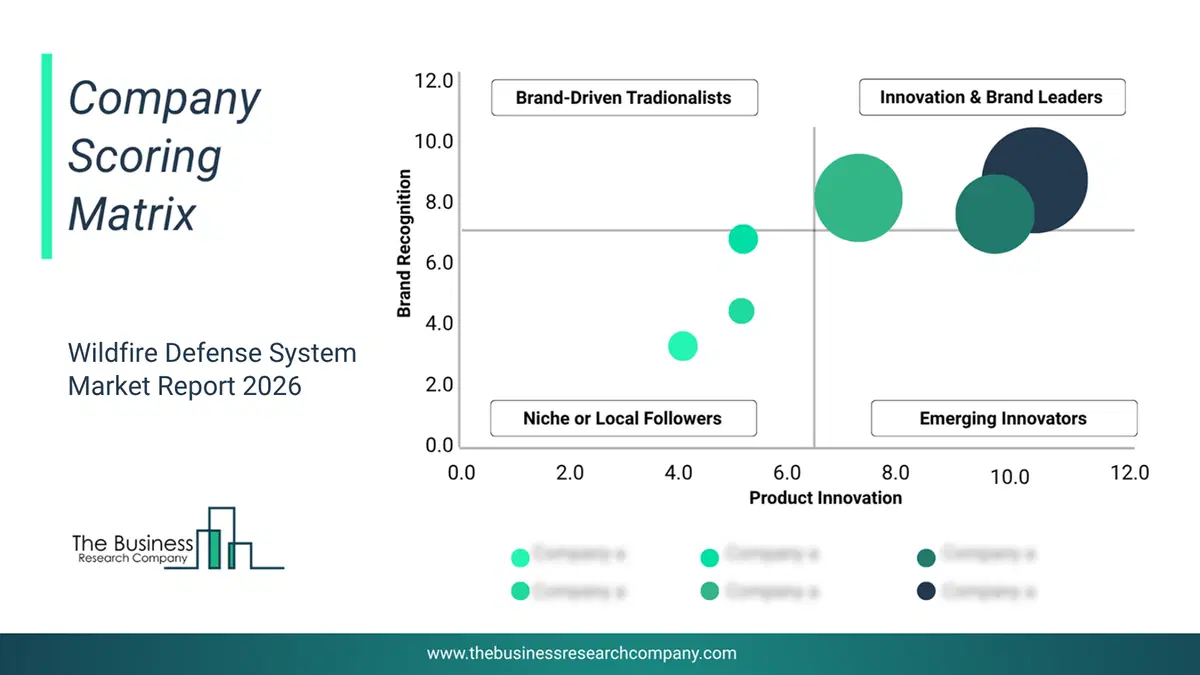
This chart maps companies by product innovation and brand strength, with bubble size indicating relative revenue, helping identify market leaders, challengers, and niche players. This is an illustrative chart; the full report provides a complete and accurate competitive analysis.
Global Wildfire Defense System Market Trends and Insights
Major companies operating in the wildfire defense system market are focusing on developing technological advancements with artificial intelligence-powered systems to enhance early detection, improve real-time monitoring, and enable rapid response to contain and mitigate the spread of wildfires effectively. Artificial intelligence-powered systems refer to technologies and strategies designed to detect, monitor, and control the boundary of a wildfire to prevent its spread. For instance, in December 2024, FireDome Ltd., an Israel-based wildfire defense system company, launched an artificial intelligence-powered wildfire perimeter defense system. FireDome’s AI-powered wildfire perimeter defense system offers significant advantages by using AI-driven cameras to detect ember-caused spot fires early and deploying fire retardant capsules to create protective barriers around properties. This technology enhances early detection and rapid response, operating autonomously without relying on local utilities, which ensures continuous protection even in remote areas. Its primary purpose is to prevent wildfires from spreading to properties, thereby minimizing the economic and environmental damage caused by wildfires.What Are Latest Mergers And Acquisitions In The Wildfire Defense System Market? Bridger Aerospace Acquires Ignis Technologies To Boost Wildfire Defense Systems
In September 2023, Bridger Aerospace, a US-based provider of aerial firefighting, wildfire detection, and data analytics services, acquired Ignis Technologies for $3 million. This acquisition enables Bridger Aerospace to expand its technology capabilities by integrating Ignis Technologies’ advanced software solutions, enhancing wildfire management and firefighting effectiveness through improved data analytics and decision support tools. Ignis Technologies is a US-based provider of wildfire risk assessment software and data analytics platforms.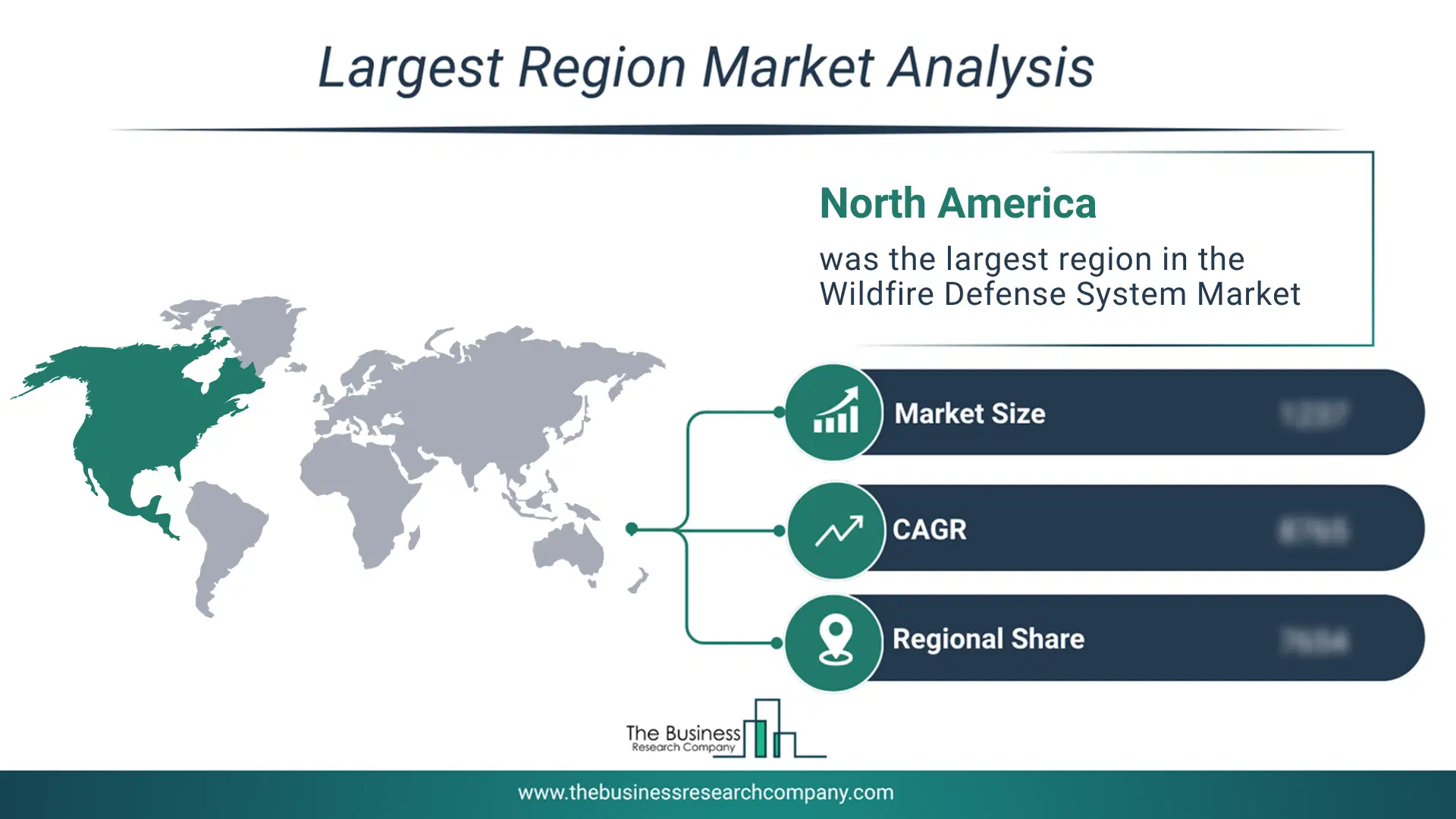
Regional Insights
North America was the largest region in the wildfire defense system market in 2025. Asia-Pacific is expected to be the fastest-growing region in the forecast period. The regions covered in this market report are Asia-Pacific, South East Asia, Western Europe, Eastern Europe, North America, South America, Middle East, Africa. The countries covered in this market report are Australia, Brazil, China, France, Germany, India, Indonesia, Japan, Taiwan, Russia, South Korea, UK, USA, Canada, Italy, SpainWhat Defines the Wildfire Defense System Market?
The wildfire defense system market includes revenues earned by entities by providing services such as property risk assessment, vegetation management, fire retardant application, defensible space creation, rooftop and gutter cleaning, ember defense installation, and emergency response planning. The market value includes the value of related goods sold by the service provider or included within the service offering. The wildfire defense system market also includes sales of fire-retardant sprays, ember-resistant vents, fire-resistant blankets, rooftop sprinkler systems, portable water tanks, flame-resistant foam, and high-pressure fire hoses. Values in this market are ‘factory gate’ values, that is, the value of goods sold by the manufacturers or creators of the goods, whether to other entities (including downstream manufacturers, wholesalers, distributors, and retailers) or directly to end customers. The value of goods in this market includes related services sold by the creators of the goods.How is Market Value Defined and Measured?
The market value is defined as the revenues that enterprises gain from the sale of goods and/or services within the specified market and geography through sales, grants, or donations in terms of the currency (in USD unless otherwise specified). The revenues for a specified geography are consumption values that are revenues generated by organizations in the specified geography within the market, irrespective of where they are produced. It does not include revenues from resales along the supply chain, either further along the supply chain or as part of other products.
This chart presents market attractiveness based on a quantitative evaluation of growth, competition, strategic alignment, and risk, offering a clear view of opportunity areas for decision-making. This chart is for illustrative purposes; the full report contains the complete analysis.

This chart highlights the Total Addressable Market (TAM) by estimating the maximum revenue opportunity using an assumption-driven approach, supporting strategic planning and opportunity sizing across markets. The chart is illustrative; the full report provides a more comprehensive analysis.
What Key Data and Analysis Are Included in the Wildfire Defense System Market Report 2026?
The wildfire defense system market research report is one of a series of new reports from The Business Research Company that provides market statistics, including industry global market size, regional shares, competitors with the market share, detailed market segments, market trends and opportunities, and any further data you may need to thrive in the wildfire defense system industry. The market research report delivers a complete perspective of everything you need, with an in-depth analysis of the current and future state of the industry.Wildfire Defense System Market Report Forecast Analysis
| Report Attribute | Details |
|---|---|
| Market Size Value In 2026 | $1.24 billion |
| Revenue Forecast In 2030 | $1.7 billion |
| Growth Rate | CAGR of 8.3% from 2026 to 2030 |
| Base Year For Estimation | 2025 |
| Actual Estimates/Historical Data | 2020-2025 |
| Forecast Period | 2026 - 2030 |
| Market Representation | Revenue in USD Billion and CAGR from 2026 to 2030 |
| Segments Covered | Product Type, Technology Type, Fire Detection Systems, Fire Management Services, End User |
| Regional Scope | Asia-Pacific, Western Europe, Eastern Europe, North America, South America, Middle East, Africa |
| Country Scope | The countries covered in the wildfire defense system market report are Australia, Brazil, China, France, Germany, India, Indonesia, Japan, Taiwan, Russia, South Korea, UK, USA, Canada, Italy, Spain |
| Key Companies Profiled | Honeywell International Inc., Viking Group Inc., Chubb Fire & Security, Firetrol Protection Systems Inc., Wildfire Defense Systems Inc., National Fire Fighter Corp., Dafo Vehicle Fire Protection AB, Frontline Wildfire Defense Inc., FireDome Inc., Ammor Fire, Ember Defense, Blazequel, Consumer Fire Products Inc., Flame Seal Products Inc., FlameSniffer LLC, EarthClean Corporation, Colorado Firebreak LLC, Firebreak Protection Systems Inc., WASP Manufacturing Ltd, FireBozz International Ltd. |
| Customization Scope | Request for Customization |
| Pricing And Purchase Options | Explore Purchase Options |