
Wind Powered Water Pumps Market Report 2026
Global Outlook – By System Type (Mechanical Wind-Powered Water Pumps, Wind-Electric Water Pump Systems, Wind–Solar Hybrid Water Pump Systems), By Component (Tower and Frame Structures, Rotor Blades, Transmission Systems (Gearbox, Slider-Crank Mechanism), Pump Rods and Shafts, Bearings and Couplings, Control and Safety Components, Other Components), By Pump Mechanism (Piston Pumps, Reciprocating Pumps, Diaphragm Pumps, Centrifugal Pumps (limited use in wind-electric systems only)), By End-Use (Agricultural Irrigation, Livestock Watering, Off-Grid Domestic Water Supply, Community and Rural Water Supply, Other Off-Grid Applications) – Market Size, Trends, Strategies, and Forecast to 2030
Wind Powered Water Pumps Market Overview
• Wind Powered Water Pumps market size has reached to $2.86 billion in 2025 • Expected to grow to $4.13 billion in 2030 at a compound annual growth rate (CAGR) of 7.6% • Growth Driver: Impact Of Clean Alternative Energy Sources On The Growth Of The Wind-Powered Water Pumps Market • Asia-Pacific was the largest region in 2025 and North America is the fastest growing region.What Is Covered Under Wind Powered Water Pumps Market?
Wind-powered water pumps utilize wind energy to mechanically pump water from natural sources, such as wells or rivers, to locations such as farms or households. These systems operate independently of traditional power sources by converting wind into mechanical power through a windmill or rotor, making them ideal for off-grid areas. The main types of wind-powered water pumps are electrical pumps and mechanical pumps. Electrical pumps use wind power to generate electricity, which in turn powers a motor that drives the water pump efficiently in converting wind energy into electrical energy, and they are equipped with batteries or storage systems to ensure consistent operation during periods of low wind. The component types are categorized into mild steel frames, pneumatic cylinders, rotor blades, slider crank discs, shafts, ball bearings, and others with capacity types including <2.5 kWh, 2.5 kWh-10 kWh, and >10 kWh. It is used for irrigation, off-grid water supply, water treatment plants, and others.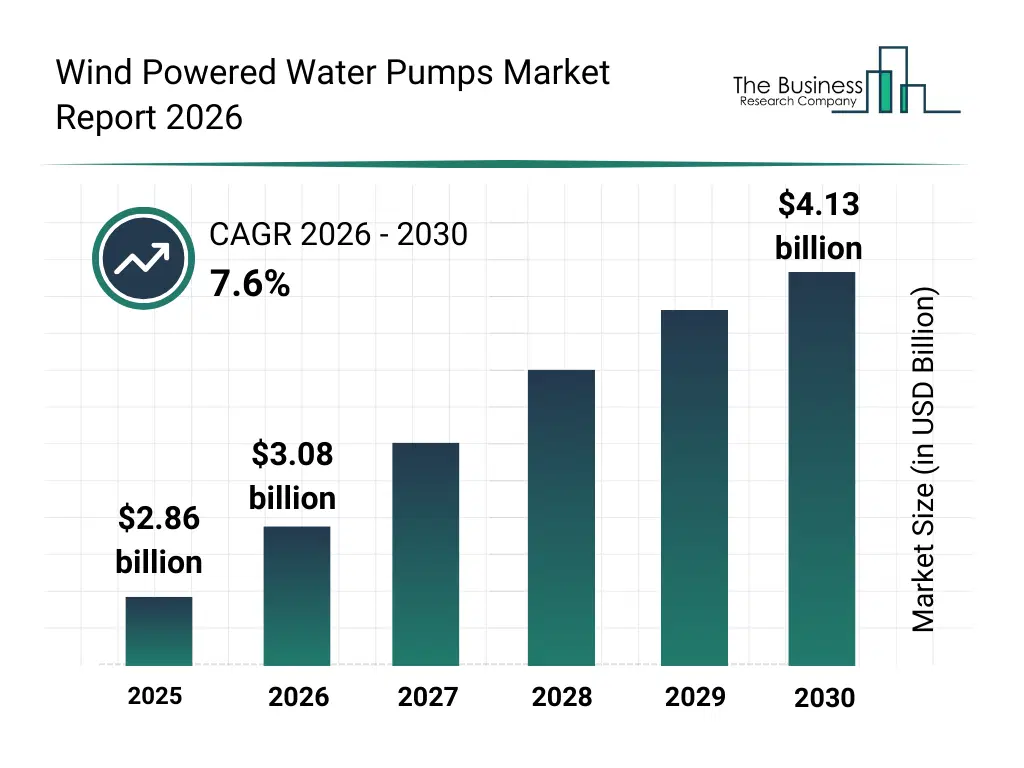
What Is The Wind Powered Water Pumps Market Size and Share 2026?
The wind powered water pumps market size has grown strongly in recent years. It will grow from $2.86 billion in 2025 to $3.08 billion in 2026 at a compound annual growth rate (CAGR) of 7.5%. The growth in the historic period can be attributed to rural electrification gaps, agricultural irrigation demand, fuel cost volatility, renewable energy awareness, water scarcity challenges.What Is The Wind Powered Water Pumps Market Growth Forecast?
The wind powered water pumps market size is expected to see strong growth in the next few years. It will grow to $4.13 billion in 2030 at a compound annual growth rate (CAGR) of 7.6%. The growth in the forecast period can be attributed to government renewable incentives, expansion of off grid farming, climate resilient water solutions, growth in remote infrastructure, sustainable water management initiatives. Major trends in the forecast period include rising adoption in off grid applications, growing demand for renewable water pumping, expansion of hybrid wind systems, increased use in agricultural irrigation, focus on low maintenance pump designs.Tariff Impact On Wind Powered Water Pumps Market
Tariffs have impacted the wind powered water pumps market by increasing costs of imported rotor blades, bearings, shafts, and mechanical components. Mechanical pump systems are most affected, particularly in developing regions dependent on imported hardware. Higher costs have slowed adoption in price sensitive markets. However, tariffs are supporting local fabrication and regional manufacturing of wind pumping systems.
Global Wind Powered Water Pumps Market Segmentation
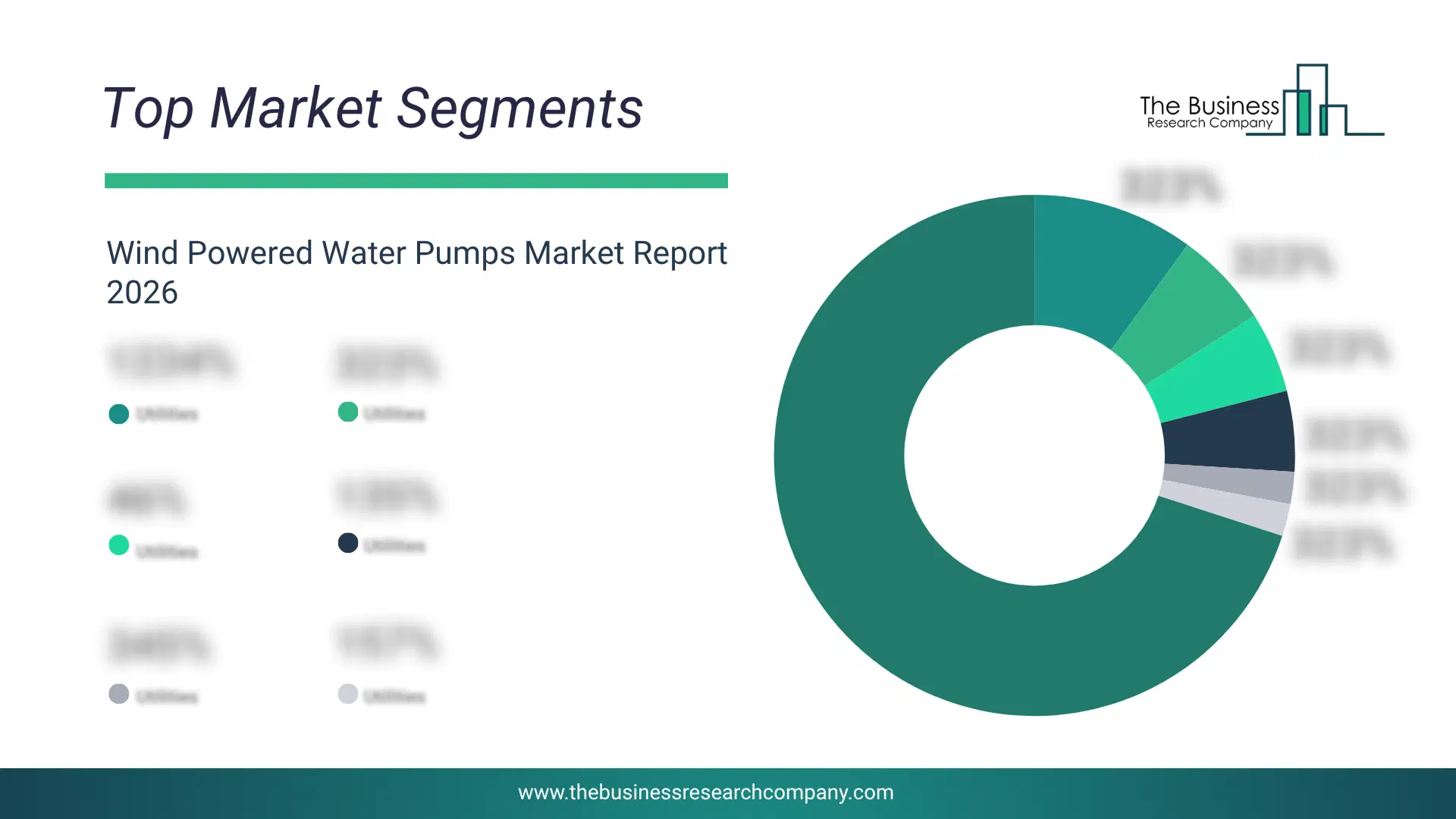
1) By System Type: Mechanical Wind-Powered Water Pumps, Wind-Electric Water Pump Systems, Wind–Solar Hybrid Water Pump Systems 2) By Component: Tower and Frame Structures, Rotor Blades, Transmission Systems (Gearbox, Slider-Crank Mechanism), Pump Rods and Shafts, Bearings and Couplings, Control and Safety Components, Other Components 3) By Pump Mechanism: Piston Pumps, Reciprocating Pumps, Diaphragm Pumps, Centrifugal Pumps (limited use in wind-electric systems only) 4) By End-Use: Agricultural Irrigation, Livestock Watering, Off-Grid Domestic Water Supply, Community and Rural Water Supply, Other Off-Grid Applications Subsegments: 1) By Mechanical Wind-Powered Water Pumps: Traditional Windmill Pumps, Multi-Blade Wind Pumps, High-Efficiency Modern Wind Pumps 2) By Wind-Electric Water Pump Systems: Submersible Wind-Electric Pumps, Surface Wind-Electric Pumps 3) By Wind–Solar Hybrid Water Pump Systems: Hybrid Submersible Pumps, Hybrid Surface PumpsWhat Are The Drivers Of The Wind Powered Water Pumps Market?
The rise in clean alternative energy sources is expected to propel the growth of the wind-powered water pump market going forward. Clean alternative energy sources offer sustainable, eco-friendly power sources, helping to minimize environmental harm and reliance on finite fossil fuels. The growing shift towards clean, alternative energy sources is driving the wind-powered water pumps market by encouraging the adoption of eco-friendly solutions. Wind-powered water pumps offer a sustainable and clean energy solution for pumping water, particularly in remote or rural areas with limited access to grid electricity. These pumps harness wind energy to draw water from wells, rivers, or underground aquifers, providing an eco-friendly alternative to conventional diesel or electric pumps. For instance, in February 2024, according to the World Resources Institute, a US-based non-profit organization, in 2023, the United States witnessed a historic installation of 31 gigawatts (GW) of solar energy capacity, marking a significant 55% surge from the installations in 2022 and surpassing the previous record set in 2021. Therefore, the rise in clean alternative energy sources drives the growth of wind-powered water pump markets. The rise in the adoption in agricultural sector is expected to propel the growth of the wind-powered water pump market going forward. The growing population and increased food demand have led farmers to implement and adopt automation techniques for greater efficiency. Simultaneously, sustainable farming is expanding, supported by government policies promoting eco-friendly practices to address environmental concerns. Wind-powered water pumps are used in the agricultural sector to provide a sustainable and cost-effective method for irrigating crops and supplying water to livestock, especially in remote or off-grid areas. For instance, in January 2024, according to the United States Government Accountability Office, a US-based government department, in 2023, about 27% of farms and ranches in the U.S. adopted precision agriculture practices for managing crops or livestock. Therefore, the rise in the adoption in agricultural sector will drive the growth of the wind-powered water pump market. The growing concerns over water scarcity are expected to propel the growth of the wind powered water pumps market going forward. Water scarcity refers to a condition in which there is an insufficient quantity of fresh, clean water available to meet the needs of a specific region's population or ecosystem. Water scarcity is rising due to rapidly increasing freshwater demand driven by population growth. Wind-powered water pumps help address water scarcity by using wind energy to extract groundwater or move water without relying on electricity or fuel. For instance, in March 2023, according to a report published by the United Nations Educational, Scientific and Cultural organization, a France-based specialized agency, on a global scale, as of 2023, approximately 2 billion individuals, constituting 26% of the world's population, do not have access to safe drinking water, and a staggering 3.6 billion people, or 46% of the global population, lack proper access to well-managed sanitation facilities. Projections indicate that by the year 2050, the number of people in urban areas facing water scarcity is expected to increase twofold, reaching a range of 1.7 to 2.4 billion people. Therefore, the growing concerns over water scarcity are driving the growth of the wind powered water pumps industry.Key Players In The Global Wind Powered Water Pumps Market
Major companies operating in the wind powered water pumps market are Grundfos Holding A/S, SWECO AB, Graco Inc., WindEnergy7 LLC, Aquatic Control Inc., CNP Pumps India Pvt Ltd., IYSERT Energy Research SL, Suzlon Energy Ltd., EcoInnovation Ltd., Iron Man Windmill Co. Ltd., Aermotor Windmill Company Inc., Koenders Water Solutions Inc., Airwell Group Pty Ltd, Sarissa Precision Limited, Lone Star Windmill Company LLC, Southern Cross Windmills Pty Ltd, Bergey Windpower Co., Waterquip Pty Ltd, O'Brock Windmill Distributors LLC, Kijito Windpower Ltd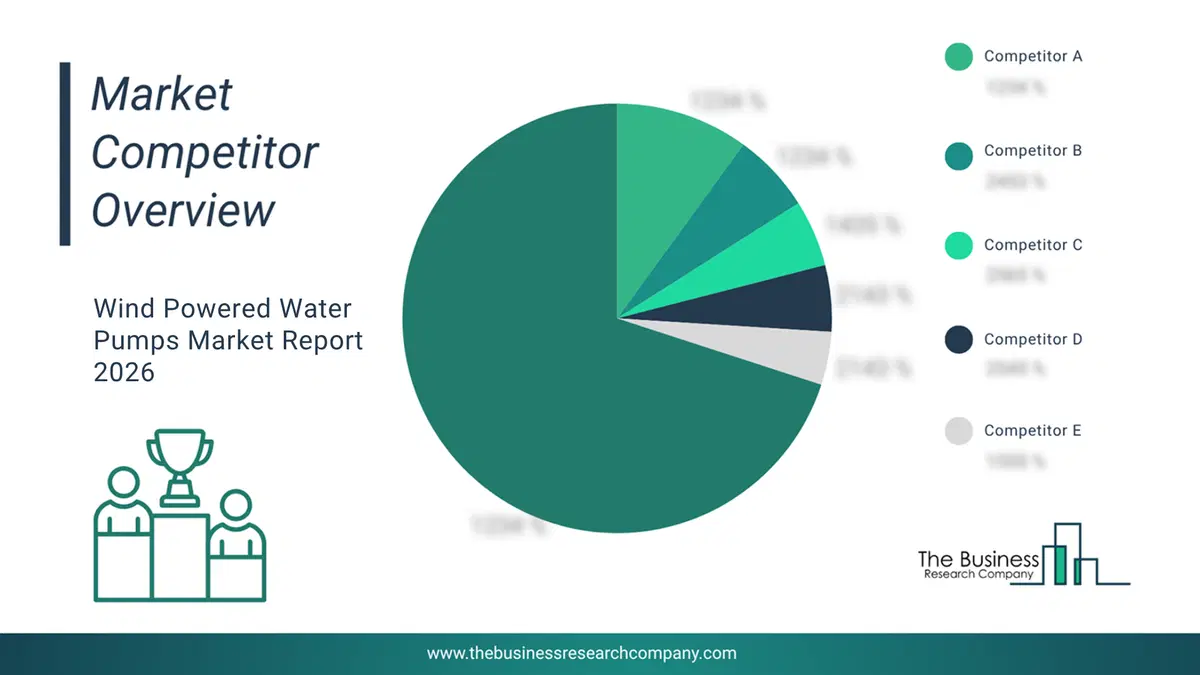
This chart is for illustrative purposes; the full report includes a detailed competitor analysis and comprehensive overview of the top 10 companies in the market.
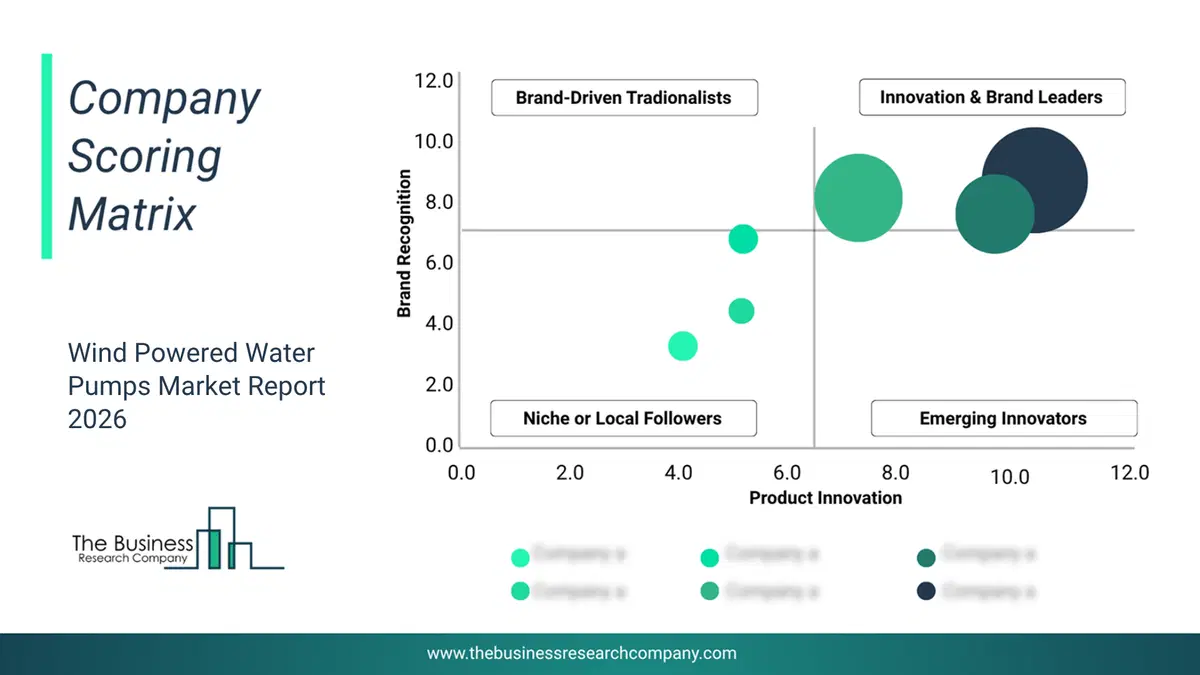
This chart maps companies by product innovation and brand strength, with bubble size indicating relative revenue, helping identify market leaders, challengers, and niche players. This is an illustrative chart; the full report provides a complete and accurate competitive analysis.
Regional Outlook
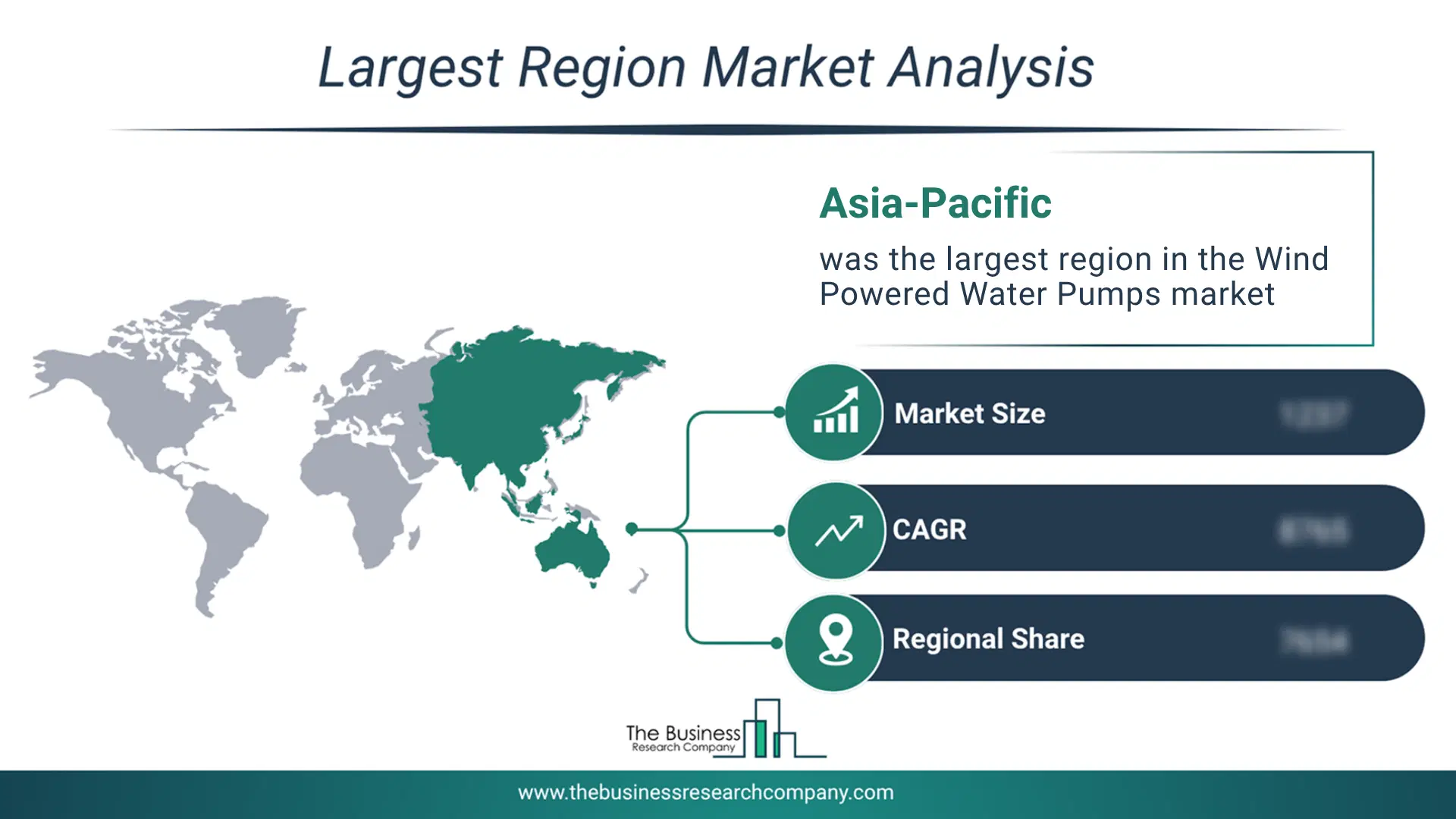
Asia-Pacific was the largest region in the wind powered water pumps market in 2025. North America is expected to be the fastest-growing region in the forecast period. The regions covered in this market report are Asia-Pacific, South East Asia, Western Europe, Eastern Europe, North America, South America, Middle East, Africa The countries covered in this market report are Australia, Brazil, China, France, Germany, India, Indonesia, Japan, Taiwan, Russia, South Korea, UK, USA, Canada, Italy, Spain.What Defines the Wind Powered Water Pumps Market?
The wind-powered water pumps market consists of sales of windmill-driven water pumps, hybrid wind-powered water pumps, high-capacity wind-powered water pumps, vertical-axis wind-powered water pumps, portable wind-powered water pumps, and automatic wind-powered water pumps. Values in this market are ‘factory gate’ values, that is, the value of goods sold by the manufacturers or creators of the goods, whether to other entities (including downstream manufacturers, wholesalers, distributors, and retailers) or directly to end customers. The value of goods in this market includes related services sold by the creators of the goods.How is Market Value Defined and Measured?
The market value is defined as the revenues that enterprises gain from the sale of goods and/or services within the specified market and geography through sales, grants, or donations in terms of the currency (in USD unless otherwise specified). The revenues for a specified geography are consumption values that are revenues generated by organizations in the specified geography within the market, irrespective of where they are produced. It does not include revenues from resales along the supply chain, either further along the supply chain or as part of other products.
This chart presents market attractiveness based on a quantitative evaluation of growth, competition, strategic alignment, and risk, offering a clear view of opportunity areas for decision-making. This chart is for illustrative purposes; the full report contains the complete analysis.

This chart highlights the Total Addressable Market (TAM) by estimating the maximum revenue opportunity using an assumption-driven approach, supporting strategic planning and opportunity sizing across markets. The chart is illustrative; the full report provides a more comprehensive analysis.
What Key Data and Analysis Are Included in the Wind Powered Water Pumps Market Report 2026?
The wind powered water pumps market research report is one of a series of new reports from The Business Research Company that provides market statistics, including industry global market size, regional shares, competitors with the market share, detailed market segments, market trends and opportunities, and any further data you may need to thrive in the wind powered water pumps industry. The market research report delivers a complete perspective of everything you need, with an in-depth analysis of the current and future state of the industry.Wind Powered Water Pumps Market Report Forecast Analysis
| Report Attribute | Details |
|---|---|
| Market Size Value In 2026 | $3.08 billion |
| Revenue Forecast In 2030 | $4.13 billion |
| Growth Rate | CAGR of 7.6% from 2026 to 2030 |
| Base Year For Estimation | 2025 |
| Actual Estimates/Historical Data | 2020-2025 |
| Forecast Period | 2026 - 2030 |
| Market Representation | Revenue in USD Billion and CAGR from 2026 to 2030 |
| Segments Covered | System Type, Component, Pump Mechanism, End-Use |
| Regional Scope | Asia-Pacific, Western Europe, Eastern Europe, North America, South America, Middle East, Africa |
| Key Companies Profiled | Grundfos Holding A/S, SWECO AB, Graco Inc., WindEnergy7 LLC, Aquatic Control Inc., CNP Pumps India Pvt Ltd., IYSERT Energy Research SL, Suzlon Energy Ltd., EcoInnovation Ltd., Iron Man Windmill Co. Ltd., Aermotor Windmill Company Inc., Koenders Water Solutions Inc., Airwell Group Pty Ltd, Sarissa Precision Limited, Lone Star Windmill Company LLC, Southern Cross Windmills Pty Ltd, Bergey Windpower Co., Waterquip Pty Ltd, O'Brock Windmill Distributors LLC, Kijito Windpower Ltd |
| Customization Scope | Request for Customization |
| Pricing And Purchase Options | Explore Purchase Options |