
Wind Turbine Automation Market Report 2026
Global Outlook – By System ( Supervisory Control And Data Acquisition (SCADA) Systems, Programmable Logic Controllers (PLC) Systems, Distributed Control Systems (DCS), Condition Monitoring Systems (CMS), Other Systems), By Component ( Hardware, Software, Services), By Application ( Offshore Wind Power Generation, Onshore Wind Power Generation, Other Applications) – Market Size, Trends, Strategies, and Forecast to 2030
Wind Turbine Automation Market Overview
• Wind Turbine Automation market size has reached to $16.84 billion in 2025 • Expected to grow to $23.54 billion in 2030 at a compound annual growth rate (CAGR) of 7% • Growth Driver: Increasing Adoption Of Wind Energy Fuels Growth In The Wind Turbine Automation Market • Market Trend: Development Of Strategic Partnerships To Enhance Wind Turbine Automation And Performance • Europe was the largest region in 2025 and North America is the fastest growing region.What Is Covered Under Wind Turbine Automation Market?
Wind turbine automation refers to integrating technology to control and optimize the operation of wind turbines, improving efficiency and reducing downtime. This automation includes real-time monitoring, control of blade pitch, power output regulation, and system diagnostics to enhance performance and reliability. The main types of wind turbine automation are supervisory control and data acquisition (SCADA) systems, programmable logic controllers (PLC) systems, distributed control systems (DCS), condition monitoring systems (CMS), and others. Supervisory control and data acquisition (SCADA) systems are centralized software applications used to monitor, control, and analyze industrial processes or infrastructure remotely. The components are hardware, software, and services and are used in various applications such as offshore wind power generation, onshore wind power generation, and others.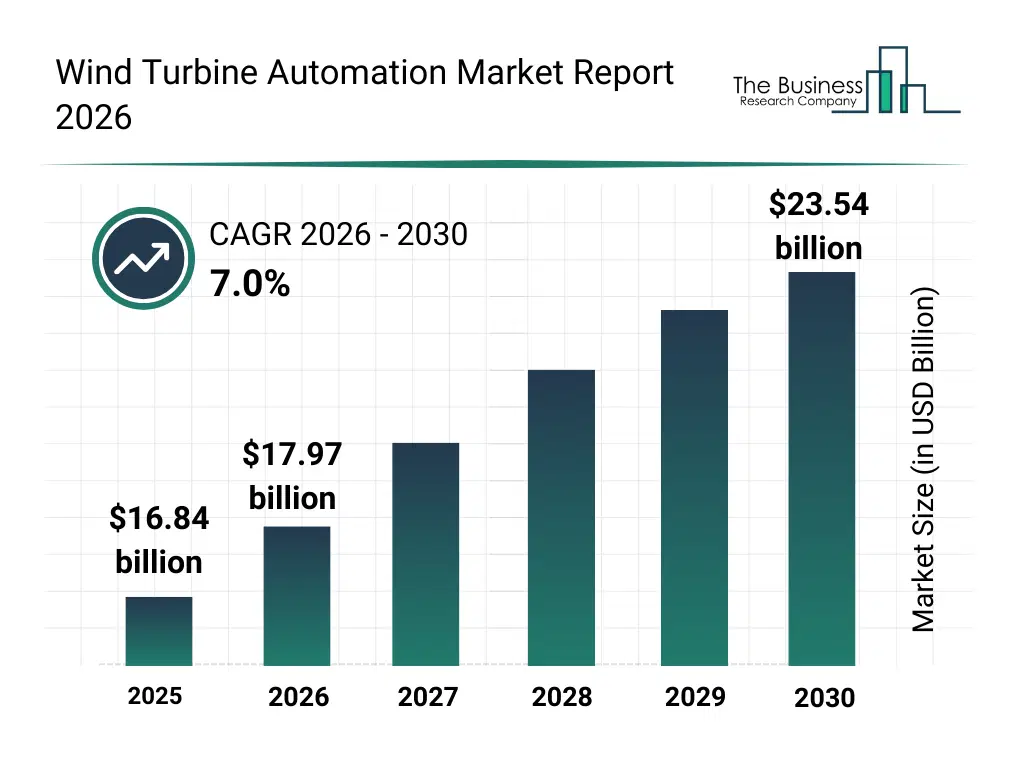
What Is The Wind Turbine Automation Market Size 2026 And Growth Rate?
The wind turbine automation market size has grown strongly in recent years. It will grow from $16.84 billion in 2025 to $17.97 billion in 2026 at a compound annual growth rate (CAGR) of 6.7%. The growth in the historic period can be attributed to growth in renewable energy installations, increasing demand for reliable turbine performance, early adoption of scada systems in wind farms, expansion of onshore turbine deployments, advancements in mechanical turbine control systems.What Is The Wind Turbine Automation Market Growth Forecast?
The wind turbine automation market size is expected to see strong growth in the next few years. It will grow to $23.54 billion in 2030 at a compound annual growth rate (CAGR) of 7.0%. The growth in the forecast period can be attributed to rising investment in offshore wind power generation, increasing shift toward autonomous turbine operations, growing demand for performance optimization technologies, expansion of large scale wind farm monitoring, advancements in condition based maintenance solutions. Major trends in the forecast period include rising adoption of automated blade pitch and power output optimization, growing use of iot enabled real time wind turbine monitoring systems, advancements in remote diagnostics and predictive maintenance, increasing integration of cloud based wind farm control platforms, expansion of intelligent automation for offshore and onshore turbines.
Global Wind Turbine Automation Market Segmentation
1) By System: Supervisory Control And Data Acquisition (SCADA) Systems, Programmable Logic Controllers (PLC) Systems, Distributed Control Systems (DCS), Condition Monitoring Systems (CMS), Other Systems 2) By Component: Hardware, Software, Services 3) By Application: Offshore Wind Power Generation, Onshore Wind Power Generation, Other Applications Subsegments: 1) By Supervisory Control And Data Acquisition (SCADA) Systems: Remote Monitoring, Data Acquisition, Data Storage And Reporting, Alarm And Event Management, Data Analytics 2) By Programmable Logic Controllers (PLC) Systems: Control And Automation Of Operations, Real-Time Monitoring And Diagnostics, Communication With SCADA, Fault Detection And Prevention, Performance Optimization 3) By Distributed Control Systems (DCS): Process Control, Safety Instrumented Systems, Network Integration, Remote Control And Monitoring, Performance Management 4) By Condition Monitoring Systems (CMS): Vibration Monitoring, Temperature Monitoring, Oil And Wear Particle Monitoring, Acoustic Monitoring, Power And Load Monitoring 5) By Other Systems: Human-Machine Interface (HMI) Systems, Energy Management Systems (EMS), Fault Detection And Diagnostics Systems, Load Shedding And Power Quality SystemsWhat Is The Driver Of The Wind Turbine Automation Market?
The increasing adoption of wind energy is expected to propel the growth of the wind turbine automation market going forward. Wind energy refers to the kinetic energy generated from the movement of air masses across the Earth's surface, primarily harnessed through wind turbines to produce electricity. The adoption of wind energy is increasing because of its sustainability and cost-effectiveness in renewable energy production. Wind turbine automation improves efficiency, reliability, and safety in turbine operations. It helps monitor, schedule maintenance, detect faults, and optimize turbine performance to increase energy production and reduce operational costs. For instance, in March 2025, the International Renewable Energy Agency, a UAE-based intergovernmental organization, reported that in 2024, wind power in the EU generated 475 TWh surpassing coal for the second year and providing over 27% of electricity highlighting the region’s clean energy growth. Therefore, the increasing adoption of wind energy is driving the growth of the wind turbine automation industry.Key Players In The Global Wind Turbine Automation Market
Major companies operating in the wind turbine automation market are Siemens AG, General Electric, Mitsubishi Electric Corporation, Schneider Electric SE, Honeywell International Inc., ABB Ltd., Eaton Corporation, Parker Hannifin Corporation, Vestas Wind Systems A/S, Emerson Electric Co., Danfoss, Rockwell Automation Inc., Nordex SE, Omron Corporation, Fanuc Corporation, Enercon GmbH, Yaskawa Electric Corporation, Yokogawa Electric Corporation, Moog Inc., Suzlon Energy Limited, Axiomtek, Bachmann electronic GmbH, Inox Wind, Prima Automation
This chart is for illustrative purposes; the full report includes a detailed competitor analysis and comprehensive overview of the top 10 companies in the market.
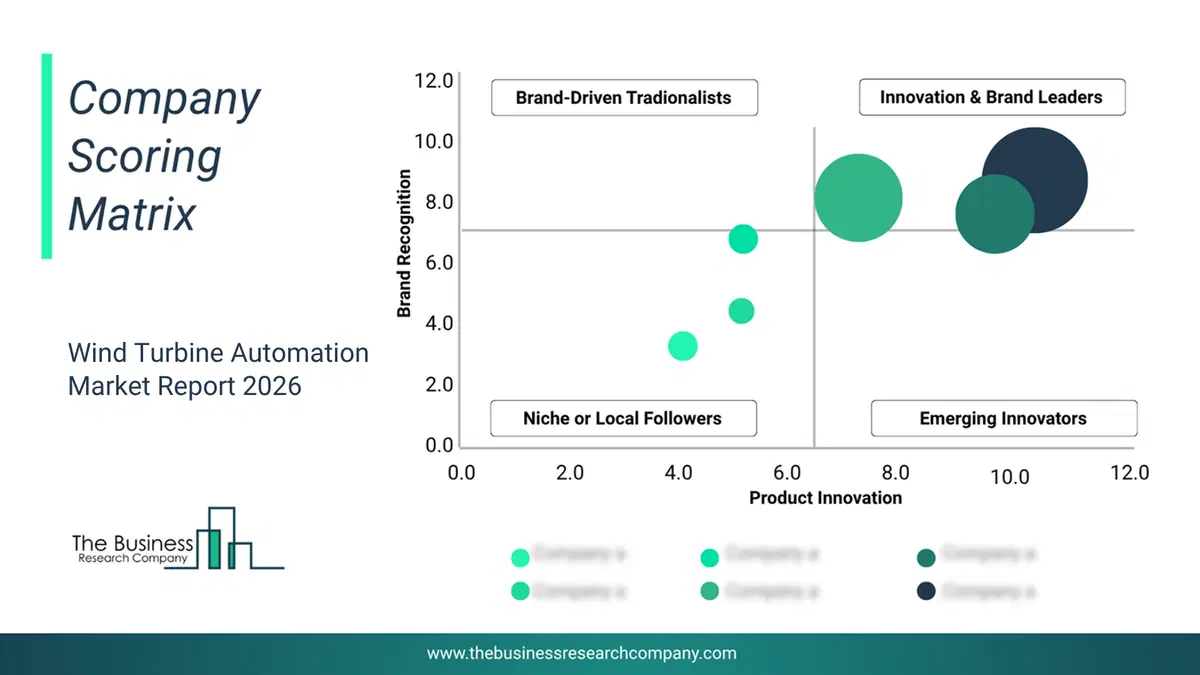
This chart maps companies by product innovation and brand strength, with bubble size indicating relative revenue, helping identify market leaders, challengers, and niche players. This is an illustrative chart; the full report provides a complete and accurate competitive analysis.
Global Wind Turbine Automation Market Trends and Insights
Major companies operating in the wind turbine automation market are focusing on strategic partnerships to develop new products and strengthen their positions in the market. A strategic alliance is a collaborative relationship between two or more entities, often organizations or businesses, that join forces to achieve mutual objectives or strategic goals. For instance, in September 2023, ABB Ltd., a Switzerland-based automation company, announced a partnership with WindESCo Inc., a US-based software company. The strategic alliance involves ABB acquiring a minority stake in WindESCo. ABB aims to enhance its wind energy portfolio by integrating WindESCo's digital solutions, thus improving turbine performance and reliability. WindESCo benefits from ABB's expertise and market presence to expand its offering in electrical system optimization. The partnership aims to provide end-to-end solutions to wind customers, enhance wind turbine performance and reliability, and open new market channels for digital offerings.What Are Latest Mergers And Acquisitions In The Wind Turbine Automation Market?
In September 2023, ABB Ltd., a Switzerland-based automation technology company acquired WindESCo for an undisclosed amount. The acquisition opens new market channels for ABB's digital offerings, allowing the company to reach a broader customer base in the growing wind energy sector. It positions ABB as a more competitive player in the renewable energy market. WindESCo is a US-based technology company that specializes in providing analytics software solutions that enhance the performance and reliability of wind turbines.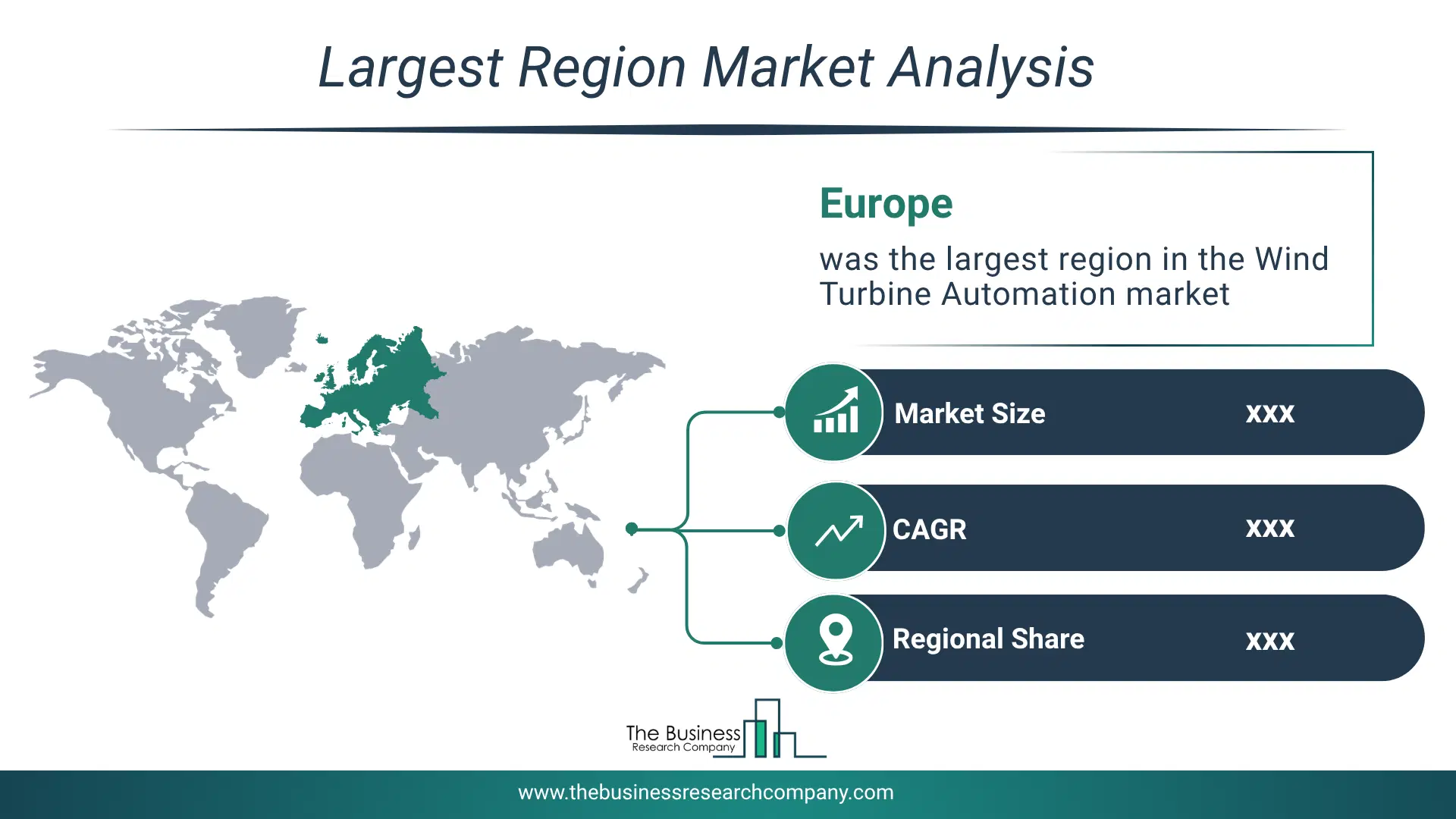
Regional Outlook
Europe was the largest region in the wind turbine automation market in 2025. North America is expected to be the fastest-growing region in the forecast period. The regions covered in this market report are Asia-Pacific, South East Asia, Western Europe, Eastern Europe, North America, South America, Middle East, Africa. The countries covered in this market report are Australia, Brazil, China, France, Germany, India, Indonesia, Japan, Taiwan, Russia, South Korea, UK, USA, Canada, Italy, Spain.What Defines the Wind Turbine Automation Market?
The wind turbine automation market consists of revenues earned by entities by providing services such as predictive analytics and maintenance services, remote monitoring and diagnostics services, and retrofit and upgrade services. The market value includes the value of related goods sold by the service provider or included within the service offering. The wind turbine automation market also includes sales of SCADA (Supervisory Control and Data Acquisition) systems, condition monitoring systems, and control systems and software that are used in providing the services. Values in this market are ‘factory gate’ values, that is, the value of goods sold by the manufacturers or creators of the goods, whether to other entities (including downstream manufacturers, wholesalers, distributors, and retailers) or directly to end customers. The value of goods in this market includes related services sold by the creators of the goods.How is Market Value Defined and Measured?
The market value is defined as the revenues that enterprises gain from the sale of goods and/or services within the specified market and geography through sales, grants, or donations in terms of the currency (in USD unless otherwise specified). The revenues for a specified geography are consumption values that are revenues generated by organizations in the specified geography within the market, irrespective of where they are produced. It does not include revenues from resales along the supply chain, either further along the supply chain or as part of other products.
This chart presents market attractiveness based on a quantitative evaluation of growth, competition, strategic alignment, and risk, offering a clear view of opportunity areas for decision-making. This chart is for illustrative purposes; the full report contains the complete analysis.

This chart highlights the Total Addressable Market (TAM) by estimating the maximum revenue opportunity using an assumption-driven approach, supporting strategic planning and opportunity sizing across markets. The chart is illustrative; the full report provides a more comprehensive analysis.
What Key Data and Analysis Are Included in the Wind Turbine Automation Market Report 2026?
The wind turbine automation market research report is one of a series of new reports from The Business Research Company that provides market statistics, including industry global market size, regional shares, competitors with the market share, detailed market segments, market trends and opportunities, and any further data you may need to thrive in the wind turbine automation industry. The market research report delivers a complete perspective of everything you need, with an in-depth analysis of the current and future state of the industry.Wind Turbine Automation Market Report Forecast Analysis
| Report Attribute | Details |
|---|---|
| Market Size Value In 2026 | $17.97 billion |
| Revenue Forecast In 2030 | $23.54 billion |
| Growth Rate | CAGR of 7% from 2026 to 2030 |
| Base Year For Estimation | 2025 |
| Actual Estimates/Historical Data | 2020-2025 |
| Forecast Period | 2026 - 2030 |
| Market Representation | Revenue in USD Billion and CAGR from 2026 to 2030 |
| Segments Covered | System, Component, Application |
| Regional Scope | Asia-Pacific, Western Europe, Eastern Europe, North America, South America, Middle East, Africa |
| Country Scope | The countries covered in the report are Australia, Brazil, China, France, Germany, India, Indonesia, Japan, Taiwan, Russia, South Korea, UK, USA, Canada, Italy, Spain. |
| Key Companies Profiled | Siemens AG, General Electric, Mitsubishi Electric Corporation, Schneider Electric SE, Honeywell International Inc., ABB Ltd., Eaton Corporation, Parker Hannifin Corporation, Vestas Wind Systems A/S, Emerson Electric Co., Danfoss, Rockwell Automation Inc., Nordex SE, Omron Corporation, Fanuc Corporation, Enercon GmbH, Yaskawa Electric Corporation, Yokogawa Electric Corporation, Moog Inc., Suzlon Energy Limited, Axiomtek, Bachmann electronic GmbH, Inox Wind, Prima Automation |
| Customization Scope | Request for Customization |
| Pricing And Purchase Options | Explore Purchase Options |