
Wine Blending Class Market Report 2026
Global Outlook – By Class Type (In Person Classes, Virtual Classes, Private Sessions, Group Sessions), By Age Group (Adults, Seniors, Youth), By Distribution Channel (Direct, Online Platform, Event Organizers, Wineries), By Application (Personal, Corporate, Educational, Hospitality), By End User (Individual Consumers, Corporate Groups, Tourists Or Travel Groups, Students And Wine Enthusiasts) – Market Size, Trends, Strategies, and Forecast to 2035
Wine Blending Class Market Overview
• Wine Blending Class market size has reached to $1.01 billion in 2025 • Expected to grow to $1.58 billion in 2030 at a compound annual growth rate (CAGR) of 9.3% • Growth Driver: Rise Of Wine Tourism Fueling The Growth Of The Market Due To Increasing Demand For Experiential And Interactive Wine Experiences • Market Trend: Integration Of Hands-on Blending Labs In Wine Education Services • North America was the largest region in 2025 and Asia-Pacific is the fastest growing region.What Is Covered Under Wine Blending Class Market?
A wine blending class is a guided experience where participants learn how to mix different wines to create their own unique blend. It is usually led by an expert who explains flavors, aromas, and blending techniques. Participants taste various wines and experiment with combinations. The main class types of wine blending class include in person classes, virtual classes, private sessions, and group sessions. In person classes refer to structured educational sessions conducted at wineries or training facilities where participants learn the art and science of blending different wines to create balanced flavors and aromas. They are categorized by age group including adults, seniors, and youth and are delivered through channels such as direct, online platform, event organizers, and wineries. They find application in personal, corporate, educational, and hospitality settings, serving end users including individual consumers, corporate groups, tourists or travel groups, and students and wine enthusiasts.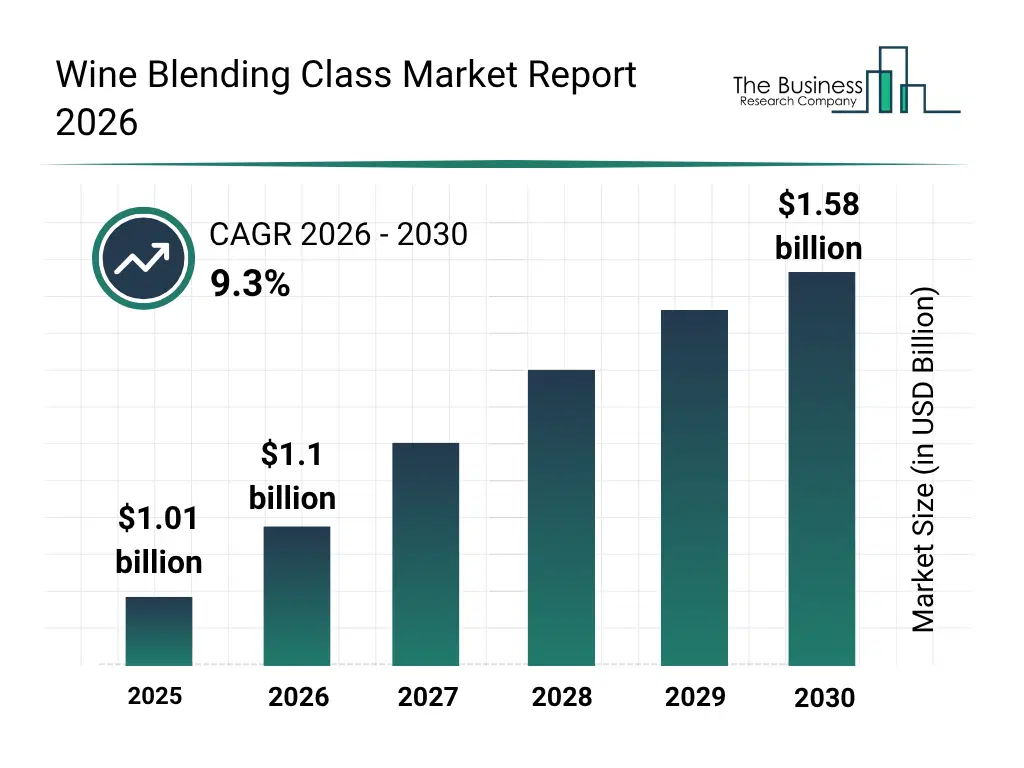
What Is The Wine Blending Class Market Size and Share 2026?
The wine blending class market size has grown strongly in recent years. It will grow from $1.01 billion in 2025 to $1.1 billion in 2026 at a compound annual growth rate (CAGR) of 9.1%. The growth in the historic period can be attributed to growth of wine tourism and vineyard experiences, rising consumer interest in premium alcoholic beverages, expansion of hospitality and leisure industry, traditional sommelier-led wine education programs, increasing popularity of experiential learning activities.What Is The Wine Blending Class Market Growth Forecast?
The wine blending class market size is expected to see strong growth in the next few years. It will grow to $1.58 billion in 2030 at a compound annual growth rate (CAGR) of 9.3%. The growth in the forecast period can be attributed to rising demand for experiential luxury tourism, growth of personalized and customized learning experiences, expansion of premium hospitality and event-based consumption, increasing disposable income among urban consumers, digital integration in beverage education and booking platforms. Major trends in the forecast period include experiential wine tourism and immersive tasting experiences adoption, rise of personalized wine blending and curated sensory education programs, increasing demand for premium hospitality-driven beverage workshops, growth of social and corporate team-building experiential learning sessions, expansion of hybrid digital and in-person wine education formats.
Global Wine Blending Class Market Segmentation
1) By Class Type: In Person Classes, Virtual Classes, Private Sessions, Group Sessions 2) By Age Group: Adults, Seniors, Youth 3) By Distribution Channel: Direct, Online Platform, Event Organizers, Wineries 4) By Application: Personal, Corporate, Educational, Hospitality 5) By End User: Individual Consumers, Corporate Groups, Tourists Or Travel Groups, Students And Wine Enthusiasts Subsegments: 1) By In Person Classes: Beginner Level Classes, Intermediate Level Classes, Advanced Level Classes, Sommelier Led Classes, Hands On Blending Workshops, Winery Hosted Classes 2) By Virtual Classes: Live Online Classes, Pre Recorded Classes, Interactive Blending Sessions, Subscription Based Classes, Expert Led Webinars 3) By Private Sessions: One On One Sessions, Couples Sessions; Corporate Private Sessions, Customized Curriculum Sessions, Luxury Experience Sessions 4) By Group Sessions: Corporate Team Building Sessions, Social Gathering Sessions, Educational Group Sessions, Wine Club Group Sessions, Tourist Group SessionsWhat Are The Drivers Of The Wine Blending Class Market?
The rise of wine tourism is expected to propel the growth of the wine blending class market going forward. Wine tourism refers to travel centered around experiencing wine, including visiting vineyards and wineries, participating in wine tastings, learning about wine production, and exploring regional wine culture, cuisine, and landscapes. The rise of wine tourism is due to increasing disposable income, enabling consumers to spend more on premium leisure experiences like vineyard visits and wine tastings. Wine blending classes support wine tourism by offering interactive, hands-on experiences that deepen visitor engagement and encourage travel to wine regions for immersive learning. For instance, in March 2026, according to the ICAEW,a UK-based professional membership organisation, data from WineGB shows that UK vineyards and wineries recorded 1.5 million visits in 2023, marking a 55% increase in visitor numbers compared to 2022, with wine tourism contributing 25% of total income. Therefore, the rise of wine tourism are driving the growth of the wine blending class industry. The growth of e-commerce platforms is expected to propel the growth of the wine blending class market going forward. E-commerce platforms refer to digital marketplaces and online channels that enable consumers to browse, purchase, and access products and services over the internet, including experiential offerings such as virtual classes and at-home kits. The growth of e-commerce platforms is driven by the growing preference for convenient, contactless purchasing experiences. Wine blending classes leverage e-commerce by offering online booking systems, virtual blending sessions, and home-delivered wine kits, enabling broader consumer reach beyond physical winery locations and enhancing accessibility for global participants. For instance, in March 2026, according to the Census Bureau, a US-based federal statistical agency, total e-commerce sales in 2025 were projected to reach $1,233.7 billion, representing a 5.4% increase (±1.2%) compared to 2024. Therefore, the growth of e-commerce platforms is driving the growth of the wine blending class industry.Key Players In The Global Wine Blending Class Market
Major companies operating in the wine blending class market are City Winery LLC, RD Winery Ltd., International Wine Center, Native Spirits Winery, Grape Vine Springs Winery, École du Vin de Bordeaux, Wine School of Philadelphia, Fine Vintage Ltd., San Francisco Wine School, Vino Bambino Winery, Wine Fusion Winery, Northstar Winery, The Wine Experience, Bennett Lane Winery, Blendtique Wine Company, The Wine House LLC, The Grape Experience Ltd., Cape Wine Academy, Wine U Design, The Blending Lab Winery.Global Wine Blending Class Market Trends and Insights
Major companies operating in the wine blending class market are focusing on developing immersive and interactive experiences, such as blending lab to enhance customer engagement, deepen wine knowledge, and create personalized offerings. A wine blending lab refers to a controlled setting where individuals experiment with combining different wine components to create customized blends with desired flavors, aromas, and characteristics. For instance, in September 2023, the Blending Lab, a US-based experiential wine company, introduced a new hands-on wine blending experience in San Luis Obispo, as highlighted by local tourism sources. Designed to provide an engaging and educational environment, the experience allows participants to sample different varietals, experiment with blending techniques, and craft personalized wines. It also emphasizes storytelling, sensory learning, and expert-led instruction to enhance understanding of flavor profiles and winemaking processes, thereby improving customer satisfaction and encouraging repeat participation.Regional Outlook/Insights
North America was the largest region in the wine blending class market in 2025. Asia-Pacific is expected to be the fastest-growing region in the forecast period. The regions covered in this market report are Asia-Pacific, South East Asia, Western Europe, Eastern Europe, North America, South America, Middle East, Africa. The countries covered in this market report are Australia, Brazil, China, France, Germany, India, Indonesia, Japan, Taiwan, Russia, South Korea, UK, USA, Canada, Italy, Spain.What Defines the Wine Blending Class Market?
The wine blending class market includes revenues earned by entities by providing services such as guided wine tasting sessions, hands-on blending workshops, sensory evaluation training, and educational instruction on grape varietals. The market value includes the value of related goods sold by the service provider or included within the service offering. Only goods and services traded between entities or sold to end consumers are included.How is Market Value Defined and Measured?
The market value is defined as the revenues that enterprises gain from the sale of goods and/or services within the specified market and geography through sales, grants, or donations in terms of the currency (in USD unless otherwise specified). The revenues for a specified geography are consumption values that are revenues generated by organizations in the specified geography within the market, irrespective of where they are produced. It does not include revenues from resales along the supply chain, either further along the supply chain or as part of other products.What Key Data and Analysis Are Included in the Wine Blending Class Market Report 2026?
The wine blending class market research report is one of a series of new reports from The Business Research Company that provides market statistics, including industry global market size, regional shares, competitors with the market share, detailed market segments, market trends and opportunities, and any further data you may need to thrive in the wine blending class industry. The market research report delivers a complete perspective of everything you need, with an in-depth analysis of the current and future state of the industry.Wine Blending Class Market Report Forecast Analysis
| Report Attribute | Details |
|---|---|
| Market Size Value In 2026 | $1.1 billion |
| Revenue Forecast In 2035 | $1.58 billion |
| Growth Rate | CAGR of 9.3% from 2026 to 2035 |
| Base Year For Estimation | 2025 |
| Actual Estimates/Historical Data | 2020-2025 |
| Forecast Period | 2026 - 2030 - 2035 |
| Market Representation | Revenue in USD Billion and CAGR from 2026 to 2035 |
| Segments Covered | Class Type, Age Group, Distribution Channel, Application, End User |
| Regional Scope | Asia-Pacific, Western Europe, Eastern Europe, North America, South America, Middle East, Africa |
| Country Scope | The countries covered in the report are Australia, Brazil, China, France, Germany, India, Indonesia, Japan, Taiwan, Russia, South Korea, UK, USA, Canada, Italy, Spain. |
| Key Companies Profiled | City Winery LLC, RD Winery Ltd., International Wine Center, Native Spirits Winery, Grape Vine Springs Winery, École du Vin de Bordeaux, Wine School of Philadelphia, Fine Vintage Ltd., San Francisco Wine School, Vino Bambino Winery, Wine Fusion Winery, Northstar Winery, The Wine Experience, Bennett Lane Winery, Blendtique Wine Company, The Wine House LLC, The Grape Experience Ltd., Cape Wine Academy, Wine U Design, The Blending Lab Winery. |
| Customization Scope | Request for Customization |
| Pricing And Purchase Options | Explore Purchase Options |