

Wireless Healthcare Market Report 2026
Global Outlook – By Technology (Wireless Personal Area Network (WPAN), Worldwide Interoperability For Microwave Access (WiMAX), Wi-Fi, Wireless Wide Area Network (WWAN)), By Component (Hardware, Software, Services), By Application (Patient Specific, Provider Specific), By End-User (Providers, Payers, Patients Or Individuals) – Market Size, Trends, Strategies, and Forecast to 2030
Wireless Healthcare Market Overview
• Wireless Healthcare market size has reached to $234.2 billion in 2025 • Expected to grow to $621.14 billion in 2030 at a compound annual growth rate (CAGR) of 21.5% • Growth Driver: Remote Access To Healthcare Via Mobile Phones Drives Wireless Healthcare Market Growth • Market Trend: Innovative Portable Wireless Healthcare Devices • Asia-Pacific was the largest region and fastest growing region.What Is Covered Under Wireless Healthcare Market?
Wireless healthcare refers to the integration of wireless technology into traditional medicine, such as diagnosis, monitoring, and treatment of illness, as well as other tools that can help individuals improve their personal health and wellbeing. Wireless healthcare ensures the accuracy of real-time documentation, reduces costs for consumers, provides access to real-time patient records, and enables real-time monitoring of patients' conditions even from a remote location. The main types of technologies for wireless healthcare include Wireless Personal Area Network (WPAN), Worldwide Interoperability for Microwave Access (WiMAX), Wi-Fi, and Wireless Wide Area Network (WWAN). Components of wireless healthcare include hardware, software, and services. A Wireless Personal Area Network (WPAN) is used to convey information over short distances among a private, intimate group of participant devices. It is a network for interconnecting devices centered around an individual person's workspace in which the connections are wireless, and the kind of network may rely on technologies such as Ultra-Wide Band (UWB), Bluetooth, or ZigBee. The major applications of wireless healthcare are patient-specific and provider-specific. The major end users associated with wireless healthcare are providers, payers, and patients.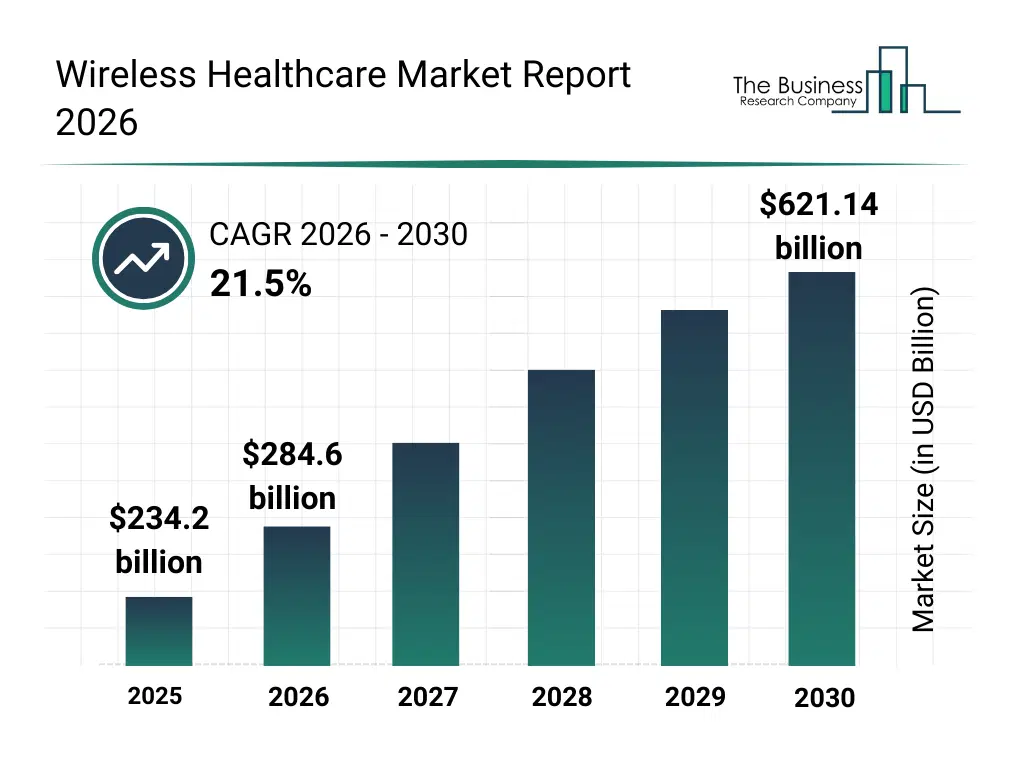
What Is The Wireless Healthcare Market Size and Share 2026?
The wireless healthcare market size has grown exponentially in recent years. It will grow from $234.2 billion in 2025 to $284.6 billion in 2026 at a compound annual growth rate (CAGR) of 21.5%. The growth in the historic period can be attributed to growing adoption of electronic health records, rising prevalence of chronic diseases, expansion of mobile health applications, increasing healthcare digitization initiatives, early deployment of wireless medical sensors.What Is The Wireless Healthcare Market Growth Forecast?
The wireless healthcare market size is expected to see exponential growth in the next few years. It will grow to $621.14 billion in 2030 at a compound annual growth rate (CAGR) of 21.5%. The growth in the forecast period can be attributed to increasing demand for home-based healthcare monitoring, rising investments in connected healthcare infrastructure, expansion of 5G-enabled medical applications, growing focus on real-time clinical decision support, increasing adoption of AI-enabled wireless diagnostics. Major trends in the forecast period include increasing adoption of remote patient monitoring solutions, rising use of wireless wearable medical devices, growing integration of real-time health data platforms, expansion of telehealth and virtual care models, enhanced focus on continuous patient connectivity.
Global Wireless Healthcare Market Segmentation
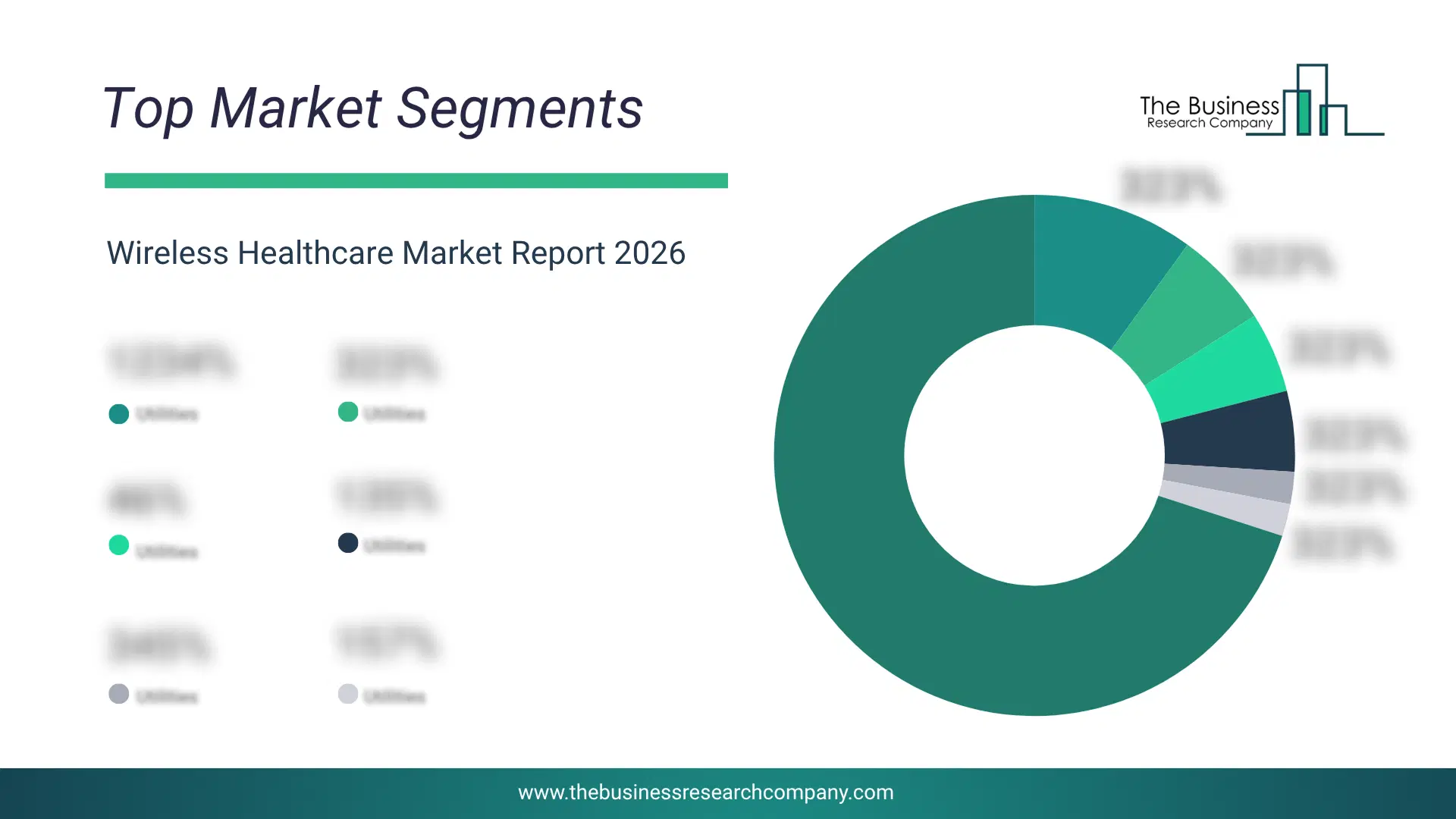
1) By Technology: Wireless Personal Area Network (WPAN), Worldwide Interoperability For Microwave Access (WiMAX), Wi-Fi, Wireless Wide Area Network (WWAN) 2) By Component: Hardware, Software, Services 3) By Application: Patient Specific, Provider Specific 4) By End-User: Providers, Payers, Patients Or Individuals Subsegments: 1) By Wireless Personal Area Network (WPAN): Bluetooth Technology, Zigbee Technology 2) By Worldwide Interoperability For Microwave Access (WiMAX): Fixed WiMAX, Mobile WiMAX 3) By Wi-Fi: Wi-Fi 5 (802.11ac), Wi-Fi 6 (802.11ax) 4) By Wireless Wide Area Network (WWAN): 4G LTE, 5G TechnologyWhat Is The Driver Of The Wireless Healthcare Market?
The rising demand for remote access to healthcare via mobile phones is a major driver of the wireless healthcare market. Remote access to healthcare services via mobile phones ensures cost benefits of telehealth as less equipment is required, and it also enhances the benefits of remote patient monitoring (RPM) to reduce the burden on medical professionals. The use of smartphones also enables doctors to view patients' documents and records. For instance, in August 2024, according to The Health Foundation, a UK-based charitable organization, In the 2023 Commonwealth Fund survey, the UK and Australia emerged as the leaders among the surveyed countries in utilizing remote consultations for primary care. Approximately 37% of participants in the UK reported having access to some form of remote virtual care or telehealth in the past year. Thus, the increase in demand for remote access to healthcare via mobile phones is driving the wireless healthcare industry growth.Key Players In The Global Wireless Healthcare Market
Major companies operating in the wireless healthcare market are AT&T Inc.; Allscripts Healthcare Solutions Inc.; Cerner Corporation; Omron Corporation; Koninklijke Philips N.V.; Verizon Communications Inc.; Qualcomm Inc.; Vocera Communications Inc.; Alcatel-Lucent Enterprise; Cisco Systems Inc.; Motorola Solutions Inc.; Healthcare Solutions Inc.; Aerohive Networks Inc.; GE Healthcare Technologies Inc.; Polar Electro Oy; Nihon Kohden Corporation; Siemens AG; Athenahealth Inc.; International Business Machines Corporation; Medtronic plc; Boston Scientific Corporation; HCA Healthcare Inc.; Tenet Healthcare Corporation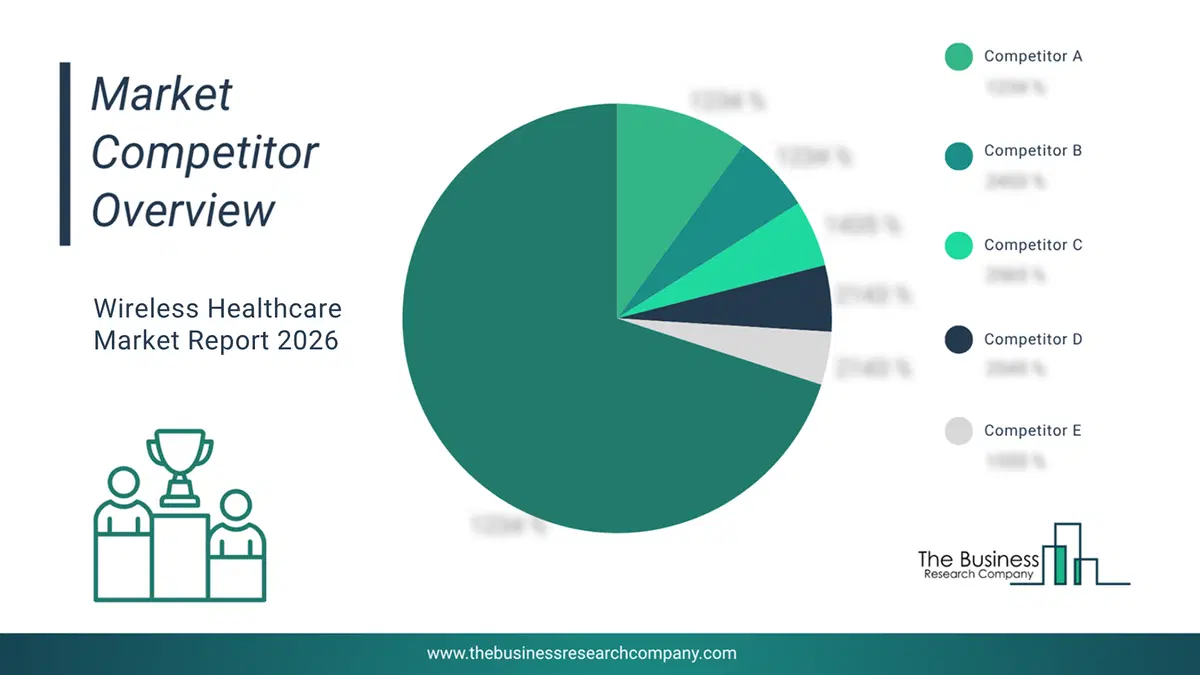
This chart is for illustrative purposes; the full report includes a detailed competitor analysis and comprehensive overview of the top 10 companies in the market.
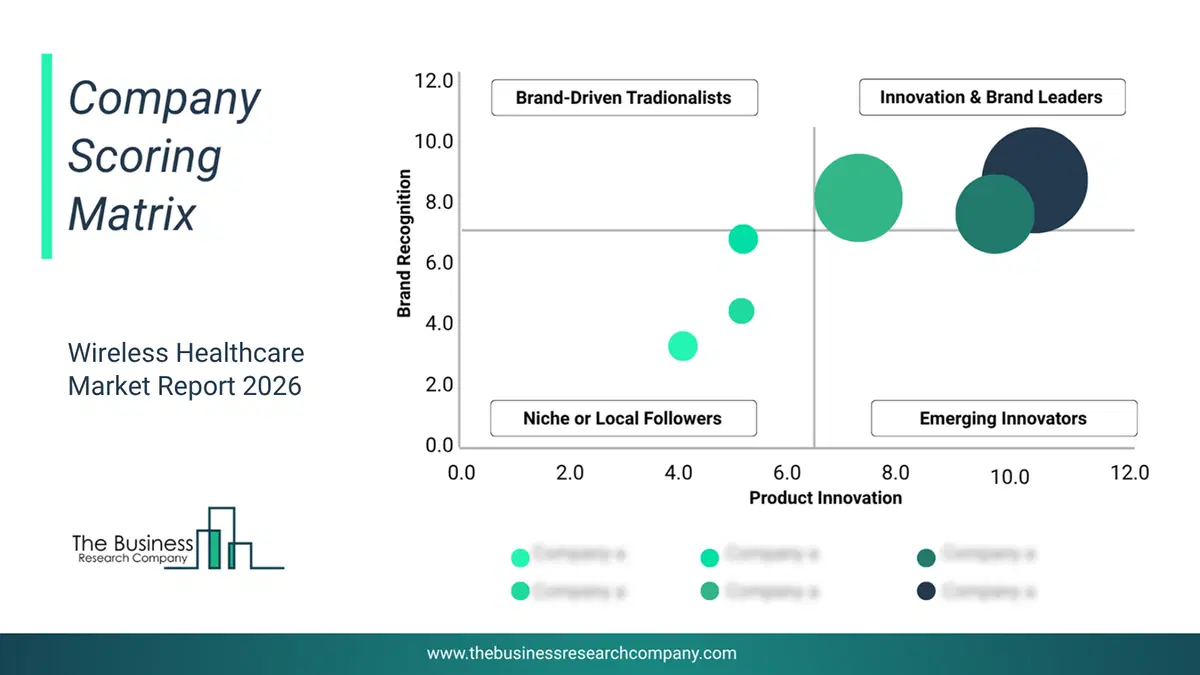
This chart maps companies by product innovation and brand strength, with bubble size indicating relative revenue, helping identify market leaders, challengers, and niche players. This is an illustrative chart; the full report provides a complete and accurate competitive analysis.
Global Wireless Healthcare Market Trends and Insights
Major companies operating in the wireless healthcare market are increasing their focus on introducing portable wireless healthcare devices to gain a competitive edge in the market. Portable wireless healthcare devices are compact, mobile instruments equipped with wireless connectivity that enable remote monitoring and tracking of health parameters and data. For instance, in August 2023, GE HealthCare, a US-based medical technology company, launched Vscan Air SL, a wireless, handheld ultrasound imaging system. The device is portable and wireless, allowing clinicians to efficiently collect and view crystal-clear cardiac and vascular images at the point of care. The Vscan Air SL incorporates GE Healthcare's proprietary SignalMax and XDclear technologies, which deliver high levels of penetration, resolution, and sensitivity in imaging performance.What Are Latest Mergers And Acquisitions In The Wireless Healthcare Market?
In April 2023, TSC Connected Care, a UK-based company, acquired Connected Health Group for an undisclosed amount. This acquisition is expected to enable TSC Connected Care to provide a more comprehensive range of digital health solutions to its customers and enhance its ability to connect patients and clinicians over the entire continuum of care. Connected Health Group is an Ireland-based company specializing in providing health care services, including wireless healthcare.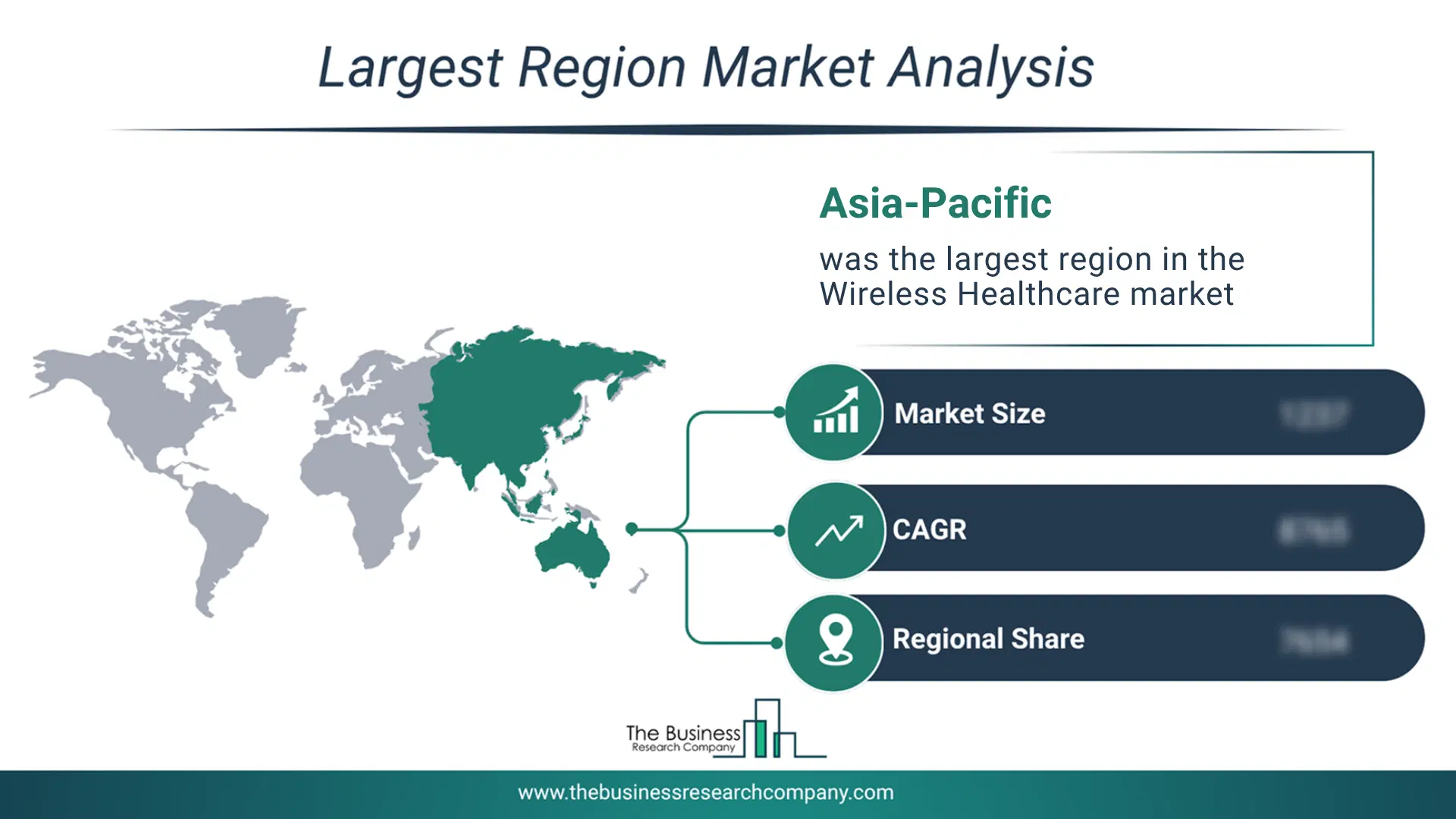
Regional Insights
Asia-Pacific was the largest region in the wireless healthcare market in 2025. Asia-Pacific is expected to be the fastest-growing region in the forecast period. The regions covered in this market report are Asia-Pacific, South East Asia, Western Europe, Eastern Europe, North America, South America, Middle East, Africa. The countries covered in this market report are Australia, Brazil, China, France, Germany, India, Indonesia, Japan, Taiwan, Russia, South Korea, UK, USA, Canada, Italy, SpainWhat Defines the Wireless Healthcare Market?
The wireless healthcare market includes revenues earned by entities by facilitating the delivery of health care with wireless RF communication technologies including Wi-Fi, Bluetooth, and cellular/mobile phones. The market value includes the value of related goods sold by the service provider or included within the service offering. Only goods and services traded between entities or sold to end consumers are included.How is Market Value Defined and Measured?
The market value is defined as the revenues that enterprises gain from the sale of goods and/or services within the specified market and geography through sales, grants, or donations in terms of the currency (in USD unless otherwise specified). The revenues for a specified geography are consumption values that are revenues generated by organizations in the specified geography within the market, irrespective of where they are produced. It does not include revenues from resales along the supply chain, either further along the supply chain or as part of other products.
This chart presents market attractiveness based on a quantitative evaluation of growth, competition, strategic alignment, and risk, offering a clear view of opportunity areas for decision-making. This chart is for illustrative purposes; the full report contains the complete analysis.

This chart highlights the Total Addressable Market (TAM) by estimating the maximum revenue opportunity using an assumption-driven approach, supporting strategic planning and opportunity sizing across markets. The chart is illustrative; the full report provides a more comprehensive analysis.
What Key Data and Analysis Are Included in the Wireless Healthcare Market Report 2026?
The wireless healthcare market research report is one of a series of new reports from The Business Research Company that provides market statistics, including industry global market size, regional shares, competitors with the market share, detailed market segments, market trends and opportunities, and any further data you may need to thrive in the wireless healthcare industry. The market research report delivers a complete perspective of everything you need, with an in-depth analysis of the current and future state of the industry.Wireless Healthcare Market Report Forecast Analysis
| Report Attribute | Details |
|---|---|
| Market Size Value In 2026 | $284.6 billion |
| Revenue Forecast In 2030 | $621.14 billion |
| Growth Rate | CAGR of 21.5% from 2026 to 2030 |
| Base Year For Estimation | 2025 |
| Actual Estimates/Historical Data | 2020-2025 |
| Forecast Period | 2026 - 2030 |
| Market Representation | Revenue in USD Billion and CAGR from 2026 to 2030 |
| Segments Covered | Technology, Component, Application, End-User |
| Regional Scope | Asia-Pacific, Western Europe, Eastern Europe, North America, South America, Middle East, Africa |
| Country Scope | The Countries Covered In This Market Report Are Australia, Brazil, China, France, Germany, India, Indonesia, Japan, Taiwan, Russia, South Korea, Uk, Usa, Canada, Italy, Spain. |
| Key Companies Profiled | AT&T Inc., Allscripts Healthcare Solutions Inc., Cerner Corporation, Omron Corporation, Koninklijke Philips N.V., Verizon Communications Inc., Qualcomm Inc., Vocera Communications Inc., Alcatel-Lucent Enterprise, Cisco Systems Inc., Motorola Solutions Inc., Healthcare Solutions Inc., Aerohive Networks Inc., GE Healthcare Technologies Inc., Polar Electro Oy, Nihon Kohden Corporation, Siemens AG, Athenahealth Inc., International Business Machines Corporation, Medtronic plc, Boston Scientific Corporation, HCA Healthcare Inc., Tenet Healthcare Corporation |
| Customization Scope | Request for Customization |
| Pricing And Purchase Options | Explore Purchase Options |