

Wireless Intrusion Prevention System Market Report 2026
Global Outlook – By Component (Hardware, Software, Services), By Deployment (On-Premises, Cloud-Based, Hybrid), By Organization Size (Small and Medium Enterprises, Large Enterprises), By End User Verticals (Banking, Financial Services, and Insurance (BFSI), Healthcare, Retail, Government, Information Technology (IT) And Telecommunications, Manufacturing, Other End User Verticals) – Market Size, Trends, Strategies, and Forecast to 2030
Wireless Intrusion Prevention System Market Overview
• Wireless Intrusion Prevention System market size has reached to $4.29 billion in 2025 • Expected to grow to $7.92 billion in 2030 at a compound annual growth rate (CAGR) of 13.1% • Growth Driver: Surge In Cybersecurity Threats Driving The Growth Of The Market Due To Increasing Vulnerabilities In Wireless Networks • Market Trend: Advanced Wireless Intrusion Alarm Systems Enhance Real-Time Threat Detection And Security Automation • North America was the largest region in 2025 and Asia-Pacific is the fastest growing region.What Is Covered Under Wireless Intrusion Prevention System Market?
A wireless intrusion prevention system is a security solution designed to monitor, detect, and automatically prevent unauthorized access and malicious activity within wireless networks. It continuously scans radio frequencies to identify rogue access points, suspicious devices, and policy violations in real time. By enforcing security policies and blocking potential threats, WIPS helps maintain the integrity, confidentiality, and availability of wireless communications. The main components of wireless intrusion prevention system include hardware, software, and services. Hardware refers to physical devices and network appliances used to detect, monitor, and prevent unauthorized wireless access or malicious activity across wireless networks. These are deployed through on-premises, cloud-based, and hybrid models. They are adopted by small and medium enterprises and large enterprises and are used across end user verticals including banking, financial services, and insurance (BFSI), healthcare, retail, government, information technology (IT) and telecommunications, manufacturing, and other end user verticals.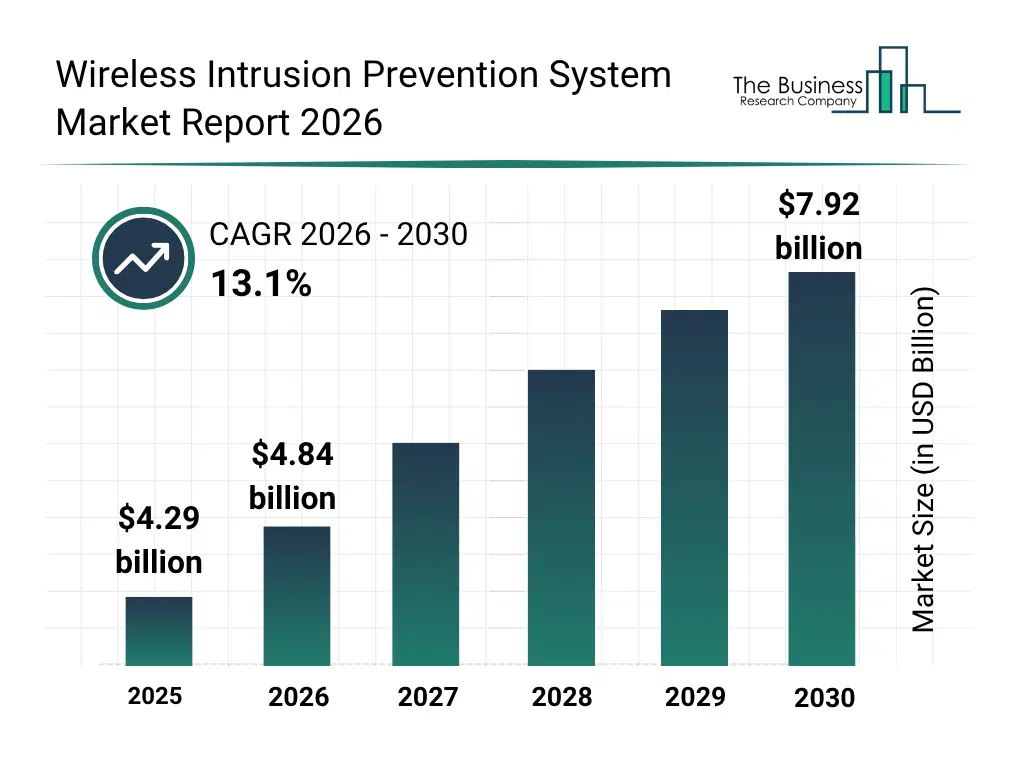
What Is The Wireless Intrusion Prevention System Market Size and Share 2026?
The wireless intrusion prevention system market size has grown rapidly in recent years. It will grow from $4.29 billion in 2025 to $4.84 billion in 2026 at a compound annual growth rate (CAGR) of 12.9%. The growth in the historic period can be attributed to increasing wireless network adoption, rising security threats in enterprises, growing regulatory compliance requirements, adoption of on-premises WIPS solutions, increasing demand for network monitoring and protection.What Is The Wireless Intrusion Prevention System Market Growth Forecast?
The wireless intrusion prevention system market size is expected to see rapid growth in the next few years. It will grow to $7.92 billion by 2030 at a compound annual growth rate (CAGR) of 13.1%. The growth in the forecast period can be attributed to growing deployment of cloud-based WIPS, rising AI-driven threat detection adoption, expansion of hybrid WIPS deployment models, increasing managed security services, rising integration with IoT and industrial networks. Major trends in the forecast period include increasing adoption of cloud-based wips solutions, rising demand for ai/ml-based anomaly detection, growing integration of rf spectrum analysis tools, expansion of managed wips services, rising focus on real-time threat detection and response.
Global Wireless Intrusion Prevention System Market Segmentation
1) By Component: Hardware, Software, Services 2) By Deployment: On-Premises, Cloud-Based, Hybrid 3) By Organization Size: Small and Medium Enterprises, Large Enterprises 4) By End User Verticals: Banking, Financial Services, And Insurance (BFSI), Healthcare, Retail, Government, Information Technology (IT) And Telecommunications, Manufacturing, Other End User Verticals Subsegments: 1) By Hardware: Sensors, Access Points With Integrated Wireless Intrusion Prevention System, Dedicated Wireless Intrusion Prevention System Appliances, Wireless Controllers, Antennas And RF Scanning Devices, Network Interface And Signal Capture Devices 2) By Software: Wireless Intrusion Prevention System Management Software, Threat Detection And Signature Analysis Software, RF Spectrum Analysis Software, Policy Management And Configuration Software, Reporting And Analytics Software, Cloud-Based Wireless Intrusion Prevention System Platforms, AI/ML-Based Anomaly Detection Software 3) By Services: Consulting And Risk Assessment Services, Deployment And Integration Services, Managed WIPS Services, Support And Maintenance Services, Training And Education Services, Security Monitoring And Incident Response Services, Compliance And Audit ServicesWhat Are The Drivers Of The Wireless Intrusion Prevention System Market?
The rising cybersecurity threats in wireless networks are expected to propel the growth of the wireless intrusion prevention system market going forward. Cybersecurity threats refer to malicious activities or attacks that target computer systems, networks, or data to gain unauthorized access, cause damage, or disrupt operations. The rise in cybersecurity threats in wireless networks is driven by the rapid increase in connected devices, as more endpoints create additional entry points for unauthorized access and network attacks. A wireless intrusion prevention system helps in addressing cybersecurity threats in wireless networks by continuously monitoring wireless traffic, detecting unauthorized devices and malicious activities, and automatically blocking potential attacks before they compromise network security. For instance, in March 2024, according to the Federal Bureau of Investigation's Internet Crime Complaint Center (IC3), a US-based government agency that serves as the central hub for reporting cybercrime to the FBI, ransomware incidents rose from 2,385 complaints in 2022 to 2,825 complaints in 2023, representing an 18% increase. Therefore, rising cybersecurity threats in wireless networks are driving the growth of the wireless intrusion prevention system industry. The proliferation of IoT devices is expected to propel the growth of the wireless intrusion prevention system market going forward. IoT devices are interconnected physical objects embedded with sensors, software, and network connectivity that enable them to collect and exchange data over wireless networks. The rise in proliferation of IoT devices is driven by the growing adoption of smart homes, industrial automation, and connected infrastructure, which increases the number of wireless endpoints connected to enterprise and consumer networks. Wireless intrusion prevention systems help IoT environments by monitoring wireless traffic, detecting unauthorized access points, and preventing malicious activities that could compromise connected devices and networks. For instance, in November 2025, according to the Office of Communications, a UK-based government agency, the number of active IoT devices in the UK increased from 24.9 million in 2023 to 26.5 million in 2024 and is projected to reach 27.7 million in 2025. Therefore, the proliferation of IoT devices is driving the growth of the wireless intrusion prevention system industry.Key Players In The Global Wireless Intrusion Prevention System Market
Major companies operating in the wireless intrusion prevention system market are Dell Technologies Inc., Huawei Technologies Co. Ltd., Cisco Systems Inc., Palo Alto Networks Inc., Arista Networks Inc, Keysight Technologies Inc., Fortinet Inc., Check Point Software Technologies Ltd., Ubiquiti Inc., Extreme Networks Inc., Sangfor Technologies Inc., Zyxel Communications Corp, Kaspersky Lab, Bitdefender, WatchGuard Technologies, Cambium Networks Corporation, D-Link Corporation, Hillstone Networks Co. Ltd., Venustech Group Inc., Topsec Technologies Group Inc.
This chart is for illustrative purposes; the full report includes a detailed competitor analysis and comprehensive overview of the top 10 companies in the market.
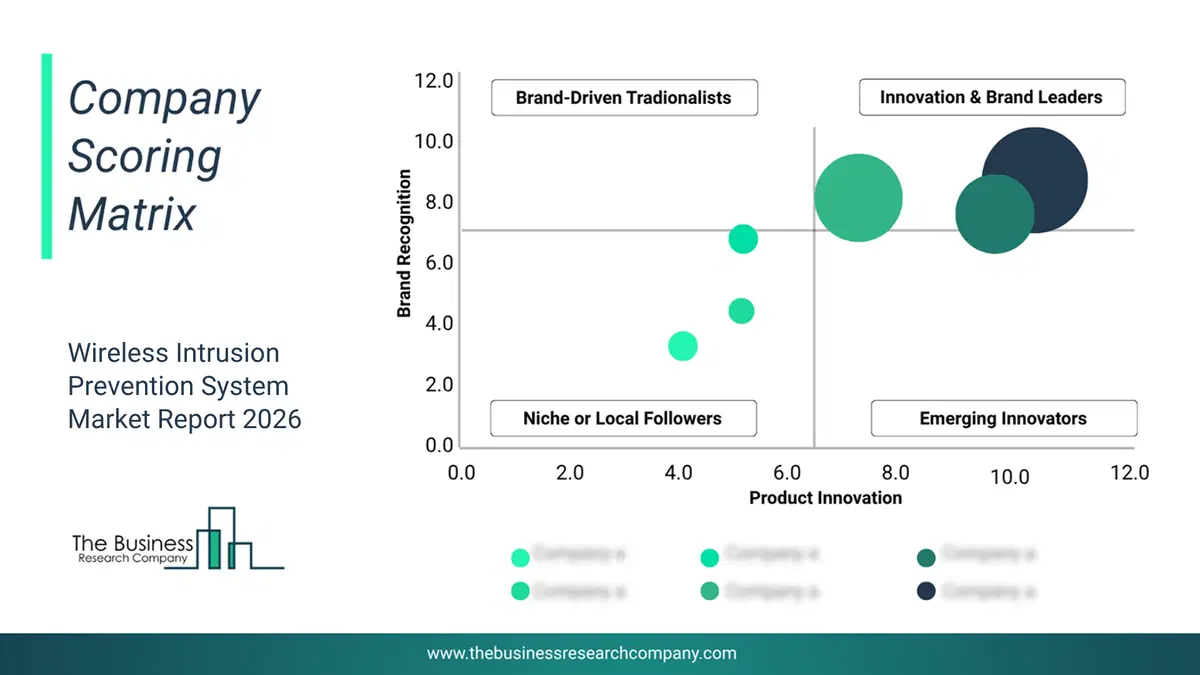
This chart maps companies by product innovation and brand strength, with bubble size indicating relative revenue, helping identify market leaders, challengers, and niche players. This is an illustrative chart; the full report provides a complete and accurate competitive analysis.
Global Wireless Intrusion Prevention System Market Trends and Insights
Major companies operating in the wireless intrusion prevention systems market are focusing on developing advanced solutions, such as integrated wireless alarm systems, to enhance real-time intrusion detection, improve system reliability, and enable smart automation capabilities. Integrated wireless alarm systems combine intrusion detection with wireless communication technologies to ensure seamless monitoring and rapid threat response. For instance, in March 2023, Hikvision India, an India-based provider of CCTV and security solutions, launched the AX PRO Series Wireless Intrusion Alarm System, designed to deliver more reliable intrusion detection with enhanced connectivity and home automation features. The system integrates multiple wireless detectors, supports long-range communication, and offers real-time alerts through mobile applications, enabling improved security management across residential and commercial environments.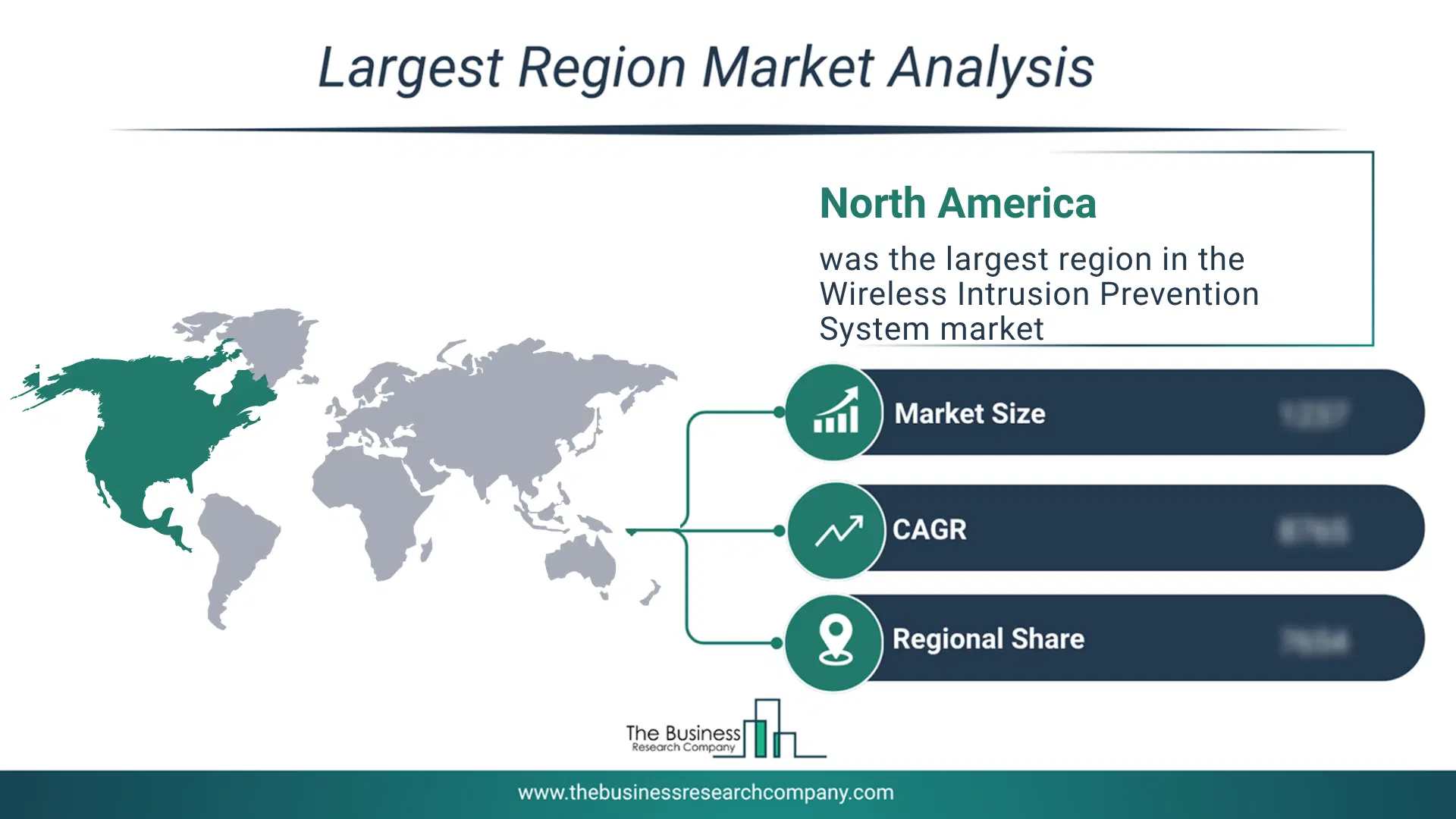
Regional Insights
North America was the largest region in the wireless intrusion prevention system market in 2025. Asia-Pacific is expected to be the fastest-growing region in the forecast period. The regions covered in this market report are Asia-Pacific, South East Asia, Western Europe, Eastern Europe, North America, South America, Middle East, Africa. The countries covered in this market report are Australia, Brazil, China, France, Germany, India, Indonesia, Japan, Taiwan, Russia, South Korea, UK, USA, Canada, Italy, Spain.What Defines the Wireless Intrusion Prevention System Market?
The wireless intrusion prevention system market consists of revenues earned by entities by providing services such as real-time rogue device detection, wireless network vulnerability assessment, policy enforcement and compliance monitoring, incident response and threat mitigation. The market value includes the value of related hardware and software products sold by the service provider or included within the service offering. The wireless intrusion prevention system market also includes sales of wireless sensors, intrusion detection appliances, management consoles, antennas, and signal analyzers. Values in this market are ‘factory gate’ values, representing the value of goods sold by manufacturers or creators of the products, whether to other entities (including downstream manufacturers, wholesalers, distributors, and retailers) or directly to customers. The value of goods in this market includes related services sold by the creators of the goods.How is Market Value Defined and Measured?
The market value is defined as the revenues that enterprises gain from the sale of goods and/or services within the specified market and geography through sales, grants, or donations in terms of the currency (in USD unless otherwise specified). The revenues for a specified geography are consumption values that are revenues generated by organizations in the specified geography within the market, irrespective of where they are produced. It does not include revenues from resales along the supply chain, either further along the supply chain or as part of other products.
This chart presents market attractiveness based on a quantitative evaluation of growth, competition, strategic alignment, and risk, offering a clear view of opportunity areas for decision-making. This chart is for illustrative purposes; the full report contains the complete analysis.

This chart highlights the Total Addressable Market (TAM) by estimating the maximum revenue opportunity using an assumption-driven approach, supporting strategic planning and opportunity sizing across markets. The chart is illustrative; the full report provides a more comprehensive analysis.
What Key Data and Analysis Are Included in the Wireless Intrusion Prevention System Market Report 2026?
The wireless intrusion prevention system market research report is one of a series of new reports from The Business Research Company that provides market statistics, including industry global market size, regional shares, competitors with the market share, detailed market segments, market trends and opportunities, and any further data you may need to thrive in the wireless intrusion prevention system industry. The market research report delivers a complete perspective of everything you need, with an in-depth analysis of the current and future state of the industry.Wireless Intrusion Prevention System Market Report Forecast Analysis
| Report Attribute | Details |
|---|---|
| Market Size Value In 2026 | $4.84 billion |
| Revenue Forecast In 2030 | $7.92 billion |
| Growth Rate | CAGR of 13.1% from 2026 to 2030 |
| Base Year For Estimation | 2025 |
| Actual Estimates/Historical Data | 2020-2025 |
| Forecast Period | 2026 - 2030 |
| Market Representation | Revenue in USD Billion and CAGR from 2026 to 2030 |
| Segments Covered | Component, Deployment, Organization Size, End User Verticals |
| Regional Scope | Asia-Pacific, Western Europe, Eastern Europe, North America, South America, Middle East, Africa |
| Country Scope | The Countries Covered In This Market Report Are Australia, Brazil, China, France, Germany, India, Indonesia, Japan, Taiwan, Russia, South Korea, Uk, Usa, Canada, Italy, Spain. |
| Key Companies Profiled | Dell Technologies Inc., Huawei Technologies Co. Ltd., Cisco Systems Inc., Palo Alto Networks Inc., Arista Networks Inc, Keysight Technologies Inc., Fortinet Inc., Check Point Software Technologies Ltd., Ubiquiti Inc., Extreme Networks Inc., Sangfor Technologies Inc., Zyxel Communications Corp, Kaspersky Lab, Bitdefender, WatchGuard Technologies, Cambium Networks Corporation, D-Link Corporation, Hillstone Networks Co. Ltd., Venustech Group Inc., Topsec Technologies Group Inc. |
| Customization Scope | Request for Customization |
| Pricing And Purchase Options | Explore Purchase Options |