
Wireless Power Transfer For Electric Vehicles (EV) Charging Market Report 2026
Global Outlook – By Technology ( Inductive Charging, Resonant Inductive Charging, Capacitive Charging, Other Technologies), By Power Supply Range ( Low Power, Medium Power, High Power), By Application ( Private Vehicles, Public Transport, Commercial Vehicles, Other Applications), By End-User ( Private, Public, Fleet) – Market Size, Trends, Strategies, and Forecast to 2030
Wireless Power Transfer For Electric Vehicles (EV) Charging Market Overview
• Wireless Power Transfer For Electric Vehicles (EV) Charging market size has reached to $1.2 billion in 2025 • Expected to grow to $4.39 billion in 2030 at a compound annual growth rate (CAGR) of 29.6% • Growth Driver: The Rise In Electric Vehicle Adoption Driving The Growth Of The Market Due To Increasing Environmental Awareness • Market Trend: Innovative Inductive Charging System Enables Convenient, Cable-Free Electric Vehicles Charging With High Efficiency And Enhanced Safety • North America was the largest region in 2025 and Asia-Pacific is the fastest growing region.What Is Covered Under Wireless Power Transfer For Electric Vehicles (EV) Charging Market?
Wireless power transfer for electric vehicles (EV) charging refers to a technology that allows electric vehicles to be charged without physical cables by transferring electrical energy through electromagnetic fields. This method enables convenient, contactless charging, enhancing user experience and reducing wear on connectors. The main technologies of wireless power transfer for electric vehicle (EV) charging are inductive charging, resonant inductive charging, capacitive charging, and other technologies. Inductive charging refers to a technology that wirelessly transfers electrical energy from a charging pad to an EV using magnetic fields, enabling cable-free and convenient vehicle charging. It is available in low-power, medium-power, and high-power ranges. These are used in various applications such as private vehicles, public transport, commercial vehicles, and other applications, serving diverse end users such as private, public, and fleet.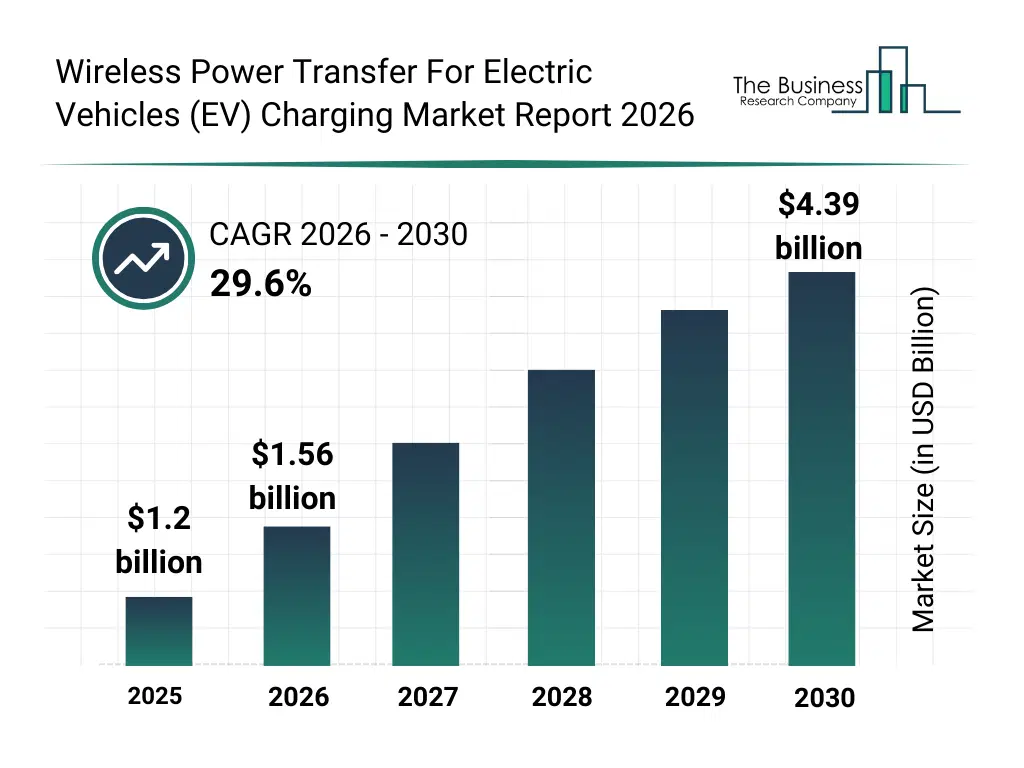
What Is The Wireless Power Transfer For Electric Vehicles (EV) Charging Market Size 2026 And Growth Rate?
The wireless power transfer for electric vehicles (EV) charging market size has grown exponentially in recent years. It will grow from $1.2 billion in 2025 to $1.56 billion in 2026 at a compound annual growth rate (CAGR) of 29.9%. The growth in the historic period can be attributed to rising adoption of electric vehicles, government incentives for clean transportation, early development of inductive charging technologies, limited public charging infrastructure, battery efficiency improvements.What Is The Wireless Power Transfer For Electric Vehicles (EV) Charging Market Growth Forecast?
The wireless power transfer for electric vehicles (EV) charging market size is expected to see exponential growth in the next few years. It will grow to $4.39 billion in 2030 at a compound annual growth rate (CAGR) of 29.6%. The growth in the forecast period can be attributed to increasing deployment of dynamic charging lanes, integration of AI in charging systems, growth of fleet electrification, expansion of public transport electrification, development of multi-coil and hybrid charging solutions. Major trends in the forecast period include wireless charging infrastructure expansion, smart charging management systems, standardized charging protocols, integration with renewable energy sources, vehicle-to-grid (V2G) technology.
Global Wireless Power Transfer For Electric Vehicles (EV) Charging Market Segmentation
1) By Technology: Inductive Charging, Resonant Inductive Charging, Capacitive Charging, Other Technologies 2) By Power Supply Range: Low Power, Medium Power, High Power 3) By Application: Private Vehicles, Public Transport, Commercial Vehicles, Other Applications 4) By End-User: Private, Public, Fleet Subsegments: 1) By Inductive Charging: Static Charging Pads, Dynamic Charging Lanes, Onboard Vehicle Coils 2) By Resonant Inductive Charging: Magnetic Resonance Coupling, Frequency Tuned Systems, Multi Coil Systems 3) By Capacitive Charging: Plate To Plate Systems, Embedded Roadway Systems, Vehicle To Infrastructure Systems 4) By Other Technologies: Radio Frequency Charging, Laser Based Charging, Hybrid Charging SystemsWhat Is The Driver Of The Wireless Power Transfer For Electric Vehicles (EV) Charging Market?
The increasing adoption of electric vehicles (EVs) is expected to propel the growth of the wireless power transfer for electric vehicles (EV) charging market going forward. Electric vehicles are automobiles powered entirely or partially by electricity, providing a cleaner alternative to traditional internal combustion engines. Increasing adoption of electric vehicles is due to growing environmental awareness, as people seek to reduce greenhouse gas emissions and combat climate change. Wireless power transfer for electric vehicle (EV) charging enhances the convenience, efficiency, and safety of electric vehicle operation by enabling cable-free, automatic energy transfer directly to the vehicle. For instance, in February 2024, according to the U.S. Department of Energy, a US-based federal agency, a comparison of monthly EV sales over the past three years reveals significant year-over-year growth for each month. Peak monthly sales reached approximately 100,000 in 2023, an increase of 25% compared to 2022. Therefore, the increasing adoption of electric vehicles (EVs) is driving the growth of the wireless power transfer for electric vehicles (EV) charging industry.Key Players In The Global Wireless Power Transfer For Electric Vehicles (EV) Charging Market
Major companies operating in the wireless power transfer for electric vehicles (EV) charging market are Toyota Motor Corporation, Siemens Aktiengesellschaft, Continental Aktiengesellschaft, Dr. Ing. h.c. F. Porsche Aktiengesellschaft, Qualcomm Incorporated, Toshiba Corporation, Zhongxing Telecommunication Equipment Corporation, DAIHEN Corporation, Mahle Gesellschaft mit beschränkter Haftung, Zhejiang VIE Science & Technology Co. Ltd., ChargePoint Inc., GuRu Wireless Inc., Mojo Mobility Inc., HEVO Inc., Momentum Dynamics Corporation, WiTricity Corporation, Powermat Technologies Ltd., Electreon Wireless Ltd., ENRX Group, InductEV Inc.
This chart is for illustrative purposes; the full report includes a detailed competitor analysis and comprehensive overview of the top 10 companies in the market.
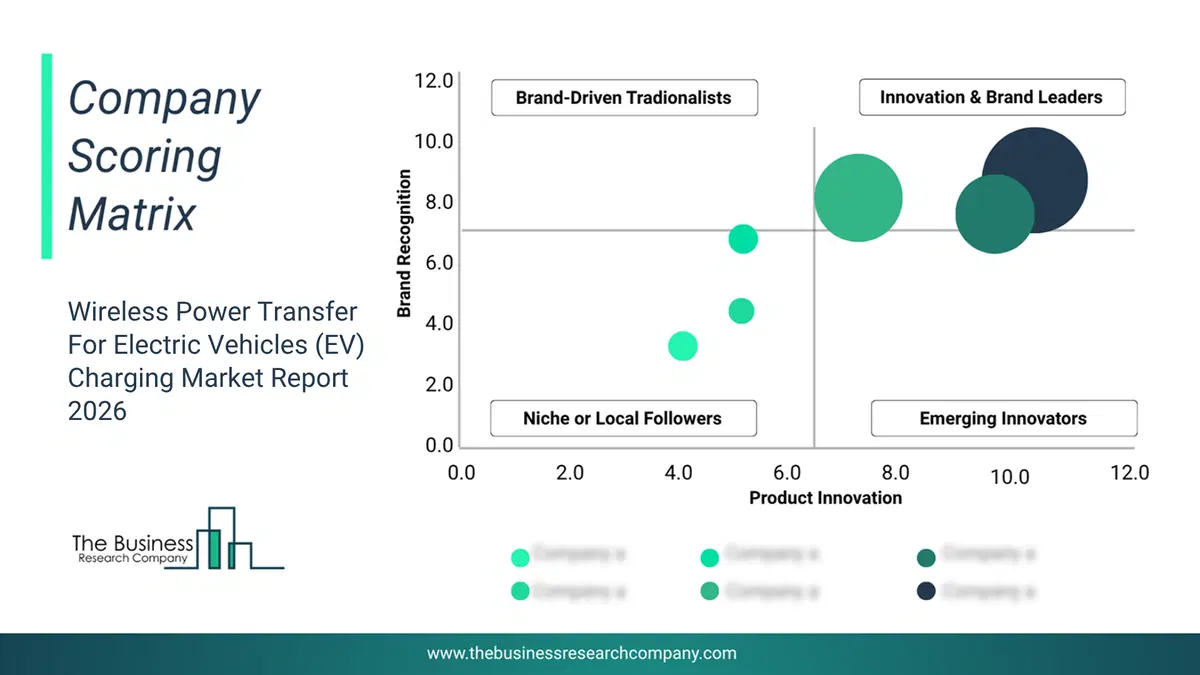
This chart maps companies by product innovation and brand strength, with bubble size indicating relative revenue, helping identify market leaders, challengers, and niche players. This is an illustrative chart; the full report provides a complete and accurate competitive analysis.
Global Wireless Power Transfer For Electric Vehicles (EV) Charging Market Trends and Insights
Major companies operating in the wireless power transfer for electric vehicles (EV) charging market are focusing on developing innovative solutions, such as inductive wireless charging systems, to provide convenient, cable-free, and efficient electric vehicle charging experiences. An inductive wireless charging system is a technology that transfers electrical energy from a charging pad to an electric vehicle using magnetic fields, eliminating the need for physical cables. For instance, in September 2025, Dr. Ing. h.c. F. Porsche AG, a Germany-based automobile manufacturer, launched the Porsche Cayenne Electric featuring an 11-kW wireless charging system for convenient, cable-free EV charging. The vehicle is equipped with an 11-kW inductive charging floor plate, allowing drivers to charge simply by parking over it, with automatic activation upon engaging the parking brake. The system delivers up to 90% energy transfer efficiency, includes motion and foreign object detection for enhanced safety, integrates with the My Porsche app for monitoring and scheduling, and employs ultra-wideband technology and Surround View to ensure precise vehicle alignment.What Are Latest Mergers And Acquisitions In The Wireless Power Transfer For Electric Vehicles (EV) Charging Market?
In October 2023, PULS GmbH, a Germany-based technology company, acquired Wiferion GmbH for an undisclosed amount. With this acquisition, PULS GmbH aims to integrate Wiferion’s advanced wireless charging technology into its portfolio to scale innovative industrial charging solutions. Wiferion GmbH is a Germany-based company that provides wireless power transfer systems for charging electric vehicles.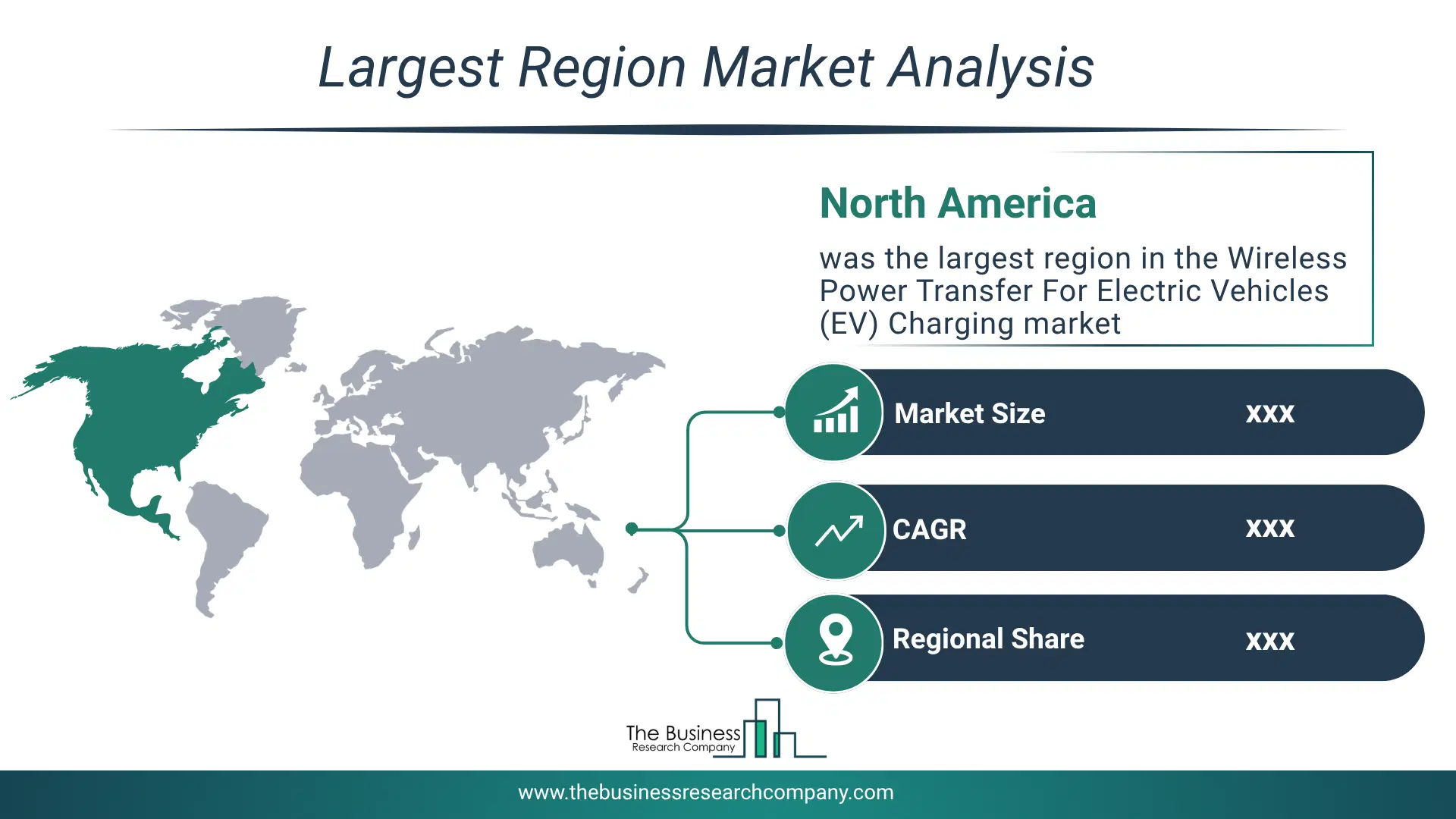
Regional Outlook
North America was the largest region in the wireless power transfer for electric vehicles (EV) charging market in 2025. Asia-Pacific is expected to be the fastest-growing region in the forecast period. The regions covered in this market report are Asia-Pacific, South East Asia, Western Europe, Eastern Europe, North America, South America, Middle East, Africa. The countries covered in this market report are Australia, Brazil, China, France, Germany, India, Indonesia, Japan, Taiwan, Russia, South Korea, UK, USA, Canada, Italy, Spain.What Defines the Wireless Power Transfer For Electric Vehicles (EV) Charging Market?
The wireless power transfer for electric vehicles (EV) charging market consists of revenues earned by entities by providing services such as maintenance and repair services, charging network management services, consulting and system integration, pay-per-use charging services, and fleet charging solutions. The market value includes the value of related goods sold by the service provider or included within the service offering. The wireless power transfer for electric vehicles (EV) charging market also includes sales of onboard vehicle power receivers, charging pad covers and protective enclosures, power converters and inverters, embedded roadway coils and communication modules. Values in this market are ‘factory gate’ values, that is the value of goods sold by the manufacturers or creators of the goods, whether to other entities (including downstream manufacturers, wholesalers, distributors and retailers) or directly to end customers. The value of goods in this market includes related services sold by the creators of the goods.How is Market Value Defined and Measured?
The market value is defined as the revenues that enterprises gain from the sale of goods and/or services within the specified market and geography through sales, grants, or donations in terms of the currency (in USD unless otherwise specified). The revenues for a specified geography are consumption values that are revenues generated by organizations in the specified geography within the market, irrespective of where they are produced. It does not include revenues from resales along the supply chain, either further along the supply chain or as part of other products.
This chart presents market attractiveness based on a quantitative evaluation of growth, competition, strategic alignment, and risk, offering a clear view of opportunity areas for decision-making. This chart is for illustrative purposes; the full report contains the complete analysis.

This chart highlights the Total Addressable Market (TAM) by estimating the maximum revenue opportunity using an assumption-driven approach, supporting strategic planning and opportunity sizing across markets. The chart is illustrative; the full report provides a more comprehensive analysis.
What Key Data and Analysis Are Included in the Wireless Power Transfer For Electric Vehicles (EV) Charging Market Report 2026?
The wireless power transfer for electric vehicles (ev) charging market research report is one of a series of new reports from The Business Research Company that provides market statistics, including industry global market size, regional shares, competitors with the market share, detailed market segments, market trends and opportunities, and any further data you may need to thrive in the wireless power transfer for electric vehicles (ev) charging industry. The market research report delivers a complete perspective of everything you need, with an in-depth analysis of the current and future state of the industry.Wireless Power Transfer For Electric Vehicles (EV) Charging Market Report Forecast Analysis
| Report Attribute | Details |
|---|---|
| Market Size Value In 2026 | $1.56 billion |
| Revenue Forecast In 2030 | $4.39 billion |
| Growth Rate | CAGR of 29.6% from 2026 to 2030 |
| Base Year For Estimation | 2025 |
| Actual Estimates/Historical Data | 2020-2025 |
| Forecast Period | 2026 - 2030 |
| Market Representation | Revenue in USD Billion and CAGR from 2026 to 2030 |
| Segments Covered | Technology, Power Supply Range, Application, End-User |
| Regional Scope | Asia-Pacific, Western Europe, Eastern Europe, North America, South America, Middle East, Africa |
| Country Scope | The countries covered in the report are Australia, Brazil, China, France, Germany, India, Indonesia, Japan, Taiwan, Russia, South Korea, UK, USA, Canada, Italy, Spain. |
| Key Companies Profiled | Toyota Motor Corporation, Siemens Aktiengesellschaft, Continental Aktiengesellschaft, Dr. Ing. h.c. F. Porsche Aktiengesellschaft, Qualcomm Incorporated, Toshiba Corporation, Zhongxing Telecommunication Equipment Corporation, DAIHEN Corporation, Mahle Gesellschaft mit beschränkter Haftung, Zhejiang VIE Science & Technology Co. Ltd., ChargePoint Inc., GuRu Wireless Inc., Mojo Mobility Inc., HEVO Inc., Momentum Dynamics Corporation, WiTricity Corporation, Powermat Technologies Ltd., Electreon Wireless Ltd., ENRX Group, InductEV Inc. |
| Customization Scope | Request for Customization |
| Pricing And Purchase Options | Explore Purchase Options |