

Workflow Market Report 2026
Global Outlook – By Component (Software, Services), By Deployment (Cloud-based, On-premise, Hybrid), By Technology (Artificial Intelligence (AI)-enabled Workflows, Machine Learning-driven Workflows, Rule-based Workflows, Intelligent Process Automation, Integration Platforms), By Application (Project Management And Coordination, Case Management, Content And Document Management, Automated Routing And Notification, Data Entry And Validation, Operational Performance Analytics), By Industry Vertical (Banking, Financial Services, And Insurance (BFSI), Healthcare And Life Sciences, Manufacturing And Logistics, Retail And Consumer Goods, Information Technology (IT) And Telecommunications, Government And Public Sector, Energy And Utilities, Other Industry Verticals) – Market Size, Trends, Strategies, and Forecast to 2030
Workflow Market Overview
• Workflow market size has reached to $0.58 billion in 2025 • Expected to grow to $0.71 billion in 2030 at a compound annual growth rate (CAGR) of 22.5% • Growth Driver: Growing Demand For Remote Work And Distributed Workforce Models Fueling The Growth Of The Market Due To Increasing Need For Seamless Collaboration, Task Automation, And Productivity Management • Market Trend: AI-Driven Automation And Intelligent Workflow Transformation • North America was the largest region in 2025 and Asia-Pacific is the fastest growing region.What Is Covered Under Workflow Market?
Workflow is a structured sequence of tasks, activities, and information flows that define how business processes are executed across people, systems, and applications within an enterprise. It enables organizations to automate, standardize, and coordinate end-to-end business operations, improving efficiency, accuracy, and operational control through rule-based and system-driven execution. The main components of workflow include software and services. Software refers to applications and platforms that automate, manage, and streamline workflow processes by coordinating tasks, data, and user activities across an organization. The deployment includes cloud-based, on-premise, and hybrid and the technologies include artificial intelligence (AI)-enabled workflows, machine learning-driven workflows, rule-based workflows, intelligent process automation, and integration platforms and the applications include project management and coordination, case management, content and document management, automated routing and notification, data entry and validation, and operational performance analytics, and the key industry verticals include banking, financial services, and insurance (BFSI), healthcare and life sciences, manufacturing and logistics, retail and consumer goods, information technology (IT) and telecommunications, government and public sector, energy and utilities, and others.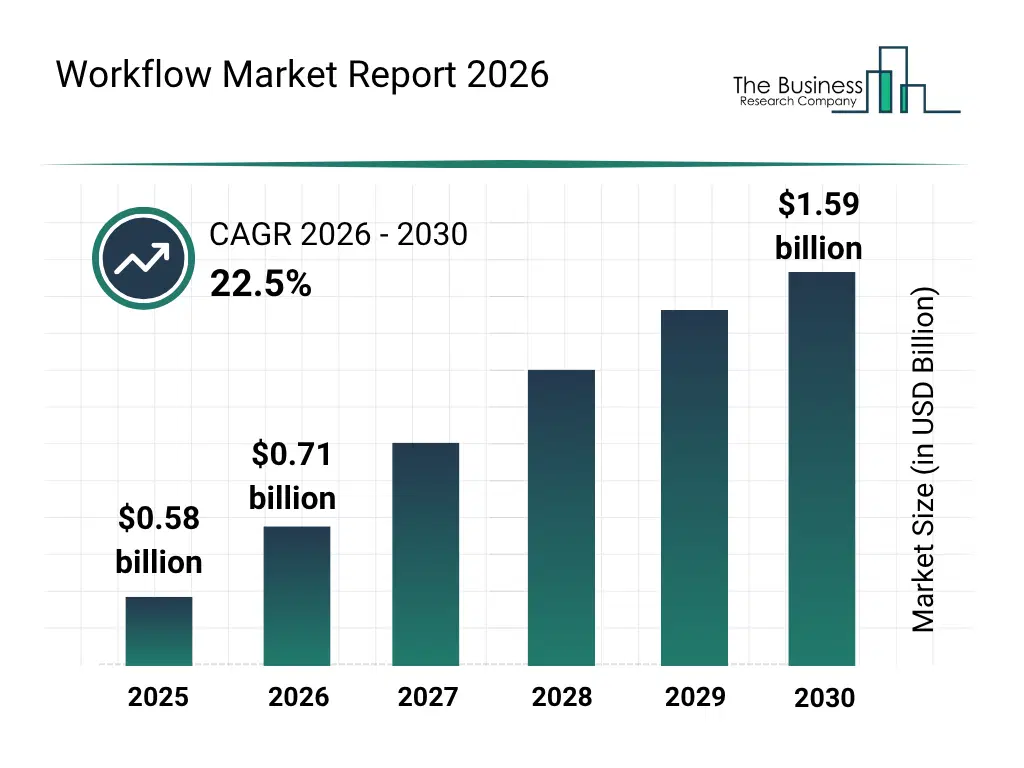
What Is The Workflow Market Size and Share 2026?
The workflow market size has grown exponentially in recent years. It will grow from $0.58 billion in 2025 to $0.71 billion in 2026 at a compound annual growth rate (CAGR) of 22.3%. The growth in the historic period can be attributed to manual process dependency in enterprises, rise of enterprise resource planning systems, digitization of business documentation, increasing need for operational efficiency, adoption of basic workflow automation tools.What Is The Workflow Market Growth Forecast?
The workflow market size is expected to see exponential growth in the next few years. It will grow to $1.59 billion by 2030 at a compound annual growth rate (CAGR) of 22.5%. The growth in the forecast period can be attributed to expansion of AI enabled process automation, rising demand for real time decision making systems, growth of hybrid and distributed workforce operations, increasing enterprise focus on process optimization, adoption of cloud native workflow platforms. Major trends in the forecast period include hyperautomation in enterprise workflow management, AI driven workflow orchestration and decision automation, low code no code workflow platform adoption, event driven and real time workflow processing, cross functional business process orchestration.
Global Workflow Market Segmentation
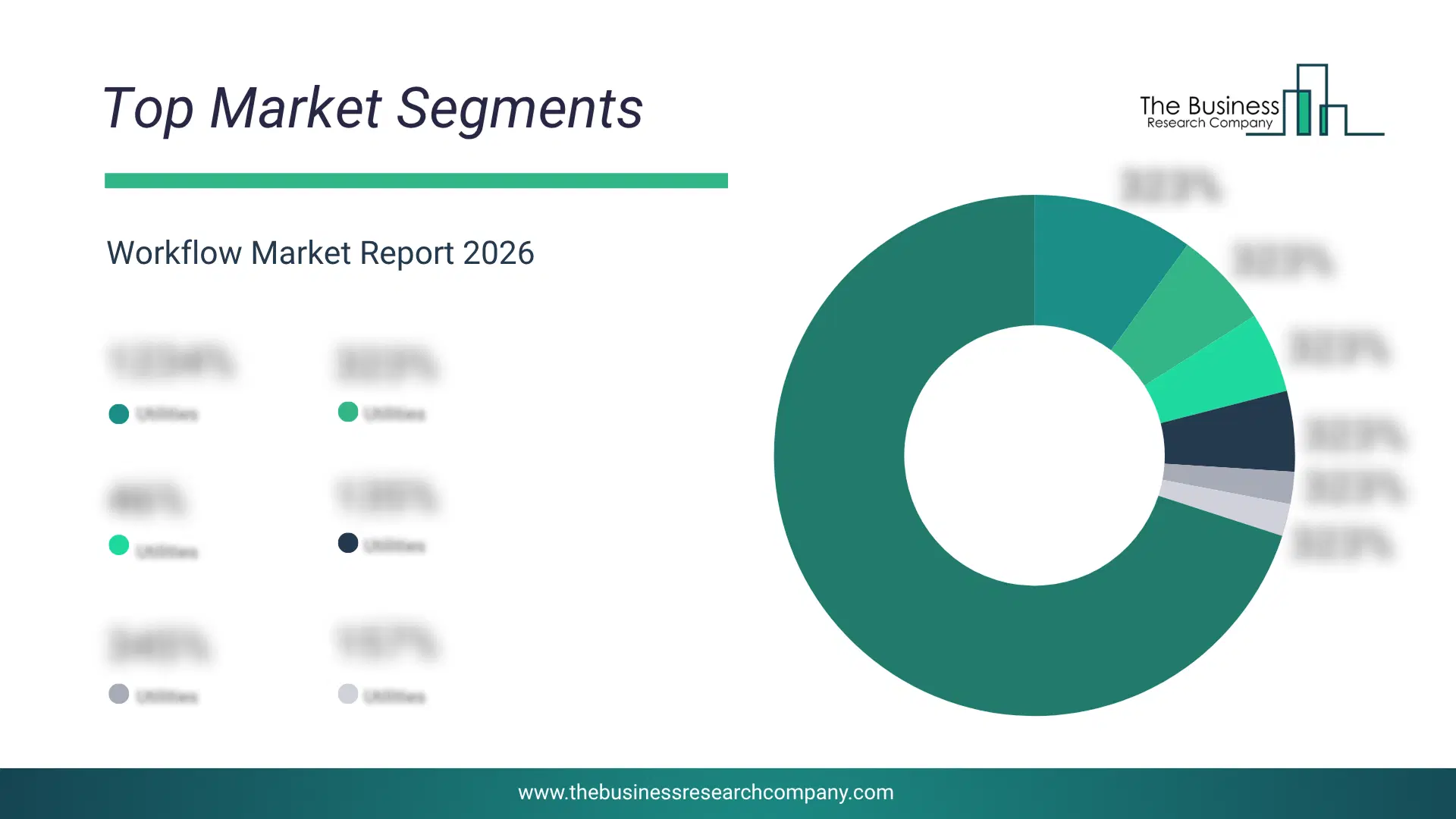
1) By Component: Software, Services 2) By Deployment: Cloud-based, On-premise, Hybrid 3) By Technology: Artificial Intelligence (AI)-enabled Workflows, Machine Learning-driven Workflows, Rule-based Workflows, Intelligent Process Automation, Integration Platforms 4) By Application: Project Management And Coordination, Case Management, Content And Document Management, Automated Routing And Notification, Data Entry And Validation, Operational Performance Analytics 5) By Industry Vertical: Banking, Financial Services, And Insurance (BFSI), Healthcare And Life Sciences, Manufacturing And Logistics, Retail And Consumer Goods, Information Technology (IT) And Telecommunications, Government And Public Sector, Energy And Utilities, Other Industry Verticals Subsegments: 1) By Software: Workflow Automation Software, Business Process Management Software, Process Orchestration Software, Case Management Software, Integration Platform Software, Intelligent Automation Software, Task Management Software, Collaboration Software, Decision Management Software, Enterprise Workflow Software 2) By Services: Consulting Services, Implementation Services, Integration Services, Customization Services, Support And Maintenance Services, Managed Services, Training And Education Services, Process Optimization Services, Migration Services, Advisory ServicesWhat Is The Driver Of The Workflow Market?
The growing demand for remote work and distributed workforce models is expected to propel the growth of the workflow market going forward. Remote work and distributed workforce models refer to work arrangements where employees work from different locations outside a central office using digital tools. The rise in remote work and distributed workforce models is driven by advancements in digital communication technologies, as they enable employees to collaborate and perform tasks effectively from any location. Workflow helps remote work and distributed workforce models by structuring, automating, and coordinating tasks across teams, enabling seamless collaboration, improved productivity, and efficient execution of processes from any location. For instance, in July 2024, according to the Bureau of Labor Statistics, a US-based government agency, 35% of employed people did some or all of their work at home on days they worked in 2023, up slightly from 34% in 2022. Therefore, the growing demand for remote work and distributed workforce models is driving the growth of the workflow industry.Key Players In The Global Workflow Market
Major companies operating in the workflow market are IBM Corporation; Oracle Corporation; SAP SE; ServiceNow Inc.; Zoho Corporation Private Limited; Pegasystems Inc.; Smartsheet Inc.; monday.com Ltd.; Asana Inc.; Appian Corporation; ClickUp Inc.; Quickbase Inc.; Camunda GmbH; Kissflow Inc.; Bizagi Group Limited; Creatio Ltd.; Agiloft Inc.; ProcessMaker Inc.; Bonitasoft S.A.; TrackVia Inc.; Newgen Software Technologies Limited; Pipefy Inc.; Nintex Global Ltd.; Integrify Inc.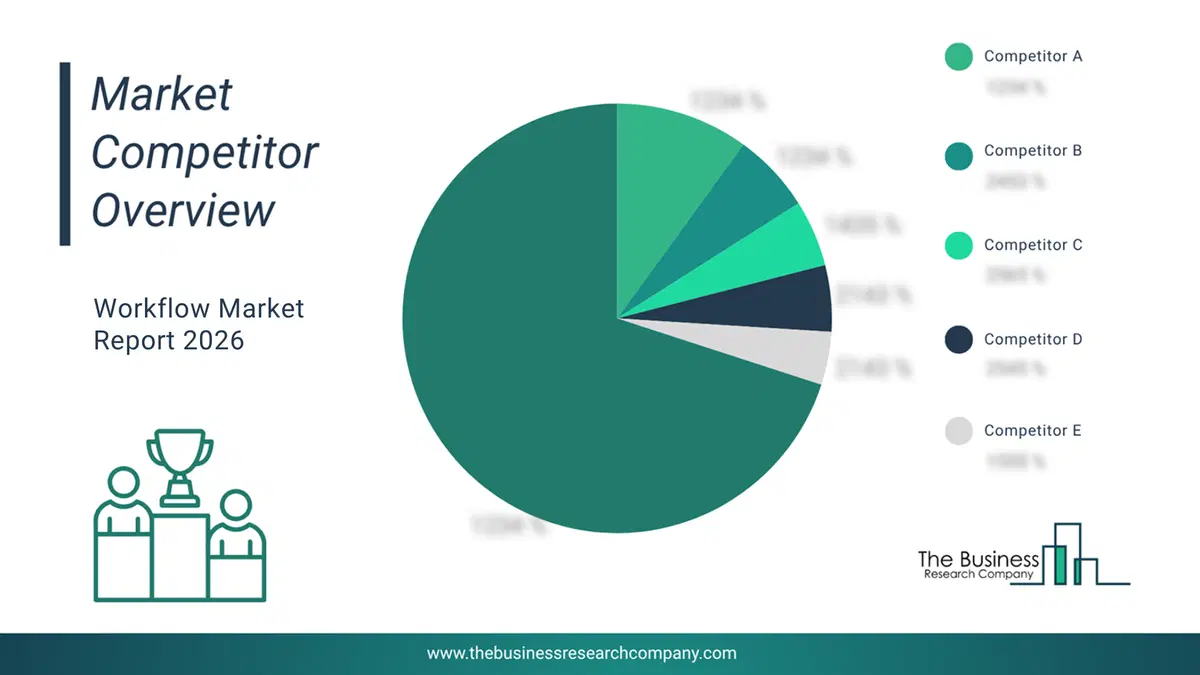
This chart is for illustrative purposes; the full report includes a detailed competitor analysis and comprehensive overview of the top 10 companies in the market.
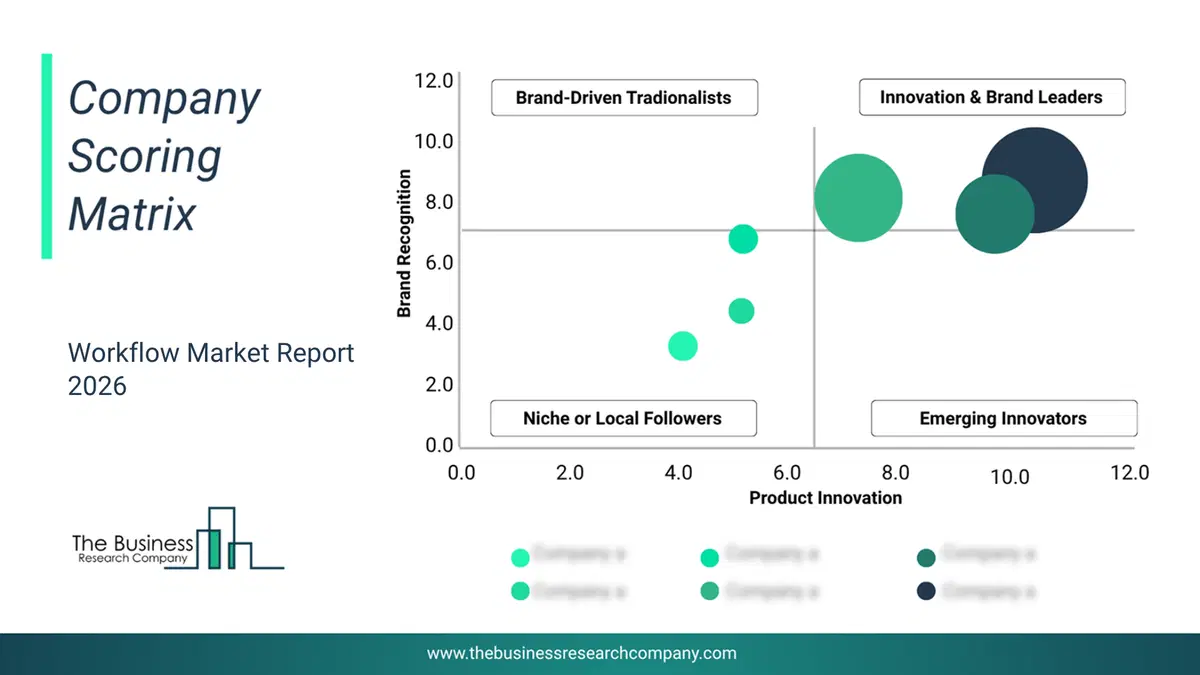
This chart maps companies by product innovation and brand strength, with bubble size indicating relative revenue, helping identify market leaders, challengers, and niche players. This is an illustrative chart; the full report provides a complete and accurate competitive analysis.
Global Workflow Market Trends and Insights
Major companies operating in the workflow management market are focusing on integrating AI-powered process automation capabilities, such as embedded AI agents, to enhance enterprise productivity, decision-making, and operational efficiency. AI-powered process automation refers to the use of artificial intelligence technologies to automate, optimize, and manage business workflows with minimal human intervention. Embedded AI agents are intelligent software agents integrated directly into workflows that can perform tasks, provide recommendations, and execute decisions autonomously within enterprise processes. For instance, in November 2025, Appian Corporation, a US-based enterprise software company, announced platform enhancements that embed powerful AI agents directly into enterprise processes. The latest Appian Platform release delivers practical and measurable value by transforming AI from a simple assistant into an active participant in workflow execution and business operations.What Are Latest Mergers And Acquisitions In The Workflow Market?
In October 2025, Infotech, Inc., a US-based provider of infrastructure construction software solutions, acquired Workflow Manager for an undisclosed amount. This acquisition enabled Infotech to expand its project lifecycle management capabilities by integrating pre-construction planning, estimating, bidding, and construction administration into a unified digital platform for civil infrastructure projects. Workflow Manager is a US-based software company that provides project planning, workflow automation, and program management solutions for infrastructure and transportation organizations.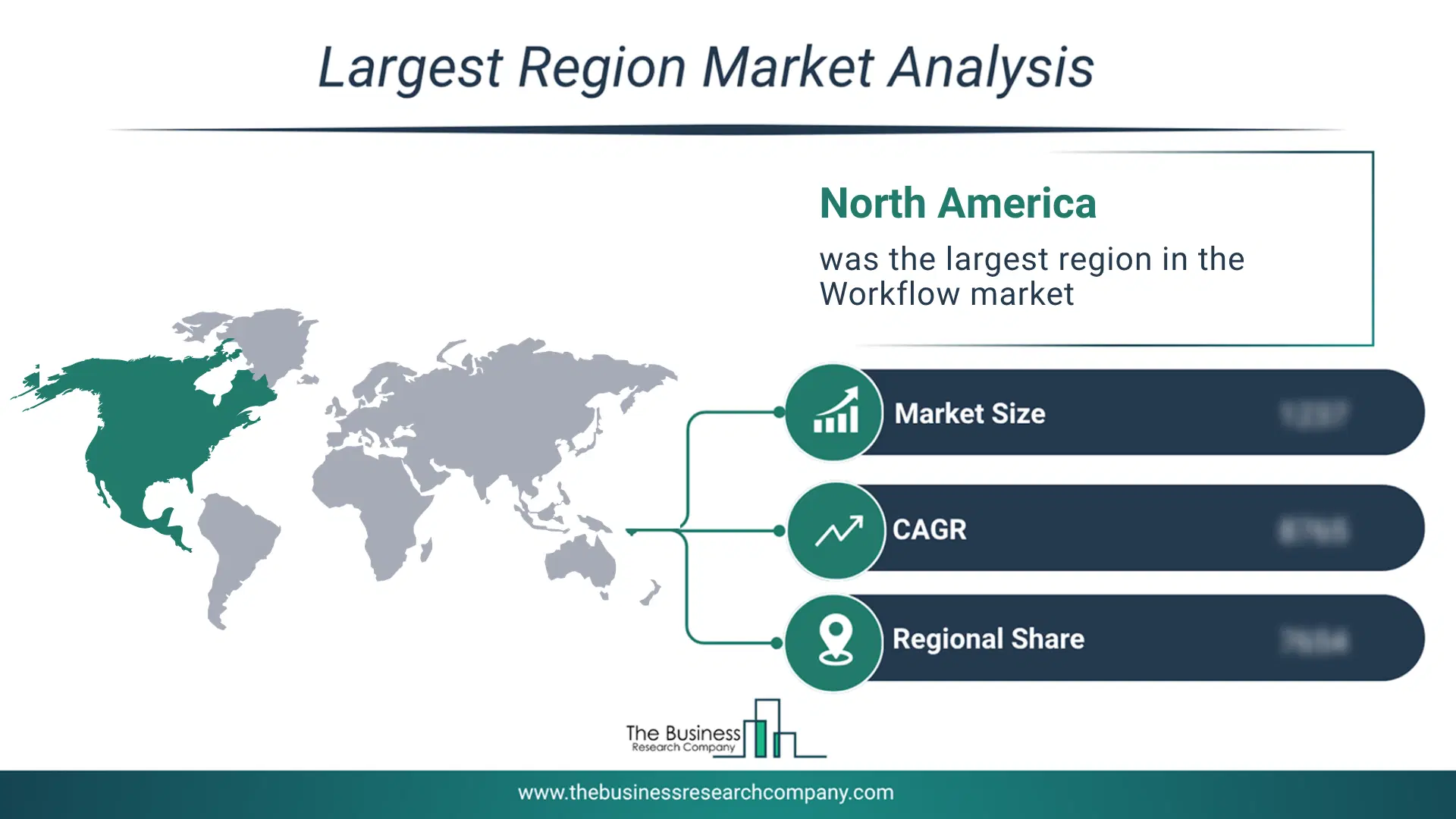
Regional Insights
North America was the largest region in the workflow market in 2025. Asia-Pacific is expected to be the fastest-growing region in the forecast period. The regions covered in this market report are Asia-Pacific, South East Asia, Western Europe, Eastern Europe, North America, South America, Middle East, Africa. The countries covered in this market report are Australia, Brazil, China, France, Germany, India, Indonesia, Japan, Taiwan, Russia, South Korea, UK, USA, Canada, Italy, Spain.What Defines the Workflow Market?
The workflow market consists of revenues earned by entities providing services such as business process automation, workflow orchestration, business process management (BPM), robotic process automation (RPA)-enabled workflows, system and application integration, process monitoring and analytics, and managed workflow services. The market value includes the value of related goods sold by the service provider or included within the service offering. Only goods and services traded between entities or sold to end consumers are included.How is Market Value Defined and Measured?
The market value is defined as the revenues that enterprises gain from the sale of goods and/or services within the specified market and geography through sales, grants, or donations in terms of the currency (in USD unless otherwise specified). The revenues for a specified geography are consumption values that are revenues generated by organizations in the specified geography within the market, irrespective of where they are produced. It does not include revenues from resales along the supply chain, either further along the supply chain or as part of other products.
This chart presents market attractiveness based on a quantitative evaluation of growth, competition, strategic alignment, and risk, offering a clear view of opportunity areas for decision-making. This chart is for illustrative purposes; the full report contains the complete analysis.

This chart highlights the Total Addressable Market (TAM) by estimating the maximum revenue opportunity using an assumption-driven approach, supporting strategic planning and opportunity sizing across markets. The chart is illustrative; the full report provides a more comprehensive analysis.
What Key Data and Analysis Are Included in the Workflow Market Report 2026?
The workflow market research report is one of a series of new reports from The Business Research Company that provides market statistics, including industry global market size, regional shares, competitors with the market share, detailed market segments, market trends and opportunities, and any further data you may need to thrive in the workflow industry. The market research report delivers a complete perspective of everything you need, with an in-depth analysis of the current and future state of the industry.Workflow Market Report Forecast Analysis
| Report Attribute | Details |
|---|---|
| Market Size Value In 2026 | $0.71 billion |
| Revenue Forecast In 2030 | $1.59 billion |
| Growth Rate | CAGR of 22.5% from 2026 to 2030 |
| Base Year For Estimation | 2025 |
| Actual Estimates/Historical Data | 2020-2025 |
| Forecast Period | 2026 - 2030 |
| Market Representation | Revenue in USD Billion and CAGR from 2026 to 2030 |
| Segments Covered | Component, Deployment, Technology, Application, Industry Vertical |
| Regional Scope | Asia-Pacific, Western Europe, Eastern Europe, North America, South America, Middle East, Africa |
| Country Scope | The Countries Covered In This Market Report Are Australia, Brazil, China, France, Germany, India, Indonesia, Japan, Taiwan, Russia, South Korea, Uk, Usa, Canada, Italy, Spain. |
| Key Companies Profiled | IBM Corporation, Oracle Corporation, SAP SE, ServiceNow Inc., Zoho Corporation Private Limited, Pegasystems Inc., Smartsheet Inc., monday.com Ltd., Asana Inc., Appian Corporation, ClickUp Inc., Quickbase Inc., Camunda GmbH, Kissflow Inc., Bizagi Group Limited, Creatio Ltd., Agiloft Inc., ProcessMaker Inc., Bonitasoft S.A., TrackVia Inc., Newgen Software Technologies Limited, Pipefy Inc., Nintex Global Ltd., Integrify Inc. |
| Customization Scope | Request for Customization |
| Pricing And Purchase Options | Explore Purchase Options |