
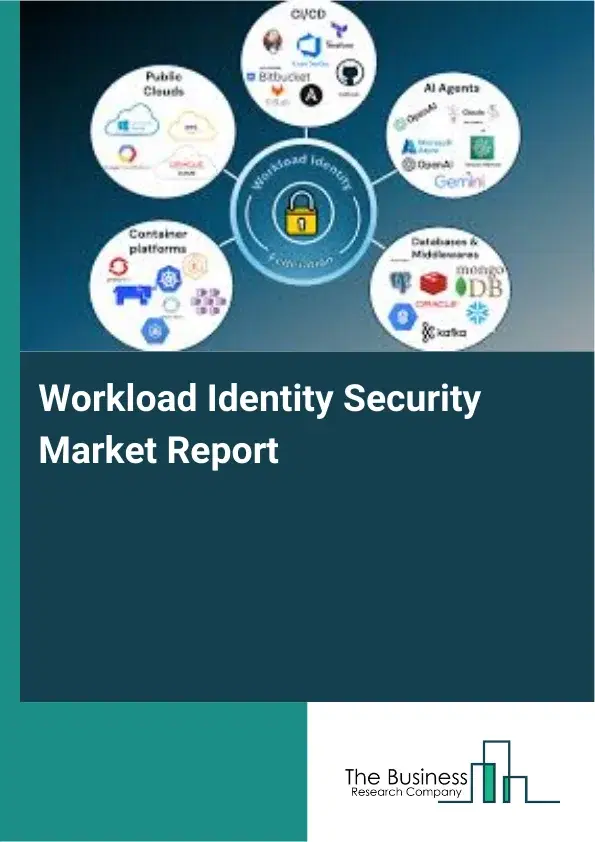
Workload Identity Security Market Report 2026
Global Outlook – By Component (Solutions, Services), By Deployment Mode (On-Premises, Cloud), By Organization Size (Large Enterprises, Small And Medium Enterprises), By Application (Access Management, Identity Governance, Compliance Management, Threat Detection, Other Applications), By End-User (Banking, Financial Services, And Insurance (BFSI), Healthcare, Information Technology And Telecom, Government, Retail, Manufacturing, Other End-Users) – Market Size, Trends, Strategies, and Forecast to 2030
Workload Identity Security Market Overview
• Workload Identity Security market size has reached to $2.05 billion in 2025 • Expected to grow to $6.08 billion in 2030 at a compound annual growth rate (CAGR) of 24.3% • Growth Driver: Rising Growth Of Non-Human Machine Identities (NHIs) Driving Expansion Of The Market Due To Increasing Adoption Of IoT Devices • Market Trend: Innovations In Workload Identity Security Strengthen Protection Against Identity-Based Attacks • North America was the largest region in 2025 and Asia-Pacific is the fastest growing region.What Is Covered Under Workload Identity Security Market?
Workload identity security refers to a cybersecurity approach that manages and protects the identities of workloads within cloud or hybrid IT environments. It ensures that only authenticated and authorized workloads can access resources or other services, minimizing the risk of breaches, privilege escalation, and lateral movement. It enforces secure workload-to-workload communication, manages credentials safely, and prevents unauthorized access in dynamic and scalable infrastructures. The main components of workload identity security include solutions and services. Solutions focus on securing machine identities, workloads, and service-to-service communications across environments. These offerings are deployed across on-premises and cloud environments to ensure secure identity management for workloads running in diverse infrastructure setups. Organizations of different sizes, including large enterprises and small and medium enterprises. The various applications involved are access management, identity governance, compliance management, and threat detection, along with other security-related use cases. The end users of workload identity security include banking, financial services, and insurance organizations, healthcare providers, information technology and telecom companies, government entities, retail businesses, manufacturing organizations, and other end users.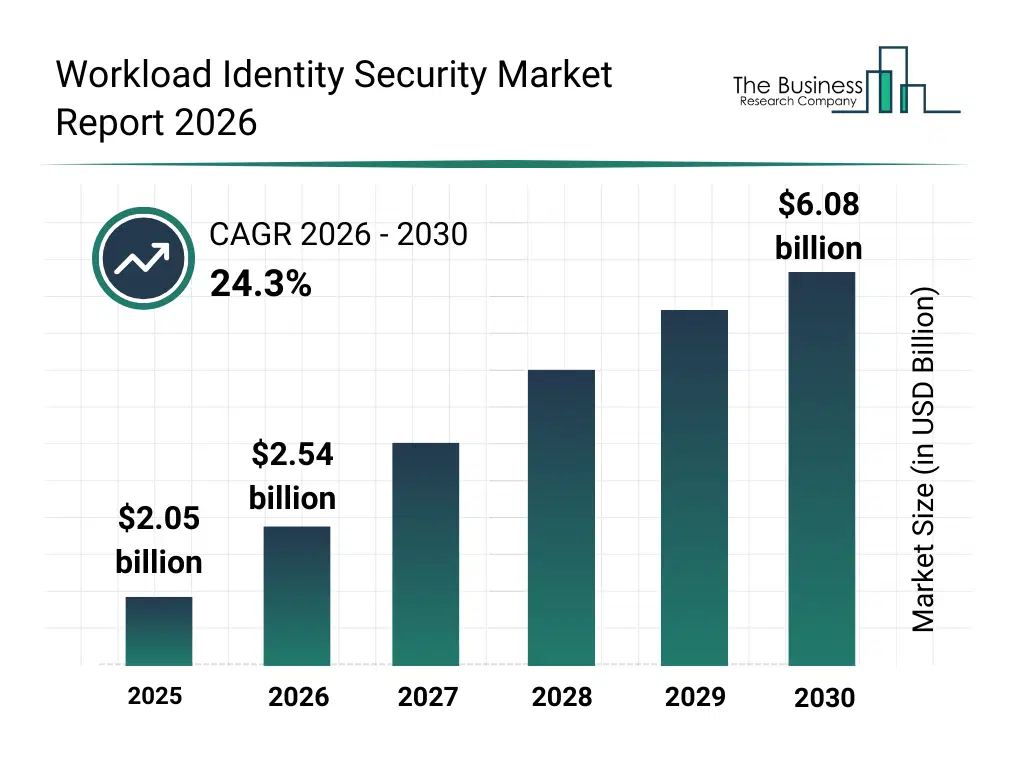
What Is The Workload Identity Security Market Size and Share 2026?
The workload identity security market size has grown exponentially in recent years. It will grow from $2.05 billion in 2025 to $2.54 billion in 2026 at a compound annual growth rate (CAGR) of 24.1%. The growth in the historic period can be attributed to rise in cloud native applications, increase in container adoption, growth in microservices architectures, historic credential leakage incidents, expansion of devops automation.What Is The Workload Identity Security Market Growth Forecast?
The workload identity security market size is expected to see exponential growth in the next few years. It will grow to $6.08 billion in 2030 at a compound annual growth rate (CAGR) of 24.3%. The growth in the forecast period can be attributed to increasing multi cloud deployments, rising zero trust mandates, growth in container orchestration, higher regulatory compliance pressure, expansion of machine identity attack surface. Major trends in the forecast period include zero trust workload authentication models, machine and service identity governance, secrets vault and rotation platforms, kubernetes native identity security, service to service authentication controls.
Global Workload Identity Security Market Segmentation
1) By Component: Solutions; Services 2) By Deployment Mode: On-Premises; Cloud 3) By Organization Size: Large Enterprises; Small And Medium Enterprises 4) By Application: Access Management; Identity Governance; Compliance Management; Threat Detection; Other Applications 5) By End-User: Banking, Financial Services, And Insurance (BFSI); Healthcare; Information Technology And Telecom; Government; Retail; Manufacturing; Other End-Users Subsegments: 1) By Solutions: Workload Identity And Access Management (IAM) Platforms; Machine Identity Management Solutions; Cloud Workload Identity Protection Solutions; Kubernetes And Container Identity Security; Application Programming Interface (API) And Service-To-Service Authentication Solutions; Zero Trust Workload Identity Solutions; Privileged Access Management (PAM) For Workloads; Secrets Management And Rotation Solutions; Policy-Based Identity Enforcement Tools; Identity Threat Detection And Response (ITDR) For Workloads 2) By Services: Workload Identity Security Consulting Services; Deployment And Integration Services; Identity Risk Assessment Services; Managed Workload Identity Security Services; Continuous Monitoring And Threat Response Services; Compliance And Audit Support Services; Identity Lifecycle Management Services; Secrets Migration And Modernization Services; Training And Awareness Services; Technical Support And Maintenance ServicesWhat Is The Driver Of The Workload Identity Security Market?
The rising growth of non-human machine identities (NHIs) is expected to propel the growth of the workload identity security market going forward. A non-human identity (NHI) is a digital credential assigned to software, services, or devices to enable them to authenticate and perform tasks automatically without direct human intervention. Non-human machine identities (NHIs) are increasing due to the growing adoption of IoT (Internet of Things) devices, which require unique machine identities to enable secure communication and data exchange. Workload identity security supports the growth of non-human machine identities (NHIs) by providing secure authentication and access controls for machine-to-machine communication, ensuring that NHIs are properly verified and protected from unauthorized access. For instance, in July 2025, according to the Cyber Security Tribe, a US-based community for cybersecurity professionals, the ratio of NHIs to human identities climbed substantially, growing from about 92:1 in early 2024 to approximately 144:1 by mid-2025, a 56% jump over just one year. Therefore, the rising growth of non-human machine identities (NHIs) is driving the growth of the workload identity security industry.Key Players In The Global Workload Identity Security Market
Major companies operating in the workload identity security market are Palo Alto Networks Inc., Fortinet Inc., Okta Inc., Tenable Holdings Inc., CyberArk Software Ltd., Delinea Inc., 1Password Inc., Wiz Inc., BeyondTrust Corporation, Sysdig Inc., AppViewX Inc., Keyfactor Inc., Aqua Security Software Ltd., Silverfort Ltd., Ping Identity Corporation, StrongDM Inc., Akeyless Technologies Ltd, Apono Inc., Strata Identity Inc., Doppler Security Inc., and Styra Inc.
This chart is for illustrative purposes; the full report includes a detailed competitor analysis and comprehensive overview of the top 10 companies in the market.
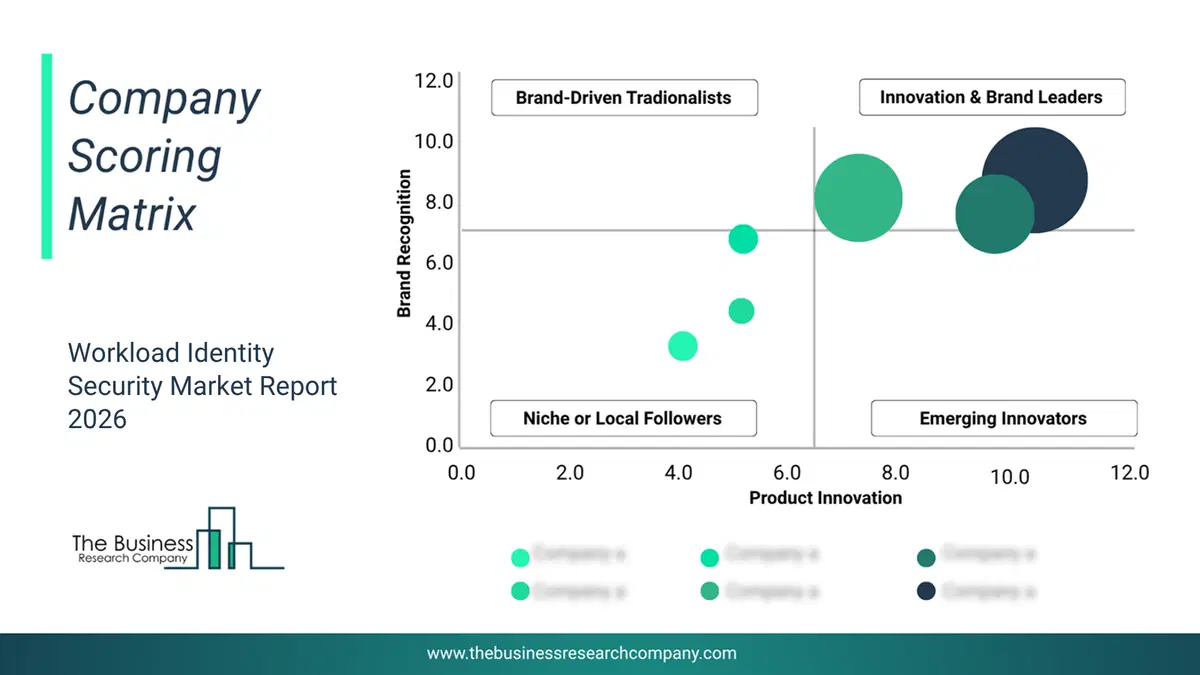
This chart maps companies by product innovation and brand strength, with bubble size indicating relative revenue, helping identify market leaders, challengers, and niche players. This is an illustrative chart; the full report provides a complete and accurate competitive analysis.
Global Workload Identity Security Market Trends and Insights
Major companies operating in the workload identity security market are focusing on developing unified identity threat detection and response solutions to improve visibility, reduce identity-related risks, and protect both human and non-human identities across hybrid environments. Unified identity threat detection and response solutions are platforms that centrally monitor and mitigate identity-based threats affecting both human and non-human identities and analyze identity activity across cloud and on-premises environments to rapidly detect anomalies and prevent attack escalation. For instance, in April 2025, Permiso, a US-based identity threat detection and response company, launched a new identity security platform designed to unify detection and protection for human and non-human identities across cloud and on-premises environments. The platform leverages a universal identity graph to map relationships between credentials and workloads, enabling real-time visibility into access patterns and rapid detection of anomalous behavior. It also incorporates extensive detection signals across IaaS, PaaS, and SaaS environments, along with runtime threat detection for non-human identities, helping organizations proactively mitigate workload identity risks and defend against sophisticated identity-based attacks.What Are Latest Mergers And Acquisitions In The Workload Identity Security Market?
In September 2025, Okta, Inc., a US‑based provider of identity and access management and privileged access security solutions, acquired Axiom Security for an undisclosed amount. With this acquisition, Okta aimed to expand its privileged access management capabilities and deepen its identity security fabric by integrating cloud‑native, identity‑centric privileged access controls for critical resources such as Kubernetes and databases. Axiom Security is an Israel-based provider of workload identity security by managing and automating access for non-human identities.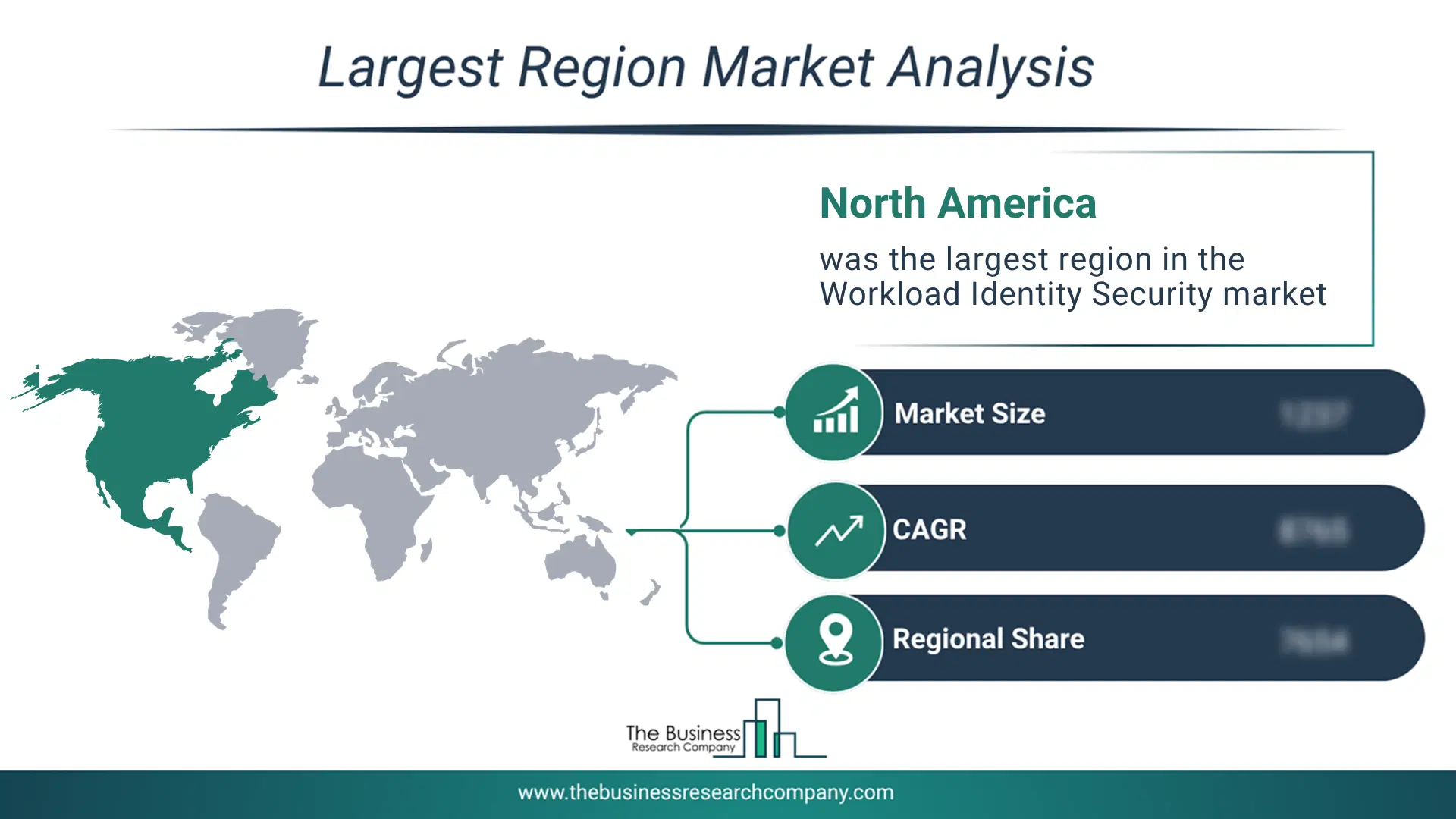
Regional Insights
North America was the largest region in the workload identity security market in 2025. Asia-Pacific is expected to be the fastest-growing region in the forecast period. The regions covered in this market report are Asia-Pacific, South East Asia, Western Europe, Eastern Europe, North America, South America, Middle East, Africa. The countries covered in this market report are Australia, Brazil, China, France, Germany, India, Indonesia, Japan, Taiwan, Russia, South Korea, UK, USA, Canada, Italy, Spain.What Defines the Workload Identity Security Market?
The workload identity security consists of revenues earned by entities by providing services such as identity and access management implementation, privileged access management consulting, workload authentication and authorization support, credential management services, and single sign-on configuration. The market value includes the value of related goods sold by the service provider or included within the service offering. The workload identity security market also includes sales of identity and access management platforms, privileged access management tools, authentication and authorization software, credential vaults, single sign-on solutions, workload identity governance platforms, and cloud-native security modules. Values in this market are ‘factory gate’ values, that is, the value of goods sold by the manufacturers or creators of the goods, whether to other entities (including downstream manufacturers, wholesalers, distributors, and retailers) or directly to end customers. The value of goods in this market includes related services sold by the creators of the goods.How is Market Value Defined and Measured?
The market value is defined as the revenues that enterprises gain from the sale of goods and/or services within the specified market and geography through sales, grants, or donations in terms of the currency (in USD unless otherwise specified). The revenues for a specified geography are consumption values that are revenues generated by organizations in the specified geography within the market, irrespective of where they are produced. It does not include revenues from resales along the supply chain, either further along the supply chain or as part of other products.
This chart presents market attractiveness based on a quantitative evaluation of growth, competition, strategic alignment, and risk, offering a clear view of opportunity areas for decision-making. This chart is for illustrative purposes; the full report contains the complete analysis.

This chart highlights the Total Addressable Market (TAM) by estimating the maximum revenue opportunity using an assumption-driven approach, supporting strategic planning and opportunity sizing across markets. The chart is illustrative; the full report provides a more comprehensive analysis.
What Key Data and Analysis Are Included in the Workload Identity Security Market Report 2026?
The workload identity security market research report is one of a series of new reports from The Business Research Company that provides market statistics, including industry global market size, regional shares, competitors with the market share, detailed market segments, market trends and opportunities, and any further data you may need to thrive in the workload identity security industry. The market research report delivers a complete perspective of everything you need, with an in-depth analysis of the current and future state of the industry.Workload Identity Security Market Report Forecast Analysis
| Report Attribute | Details |
|---|---|
| Market Size Value In 2026 | $2.54 billion |
| Revenue Forecast In 2030 | $6.08 billion |
| Growth Rate | CAGR of 24.3% from 2026 to 2030 |
| Base Year For Estimation | 2025 |
| Actual Estimates/Historical Data | 2020-2025 |
| Forecast Period | 2026 - 2030 |
| Market Representation | Revenue in USD Billion and CAGR from 2026 to 2030 |
| Segments Covered | Component, Deployment Mode, Organization Size, Application, End-User |
| Regional Scope | Asia-Pacific, Western Europe, Eastern Europe, North America, South America, Middle East, Africa |
| Country Scope | The Countries Covered In This Market Report Are Australia, Brazil, China, France, Germany, India, Indonesia, Japan, Taiwan, Russia, South Korea, Uk, Usa, Canada, Italy, Spain. |
| Key Companies Profiled | Palo Alto Networks Inc., Fortinet Inc., Okta Inc., Tenable Holdings Inc., CyberArk Software Ltd., Delinea Inc., 1Password Inc., Wiz Inc., BeyondTrust Corporation, Sysdig Inc., AppViewX Inc., Keyfactor Inc., Aqua Security Software Ltd., Silverfort Ltd., Ping Identity Corporation, StrongDM Inc., Akeyless Technologies Ltd, Apono Inc., Strata Identity Inc., Doppler Security Inc., and Styra Inc. |
| Customization Scope | Request for Customization |
| Pricing And Purchase Options | Explore Purchase Options |