

X-Ray Detectors Market 2026
By Technology (Flat-Panel Detectors, Computed Radiography Detectors, Line-Scan Detectors, Charge-Coupled Device Detectors), By Portability (Portable, Fixed), By Field Of View (Large Field Of View FPDs, Medium Field Of View FPDs, Small Field Of View FPDs), By Application (Medical, Security, Veterinary, Industrial, Other Applications), And By Region, Opportunities And Strategies – Global Forecast To 2035
X-Ray Detectors Market Definition
X-ray detectors are devices designed to capture and convert X-ray radiation into visible images, digital signals, or measurable data for diagnostic, industrial, and security applications. They work by absorbing X-rays that pass through an object or body and translating the energy into information that reveals internal structures or defects. The primary purpose of X-ray detectors is to enable accurate imaging and analysis for applications such as medical diagnostics, non-destructive testing, security screening, and scientific research. The X-ray detectors market consists of sales by entities (organizations, sole traders, and partnerships) of X-ray detectors that are designed to capture and convert X-ray radiation into visible images or digital signals for diagnostic, industrial, and security purposes. These detectors enable the visualization of internal structures or defects in objects, materials, or biological tissues without causing damage.
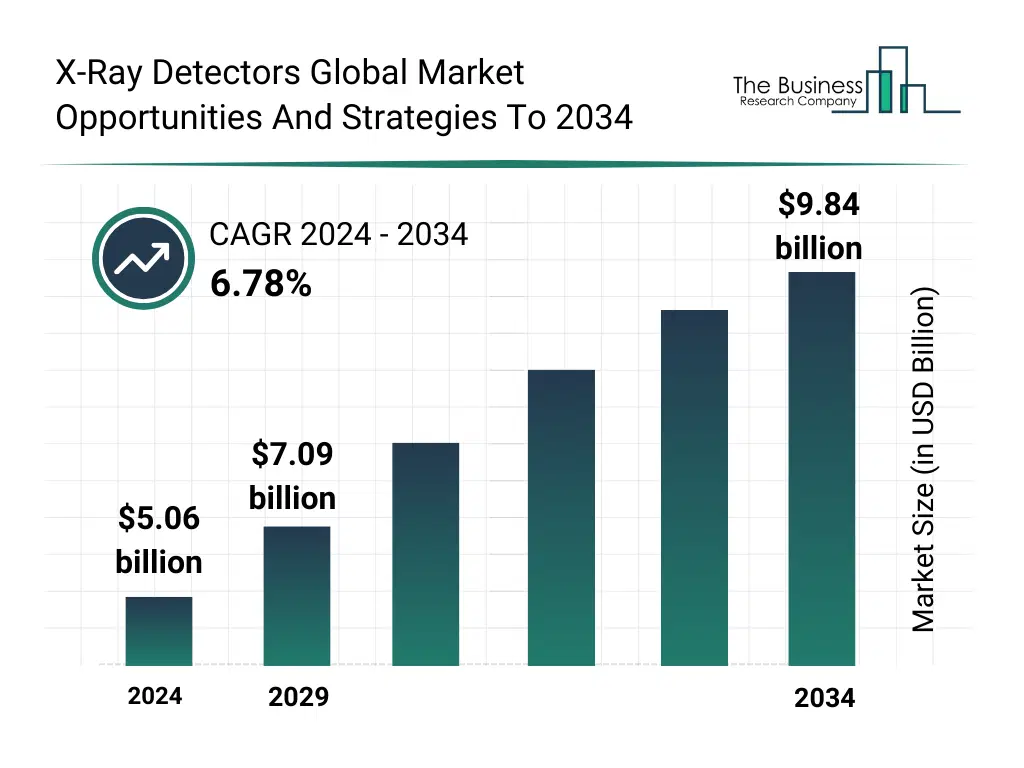
X-Ray Detectors Market Size
The global X-ray detectors market reached a value of nearly $5,055.23 million in 2024, having grown at a compound annual growth rate (CAGR) of 7.76% since 2019. The market is expected to grow from $5,055.23 million in 2024 to $7,088.47 million in 2029 at a rate of 6.99%. The market is then expected to grow at a CAGR of 6.78% from 2029 and reach $9,837.95 million in 2034. Growth in the historic period resulted from increasing adoption of minimally invasive procedures, expansion of healthcare infrastructure in emerging markets, growing demand for early and accurate diagnosis and increasing adoption of digital imaging. Factors that negatively affected growth in the historic period were health and safety concerns from radiation exposure and shortage of skilled professionals. Going forward, rising geriatric population, rising prevalence of chronic diseases and cancer, government support and investments in healthcare modernization and growing demand from industrial and security applications will drive the growth. Factor that could hinder the growth of the X-ray detectors market in the future include high initial cost and installation, stringent regulatory requirements and impact of trade war and tariff.X-Ray Detectors Market Drivers
The key drivers of the X-ray detectors market include: Rising Geriatric Population During the forecast period, the rising geriatric population will significantly propel the growth of the X-ray detectors market. An increasing share of the global population is aging, which leads to greater demand for diagnostic imaging because older individuals typically experience more health conditions requiring monitoring, screening, and follow-up. As people age, the incidence of bone disorders, degenerative joint diseases, osteoarthritis, osteoporosis, cardiovascular issues, and other age-related pathologies rises, all of which often require routine X-ray imaging to diagnose or monitor. This increase in imaging volume exerts pressure on hospitals and diagnostic centers to upgrade or expand their digital radiography capacities, particularly by investing in more sensitive, faster, and higher resolution X-ray detectors to handle larger throughput while maintaining image quality and reducing radiation dose. The trend also pushes innovation toward more user-friendly, portable, or bedside detectors so that elderly or mobility-impaired patients can be imaged more easily, increasing adoption of detector systems optimized for these use cases. The cumulative effect is that as geriatric population grows, more X-ray detectors are needed across healthcare infrastructure to meet the clinical demand. The rising geriatric population growth during the forecast period in 2024 is 1.03%.X-Ray Detectors Market Restraints
The key restraints on the X-ray detectors market include: High Initial Cost And Installation During the forecast period, the high initial cost and installation will restrain the growth of the X-ray detectors market. Advanced X-ray detector systems, especially flat-panel, CMOS (complementary metal-oxide-semiconductor), and photon-counting detectors, require substantial capital investment. Hospitals, diagnostic centers, and industrial users often face budget constraints, making it challenging to adopt the latest digital detector technologies. High upfront costs can delay procurement, limit the scale of adoption, or force facilities to continue using older analog systems. Installation of these systems also requires specialized infrastructure, including shielding, power, and integration with existing imaging and IT (information technology) workflows, adding to the initial expenditure. This financial barrier slows the overall market penetration and reduces the speed at which end-users can upgrade their imaging capabilities. Growth affected by high initial cost and installation during the forecast period in 2024 is -2.00%.X-Ray Detectors Market Trends
Major trends shaping the X-ray detectors market include: Adoption Of AI-Powered Image Processing For Diagnostic Accuracy Companies operating in the X-ray detectors are increasingly investing in AI-powered image processing solutions to enhance diagnostic accuracy, automate detection of critical pathologies, speed up workflow, and reduce radiologist workload. These algorithms are being embedded on-device (or tightly integrated), allowing for immediate feedback, alerting clinicians in real-time and enabling consistent image quality control. For example, in September 2025, Varex Imaging, a US-based medical imaging company, launched the XRD 3131N X-ray detector designed for high-throughput electric vehicle battery inspection. The detector integrates AI-powered imaging analytics to automatically identify defects, anomalies, and inconsistencies within battery cells, enabling faster and more accurate quality control. The XRD 3131N offers high resolution, rapid data acquisition, and robust performance, supporting manufacturers in meeting the growing demand for reliable, efficient, and intelligent battery inspection. Shift Toward Portable And Bedside Imaging Solutions Major companies in the X-ray detectors market are increasingly investing in digital and portable radiography solutions to enable imaging closer to patients (bedside or in mobile setups), reduce setup time, and improve workflow efficiency in hospitals and ambulatory care centers. These portable systems allow radiologic technologists to deliver high image quality at the point of care, lowering patient movement risks, enhancing safety for staff, and improving utilization of imaging of critical or remote areas. For instance, in July 2025, FUJIFILM Holdings Corporation, a Japan-based company engaged in the healthcare, materials, business innovation, and imaging businesses, launched the FDR (fujifilm digital radiography) Go iQ (intelligent quality), a full-size portable digital radiography system designed for hospitals and ambulatory surgery centers. It features a slim, lightweight design, retractable column, ultra-low profile, built-in touchscreen controls, and smart charging to bring x-ray room-level imaging to the patient bedside.Opportunities And Recommendations In The X-Ray Detectors Market
Opportunities – The top opportunities in the X-ray detectors markets segmented by technology will arise in the flat-panel detectors segment, which will gain $1,227.55 million of global annual sales by 2029. The top opportunities in the X-ray detectors markets segmented by portability will arise in the fixed segment, which will gain $1,055.88 million of global annual sales by 2029. The top opportunities in the X-ray detectors markets segmented by field of view will arise in the large field of view segment, which will gain $1,082.65 million of global annual sales by 2029. The top opportunities in the X-ray detectors markets segmented by application will arise in the medical segment, which will gain $1,292.76 million of global annual sales by 2029. The X-ray detectors market size will gain the most in the USA at $513.89 million. Recommendations- To take advantage of the opportunities, The Business Research Company recommends the X-ray detectors companies to focus on integrating AI-driven imaging to expand industrial and healthcare applications, focus on expanding portable and digital radiography to enhance point-of-care imaging, focus on advancing high-resolution flat-panel and CMOS detectors for precision imaging, focus on advancing digital detector technologies for industrial non-destructive testing, focus on developing rugged, high-throughput, and spectral detectors for industrial and security screening, focus on flat-panel detectors to drive sustainable growth, focus on portable flat panel detectors for sustained growth, focus on large field of view detectors to capture market leadership, expand in emerging markets, focus on strengthening multichannel distribution networks, focus on optimizing value-based pricing to strengthen market position, strengthen market presence through integrated digital engagement, enhance brand authority through strategic partnerships and thought leadership and focus on the medical segment for sustainable growth.X-Ray Detectors Market Segmentation
The X-ray detectors market is segmented by technology, by portability, by field of view and by application.By Technology –
The X-ray detectors market is segmented by technology into:
- a) Flat-Panel Detectors
- b) Computed Radiography Detectors
- c) Line-Scan Detectors
- d) Charge-Coupled Device Detectors
By Portability –
The X-ray detectors market is segmented by portability into:
- a) Fixed Wing
- b) Portable
By Field Of View –
The X-ray detectors market is segmented by field of view into:
- a) Large Field Of View FPDs
- b) Medium Field Of View FPDs
- c) Small Field Of View FPDs
By Application –
The X-ray detectors market is segmented by application into:
- a) Medical
- b) Security
- c) Veterinary
- d) Industrial
- e) Other Applications
By Geography - The X-ray detectors market is segmented by geography into:
- • China
- • India
- • Japan
- • Australia
- • Indonesia
- • South Korea
- • USA
- • Canada
- • Brazil
- • France
- • Germany
- • UK
- • Italy
- • Spain
- • Russia
-
o Asia Pacific
o Africa