
Yearly Disposable Contact Lenses Market Report 2026
Global Outlook – By Design Type (Spherical Lenses, Toric Lenses, Multifocal Or Bifocal Lenses, Custom Specialty Lenses, Colored Lenses), By Material Type (Hydrogel, Silicone Hydrogel, Rigid Gas Permeable (RGP)), By Wearing Modality (Daily Wear, Extended Wear), By Distribution Channel (Optical Stores, Eye Care Clinics, Hospitals, Online Retail, Other Distribution Channels), By End User (Corrective, Cosmetic, Therapeutic) – Market Size, Trends, Strategies, and Forecast to 2030
Yearly Disposable Contact Lenses Market Overview
• Yearly Disposable Contact Lenses market size has reached to $3.18 billion in 2025 • Expected to grow to $4.43 billion in 2030 at a compound annual growth rate (CAGR) of 6.9% • Growth Driver: Rising Global Prevalence of Refractive Errors Fueling the Growth Of The Market Due To Increasing Demand For Long-Term Vision Correction Solutions • Market Trend: Innovations In Artificial Intelligence (AI) Technology Enhance Enterprise Workflow Automation And Operational Efficiency • North America was the largest region in 2025 and Asia-Pacific is the fastest growing region.What Is Covered Under Yearly Disposable Contact Lenses Market?
Yearly disposable contact lenses are vision correction devices designed to be worn repeatedly and replaced after one year of use, provided they are properly cleaned, disinfected, and maintained according to manufacturer recommendations. They are engineered to provide clear vision, long-term comfort, durability, and effective correction of refractive errors while supporting ocular health through regular care and maintenance. The main design types of yearly disposable contact lenses include spherical lenses, toric lenses, multifocal or bifocal lenses, custom specialty lenses, and colored lenses. Spherical lenses refer to contact lenses with a uniform curvature across the surface, designed to correct common refractive errors such as nearsightedness and farsightedness by improving visual clarity. These lenses are manufactured using materials such as hydrogel, silicone hydrogel, and rigid gas permeable (RGP) and are available in daily wear and extended wear modalities. They are distributed through optical stores, eye care clinics, hospitals, online retail, and others and are utilized by end users including corrective, cosmetic, and therapeutic.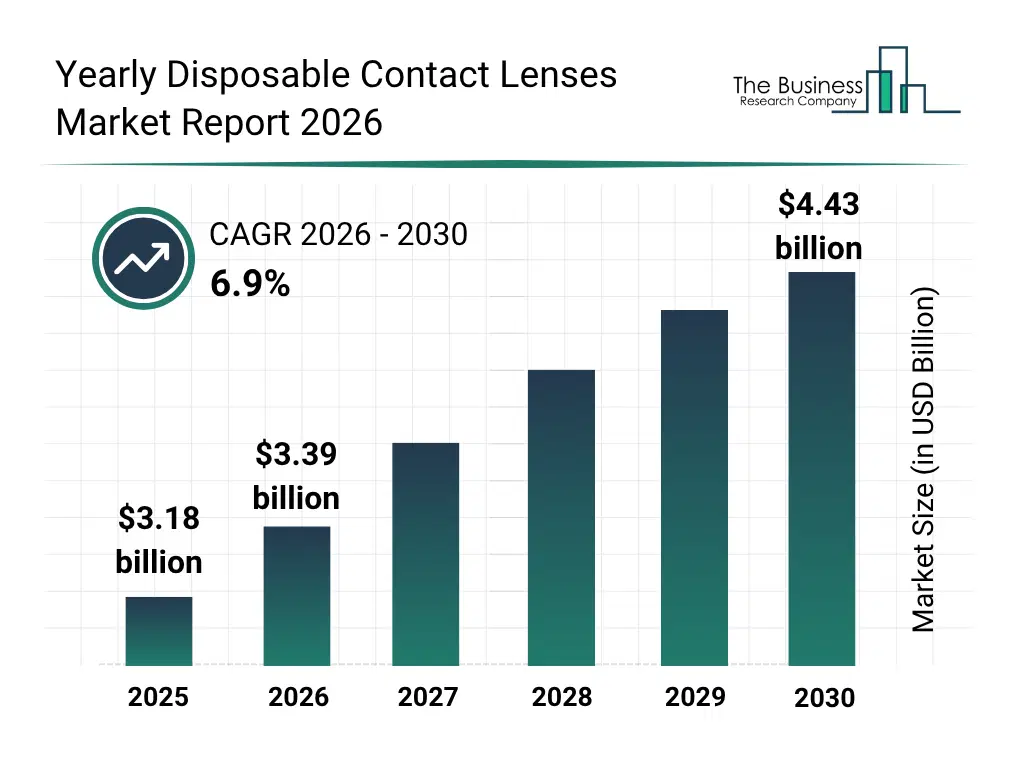
What Is The Yearly Disposable Contact Lenses Market Size and Share 2026?
The yearly disposable contact lenses market size has grown strongly in recent years. It will grow from $3.18 billion in 2025 to $3.39 billion in 2026 at a compound annual growth rate (CAGR) of 6.7%. The growth in the historic period can be attributed to increasing prevalence of refractive vision disorders, rising awareness of vision correction solutions, growing adoption of contact lenses among consumers, increasing demand for convenient alternatives to eyeglasses, expanding availability of vision care products through retail channels.What Is The Yearly Disposable Contact Lenses Market Growth Forecast?
The yearly disposable contact lenses market size is expected to see strong growth in the next few years. It will grow to $4.43 billion in 2030 at a compound annual growth rate (CAGR) of 6.9%. The growth in the forecast period can be attributed to increasing demand for customized contact lens solutions, rising focus on advanced eye care products, growing adoption of premium vision correction lenses, expanding online distribution of contact lenses, increasing consumer preference for comfortable and durable eyewear solutions. Major trends in the forecast period include increasing demand for advanced lens materials with improved comfort and durability, rising preference for long term vision correction solutions with enhanced wearability, growing focus on ocular health and improved contact lens maintenance practices, expanding availability of personalized vision correction options, increasing adoption of specialized contact lenses for diverse vision requirements.
Global Yearly Disposable Contact Lenses Market Segmentation
1) By Design Type: Spherical Lenses, Toric Lenses, Multifocal Or Bifocal Lenses, Custom Specialty Lenses, Colored Lenses 2) By Material Type: Hydrogel, Silicone Hydrogel, Rigid Gas Permeable (RGP) 3) By Wearing Modality: Daily Wear, Extended Wear 4) By Distribution Channel: Optical Stores, Eye Care Clinics, Hospitals, Online Retail, Other Distribution Channels 5) By End User: Corrective, Cosmetic, Therapeutic Subsegments: 1) By Spherical Lenses: Hydrogel Spherical Lenses, Silicone Hydrogel Spherical Lenses, Daily Wear Spherical Lenses, Extended Wear Spherical Lenses 2) By Toric Lenses: Hydrogel Toric Lenses, Silicone Hydrogel Toric Lenses, Daily Wear Toric Lenses, Extended Wear Toric Lenses 3) By Multifocal Or Bifocal Lenses: Hydrogel Multifocal Lenses, Silicone Hydrogel Multifocal Lenses, Daily Wear Multifocal Lenses, Extended Wear Multifocal Lenses 4) By Custom Specialty Lenses: Keratoconus Lenses, Post-Surgical Lenses, High Refractive Error Lenses, Irregular Cornea Lenses 5) By Colored Lenses: Visibility Tint Lenses, Enhancement Tint Lenses, Opaque Cosmetic Lenses, Prosthetic Colored LensesWhat Is The Driver Of The Yearly Disposable Contact Lenses Market?
The rising global prevalence of refractive error is expected to propel the growth of the yearly disposable contact lens market going forward. Refractive error refers to a vision condition in which the eye cannot properly focus light onto the retina, resulting in blurred vision. The prevalence of refractive error is due to increased screen time and near-work activities, which place prolonged visual stress on the eyes and contribute to the development of vision problems, particularly myopia. Yearly disposable contact lenses correct refractive errors by providing a stable, comfortable, and effective optical surface that accurately focuses light onto the retina, improving visual acuity in individuals with myopia, hyperopia, astigmatism, and, in some cases, presbyopia when properly prescribed and fitted. For instance, in June 2026, according to the PlenOptika, a US-based medical equipment manufacturing company, myopia is predicted to become a major public health concern, affecting approximately 40% of the global pediatric population by 2050. Therefore, the rising global prevalence of refractive error is driving the growth of the yearly disposable contact lens market.Key Players In The Global Yearly Disposable Contact Lenses Market
Major companies operating in the yearly disposable contact lenses market are Alcon Inc., The Cooper Companies Inc., Johnson & Johnson Vision Care Inc., Bausch + Lomb Corporation, Menicon Co. Ltd., SEED Co. Ltd., St. Shine Optical Co. Ltd., Interojo Inc., Gelflex Laboratories Pty Ltd, Solótica Indústria e Comércio Ltda., Dreamcon Co. Ltd., Maxvue Vision Sdn Bhd, SwissLens SA, Neo Vision Co. Ltd., Cantor & Nissel Limited, Vision Science Co. Ltd., Medios Co. Ltd., Sun Contact Lens Co. Ltd., NEO Plus Co. Ltd., Omni Lens Private Limited, Bella Contact Lens, Orion Vision Group B.V.
This chart is for illustrative purposes; the full report includes a detailed competitor analysis and comprehensive overview of the top 10 companies in the market.
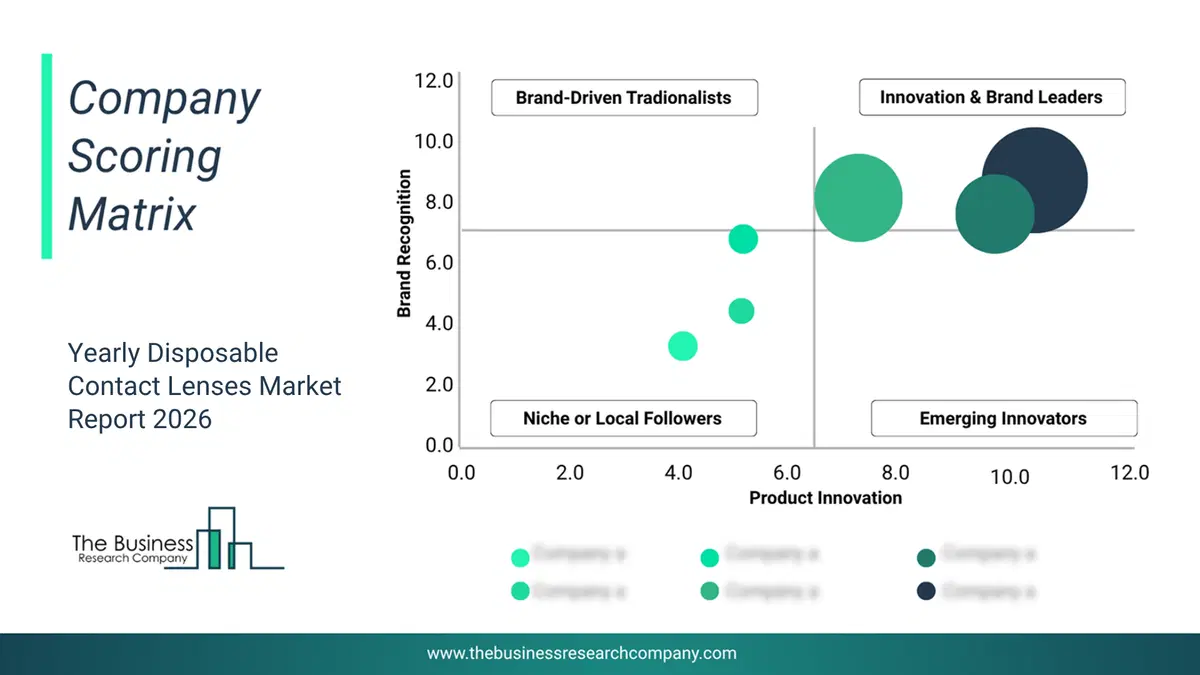
This chart maps companies by product innovation and brand strength, with bubble size indicating relative revenue, helping identify market leaders, challengers, and niche players. This is an illustrative chart; the full report provides a complete and accurate competitive analysis.
Global Yearly Disposable Contact Lenses Market Trends and Insights
Major companies operating in the yearly disposable contact lenses market are increasingly prioritizing private-label contact lens portfolios, advanced silicone hydrogel materials, and practice-focused lens programs to improve patient convenience, strengthen eye-care provider loyalty, and support practice profitability. Advanced silicone hydrogel materials are breathable contact lens materials designed to allow more oxygen to reach the eye while providing comfort and maintaining lens performance. For instance, in May 2026, Professional Eye Care Associates of America (PECAA), a US-based eye-care organization, launched PECAA promise, a customer-brand contact lens portfolio comprising PECAA promise 1 day and PECAA promise 1 day premium. The lenses are manufactured by CooperVision and use silicone hydrogel technology, with options covering sphere, toric, and multifocal prescriptions. Vision Monday – PECAA launches Promise customer-brand contact lenses. It is offering a private-label range with broad prescription coverage and daily replacement convenience, PECAA aims to help eye-care practices strengthen patient loyalty, retain contact-lens business, and improve practice profitability while providing patients with convenient lens options.What Are Latest Mergers And Acquisitions In The Yearly Disposable Contact Lenses Market?
In June 2025, Carl Zeiss Vision International GmbH, a Germany-based company that provides vision care products and solutions, acquired 100% of the shares of Brighten Optix for an undisclosed amount. Through this acquisition, Carl Zeiss Vision International aims to strengthen its myopia management portfolio by integrating Brighten Optix’s specialty contact lenses and orthokeratology solutions, expanding its offerings for progressive myopia management. Brighten Optix Corporation is a Taiwan-based company that provides orthokeratology and specialty contact lenses, yearly disposable contact lenses including myopia management products such as myOK, for eye care professionals and clinics.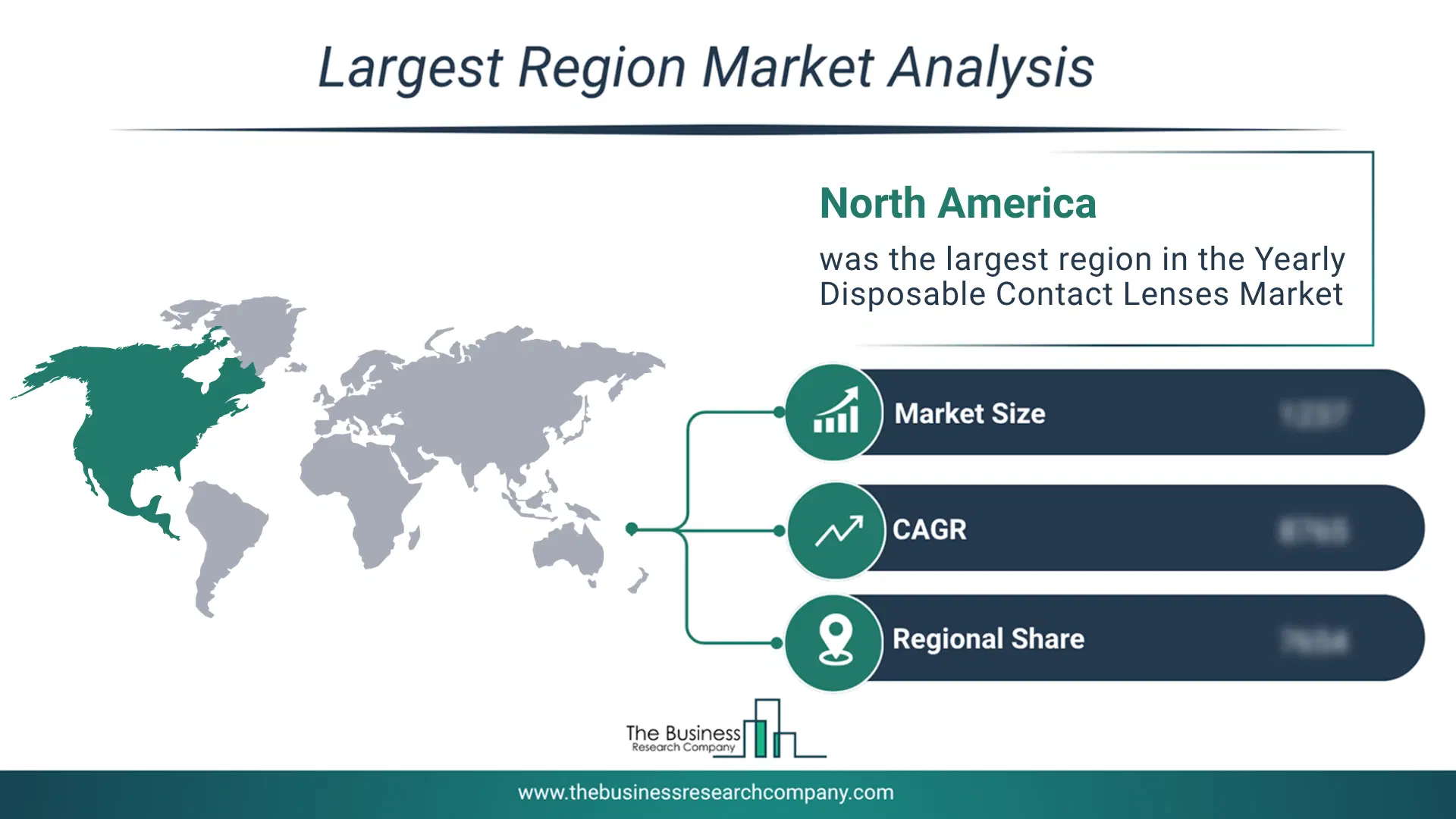
Regional Outlook
North America was the largest region in the yearly disposable contact lenses market in 2025. Asia-Pacific is expected to be the fastest-growing region in the forecast period. The regions covered in this market report are Asia-Pacific, South East Asia, Western Europe, Eastern Europe, North America, South America, Middle East, Africa. The countries covered in this market report are Australia, Brazil, China, France, Germany, India, Indonesia, Japan, Taiwan, Russia, South Korea, UK, USA, Canada, Italy, Spain.What Defines the Yearly Disposable Contact Lenses Market?
The yearly disposable contact lenses market consists of sales of spherical yearly contact lenses, toric yearly contact lenses, multifocal yearly contact lenses, bifocal yearly contact lenses, colored yearly contact lenses, cosmetic yearly contact lenses, custom prescription yearly contact lenses, and specialty yearly contact lenses. Values in this market are ‘factory gate’ values, that is, the value of goods sold by the manufacturers or creators of the goods, whether to other entities (including downstream manufacturers, wholesalers, distributors, and retailers) or directly to end customers. The value of goods in this market includes related services sold by the creators of the goods.How is Market Value Defined and Measured?
The market value is defined as the revenues that enterprises gain from the sale of goods and/or services within the specified market and geography through sales, grants, or donations in terms of the currency (in USD unless otherwise specified). The revenues for a specified geography are consumption values that are revenues generated by organizations in the specified geography within the market, irrespective of where they are produced. It does not include revenues from resales along the supply chain, either further along the supply chain or as part of other products.
This chart presents market attractiveness based on a quantitative evaluation of growth, competition, strategic alignment, and risk, offering a clear view of opportunity areas for decision-making. This chart is for illustrative purposes; the full report contains the complete analysis.

This chart highlights the Total Addressable Market (TAM) by estimating the maximum revenue opportunity using an assumption-driven approach, supporting strategic planning and opportunity sizing across markets. The chart is illustrative; the full report provides a more comprehensive analysis.
What Key Data and Analysis Are Included in the Yearly Disposable Contact Lenses Market Report 2026?
The yearly disposable contact lenses market research report is one of a series of new reports from The Business Research Company that provides market statistics, including industry global market size, regional shares, competitors with the market share, detailed market segments, market trends and opportunities, and any further data you may need to thrive in the yearly disposable contact lenses industry. The market research report delivers a complete perspective of everything you need, with an in-depth analysis of the current and future state of the industry.Yearly Disposable Contact Lenses Market Report Forecast Analysis
| Report Attribute | Details |
|---|---|
| Market Size Value In 2026 | $3.39 billion |
| Revenue Forecast In 2030 | $4.43 billion |
| Growth Rate | CAGR of 6.9% from 2026 to 2030 |
| Base Year For Estimation | 2025 |
| Actual Estimates/Historical Data | 2020-2025 |
| Forecast Period | 2026 - 2030 |
| Market Representation | Revenue in USD Billion and CAGR from 2026 to 2030 |
| Segments Covered | Design Type, Material Type, Wearing Modality, Distribution Channel, End User |
| Regional Scope | Asia-Pacific, Western Europe, Eastern Europe, North America, South America, Middle East, Africa |
| Country Scope | The countries covered in the report are Australia, Brazil, China, France, Germany, India, Indonesia, Japan, Taiwan, Russia, South Korea, UK, USA, Canada, Italy, Spain. |
| Key Companies Profiled | Alcon Inc., The Cooper Companies Inc., Johnson & Johnson Vision Care Inc., Bausch + Lomb Corporation, Menicon Co. Ltd., SEED Co. Ltd., St. Shine Optical Co. Ltd., Interojo Inc., Gelflex Laboratories Pty Ltd, Solótica Indústria e Comércio Ltda., Dreamcon Co. Ltd., Maxvue Vision Sdn Bhd, SwissLens SA, Neo Vision Co. Ltd., Cantor & Nissel Limited, Vision Science Co. Ltd., Medios Co. Ltd., Sun Contact Lens Co. Ltd., NEO Plus Co. Ltd., Omni Lens Private Limited, Bella Contact Lens, Orion Vision Group B.V. |
| Customization Scope | Request for Customization |
| Pricing And Purchase Options | Explore Purchase Options |