
Zero Emission Vehicle Market Report 2026
Global Outlook – By Vehicle Type (Battery Electric Vehicle (BEV), Fuel Cell Electric Vehicle (FCEV)), By Vehicle Drive Type (Front Wheel Drive, Rear Wheel Drive, All Wheel Drive), By Application (Commercial Vehicle, Passenger Vehicle, Two Wheelers), By End-Use Industry (Government, Public Transportation, Logistics) – Market Size, Trends, Strategies, and Forecast to 2030
Zero Emission Vehicle Market Overview
• Zero Emission Vehicle market size has reached to $334.9 billion in 2025 • Expected to grow to $923.41 billion in 2030 at a compound annual growth rate (CAGR) of 22.6% • Growth Driver: Climate Change Impact And The Acceleration Of Zero-Emission Vehicles • Market Trend: Innovative Developments In Zero-Emission Vehicle Market • North America was the largest region in 2025 and Asia-Pacific is the fastest growing region.What Is Covered Under Zero Emission Vehicle Market?
Zero-emission vehicle refers to any vehicle that uses a propulsion system that does not emit gasoline, diesel, or other carbon emissions when in operation. Zero-emission vehicles are considered environmentally friendly as they help reduce air pollution and decrease dependence on fossil fuels, combating climate change and promoting sustainable transportation. The main types of zero-emission vehicles are battery electric vehicles (BEV), plug-in hybrid electric vehicles (PHEV), and fuel cell electric vehicles (FCEV). A battery electric vehicle (BEV) refers to a vehicle or truck that gets all its power from the batteries alone, without the support of another engine, and is used as a zero-emission vehicle as it does not produce any air pollution hazards or harmful emissions. These vehicles can be operated in drive types such as front-wheel drive, rear-wheel drive, and all-wheel drive, powered by various sources of gasoline, diesel, compressed natural gas (CNG), and others, and are used in applications including commercial vehicles, passenger vehicles, and two-wheelers. The end users are the government, public transportation, and logistics industries.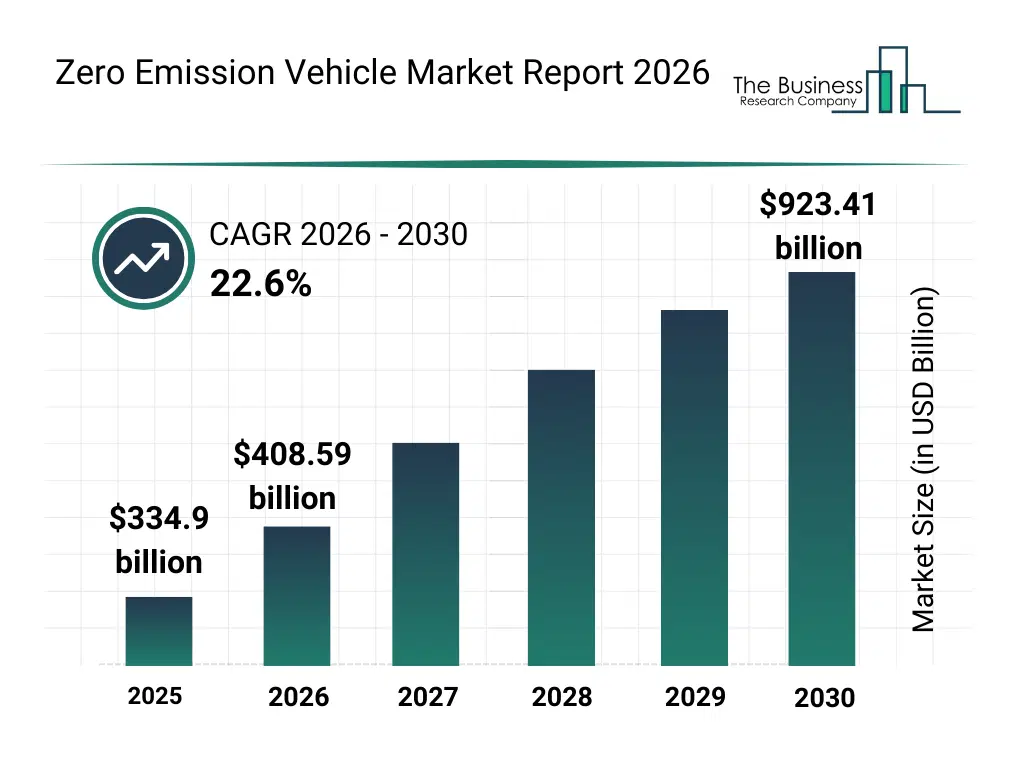
What Is The Zero Emission Vehicle Market Size and Share 2026?
The zero emission vehicle market size has grown exponentially in recent years. It will grow from $334.9 billion in 2025 to $408.59 billion in 2026 at a compound annual growth rate (CAGR) of 22.0%. The growth in the historic period can be attributed to emission regulations, early ev adoption, fuel price volatility, government subsidies, urban air pollution.What Is The Zero Emission Vehicle Market Growth Forecast?
The zero emission vehicle market size is expected to see exponential growth in the next few years. It will grow to $923.41 billion in 2030 at a compound annual growth rate (CAGR) of 22.6%. The growth in the forecast period can be attributed to electric vehicle cost reduction, charging network expansion, battery technology advancements, zero emission mandates, fleet electrification. Major trends in the forecast period include rapid adoption of battery electric vehicles, expansion of charging infrastructure, growth of fuel cell vehicles, rising government incentives, oem electrification strategies.
Global Zero Emission Vehicle Market Segmentation
1) By Vehicle Type: Battery Electric Vehicle (BEV), Fuel Cell Electric Vehicle (FCEV) 2) By Vehicle Drive Type: Front Wheel Drive, Rear Wheel Drive, All Wheel Drive 3) By Application: Commercial Vehicle, Passenger Vehicle, Two Wheelers 4) By End-Use Industry: Government, Public Transportation, Logistics Subsegments: 1) By Battery Electric Vehicle (BEV): Small BEVs, Medium BEVs, Large BEVs 2) By Fuel Cell Electric Vehicle (FCEV): Passenger FCEV, Commercial FCEVWhat Is The Driver Of The Zero Emission Vehicle Market?
The increasing climatic change is expected to boost the growth of the zero-emission vehicle market going forward. Climate change involves enduring modifications in temperature, precipitation, wind patterns, and various elements of the Earth's climate system over an extended period. As the urgency to combat climate change intensifies, zero-emission vehicles (ZEVs) are increasingly seen as a critical weapon, as it reduces transportation-related CO2 emissions, helping to curb global warming and its devastating effects. For instance, in October 2023, according to a report published by the World Health Organization (WHO), a Switzerland-based intergovernmental organization, about 3.6 billion individuals reside in regions highly vulnerable to the impacts of climate change by 2023. It is projected that from 2030 to 2050, climate change will lead to an estimated annual increase of approximately 250,000 deaths due to factors such as undernutrition, malaria, diarrhea, and heat stress. Therefore, increasing climatic change is driving the growth of the zero-emission vehicle market.Key Players In The Global Zero Emission Vehicle Market
Major companies operating in the zero emission vehicle market report include Volkswagen AG, Toyota Motor Corporation, Mercedes-Benz Group AG, Ford Motor Company, General Motors, Bayerische Motoren Werke AG (BMW), Hyundai Motor Company, Tesla Inc., Nissan Motor Co. Ltd., Audi AG, Kia Corporation, BYD Company Limited, Nikola Corporation, Renault Group, AB Volvo, Porsche AG, Jaguar Land Rover Automotive PLC, Geely Automobile Holdings Limited, NIO Inc., XPeng Inc., Rivian Automotive LLC, Lucid Group Inc., Proterra Inc., Energica Motor Company S.p.A., Bollinger Motors, Workhorse Group Inc., Fisker Inc.
This chart is for illustrative purposes; the full report includes a detailed competitor analysis and comprehensive overview of the top 10 companies in the market.
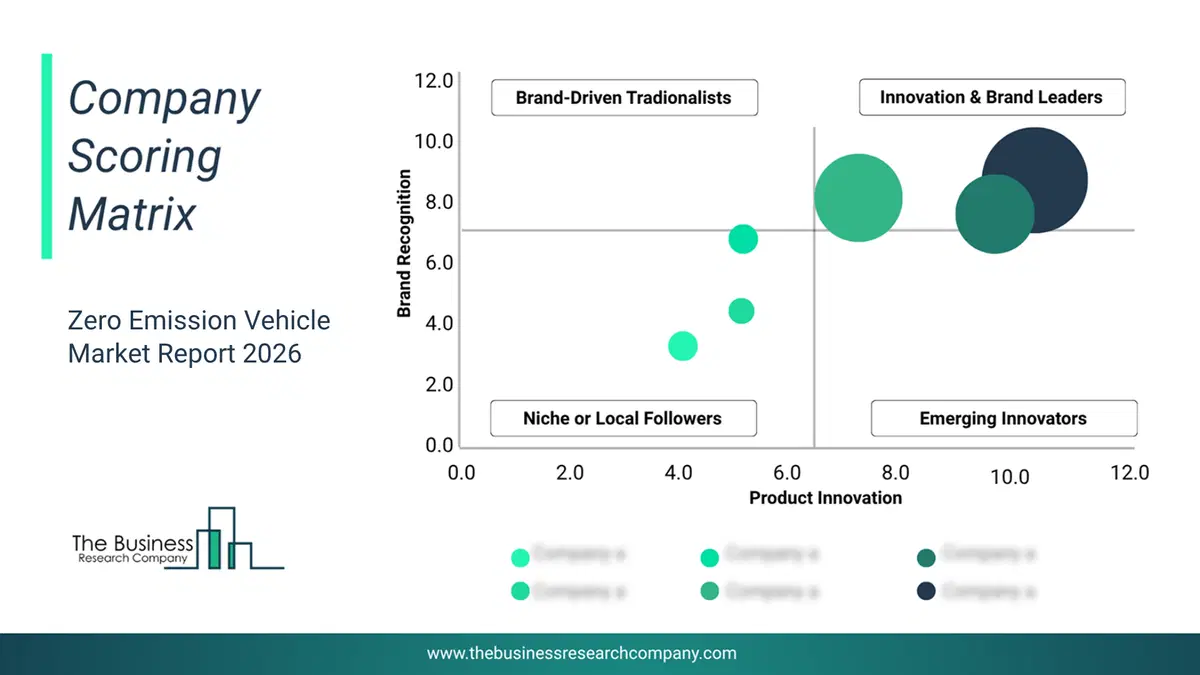
This chart maps companies by product innovation and brand strength, with bubble size indicating relative revenue, helping identify market leaders, challengers, and niche players. This is an illustrative chart; the full report provides a complete and accurate competitive analysis.
Global Zero Emission Vehicle Market Trends and Insights
Major companies operating in the zero-emission vehicle market are focusing on developing innovative solutions, such as fully electric commercial trucks with configurable body types and advanced powertrains, to expand operational versatility and sustainability compared with traditional diesel trucks. These vehicles feature modular designs, multiple drivetrain options, and high-capacity battery systems, enabling longer ranges and optimized performance for specific applications. For instance, in May 2023, Daimler Truck AG, a Germany-based commercial vehicle manufacturer, launched the RIZON line of zero-emission electric trucks. The RIZON trucks offer multiple configurations including dry vans, flatbeds, landscaping dumps, and reefers, integrate efficient electric drivetrains with battery management systems, and provide tailored options for urban retail logistics; unique benefits include reduced greenhouse gas emissions, lower operating costs, flexible application across industries, and improved efficiency for last-mile delivery and specialized commercial operations.What Are Latest Mergers And Acquisitions In The Zero Emission Vehicle Market?
In February 2023, Lloyds Banking Group plc, a UK-based financial services company, acquired Tusker for an undisclosed amount. With this acquisition, Lloyds Banking Group sought to expand its vehicle-leasing business and accelerate its push into sustainable transportation by integrating low-emission vehicle leasing into its offerings. Tuskerdirect Limited is a UK-based vehicle management and leasing company that specialises in providing electric vehicles (EVs) and ultra-low emission vehicles (ULEVs) to companies via salary-sacrifice car‐benefit schemes.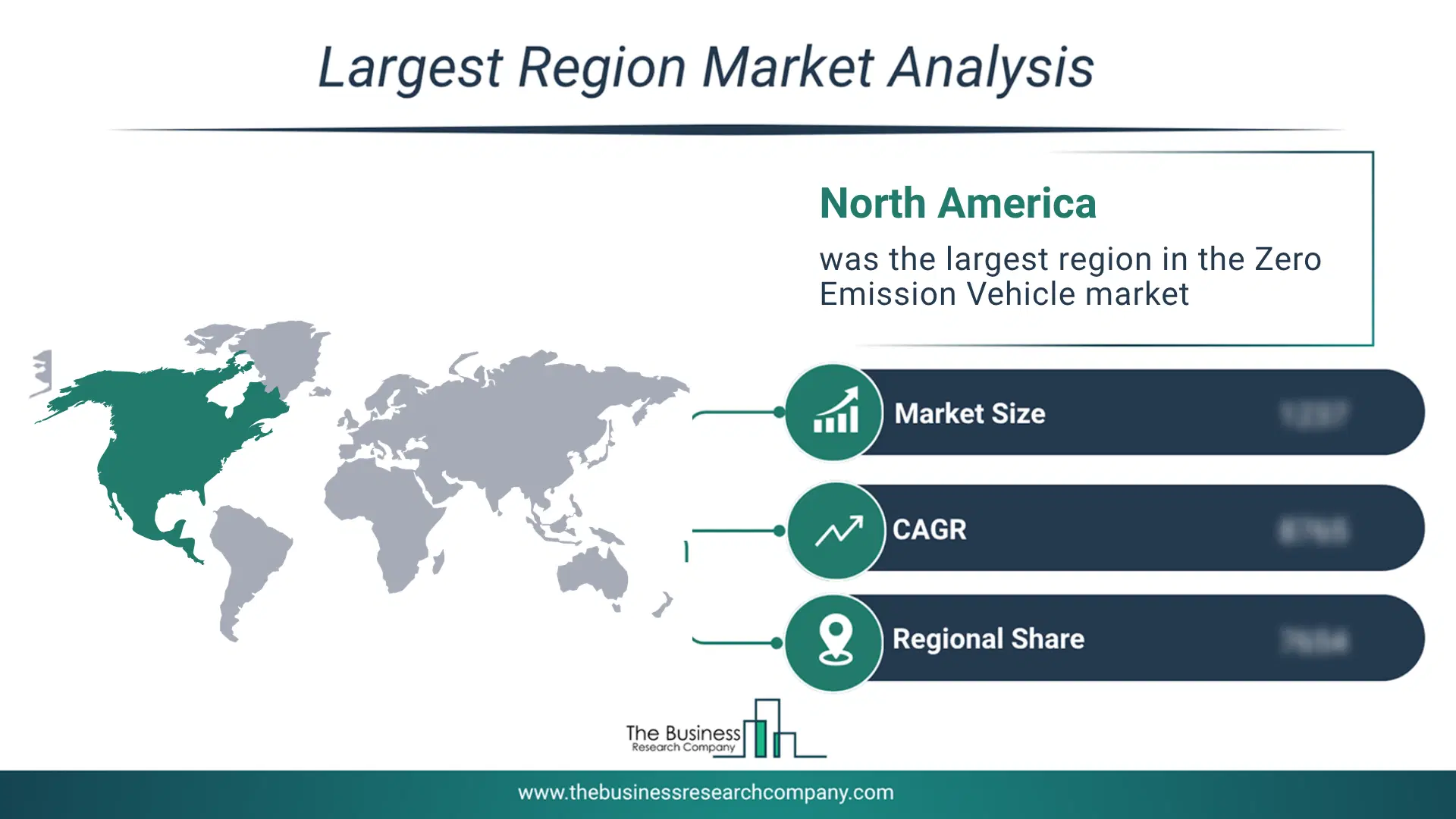
Regional Outlook
North America was the largest region in the zero-emission vehicle market in 2025. Asia-Pacific is expected to be the fastest-growing region in the zero-emission vehicle market report during the forecast period. The regions covered in this market report include Asia-Pacific, South East Asia, Western Europe, Eastern Europe, North America, South America, Middle East, Africa. The countries covered in this market report include Australia, Brazil, China, France, Germany, India, Indonesia, Japan, Taiwan, Russia, South Korea, UK, USA, Canada, Italy, SpainWhat Defines the Zero Emission Vehicle Market?
The zero-emission vehicle market consists of sales of traction battery packs, electric motors, onboard chargers, power inverters and charge ports. Values in this market are ‘factory gate’ values, that is the value of goods sold by the manufacturers or creators of the goods, whether to other entities (including downstream manufacturers, wholesalers, distributors and retailers) or directly to end customers. The value of goods in this market includes related services sold by the creators of the goods.How is Market Value Defined and Measured?
The market value is defined as the revenues that enterprises gain from the sale of goods and/or services within the specified market and geography through sales, grants, or donations in terms of the currency (in USD unless otherwise specified). The revenues for a specified geography are consumption values that are revenues generated by organizations in the specified geography within the market, irrespective of where they are produced. It does not include revenues from resales along the supply chain, either further along the supply chain or as part of other products.
This chart presents market attractiveness based on a quantitative evaluation of growth, competition, strategic alignment, and risk, offering a clear view of opportunity areas for decision-making. This chart is for illustrative purposes; the full report contains the complete analysis.

This chart highlights the Total Addressable Market (TAM) by estimating the maximum revenue opportunity using an assumption-driven approach, supporting strategic planning and opportunity sizing across markets. The chart is illustrative; the full report provides a more comprehensive analysis.
What Key Data and Analysis Are Included in the Zero Emission Vehicle Market Report 2026?
The zero emission vehicle market research report is one of a series of new reports from The Business Research Company that provides market statistics, including industry global market size, regional shares, competitors with the market share, detailed market segments, market trends and opportunities, and any further data you may need to thrive in the zero emission vehicle industry. The market research report delivers a complete perspective of everything you need, with an in-depth analysis of the current and future state of the industry.Zero Emission Vehicle Market Report Forecast Analysis
| Report Attribute | Details |
|---|---|
| Market Size Value In 2026 | $408.59 billion |
| Revenue Forecast In 2030 | $923.41 billion |
| Growth Rate | CAGR of 22.0% from 2026 to 2030 |
| Base Year For Estimation | 2025 |
| Actual Estimates/Historical Data | 2020-2025 |
| Forecast Period | 2026 - 2030 - 2030 |
| Market Representation | Revenue in USD Billion and CAGR from 2026 to 2030 |
| Segments Covered | Vehicle Type, Vehicle Drive Type, Application, End-Use Industry |
| Regional Scope | Asia-Pacific, Western Europe, Eastern Europe, North America, South America, Middle East, Africa |
| Country Scope | The countries covered in the report are Australia, Brazil, China, France, Germany, India, Indonesia, Japan, Taiwan, Russia, South Korea, UK, USA, Canada, Italy, Spain. |
| Key Companies Profiled | Volkswagen AG, Toyota Motor Corporation, Mercedes-Benz Group AG, Ford Motor Company, General Motors, Bayerische Motoren Werke AG (BMW), Hyundai Motor Company, Tesla Inc., Nissan Motor Co. Ltd., Audi AG, Kia Corporation, BYD Company Limited, Nikola Corporation, Renault Group, AB Volvo, Porsche AG, Jaguar Land Rover Automotive PLC, Geely Automobile Holdings Limited, NIO Inc., XPeng Inc., Rivian Automotive LLC, Lucid Group Inc., Proterra Inc., Energica Motor Company S.p.A., Bollinger Motors, Workhorse Group Inc., Fisker Inc. |
| Customization Scope | Request for Customization |
| Pricing And Purchase Options | Explore Purchase Options |