
Zero Liquid Discharge Systems Market Report 2026
Global Outlook – By System (Conventional ZLD systems, Hybrid ZLD systems), By Process (Pretreatment, Filtration, Evaporation), By Technology (Thermal based, Membrane based), By Application (Power generation, Oil & Gas, Chemicals & Petrochemicals, Mining and metallurgy, Pharmaceuticals, Other Applications) – Market Size, Trends, Strategies, and Forecast to 2030
Zero Liquid Discharge Systems Market Overview
• Zero Liquid Discharge Systems market size has reached to $7.02 billion in 2025 • Expected to grow to $10.6 billion in 2030 at a compound annual growth rate (CAGR) of 8.6% • Growth Driver: Rapid Urbanization Accelerates The Zero Liquid Discharge Systems Market Growth • Market Trend: Advanced High-Recovery Treatment Technologies Accelerating Water Reuse And Resource Efficiency • North America was the largest region in 2025 and Asia-Pacific is the fastest growing region.What Is Covered Under Zero Liquid Discharge Systems Market?
Zero liquid discharge (ZLD) systems are advanced water treatment processes designed to completely eliminate liquid waste discharge from industrial plants. These systems treat wastewater by recycling and recovering as much water as possible, often reusing it within the facility, and converting the remaining waste into solid residue that can be disposed of or processed further. The main types of zero-liquid discharge systems are conventional ZLD systems and hybrid ZLD systems. A conventional Zero Liquid Discharge (ZLD) system is a treatment method for removing all liquid waste from a system. The processes include pretreatment, filtration, and evaporation by using various technologies such as thermal-based and membrane-based for different applications including power generation, oil and gas, chemicals and petrochemicals, mining and metallurgy, pharmaceuticals, and other applications.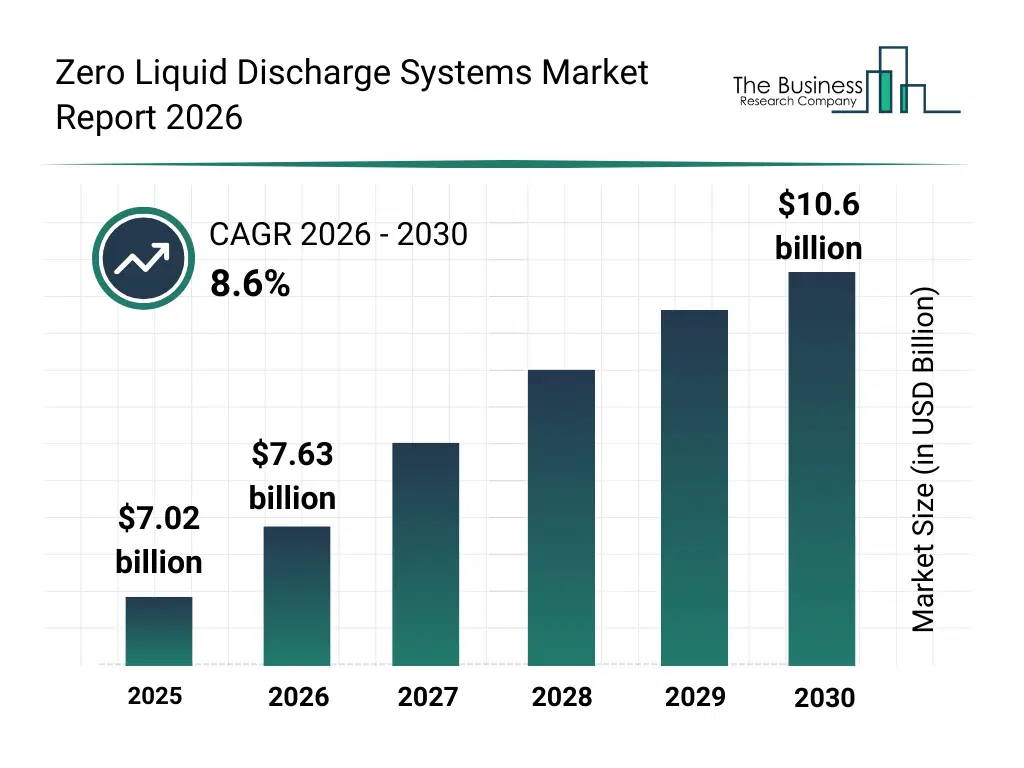
What Is The Zero Liquid Discharge Systems Market Size and Share 2026?
The zero liquid discharge systems market size has grown strongly in recent years. It will grow from $7.02 billion in 2025 to $7.63 billion in 2026 at a compound annual growth rate (CAGR) of 8.7%. The growth in the historic period can be attributed to industrial water pollution control, regulatory discharge limits, expansion of thermal power plants, water scarcity concerns, growth in heavy industries.What Is The Zero Liquid Discharge Systems Market Growth Forecast?
The zero liquid discharge systems market size is expected to see strong growth in the next few years. It will grow to $10.6 billion in 2030 at a compound annual growth rate (CAGR) of 8.6%. The growth in the forecast period can be attributed to stricter environmental regulations, rising industrial water reuse needs, expansion of petrochemical projects, growth in mining operations, adoption of circular water management. Major trends in the forecast period include rising adoption of industrial water recycling, expansion of hybrid zld system deployments, growing use of membrane based technologies, integration of energy efficient evaporation systems, focus on complete wastewater elimination.Tariff Impact On Zero Liquid Discharge Systems Market
Tariffs have impacted the zero liquid discharge systems market by increasing the cost of imported membranes, evaporators, crystallizers, and automation components, raising project implementation costs. The impact is most pronounced in thermal based and hybrid ZLD systems, particularly in Asia Pacific and the Middle East. These pressures have influenced project phasing decisions. At the same time, tariffs are promoting domestic equipment manufacturing and localized ZLD system integration.
Global Zero Liquid Discharge Systems Market Segmentation
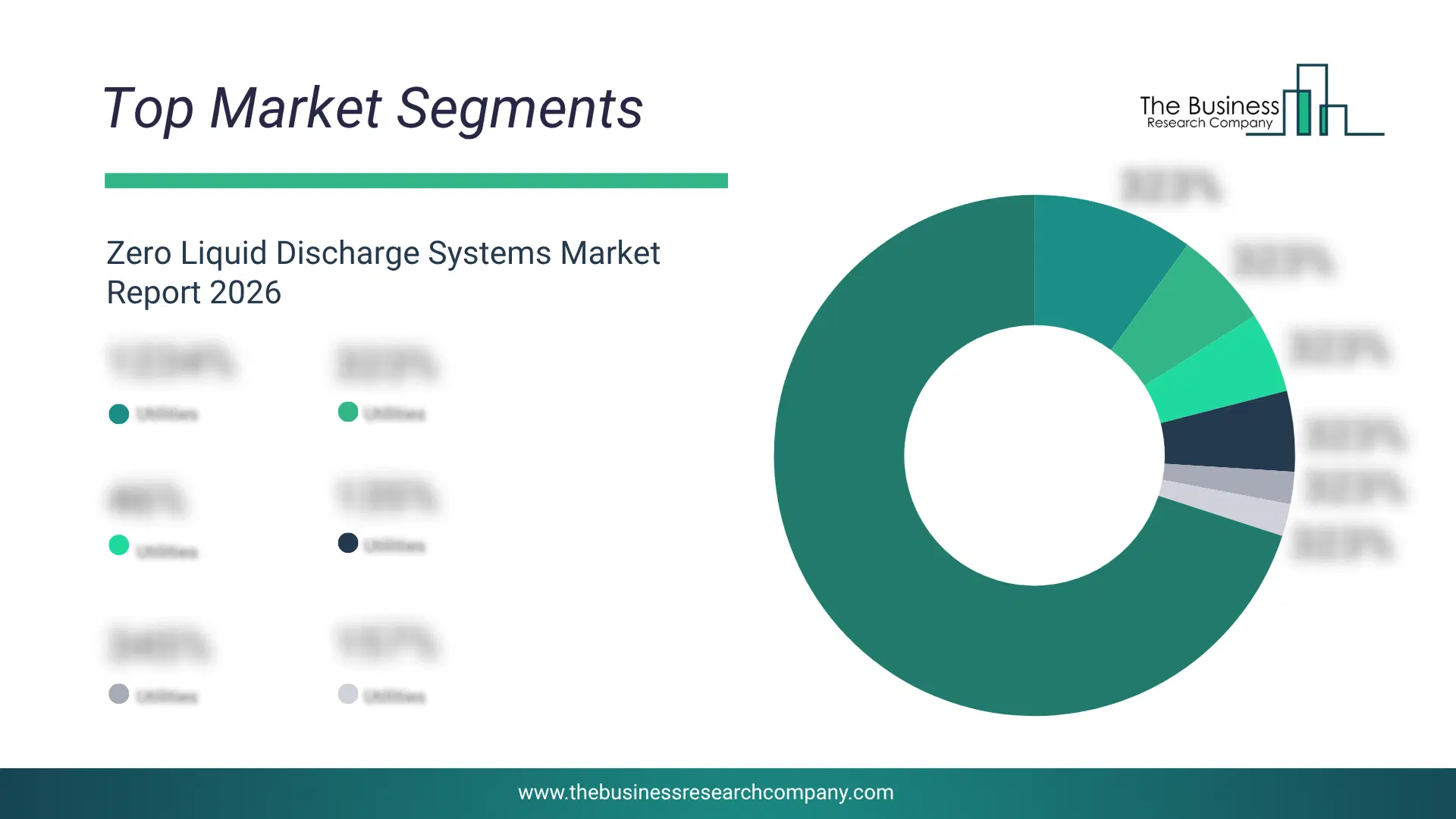
1) By System: Conventional ZLD systems, Hybrid ZLD systems 2) By Process: Pretreatment, Filtration, Evaporation 3) By Technology: Thermal based, Membrane based 4) By Application: Power generation, Oil & Gas, Chemicals & Petrochemicals, Mining and metallurgy, Pharmaceuticals, Other Applications Subsegments: 1) By Conventional ZLD Systems: Evaporation and Crystallization Systems, Reverse Osmosis (RO) Systems, Mechanical Vapor Compression (MVC) Systems, Multi-Effect Distillation (MED) Systems, Zero Liquid Discharge Wastewater Treatment Plants 2) By Hybrid ZLD Systems: Combination of Membrane and Thermal Technologies, Custom Hybrid SystemsWhat Is The Driver Of The Zero Liquid Discharge Systems Market?
The growth in urbanization is expected to propel the growth of the zero liquid discharge systems market going forward. Urbanization refers to the mass movement of populations from rural areas to urban areas. Urbanization favors the demand for zero liquid discharge systems due to the increasing need for energy and water. For instance, according to a report published by the World Bank, a US-based international organization, in 2022, more than 50% of the world's population reside in urban regions. The number of people living in urban areas is projected to rise to 6 billion by 2045, a 1.5-fold increase. By 2030, the world is predicted to have 1.2 million km2 more of urban built-up area as urban land consumption is expected to continue to expand at a rate that is up to 50% faster than population growth. Therefore, growth in urbanization is driving the growth of zero liquid discharge systems industry.Key Players In The Global Zero Liquid Discharge Systems Market
Major companies operating in the zero liquid discharge systems market are Alfa Laval AB, Aquatech International LLC, ENCON Evaporators, GEA Group, Oasys Water Inc., Veolia Water Technologies, Suez SA, Condorchem Envitech, Evoqua Water Technologies LLC, Aquarion AG, IDE Technologies Ltd., Thermax Global, GE Water & Process Technologies, 3v Green Eagle SpA, Doosan Hydro Technology, Praj Industries Limited, Andritz AG, H2O GmbH, SafBon Water Technology (Shanghai) Co. Ltd., Ion Exchange India Ltd., Toshiba Infrastructure Systems & Solutions Corporation, Petro Sep Corporation, Fluence Corporation Limited, Kurita Water Industries Ltd., Arvind Envisol Limited, Hydro Air Research Italia S.r.l., Samco Technologies Inc., Lenntech B.V., Saltworks Technologies Inc.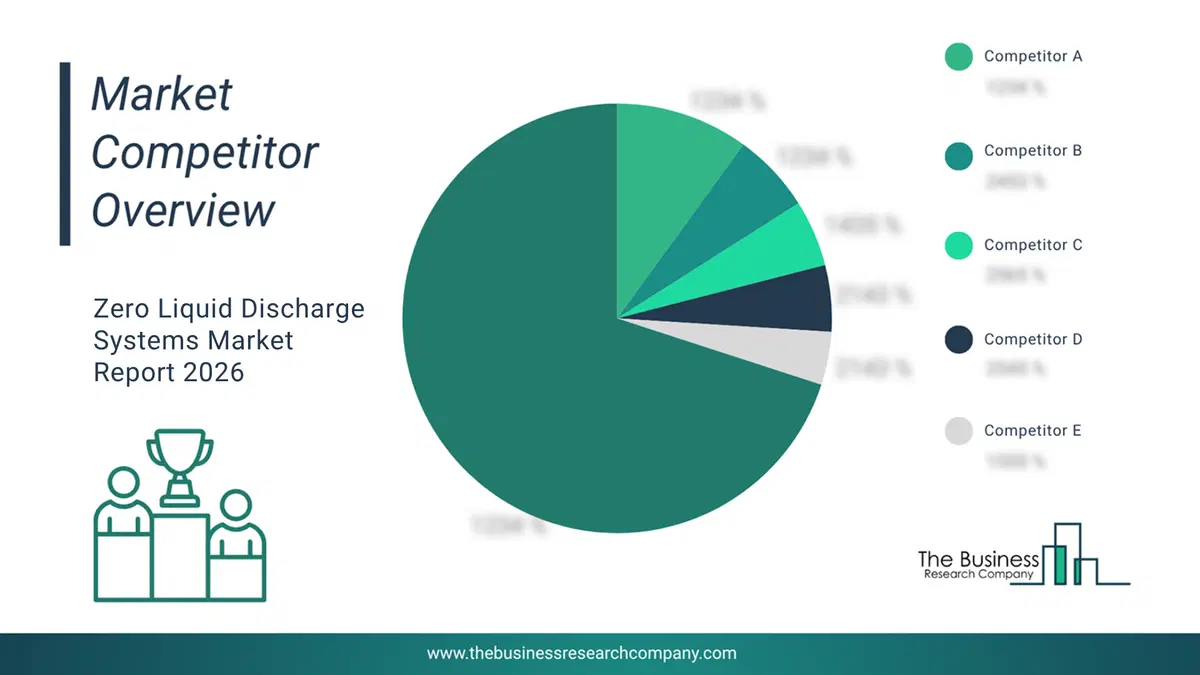
This chart is for illustrative purposes; the full report includes a detailed competitor analysis and comprehensive overview of the top 10 companies in the market.
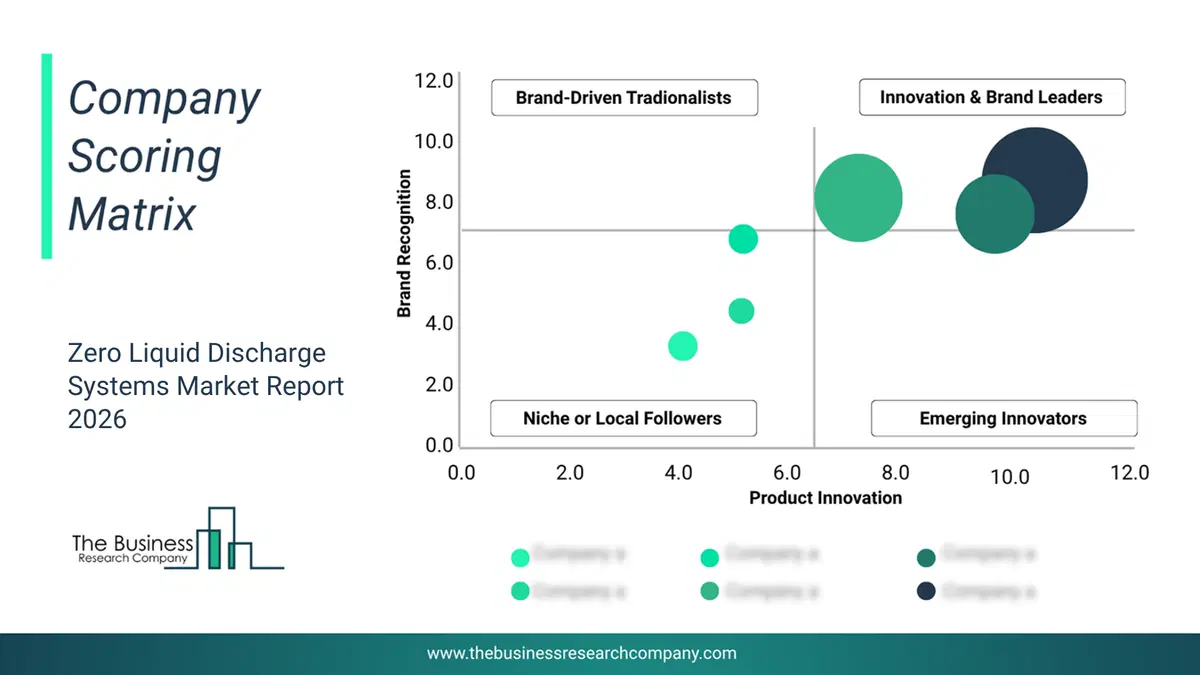
This chart maps companies by product innovation and brand strength, with bubble size indicating relative revenue, helping identify market leaders, challengers, and niche players. This is an illustrative chart; the full report provides a complete and accurate competitive analysis.
Global Zero Liquid Discharge Systems Market Trends and Insights
Major companies operating in the zero liquid discharge systems market are focusing on developing advanced, high-recovery treatment technologies such as electrodialysis reversal solutions that enhance water reuse, improve resource recovery, minimize fouling and maintenance, and support efficient operation under challenging industrial conditions. For instance, in October 2025, QUA, a US-based membrane technology company, has launched EDR-Q, an advanced electrodialysis reversal technology designed for high-recovery desalination, water reuse, and specialized process applications. Expanding QUA’s membrane portfolio, EDR-Q supports industries such as food and beverage, critical minerals, and wastewater treatment by enabling selective ion removal and efficient resource recovery. The system uses automatic polarity reversal to limit fouling and scaling, allowing up to 95% water recovery and reliable performance under high silica, sulfate, and turbidity conditions. With chemical-free in situ cleaning, broad pH tolerance, and low-maintenance operation, EDR-Q offers a cost-efficient solution. It is available in three compact, modular models with flow rates from 1.5 to 9.0 m³/hr.What Are Latest Mergers And Acquisitions In The Zero Liquid Discharge Systems Market?
In February 2023, Gradiant, a US-based water technology company, acquired Advanced Watertek for an undisclosed amount. The acquisition allows Gradiant to accelerate the deployment of its full range of technologies to clients in the rapidly growing Middle Eastern market, addressing increasing demands for sustainable water management solutions. Advanced Watertek is a UAE-based provider of zero liquid discharge systems.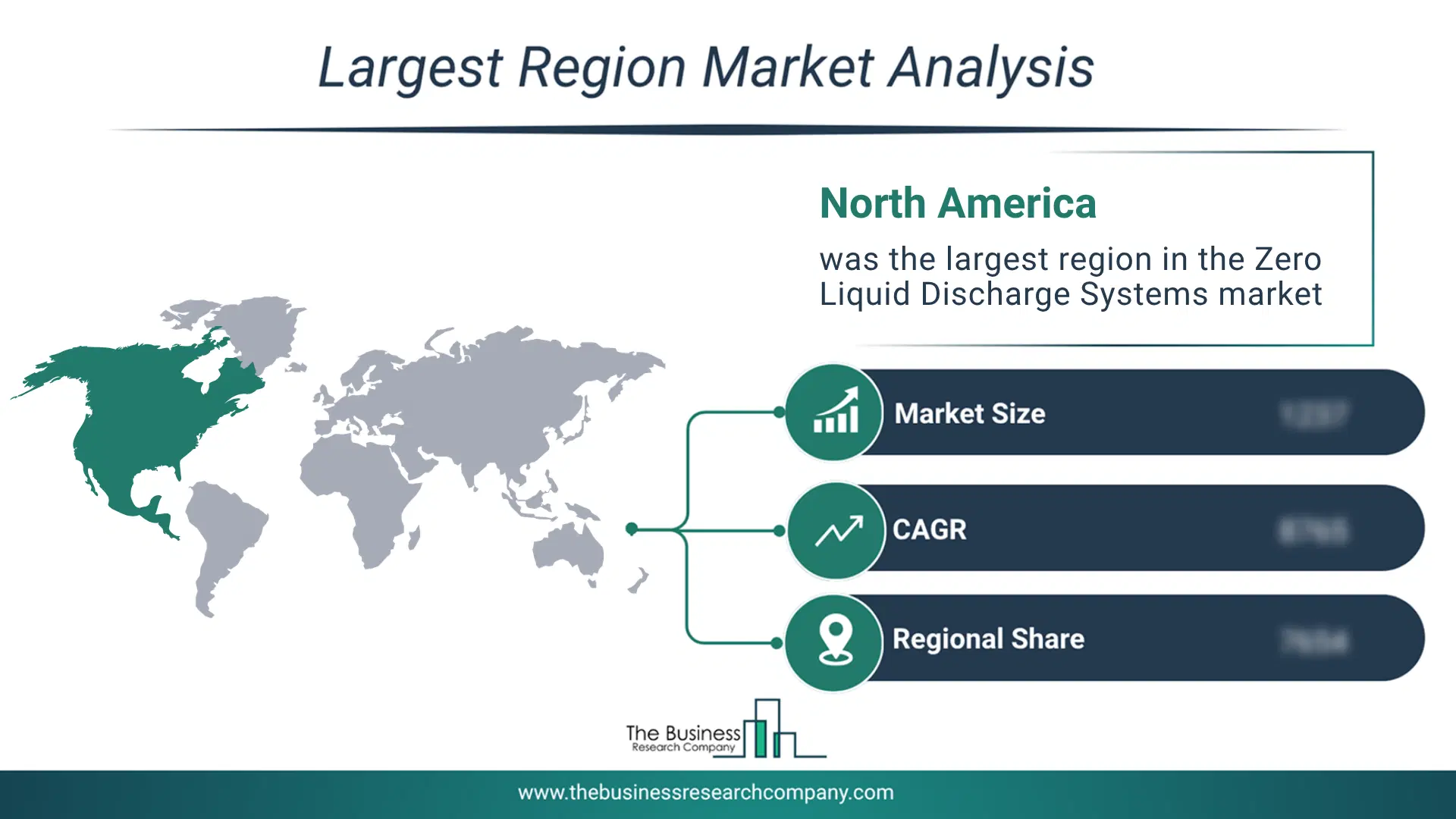
Regional Outlook
North America was the largest region in the zero liquid discharge systems market in 2025. Asia-Pacific is expected to be the fastest-growing region in the forecast period. The regions covered in this market report are Asia-Pacific, South East Asia, Western Europe, Eastern Europe, North America, South America, Middle East, Africa The countries covered in this market report are Australia, Brazil, China, France, Germany, India, Indonesia, Japan, Taiwan, Russia, South Korea, UK, USA, Canada, Italy, Spain.What Defines the Zero Liquid Discharge Systems Market?
The zero liquid discharge systems market consists of sales of ultrafiltration systems, reverse osmosis systems, crystallization units, and fractional electro-deionization systems. Values in this market are ‘factory gate’ values, that is, the value of goods sold by the manufacturers or creators of the goods, whether to other entities (including downstream manufacturers, wholesalers, distributors, and retailers) or directly to end customers. The value of goods in this market includes related services sold by the creators of the goods.How is Market Value Defined and Measured?
The market value is defined as the revenues that enterprises gain from the sale of goods and/or services within the specified market and geography through sales, grants, or donations in terms of the currency (in USD unless otherwise specified). The revenues for a specified geography are consumption values that are revenues generated by organizations in the specified geography within the market, irrespective of where they are produced. It does not include revenues from resales along the supply chain, either further along the supply chain or as part of other products.
This chart presents market attractiveness based on a quantitative evaluation of growth, competition, strategic alignment, and risk, offering a clear view of opportunity areas for decision-making. This chart is for illustrative purposes; the full report contains the complete analysis.

This chart highlights the Total Addressable Market (TAM) by estimating the maximum revenue opportunity using an assumption-driven approach, supporting strategic planning and opportunity sizing across markets. The chart is illustrative; the full report provides a more comprehensive analysis.
What Key Data and Analysis Are Included in the Zero Liquid Discharge Systems Market Report 2026?
The zero liquid discharge systems market research report is one of a series of new reports from The Business Research Company that provides market statistics, including industry global market size, regional shares, competitors with the market share, detailed market segments, market trends and opportunities, and any further data you may need to thrive in the zero liquid discharge systems industry. The market research report delivers a complete perspective of everything you need, with an in-depth analysis of the current and future state of the industry.Zero Liquid Discharge Systems Market Report Forecast Analysis
| Report Attribute | Details |
|---|---|
| Market Size Value In 2026 | $7.63 billion |
| Revenue Forecast In 2030 | $10.6 billion |
| Growth Rate | CAGR of 8.6% from 2026 to 2030 |
| Base Year For Estimation | 2025 |
| Actual Estimates/Historical Data | 2020-2025 |
| Forecast Period | 2026 - 2030 |
| Market Representation | Revenue in USD Billion and CAGR from 2026 to 2030 |
| Segments Covered | System, Process, Technology, Application |
| Regional Scope | Asia-Pacific, Western Europe, Eastern Europe, North America, South America, Middle East, Africa |
| Key Companies Profiled | Alfa Laval AB, Aquatech International LLC, ENCON Evaporators, GEA Group, Oasys Water Inc., Veolia Water Technologies, Suez SA, Condorchem Envitech, Evoqua Water Technologies LLC, Aquarion AG, IDE Technologies Ltd., Thermax Global, GE Water & Process Technologies, 3v Green Eagle SpA, Doosan Hydro Technology, Praj Industries Limited, Andritz AG, H2O GmbH, SafBon Water Technology (Shanghai) Co. Ltd., Ion Exchange India Ltd., Toshiba Infrastructure Systems & Solutions Corporation, Petro Sep Corporation, Fluence Corporation Limited, Kurita Water Industries Ltd., Arvind Envisol Limited, Hydro Air Research Italia S.r.l., Samco Technologies Inc., Lenntech B.V., Saltworks Technologies Inc. |
| Customization Scope | Request for Customization |
| Pricing And Purchase Options | Explore Purchase Options |