
Supplier And Distributor Research: The Most Consequential Decision In A New Market
Published date: 17 August, 2026
When a company enters a new geography, the distributor it appoints will, for a period of years, be the company in that market. They will hold the customer relationships. They will set the service experience. They will influence the price the market believes your product is worth. And in many jurisdictions, terminating them is considerably harder than appointing them.
This is why partner selection deserves the same rigour as an acquisition — and why so often it receives the rigour of a supplier tender. The asymmetry is striking: companies that would never acquire a business without diligence will routinely hand exclusive national distribution rights to a firm they met at a trade show.


The Channel Is Not a Detail. It Is the Business Model.
Forrester has long estimated that roughly 75% of world trade flows through indirect channels — resellers, distributors, agents, systems integrators and other intermediaries. That figure is sometimes quoted loosely, and it is worth noting the nuance: Channelnomics' 2025 Channel Chief Outlook survey found vendors reported an average of 56% of sales originating with partners, which is a stricter measure of partner-originated business rather than product merely passing through an intermediary. Either way, the conclusion holds. For most companies entering a new market, indirect channels are not a supplementary route. They are the route.
The performance data reinforces how much the choice matters. Research on B2B channel programmes indicates that partner-sourced deals are around 53% more likely to close and close roughly 46% faster than direct deals, and Forrester has found that mature partner programmes can contribute up to 28% of total company revenue and drive materially higher growth than immature ones. Omdia data suggests corporate buyers work with an average of 6.3 partners simultaneously, meaning your partner is rarely selling only your product.
Yet the discipline lags the dependence. Studies of partner programmes consistently find that only a quarter to a third of companies operate a formal partner education or enablement programme, and that firms with formal partner strategies report far higher satisfaction with channel ROI than those running ad-hoc approaches. The gap between how much revenue depends on partners and how systematically partners are selected and supported is one of the most under-managed risks in international expansion.

What Goes Wrong Without Structured Partner Research
The Convenient Partner Problem
The distributor easiest to find is rarely the best fit. Companies frequently appoint the first credible party who expresses interest — often one already active in the category, which sounds like an advantage until it emerges that they carry a competing line and will prioritise whichever product delivers better margin. Exclusivity granted to a partner with divided incentives is a structural handicap that no amount of marketing spend corrects.
Capability Mismatch
A distributor with excellent reach into one customer segment may have none into the segment that actually buys your product. Coverage maps look similar on a slide deck; they are not similar in practice. Verifying which accounts a partner genuinely holds, and in which regions, requires primary work rather than a capability statement.
Financial and Compliance Exposure
A partner's financial fragility becomes your inventory risk. Their compliance posture becomes your regulatory exposure — under many anti-bribery and sanctions regimes, the conduct of an appointed intermediary can create liability for the principal. Partner diligence is not merely a commercial exercise; it is a compliance control.
The Contract You Cannot Exit
Several jurisdictions provide statutory protection to agents and distributors, including compensation on termination. A relationship entered casually can be extremely costly to end. Understanding the legal character of the arrangement before signing is materially cheaper than discovering it afterwards.


How The Business Research Company Approaches Supplier And Distributor Research
Our distributor and partner research is built to move a client from an unknown market to a working, strategically sound network. The process is deliberately sequential, because each stage narrows the field on evidence rather than on availability.
- Thorough long-listing. We compile a tailored long list of distributors and suppliers matched to your specific product, segment, and geography — built through research rather than assembled from a directory.
- Strategic shortlisting. We apply customised criteria to select partners genuinely aligned with your business objectives, assessing compatibility and relevance rather than availability.
- Appointment setting. We schedule meetings with the most promising suppliers and distributors, so your team spends its time in qualified conversations instead of prospecting.
- Expert recommendation. We advise on which partner best fits your goals for a long-lasting and profitable relationship, with the reasoning made explicit.
- Network construction. The objective is not a single appointment but a coherent distribution network that supports growth and profitability across the territory.
This work sits alongside our broader customized research practice, which means partner research can be run in conjunction with competitor evaluation, customer research and regulatory analysis rather than in isolation. That integration matters: the right distributor for a premium positioning is frequently the wrong distributor for a volume play, and you cannot determine positioning without demand and competitive data.
We have delivered supply-side and channel work across sectors, including a USA and Europe pharmaceutical microbiology testing technology market study, a hardware business supply chain study covering Alphabet, Amazon and Facebook, and a USA and Europe mesh filter and microfilament yarn products study.
The Supplier & Distributor Package
- ✓Meticulous long listing of suppliers and distributors tailored to your criteria
- ✓Supplier selection support with strategic shortlisting for compatibility and relevance
- ✓Seamless distribution network design to accelerate market reach
- ✓Regulatory compliance considerations built into partner assessment
- ✓HR and administrative support for establishing local operations
Note the inclusion of regulatory compliance and administrative support in the same package. That is intentional. In a new geography, appointing a partner and satisfying local regulatory and employment requirements are not sequential problems — they are the same problem viewed from two angles, and treating them separately is how companies end up with a signed distributor and no lawful route to supply them.

Suppliers Deserve the Same Scrutiny as Distributors
Most discussion of channel research focuses downstream, toward the customer. Upstream supplier research is equally consequential in a new geography, particularly where local content requirements, import restrictions, or tariff exposure make domestic sourcing necessary or advantageous.
The questions mirror the downstream ones: which suppliers genuinely have capacity at the quality standard required, what is their financial stability, what is their compliance and labour standards posture, how concentrated is your exposure if one fails, and what does the tariff and trade policy environment imply for landed cost over a three-year horizon rather than at today's rates. Given how sharply trade policy has moved in recent years, a sourcing decision made on current tariff schedules without scenario analysis is a decision made on an assumption that is unlikely to hold.
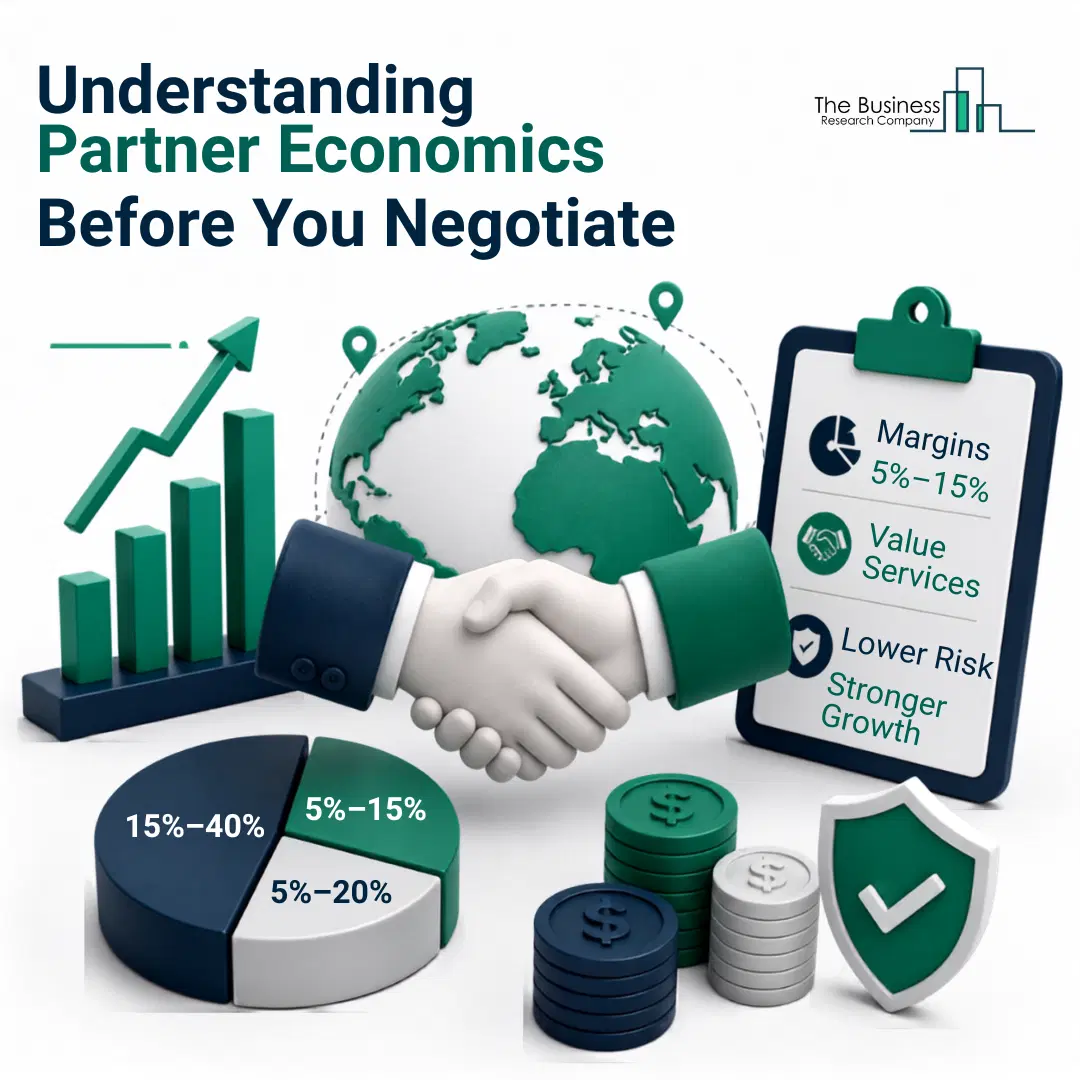

Understanding Partner Economics Before You Negotiate
A distributor agreement is fundamentally a margin-sharing arrangement, and entering the negotiation without a grounded view of local channel economics puts you at a structural disadvantage. Margin expectations vary widely by category and geography, and the party who understands the norm sets the anchor.
As a general orientation in B2B channels, resellers and value-added resellers commonly capture somewhere in the region of 15% to 40% of contract value depending on the services they layer on, pure distributors typically operate on thinner margins in the 5% to 15% band, and referral partners fall between roughly 5% and 20% of first-year value. These are broad benchmarks rather than rules, and they shift substantially by sector, by the working capital the partner carries, and by whether the partner performs installation, service and support or simply moves product.
What matters more than the headline percentage is what the margin buys. A partner taking 30% while carrying inventory, providing local technical support, holding regulatory registrations and funding demand generation may deliver considerably better economics than one taking 15% and doing nothing but invoicing. Partner research should establish not just what partners charge but what they actually do — and whether the activities you are paying for are activities they genuinely perform.
There is a related concentration risk worth quantifying early. In most B2B partner programmes, a small minority of partners generate the overwhelming majority of channel revenue — the familiar pattern of roughly 20% of partners producing around 80% of the result. In a new geography, that means your entire market position may rest on one or two relationships. Understanding that dependency before signing is what allows you to structure around it, whether through non-exclusivity, regional segmentation, or staged territory grants.

Selection Is the Beginning, Not the End
Companies that invest in partner selection frequently under-invest in what follows, which is where much of the value is won or lost. Research into channel programmes consistently finds that structured partner enablement produces materially higher partner-driven revenue than unstructured approaches, and that partners who complete certification and training substantially outperform those who do not.
The practical implication for a new market entrant is that the partner appointment should come with an enablement plan attached: product and technical training, sales tooling adapted to the local language and buying process, clear rules of engagement, defined lead handling, and agreed performance metrics reviewed on a fixed cadence. A distributor who does not understand your product well enough to answer a technical objection will lose deals you would have won, and will attribute the loss to price.
Performance measurement deserves the same rigour. Territory ownership, pricing authority, lead distribution and customer success handoffs should be documented at the outset, and partner tier requirements should be measurable and reviewed at least annually so that a partner cannot coast on an initial appointment. In markets where distributor termination carries statutory protection, documented performance criteria agreed in advance are also your most useful protection.
A Practical Partner Diligence Checklist
- Portfolio conflict — what competing or adjacent lines do they carry, and where would your product rank in their priorities?
- Verified coverage — which named accounts and regions do they genuinely hold, confirmed independently rather than claimed?
- Financial stability — can they fund inventory and extend credit without becoming a working-capital risk to you?
- Regulatory standing — do they hold the licences and registrations your product requires, and is their compliance history clean?
- Technical and service capability — can they support the product post-sale to the standard your brand requires?
- Contractual exit — what does termination cost under local law, and what performance triggers can be agreed up front?
- Reference evidence — what do their existing principals say, and what do their customers say?

Treat Partner Selection as an Investment Decision
The practical shift we advocate is straightforward. Apply to partner selection the process you would apply to an acquisition of comparable revenue significance: a defined universe, objective screening criteria, primary verification, financial and compliance diligence, structured reference conversations, and a documented rationale for the final choice.
That process is not expensive relative to what it protects. A distributor appointment in a mid-sized market routinely governs several years of revenue and the entirety of your brand experience in that territory. Researching it properly costs a fraction of one year of the underperformance that a poor appointment produces.
There is also a timing argument that is easy to overlook. The best partners in any market are, by definition, the ones already performing well for other principals — which means they have capacity constraints, existing commitments, and the ability to be selective about who they take on. Companies that arrive in a market with a clear proposition, evidence of demand, and a professional approach to partner selection are considerably more attractive to those partners than companies arriving with an untested product and an open question about strategy. Partner research therefore does more than help you choose well; it helps you be chosen. In competitive categories, the distributor is assessing you at least as carefully as you are assessing them, and the quality of your market preparation is the most visible signal you send.