
Will Businesses Trust AI Agents With Strategic Decisions?
Published date: 3rd July, 2026
Artificial intelligence has moved from answering questions to taking actions. The newest wave — agentic AI — does not just summarize a market; it can plan, decide, and execute multi-step work with limited human oversight. The question facing every executive in 2026 is no longer whether AI is capable, but whether they are willing to trust it with decisions that move revenue, reputation, and risk.

The Momentum Is Real — and Measurable
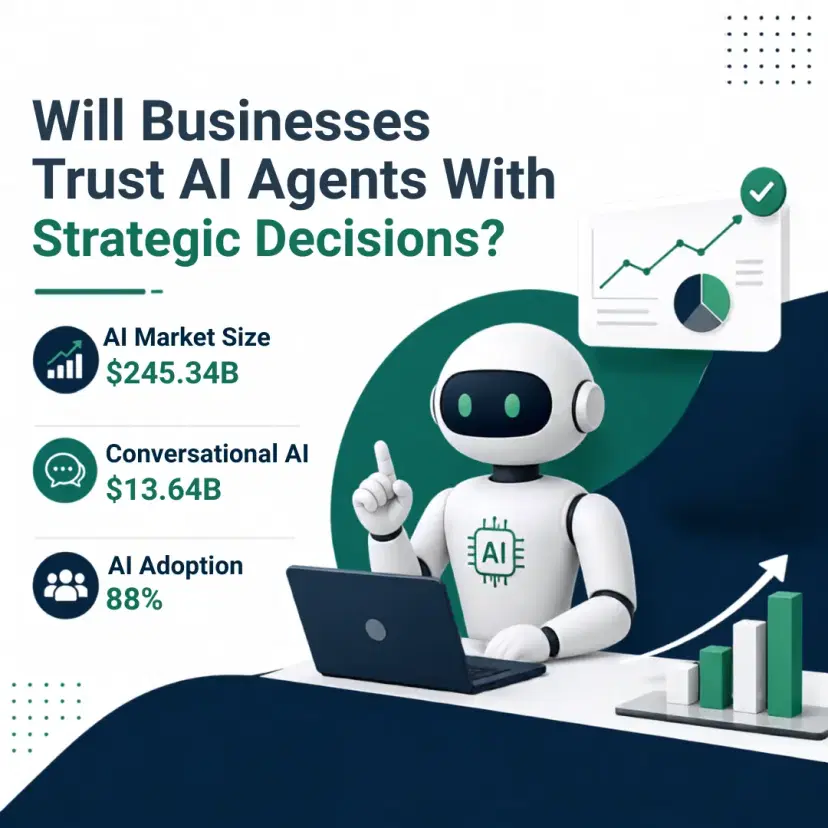
The scale of the underlying AI economy is staggering. The Business Research Company's research values the global artificial intelligence market at $245.34 billion in 2025, projected to reach $919.62 billion by 2030 at a 30.4% CAGR. Conversational and agentic capabilities are a fast-moving slice of that: TBRC sizes the conversational AI market at $13.64 billion in 2025, climbing to $42.51 billion by 2030 at a 25.5% CAGR. Adoption is broad. According to McKinsey's State of AI (November 2025), an online survey of 1,993 participants across 105 nations, 88% of organizations report regular AI use in at least one business function, compared with 78% a year ago. Critically for the agentic question, 62% of organizations are at least experimenting with AI agents, and 23% report scaling agentic AI somewhere in the enterprise.

Where Trust Breaks Down
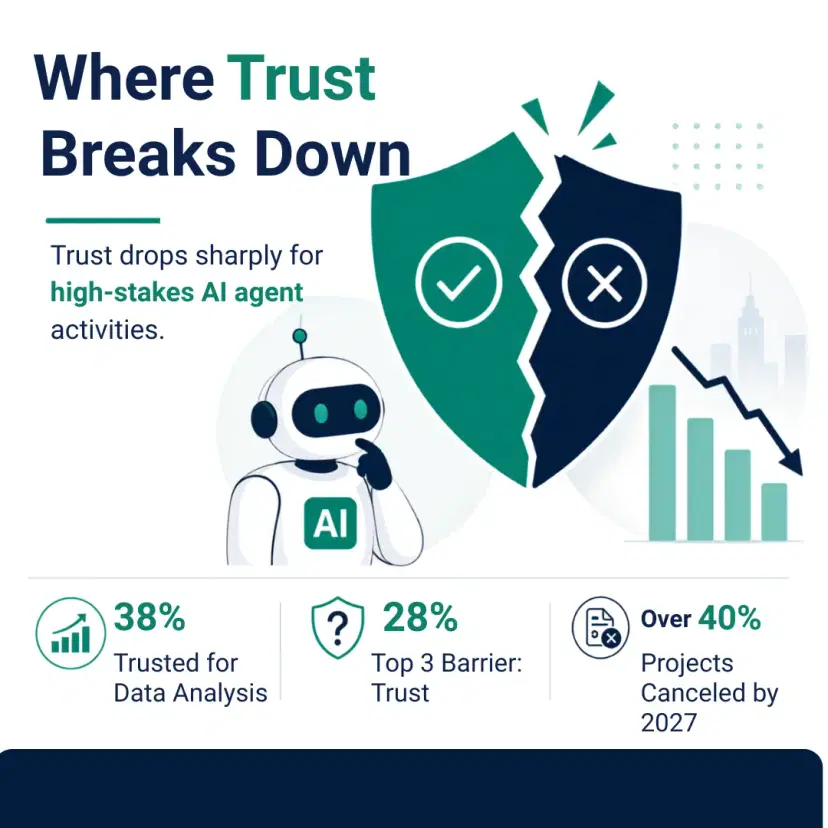
Capability and trust are not the same thing. PwC's AI Agent Survey — conducted in April 2025 among 308 US business executives — found that respondents trusted agents most for data analysis (38%), performance improvement (35%), and day-to-day collaboration (31%), but trust dropped sharply for high-stakes activities like financial transactions (20%) and autonomous employee interactions (22%). More than a quarter (28%) ranked lack of trust as a top-three barrier to adoption. Gartner adds a sobering forecast. In its June 2025 research, Gartner predicted that over 40% of agentic AI projects will be canceled by the end of 2027, due to escalating costs, unclear business value, or inadequate risk controls. Gartner also warns of 'agent washing': it estimates only about 130 of the thousands of agentic AI vendors are real.

What the Autonomy Curve Actually Looks Like
Gartner projects that at least 15% of day-to-day work decisions will be made autonomously through agentic AI by 2028, up from effectively 0% in 2024, and that 33% of enterprise software applications will embed agentic AI by 2028. The trajectory is clear, but the high-value, high-ambiguity decisions — market entry, M&A, pricing strategy, capital allocation — are precisely where leaders remain cautious.
The Trust Bridge: Human-Validated Intelligence
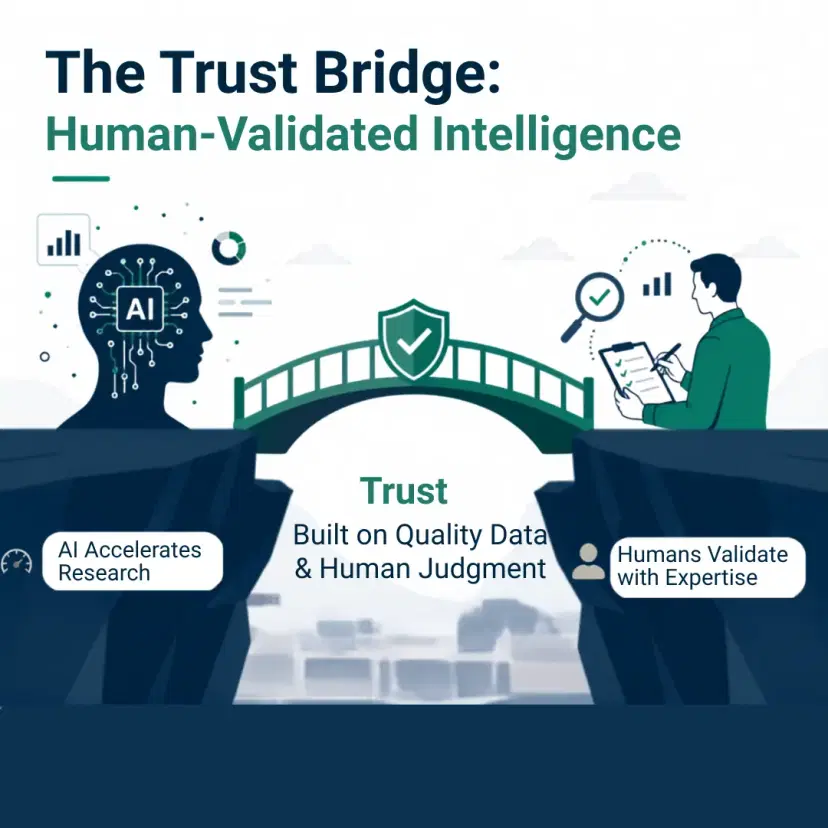
Here is where market intelligence becomes the trust layer. McKinsey found that AI high performers are 2.8 times more likely than peers to have fundamentally redesigned workflows (55% vs. 20%) and far more likely to maintain defined human-in-the-loop validation processes (65% vs. 23%). In other words, trust is engineered, not assumed — and it depends on the quality of the data and the governance around it. At The Business Research Company, this is the model we advocate and practice: AI accelerates research; humans validate it. Our analysts pair AI-empowered research tooling with multi-factor analysis — macro scenarios covering interest rates, inflation, geopolitics, tariffs, and supply chain shocks — so that an autonomous recommendation rests on a defensible evidence base, not a black box.


The Verdict for 2026
Businesses will trust AI agents with strategic decisions — incrementally, and only where the evidence base is transparent, validated, and continuously refreshed. The winners will not be the firms with the most pilots; McKinsey's data shows only about 6% of organizations qualify as 'AI high performers' (defined as achieving more than 5% EBIT impact from AI). The winners will be those that wrap agentic capability around rigorous, human-checked market intelligence.