

3D Machine Vision Market Report 2026
Global Outlook – By Component (Hardware, Software), By Product (Smart Camera-Based Systems, PC-Based Systems), By Application (Quality Assurance And Inspection, Positioning And Guidance, Measurement, Identification, Other Applications), By End-Use (Automotive, Pharmaceuticals And Chemicals, Electronics And Semiconductor, Pulp And Paper, Printing And Labelling, Food And Beverage, Postal And Logistics, Other End-Uses) – Market Size, Trends, Strategies, and Forecast to 2030
3D Machine Vision Market Overview
• 3D Machine Vision market size has reached to $2.17 billion in 2025 • Expected to grow to $3.18 billion in 2030 at a compound annual growth rate (CAGR) of 7.8% • Growth Driver: The Surge In Robotics Integration Fueling Market Growth Due To Rising Automation Needs In Manufacturing • Market Trend: Innovations In 3D Machine Vision Technology With A Focus On Advanced Sensing Scanners • Asia-Pacific was the largest region and fastest growing region.What Is Covered Under 3D Machine Vision Market?
3D machine vision refers to the use of imaging systems and algorithms to perceive and analyze the three-dimensional structure of objects in a given environment. It enables machines to understand spatial relationships and depth information for applications such as robotic automation, quality control, and augmented reality. The main components in 3D machine vision are hardware and software. Hardware refers to the physical components of a computer system or device, such as cameras, sensors, and processors utilized in 3D machine vision for data capture and processing. The several products are categorized into smart camera-based systems and PC-based systems, which are used in several applications, including quality assurance and inspection, positioning and guidance, measurement, identification, and others. These are used by various end users, such as automotive, pharmaceuticals and chemicals, electronics and semiconductors, pulp and paper, printing and labeling, food and beverage, postal and logistics, and others.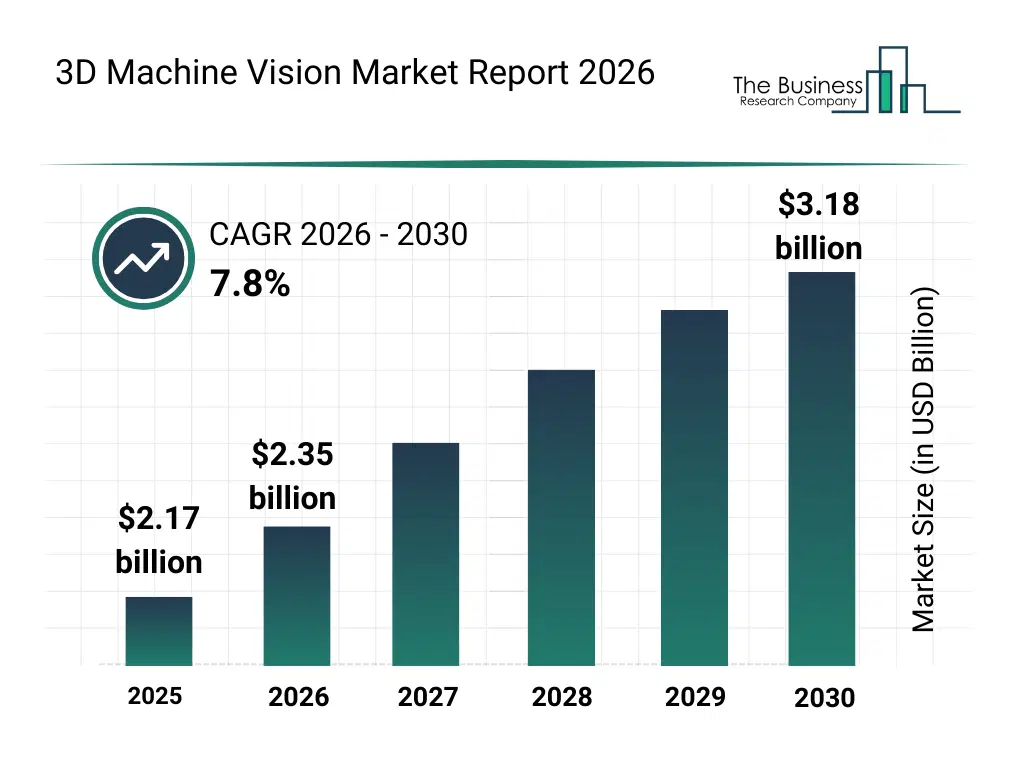
What Is The 3D Machine Vision Market Size and Share 2026?
The 3D machine vision market size has grown strongly in recent years. It will grow from $2.17 billion in 2025 to $2.35 billion in 2026 at a compound annual growth rate (CAGR) of 8.1%. The growth in the historic period can be attributed to initial deployment in automotive manufacturing, use in electronics quality inspection, early adoption in pharmaceuticals, growth in industrial automation, reliance on 2D imaging techniques.What Is The 3D Machine Vision Market Growth Forecast?
The 3D machine vision market size is expected to see strong growth in the next few years. It will grow to $3.18 billion in 2030 at a compound annual growth rate (CAGR) of 7.8%. The growth in the forecast period can be attributed to increasing adoption of AI-enhanced inspection systems, integration in robotics and augmented reality, expansion in food and beverage quality control, deployment in printing and labeling, rise of PC-based smart vision systems. Major trends in the forecast period include development of ai-based 3D imaging algorithms, implementation of machine learning for defect detection, integration of high-resolution cameras, expansion of robotic vision applications, adoption of real-time 3D data processing.Tariff Impact On 3D Machine Vision Market
Tariffs are affecting the 3D machine vision market by raising prices for imported high-resolution cameras, sensors, and processing units. Automotive, electronics, pharmaceuticals, and food processing sectors in Asia-Pacific and Europe are most impacted. Nonetheless, tariffs are driving local manufacturing, regional sourcing, and innovation in AI-powered 3D vision solutions, improving supply chain resilience and accelerating adoption of advanced machine vision technologies.
Global 3D Machine Vision Market Segmentation
1) By Component: Hardware, Software 2) By Product: Smart Camera-Based Systems, PC-Based Systems 3) By Application: Quality Assurance And Inspection, Positioning And Guidance, Measurement, Identification, Other Applications 4) By End-Use: Automotive, Pharmaceuticals And Chemicals, Electronics And Semiconductor, Pulp And Paper, Printing And Labelling, Food And Beverage, Postal And Logistics, Other End-Uses Subsegments: 1) By Hardware: Cameras, Sensors, Lighting, Processing Units, Frame Grabbers 2) By Software: 3D Imaging Software, Machine Learning Software, Analysis Software, Application SoftwareWhat Is The Driver Of The 3D Machine Vision Market?
The surge in demand for robotics integration is expected to propel the growth of the 3D machine vision market going forward. Robotics integration refers to the incorporation of robotic systems into production lines and workflows so that robots work seamlessly with machines, software, and humans to automate tasks. Demand for robotics integration is rising primarily due to manufacturers’ need to boost productivity and efficiency amid labor constraints and rising production complexity. The 3D machine vision supports this driver by providing robots with precise, depth-aware visual perception that improves accuracy in tasks such as object recognition, inspection, and handling. For instance, in September 2024, according to the International Federation of Robotics (IFR), a Germany-based industry association, annual industrial robot installations reached 541,302 units in 2023, the second-highest level ever recorded and only 2% below the 2022 record of 552,946 units, with 70% of all newly deployed robots installed in Asia, 17% in Europe, and 10% in the Americas. Therefore, the surge in demand for robotics integration is driving the growth of the 3D machine vision industry.Key Players In The Global 3D Machine Vision Market
Major companies operating in the 3D machine vision market are Omron Corporation, Keyence Corporation, Hexagon AB, Zebra Technologies Corporation, Teledyne Technologies Incorporated, Synopsys Inc., Coherent Inc., Basler AG, Sick AG, National Instruments Corporation, Cognex Corporation, IFM Electronic GmbH, Pepperl+Fuchs Group, Teledyne DALSA Inc., Edmund Optics Inc., Isra Vision AG, Stemmer Imaging, LMI Technologies Inc., Baumer Group, JAI AS, Optotune AG, Zivid AS, MVTec Software GmbH, Nerian Vision Technologies, Photoneo s.r.o., Robotic Vision Technologies Inc., Zivid Labs AS, Roboception GmbH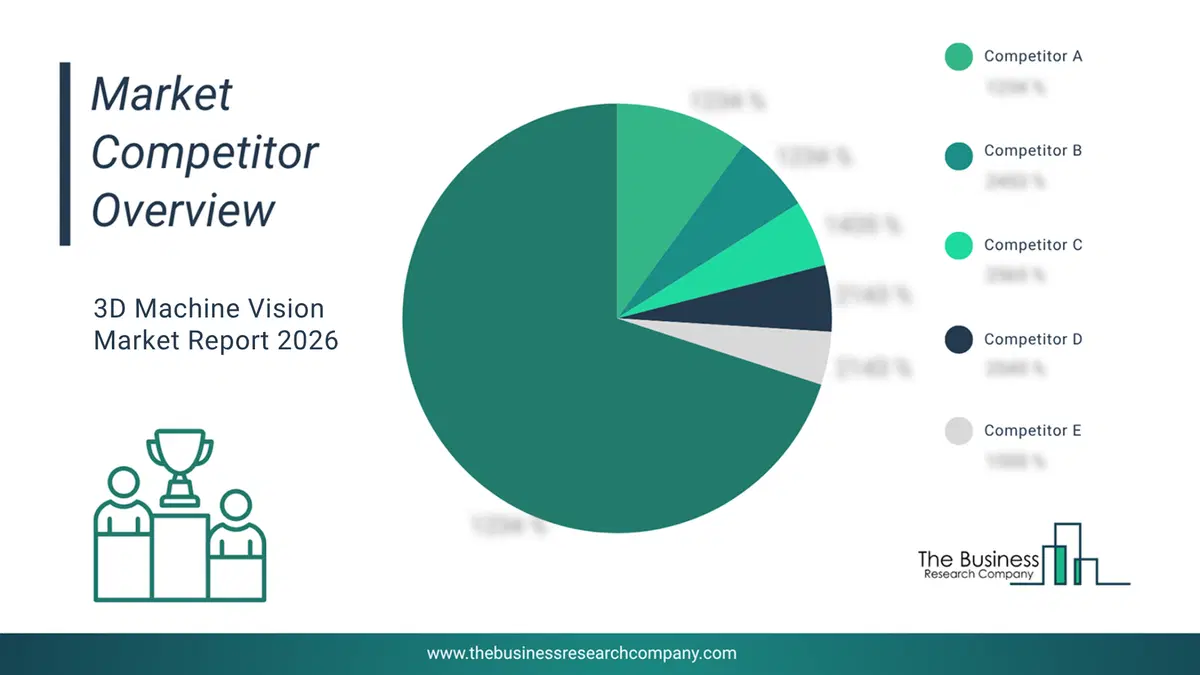
This chart is for illustrative purposes; the full report includes a detailed competitor analysis and comprehensive overview of the top 10 companies in the market.
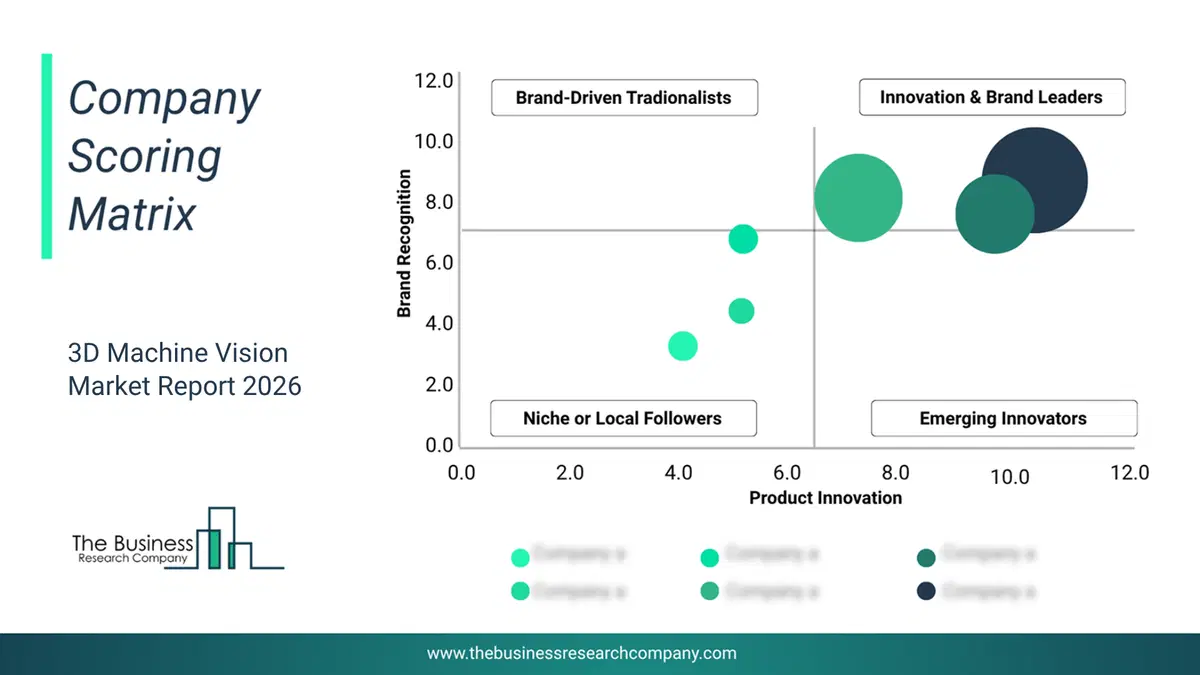
This chart maps companies by product innovation and brand strength, with bubble size indicating relative revenue, helping identify market leaders, challengers, and niche players. This is an illustrative chart; the full report provides a complete and accurate competitive analysis.
Global 3D Machine Vision Market Trends and Insights
Major companies operating in the 3D machine vision market are focusing on product innovations, such as advanced sensing scanners, to address evolving demands for enhanced precision and efficiency in dimensional imaging and analysis. It employs technologies such as laser scanning, structured light scanning, stereo vision, photogrammetry, computed tomography, ultrasound, and time-of-flight cameras to capture three-dimensional data. For instance, in June 2023, Photoneo s.r.o., a Slovakia-based provider of robotic vision and intelligence, launched the Alpha 3D Scanner, a plug-and-play device tailored for straightforward machine vision tasks in sectors such as logistics. Featuring structured light 3D sensing technology, it boasts a resolution of 1440 x 1080, an optimal scanning distance of up to 2331 mm, a maximum scanning distance of 3780 mm, and a sweet spot scanning area of 1091 x 761 mm, with a rapid scanning time starting at 450 ms. Operating at 24V power with PoE capability, it is equipped with a 1 Gbit Ethernet connection. Compact at 416 x 68 x 86 mm and 950 g, it maintains an operational temperature range of 0–40 °C and holds an IP65 rating.What Are Latest Mergers And Acquisitions In The 3D Machine Vision Market?
In December 2024, Zebra Technologies Corporation, a US-based enterprise asset intelligence company, acquired Photoneo Brightpick Group for an undisclosed amount. Through this acquisition, Zebra aims to expand its 3D machine vision solutions portfolio by integrating Photoneo’s advanced structured-light 3D vision hardware and software, strengthening its offerings for automated inspection, robotics, and vision-guided operations across manufacturing, logistics, and material handling industries. Photoneo Brightpick Group is a US-based company that provides 3D machine vision.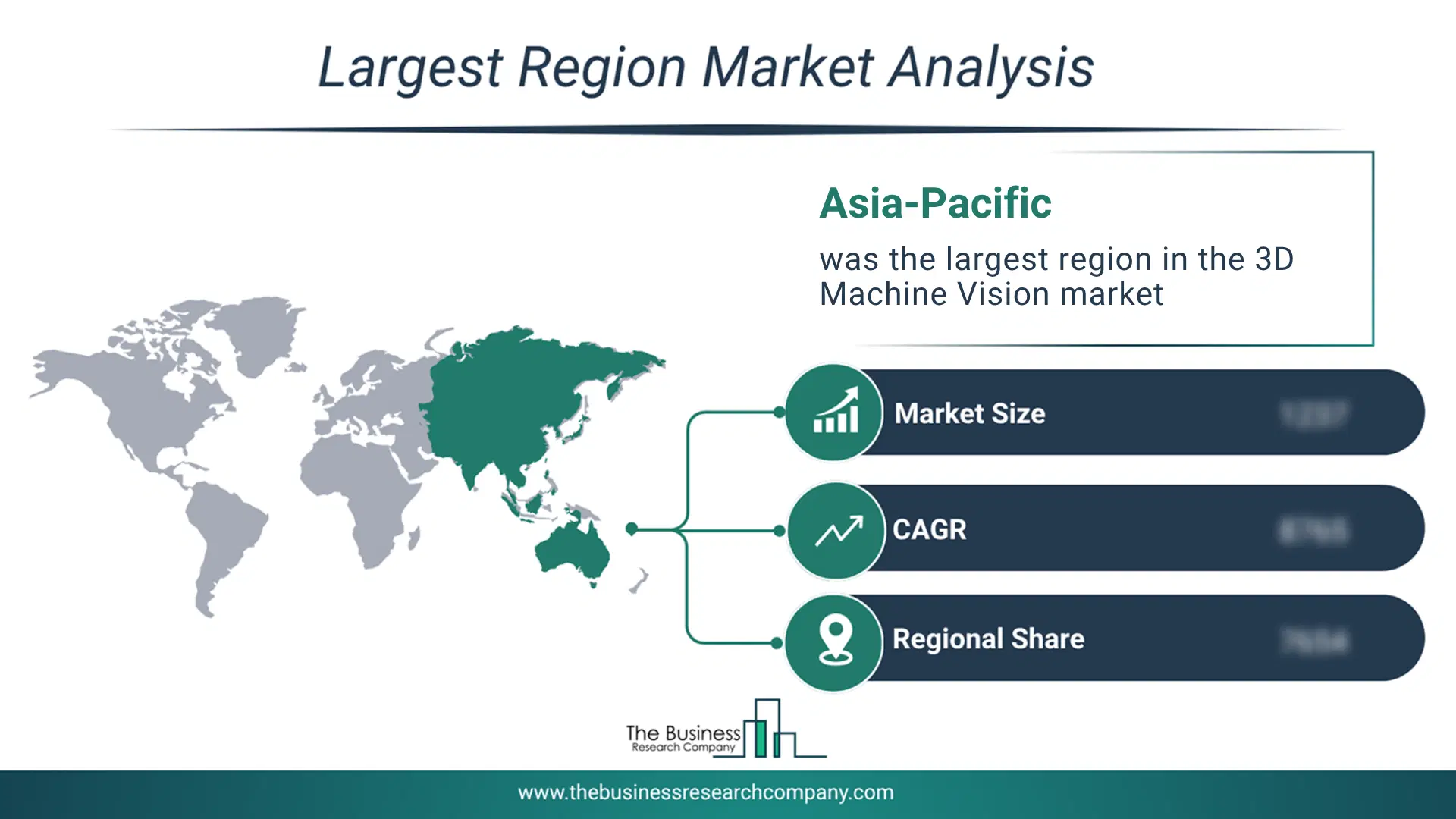
Regional Outlook
Asia-Pacific was the largest region in the 3D machine vision market in 2025. It is expected to be the fastest-growing region in the forecast period. The regions covered in this market report are Asia-Pacific, South East Asia, Western Europe, Eastern Europe, North America, South America, Middle East, Africa The countries covered in this market report are Australia, Brazil, China, France, Germany, India, Indonesia, Japan, Taiwan, Russia, South Korea, UK, USA, Canada, Italy, Spain.What Defines the 3D Machine Vision Market?
The 3D machine vision market consists of revenues earned by entities providing services such as object recognition and classification, quality control and inspection services, and navigation and mapping in autonomous vehicles. The market value includes the value of related goods sold by the service provider or included within the service offering. The 3D machine vision market also includes sales of 3D cameras, laser scanners, 3D sensors, and robotic vision systems. Values in this market are ‘factory gate’ values, that is the value of goods sold by the manufacturers or creators of the goods, whether to other entities (including downstream manufacturers, wholesalers, distributors and retailers) or directly to end customers. The value of goods in this market includes related services sold by the creators of the goods.How is Market Value Defined and Measured?
The market value is defined as the revenues that enterprises gain from the sale of goods and/or services within the specified market and geography through sales, grants, or donations in terms of the currency (in USD unless otherwise specified). The revenues for a specified geography are consumption values that are revenues generated by organizations in the specified geography within the market, irrespective of where they are produced. It does not include revenues from resales along the supply chain, either further along the supply chain or as part of other products.
This chart presents market attractiveness based on a quantitative evaluation of growth, competition, strategic alignment, and risk, offering a clear view of opportunity areas for decision-making. This chart is for illustrative purposes; the full report contains the complete analysis.

This chart highlights the Total Addressable Market (TAM) by estimating the maximum revenue opportunity using an assumption-driven approach, supporting strategic planning and opportunity sizing across markets. The chart is illustrative; the full report provides a more comprehensive analysis.
What Key Data and Analysis Are Included in the 3D Machine Vision Market Report 2026?
The 3d machine vision market research report is one of a series of new reports from The Business Research Company that provides market statistics, including industry global market size, regional shares, competitors with the market share, detailed market segments, market trends and opportunities, and any further data you may need to thrive in the 3d machine vision industry. The market research report delivers a complete perspective of everything you need, with an in-depth analysis of the current and future state of the industry.3D Machine Vision Market Report Forecast Analysis
| Report Attribute | Details |
|---|---|
| Market Size Value In 2026 | $2.35 billion |
| Revenue Forecast In 2030 | $3.18 billion |
| Growth Rate | CAGR of 7.8% from 2026 to 2030 |
| Base Year For Estimation | 2025 |
| Actual Estimates/Historical Data | 2020-2025 |
| Forecast Period | 2026 - 2030 |
| Market Representation | Revenue in USD Billion and CAGR from 2026 to 2030 |
| Segments Covered | Component, Product, Application, End-Use |
| Regional Scope | Asia-Pacific, Western Europe, Eastern Europe, North America, South America, Middle East, Africa |
| Key Companies Profiled | Omron Corporation, Keyence Corporation, Hexagon AB, Zebra Technologies Corporation, Teledyne Technologies Incorporated, Synopsys Inc., Coherent Inc., Basler AG, Sick AG, National Instruments Corporation, Cognex Corporation, IFM Electronic GmbH, Pepperl+Fuchs Group, Teledyne DALSA Inc., Edmund Optics Inc., Isra Vision AG, Stemmer Imaging, LMI Technologies Inc., Baumer Group, JAI AS, Optotune AG, Zivid AS, MVTec Software GmbH, Nerian Vision Technologies, Photoneo s.r.o., Robotic Vision Technologies Inc., Zivid Labs AS, Roboception GmbH |
| Customization Scope | Request for Customization |
| Pricing And Purchase Options | Explore Purchase Options |