

5G IoT Market Report 2026
Global Outlook – By Component (Solution, Hardware, Software And Platform, Services), By Network Type (5G Standalone (SA), 5G Non-Standalone (NSA)), By Enterprise Size (Large Enterprises, Small and Medium Enterprises), By End User (Manufacturing, Healthcare, Energy And Utilities, Automotive And Transportation, Supply Chain And Logistics, Government And Public Safety, Agriculture, Other End Users) – Market Size, Trends, Strategies, and Forecast to 2030
5G IoT Market Overview
• 5G IoT market size has reached to $20.03 billion in 2025 • Expected to grow to $268.1 billion in 2030 at a compound annual growth rate (CAGR) of 67.9% • Growth Driver: The Role Of Surging Mobile Data Traffic In Driving 5G IoT Market Expansion • Market Trend: Innovative Products Enhanced 5G IoT Market Presence • North America was the largest region in 2025.What Is Covered Under 5G IoT Market?
5G IoT refers to a service that communicates across all bands with both the local area network and the wide area network (WAN) with the proper speed, latency, and cost trade-offs. The 5G IoT is used for faster, more stable, and more secure connectivity, advancing everything from self-driving cars to smart grids for renewable energy to AI-enabled robots on factory floors. The main components in 5G IoT are solution, hardware, software and platform, services. Hardware refers to the tangible, touchable, physical parts of a computer system. These range from IoT modules, IoT gateways, and modem cards to 5G SIMs. The major network types are 5G standalone (SA) and 5G non-standalone (NSA). The different enterprise sizes include large enterprises and small and medium enterprises. The major end users include manufacturing, healthcare, energy and utilities, automotive and transportation, supply chain and logistics, government and public safety, agriculture and others.
What Is The 5G IoT Market Size and Share 2026?
The 5G iot market size has grown exponentially in recent years. It will grow from $20.03 billion in 2025 to $33.74 billion in 2026 at a compound annual growth rate (CAGR) of 68.5%. The growth in the historic period can be attributed to growth of connected devices, adoption of lte iot, expansion of smart manufacturing, demand for real time monitoring, early smart city projects.What Is The 5G IoT Market Growth Forecast?
The 5G iot market size is expected to see exponential growth in the next few years. It will grow to $268.1 billion in 2030 at a compound annual growth rate (CAGR) of 67.9%. The growth in the forecast period can be attributed to 5G standalone deployment, automation across industries, growth of smart grids, adoption of autonomous vehicles, demand for secure connectivity. Major trends in the forecast period include massive iot connectivity, ultra low latency applications, industrial iot integration, edge based iot analytics, private 5G iot networks.
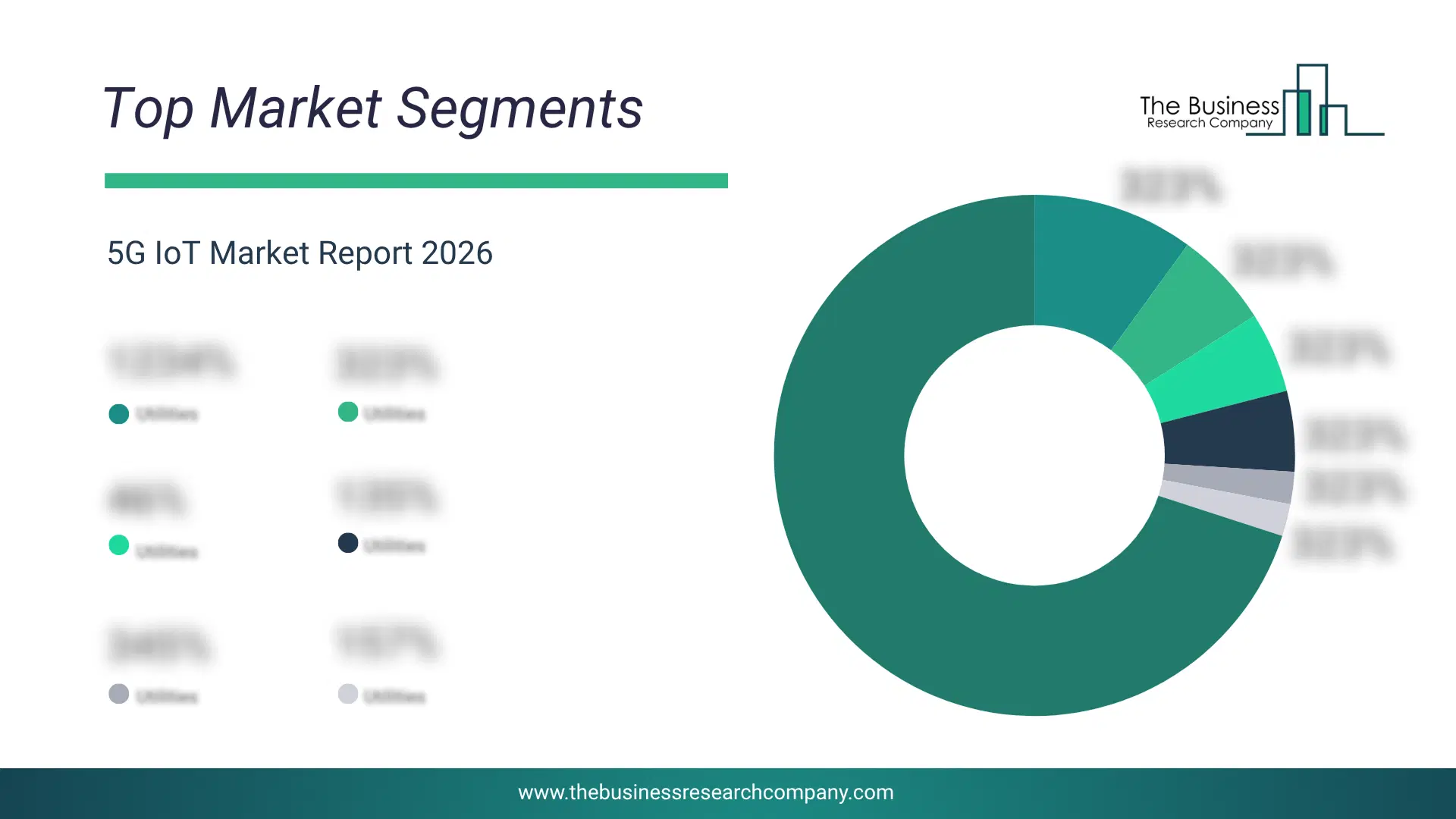
Global 5G IoT Market Segmentation
1) By Component: Solution, Hardware, Software And Platform, Services 2) By Network Type: 5G Standalone (SA), 5G Non-Standalone (NSA) 3) By Enterprise Size: Large Enterprises, Small and Medium Enterprises 4) By End User: Manufacturing, Healthcare, Energy And Utilities, Automotive And Transportation, Supply Chain And Logistics, Government And Public Safety, Agriculture, Other End Users Subsegments: 1) By Solution: Connectivity Solutions, Device Management Solutions, Security Solutions 2) By Hardware: IoT Devices (Sensors, Actuators), Gateways, Network Equipment 3) By Software and Platform: Analytics Software, Application Development Platforms, Operating Systems 4) By Services: Consulting Services, Integration Services, Managed ServicesWhat Is The Driver Of The 5G IoT Market?
A surge in mobile network data traffic is expected to propel the growth of the 5G IoT market going forward. 5G IoT helps to support large volumes of mobile network data traffic and large numbers of users, including IoT devices. Large volumes of mobile network data traffic aid in the expansion of the 5G IoT by providing fast, dependable, low-latency, and secure connections. For instance, in November 2024, according to the International Telecommunication Union, a Switzerland-based specialized agency, in 2023, global mobile broadband traffic for end-user internet usage surpassed 1 zettabyte for the first time. It is projected to grow to around 1.3 zettabytes in 2024. In comparison, fixed broadband traffic is expected to increase from 5.1 zettabytes in 2023 to about 6 zettabytes in 2024. Therefore, the surge in mobile network data traffic is driving the growth of the 5G IoT industry.Key Players In The Global 5G IoT Market
Major companies operating in the 5G iot market are Samsung Electronics Co. Ltd.; China Mobile Ltd.; Verizon Communications Inc.; Deutsche Telekom AG; AT&T Inc.; Huawei Technologies Co. Ltd.; T-Mobile International AG; China Telecom Corporation Limited; LG Electronics Inc.; Intel Technology Corporation; Cisco Systems Inc.; NTT Docomo Inc.; China Unicom Limited; Vodafone Group plc; Orange S.A.; Telefonica S.A; Qualcomm Technologies Inc.; Fujitsu Ltd.; BT Group plc; Ericsson AB; Nokia Corporation; NEC Corporation; Telstra Corporation Limited; Thales Group; KT Corporation; TIM S.p.A.; ZTE Corporation; SK Telecom Co. Ltd.; Swisscom AG; Singtel Optus Pty Limited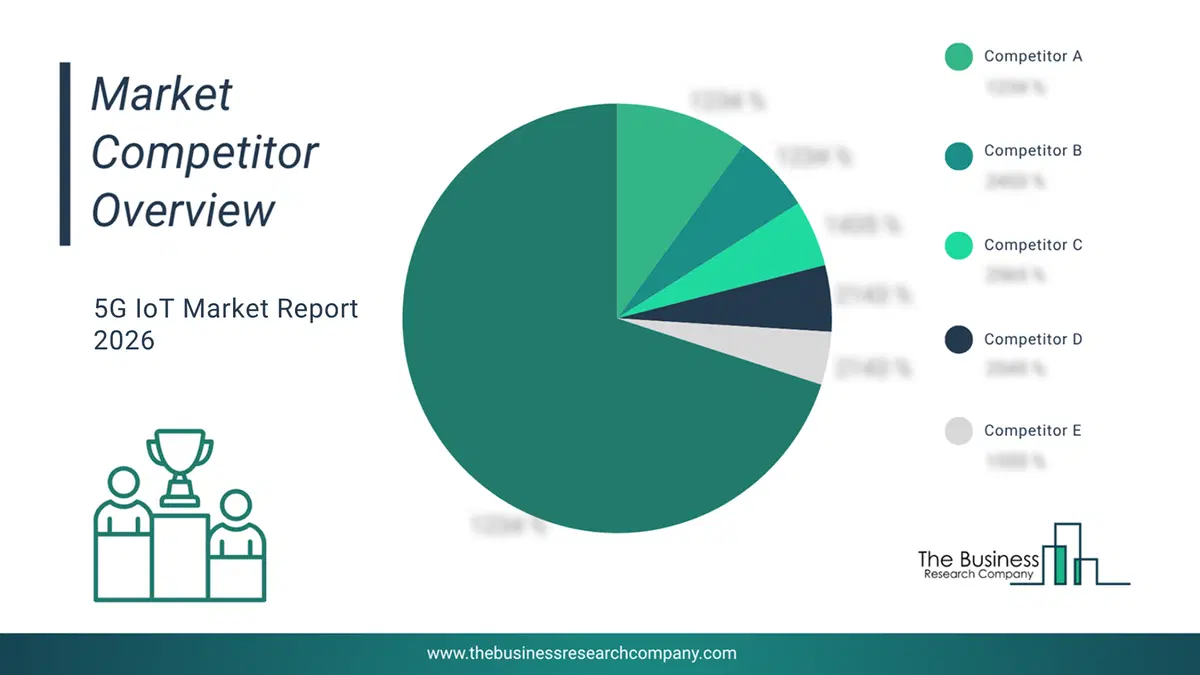
This chart is for illustrative purposes; the full report includes a detailed competitor analysis and comprehensive overview of the top 10 companies in the market.
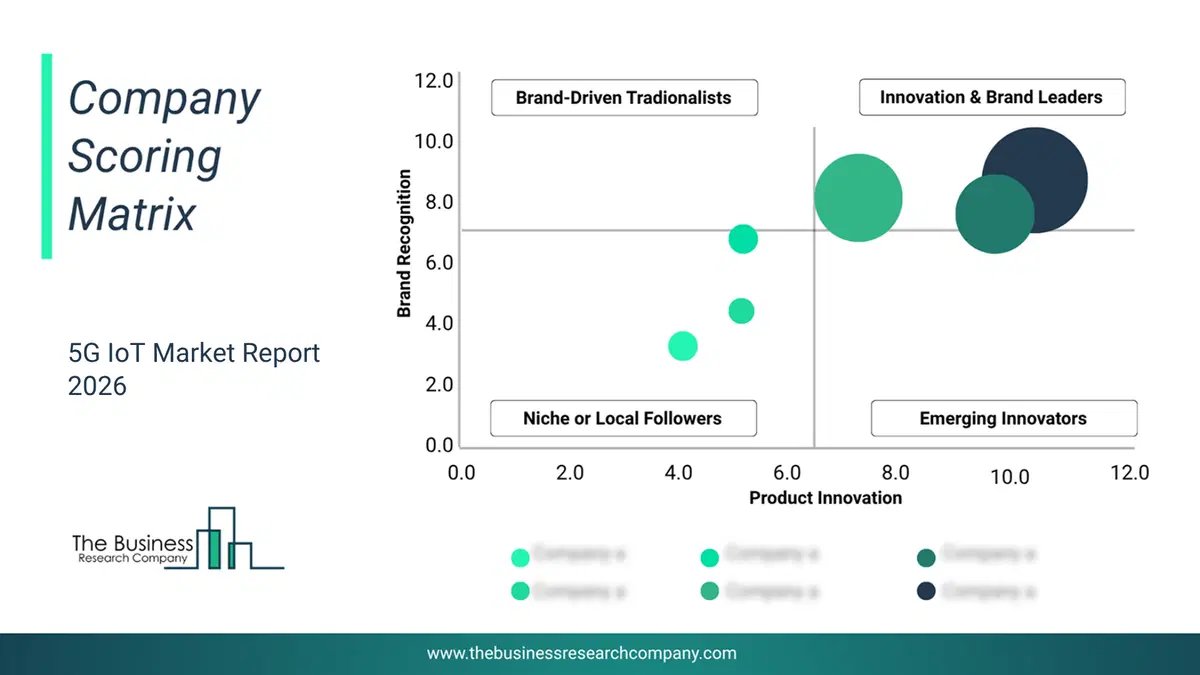
This chart maps companies by product innovation and brand strength, with bubble size indicating relative revenue, helping identify market leaders, challengers, and niche players. This is an illustrative chart; the full report provides a complete and accurate competitive analysis.
Global 5G IoT Market Trends and Insights
Major companies operating in the 5G IoT market are focusing on innovative products, such as RAN software, to better meet the needs of their existing consumers. The term RAN software refers to the software components that regulate and manage radio communications connecting mobile devices (such as smartphones) and the cell phone network. For instance, in June 2023, Telefonaktiebolaget LM Ericsson, a Sweden-based telecommunications company that offers 5G IoT services, launched Ericsson Reduced Capability (RedCap). Ericsson's reduced capability will help to build an ecosystem for new sorts of devices that can connect to 5G networks. An expanding additional radio (NR) device ecosystem with additional capabilities will drive the expansion of even more 5G use cases. Ericsson RedCap will enable wearables that are available with only LTE devices and will promote leaner techniques for minimizing device energy usage. Ericsson RedCap will handle low-complexity devices such as augmented reality (AR) smartwatches, video surveillance devices, industrial sensors, and smart energy systems. The innovative method uses less energy than conventional LTE low categories and has already piqued the interest of the wearable OEM (original equipment manufacturer) business.What Are Latest Mergers And Acquisitions In The 5G IoT Market?
In January 2025, Sequans Communications S.A., a France-based provider of cellular IoT solutions, acquired Advanced Circuit Pursuit AG, for an undisclosed amount. With this acquisition, Sequans aims to accelerate its RedCap (Reduced Capability) 5G product development, expand its IoT device ecosystem, strengthen its European market presence, enhance its end-to-end IoT connectivity solutions, unlock new revenue streams, and drive innovation across low-power and industrial IoT applications. Advanced Circuit Pursuit AG is a Switzerland-based IoT electronics company specializing in IoT electronics and modules that support low-power, wide-area, and cellular IoT applications.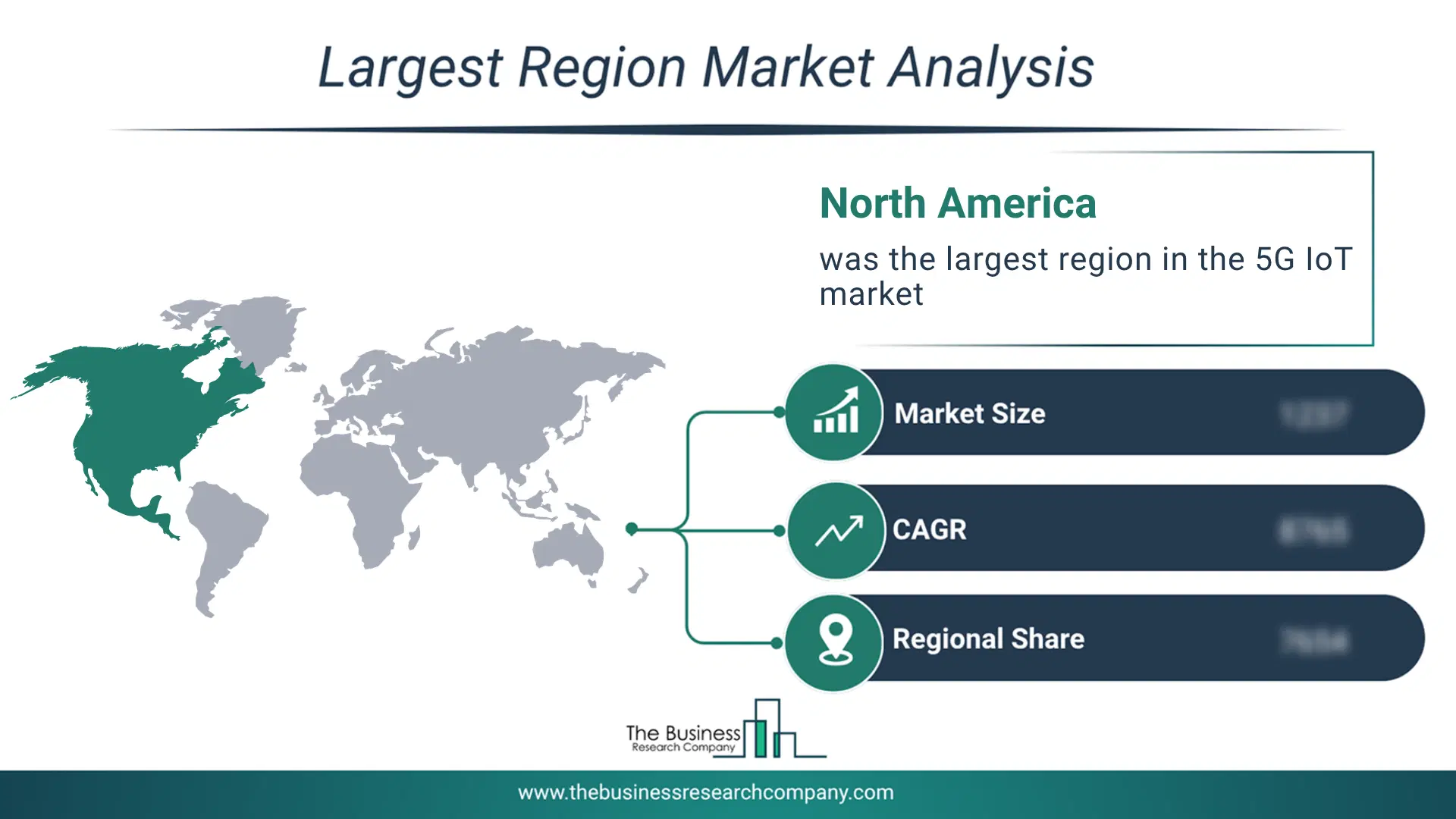
Regional Insights
North America was the largest region in the 5G IoT market in 2025. The regions covered in this market report are Asia-Pacific, South East Asia, Western Europe, Eastern Europe, North America, South America, Middle East, Africa. The countries covered in this market report are Australia, Brazil, China, France, Germany, India, Indonesia, Japan, Taiwan, Russia, South Korea, UK, USA, Canada, Italy, SpainWhat Defines the 5G IoT Market?
The 5G IoT market includes revenues earned by entities by providing enterprise and high-speed industrial networking services, mobile computing, video broadcasting, fixed wireless access (FWA). The market value includes the value of related goods sold by the service provider or included within the service offering. Only goods and services traded between entities or sold to end consumers are included.How is Market Value Defined and Measured?
The market value is defined as the revenues that enterprises gain from the sale of goods and/or services within the specified market and geography through sales, grants, or donations in terms of the currency (in USD unless otherwise specified). The revenues for a specified geography are consumption values that are revenues generated by organizations in the specified geography within the market, irrespective of where they are produced. It does not include revenues from resales along the supply chain, either further along the supply chain or as part of other products.
This chart presents market attractiveness based on a quantitative evaluation of growth, competition, strategic alignment, and risk, offering a clear view of opportunity areas for decision-making. This chart is for illustrative purposes; the full report contains the complete analysis.

This chart highlights the Total Addressable Market (TAM) by estimating the maximum revenue opportunity using an assumption-driven approach, supporting strategic planning and opportunity sizing across markets. The chart is illustrative; the full report provides a more comprehensive analysis.
What Key Data and Analysis Are Included in the 5G IoT Market Report 2026?
The 5g iot market research report is one of a series of new reports from The Business Research Company that provides market statistics, including industry global market size, regional shares, competitors with the market share, detailed market segments, market trends and opportunities, and any further data you may need to thrive in the 5g iot industry. The market research report delivers a complete perspective of everything you need, with an in-depth analysis of the current and future state of the industry.5G IoT Market Report Forecast Analysis
| Report Attribute | Details |
|---|---|
| Market Size Value In 2026 | $33.74 billion |
| Revenue Forecast In 2030 | $268.1 billion |
| Growth Rate | CAGR of 67.9% from 2026 to 2030 |
| Base Year For Estimation | 2025 |
| Actual Estimates/Historical Data | 2020-2025 |
| Forecast Period | 2026 - 2030 |
| Market Representation | Revenue in USD Billion and CAGR from 2026 to 2030 |
| Segments Covered | Component, Network Type, Enterprise Size, End User |
| Regional Scope | Asia-Pacific, Western Europe, Eastern Europe, North America, South America, Middle East, Africa |
| Country Scope | The Countries Covered In This Market Report Are Australia, Brazil, China, France, Germany, India, Indonesia, Japan, Taiwan, Russia, South Korea, Uk, Usa, Canada, Italy, Spain. |
| Key Companies Profiled | Samsung Electronics Co. Ltd., China Mobile Ltd., Verizon Communications Inc., Deutsche Telekom AG, AT&T Inc., Huawei Technologies Co. Ltd., T-Mobile International AG, China Telecom Corporation Limited, LG Electronics Inc., Intel Technology Corporation, Cisco Systems Inc., NTT Docomo Inc., China Unicom Limited, Vodafone Group plc, Orange S.A., Telefonica S.A, Qualcomm Technologies Inc., Fujitsu Ltd., BT Group plc, Ericsson AB, Nokia Corporation, NEC Corporation, Telstra Corporation Limited, Thales Group, KT Corporation, TIM S.p.A., ZTE Corporation, SK Telecom Co. Ltd., Swisscom AG, Singtel Optus Pty Limited |
| Customization Scope | Request for Customization |
| Pricing And Purchase Options | Explore Purchase Options |