
5G In Agriculture Market Report 2026
Global Outlook – By Component (Hardware, Software, Services), By Connectivity Type (Enhanced Mobile Broadband (eMBB), Ultra-Reliable Low Latency Communication (URLLC), Massive Machine-Type Communication (mMTC) ), By Deployment Mode (On-Premises, Cloud), By Application (Precision Farming, Livestock Monitoring, Smart Greenhouses, Autonomous Tractors, Drones, Other Application), By End-User (Farmers, Agribusinesses, Research Institutes, Other End-Users) – Market Size, Trends, Strategies, and Forecast to 2030
5G In Agriculture Market Overview
• 5G In Agriculture market size has reached to $3.88 billion in 2025 • Expected to grow to $15.18 billion in 2030 at a compound annual growth rate (CAGR) of 31.3% • Growth Driver: Rising Precision Agriculture Fueling The Growth Of The Market Due To Demand For Optimized Resource Utilization And Enhanced Crop Yields • Market Trend: Smart Agriculture Project Enhances Precision Irrigation And Fertilization • North America was the largest region in 2025 and Asia-Pacific is the fastest growing region.Market Gains By 2030 – Top Opportunities By Segment
Market Gain identifies the most promising market opportunities by highlighting the segments or products expected to generate the highest incremental revenue growth over the next five years.
What Is Covered Under 5G In Agriculture Market?
5G in agriculture refers to the use of fifth-generation wireless communication technology to enhance agricultural operations through faster, more reliable, and low-latency connectivity. It enables real-time data collection, monitoring, and control of agricultural processes, improving efficiency and productivity. The technology supports advanced applications such as precision farming, automated machinery, and smart irrigation systems, transforming traditional farming practices. The main components of 5G in agriculture include hardware, software, and services. Hardware forms the foundation of 5G-enabled agricultural solutions by supporting high-speed data transmission, real-time monitoring, and seamless connectivity across smart farming ecosystems. These solutions operate across enhanced mobile broadband, ultra-reliable low latency communication, and massive machine-type communication connectivity types and are deployed through on-premises and cloud-based models. 5G in agriculture is applied across precision farming, livestock monitoring, smart greenhouses, autonomous tractors, drones, and others, serving end-users such as farmers, agribusinesses, research institutes, and others.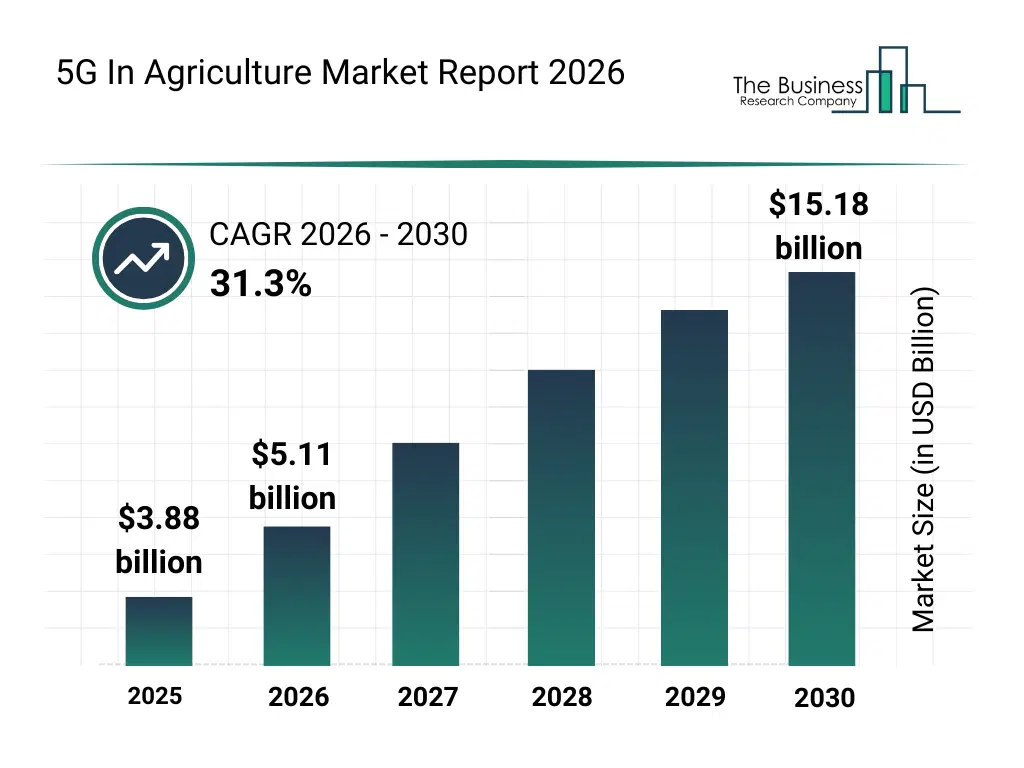
What Is The 5G In Agriculture Market Size and Share 2026?
The 5G in agriculture market size has grown exponentially in recent years. It will grow from $3.88 billion in 2025 to $5.11 billion in 2026 at a compound annual growth rate (CAGR) of 31.6%. The growth in the historic period can be attributed to increasing adoption of digital farming tools, growing demand for high-efficiency crop management, rising use of connected equipment, expansion of precision irrigation practices, and increasing integration of remote monitoring systems.What Is The 5G In Agriculture Market Growth Forecast?
The 5G in agriculture market size is expected to see exponential growth in the next few years. It will grow to $15.18 billion in 2030 at a compound annual growth rate (CAGR) of 31.3%. The growth in the forecast period can be attributed to growing deployment of advanced connectivity solutions, rising demand for real-time agricultural insights, increasing adoption of automated farming processes, expanding use of smart machinery, and growing implementation of data-driven farm management. Major trends in the forecast period include advancements in wireless communication technologies, innovations in automated farming solutions, developments in connected sensing systems, research and development in agri-iot platforms, and advancements in cloud-based farm analytics.
Global 5G In Agriculture Market Segmentation
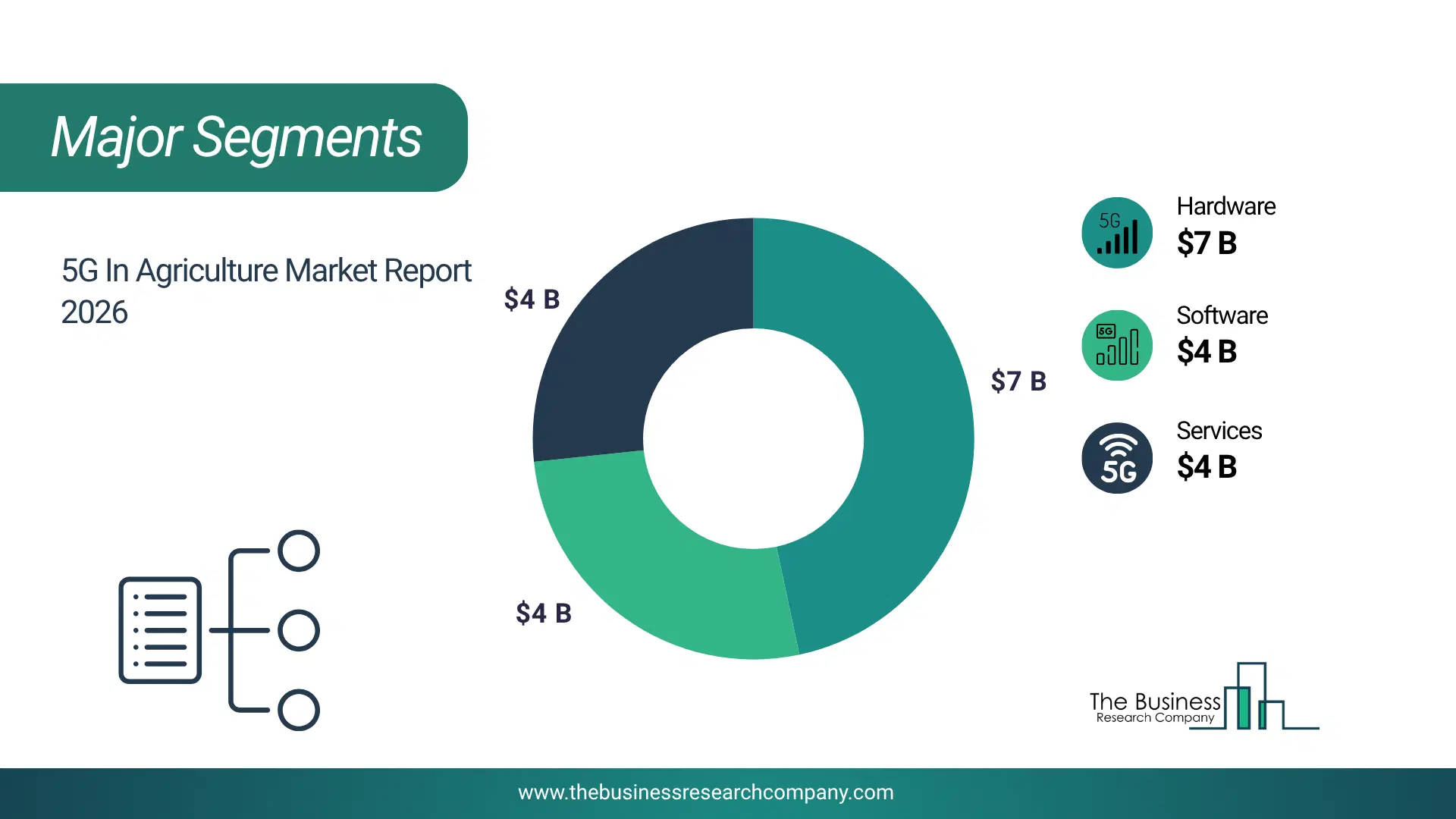
1) By Component: Hardware, Software, Services 2) By Connectivity Type: Enhanced Mobile Broadband (eMBB), Ultra-Reliable Low Latency Communication (URLLC), Massive Machine-Type Communication (mMTC) 3) By Deployment Mode: On-Premises, Cloud 4) By Application: Precision Farming, Livestock Monitoring, Smart Greenhouses, Autonomous Tractors, Drones, Other Application 5) By End-User: Farmers, Agribusinesses, Research Institutes, Other End-Users Subsegments: 1) By Hardware: Sensors, Drones, Autonomous Vehicles, Communication Devices, Control Systems 2) By Software: Farm Management Software, Data Analytics Software, Monitoring Software, Automation Software, Decision Support Systems 3) By Services: Network Management Services, Consulting Services, Analytics Services, Maintenance Services, Support Services The top segments in the 5g in agriculture market will be: • Hardware will reach $7 Billion by 2030. • Software will reach $3.74 Billion by 2030. • Services will reach $3.69 Billion by 2030.What Is The Driver Of The 5G In Agriculture Market?
The rising prevalence of precision agriculture is expected to propel the growth of the 5G in agriculture market going forward. Precision agriculture uses advanced technologies and data-driven insights to improve crop yields, reduce resource waste, and enhance overall farm productivity. Precision agriculture is increasing due to the rising demand for optimized resource utilization that enhances crop yield and reduces input costs. 5G in agriculture enhances precision agriculture by enabling real-time data transmission, IoT connectivity, and remote monitoring of crops and livestock. It improves resource efficiency, crop yields, and farm management decisions. For instance, in January 2024, according to the United States Government Accountability Office, a US-based government department, in 2023, about 27% of farms and ranches in the U.S. adopted precision agriculture practices for managing crops or livestock. Therefore, the rising prevalence of precision agriculture is driving the growth of the 5G in agriculture industry.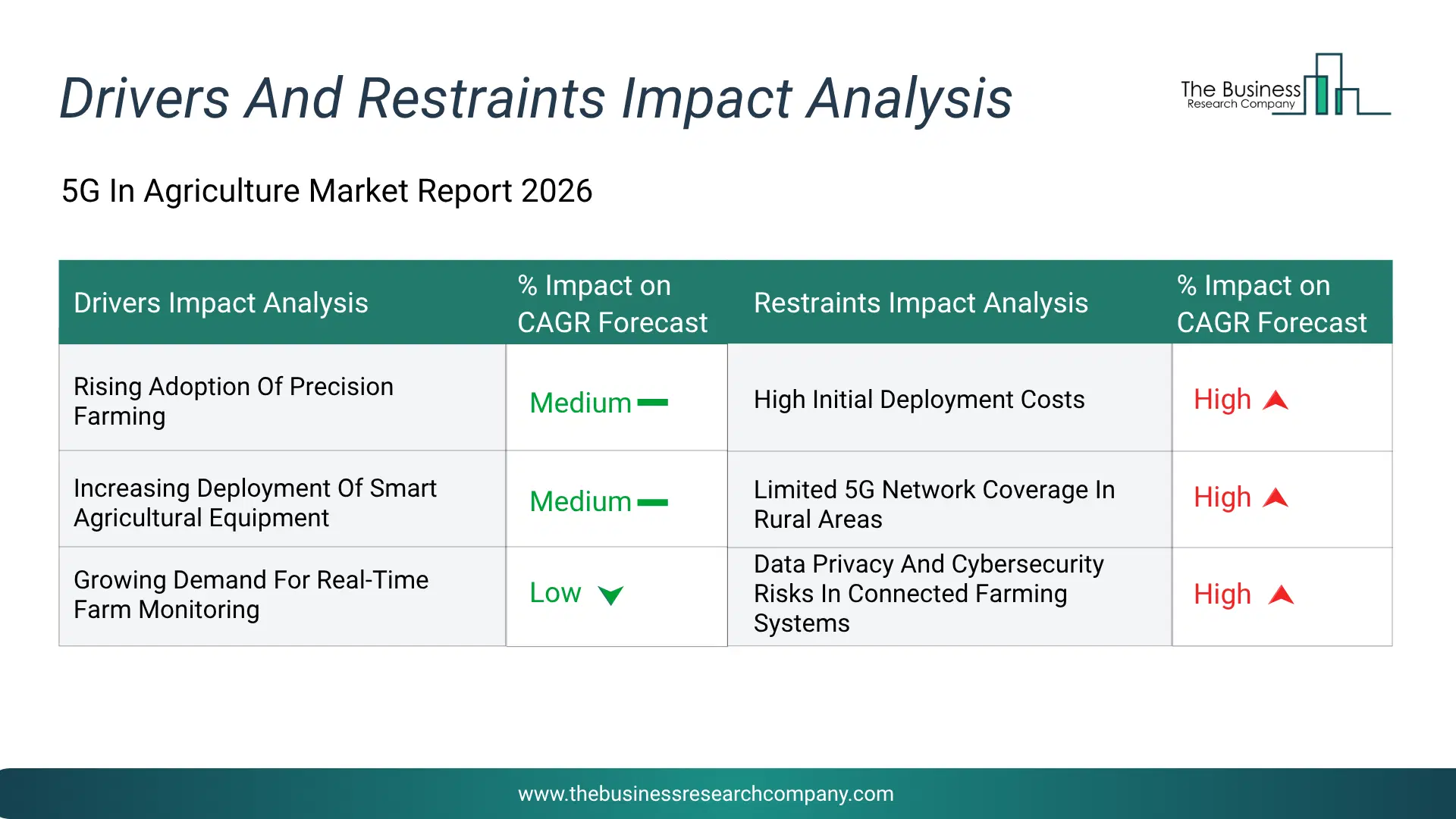
Infographic Chart Showing Key Market Drivers Analysis And Restraints For 5G In Agriculture Market
The chart presents an impact analysis of key drivers and restraints, quantifying their relative influence on the market's growth rate and helping assess the balance between growth enablers and limiting factors. This chart offers a high-level perspective; the full report contains more detailed insights.
How Will The Drivers Impact Growth In The Global 5G In Agriculture Market?
• Rising Adoption Of Precision Farming (Medium) – During the forecast period, the rising adoption of precision farming is expected to become a key growth driver for the 5G in agriculture market by 2030. Agricultural producers are increasingly leveraging connected technologies to improve field-level decision-making, maximize crop productivity, and optimize the use of agricultural inputs. High-speed 5G connectivity enables seamless communication between field sensors, drones, GPS-enabled machinery, and digital farm management platforms, supporting highly accurate farming operations. As growers continue shifting toward data-centric cultivation practices to improve profitability and sustainability, demand for reliable next-generation communication networks is accelerating. • Increasing Deployment Of Smart Agricultural Equipment (Medium) – During the forecast period, the increasing deployment of smart agricultural equipment is expected to emerge as a major factor driving the expansion of the 5G in agriculture market by 2030. Farms are increasingly integrating autonomous machinery, robotic systems, intelligent irrigation equipment, and connected field devices to streamline operations and improve resource utilization. These advanced systems require ultra-fast, low-latency wireless connectivity to enable synchronized operation, remote control, and continuous machine-to-machine communication. The growing modernization of agricultural infrastructure and expanding investments in farm automation are creating sustained demand for robust 5G networks. • Growing Demand For Real-Time Farm Monitoring (Low) – During the forecast period, the growing demand for real-time farm monitoring is expected to act as a key growth catalyst for the 5G in agriculture market by 2030. Agricultural enterprises are increasingly adopting continuous monitoring solutions to improve visibility across crop conditions, livestock health, environmental parameters, and equipment utilization. Advanced 5G connectivity supports rapid transmission of high-volume data generated by distributed monitoring systems, enabling timely interventions and more efficient farm management. The increasing focus on minimizing production risks, improving operational resilience, and enhancing agricultural output is further strengthening the need for always-connected farming environments.How Will The Restraints Impact Growth In The Global 5G In Agriculture Market?
• High Initial Deployment Costs (Medium) – During the forecast period, the high initial deployment costs act as a major restraint for the 5G in agriculture market because implementing 5G-enabled farming solutions requires substantial investment in network infrastructure, sensors, drones, autonomous machinery, smart irrigation systems, and data management platforms. Many farmers, particularly small and medium-sized operators, face budget limitations that make adoption difficult. The cost of upgrading existing agricultural equipment and integrating new technologies further increases financial pressure. These expenses can delay investment decisions and reduce adoption rates. As a result, market growth may be slower in cost-sensitive agricultural regions. • Limited 5G Network Coverage In Rural Areas (Medium) – During the forecast period, the limited 5G network coverage in rural areas acts as a significant restraint for the 5G in agriculture market because most agricultural activities take place in remote locations where advanced telecommunications infrastructure is often underdeveloped. Without reliable network connectivity, farmers cannot fully utilize real-time monitoring, automation, and data-driven farming applications. Network deployment in sparsely populated regions can be expensive and less attractive for telecom providers. This connectivity gap restricts the practical implementation of 5G-enabled agricultural solutions. Consequently, market expansion remains constrained in many farming communities. • Data Privacy And Cybersecurity Risks In Connected Farming Systems (Low) – During the forecast period, the data privacy and cybersecurity risks in connected farming systems are expected to restrain the growth of the 5G in agriculture market. The adoption of 5G-enabled agriculture relies on interconnected sensors, autonomous machinery, drones, cloud platforms, and Internet of Things (IoT) devices that continuously collect, transmit, and process large volumes of farm and operational data. This increased connectivity expands the potential attack surface for cyber threats, unauthorized access, ransomware, and data breaches that could disrupt agricultural operations or compromise sensitive farm information. Farmers and agribusinesses may be reluctant to adopt connected farming solutions due to concerns over data ownership, privacy, and the security of critical agricultural infrastructure. In addition, complying with evolving cybersecurity standards and implementing robust security frameworks requires additional investment in encryption technologies, network monitoring, and access control systems. These security challenges increase implementation complexity and operational costs, particularly for small and medium-sized farming operations. Consequently, data privacy and cybersecurity risks in connected farming systems remain a significant restraint on the growth of the 5G in agriculture market.Key Players In The Global 5G In Agriculture Market
Major companies operating in the 5G in agriculture market are Microsoft Corporation, Intel Corporation, Samsung Electronics Co. Ltd., Deutsche Telekom AG, Verizon Communications Inc., Huawei Technologies Co. Ltd., T-Mobile US Inc., Cisco Systems Inc., Deere & Company, Vodafone Group plc, Qualcomm Incorporated, Telefonaktiebolaget LM Ericsson, Nippon Electric Company Limited, Nokia Corporation, Kubota Corporation, Zhongxing Telecommunication Equipment Corporation, AGCO Corporation, Hexagon AB, Trimble Inc., Fibocom Wireless Inc., Lindsay Corporation, u-blox Holding AG, Telit Cinterion, Quectel Wireless Solutions Co. Ltd.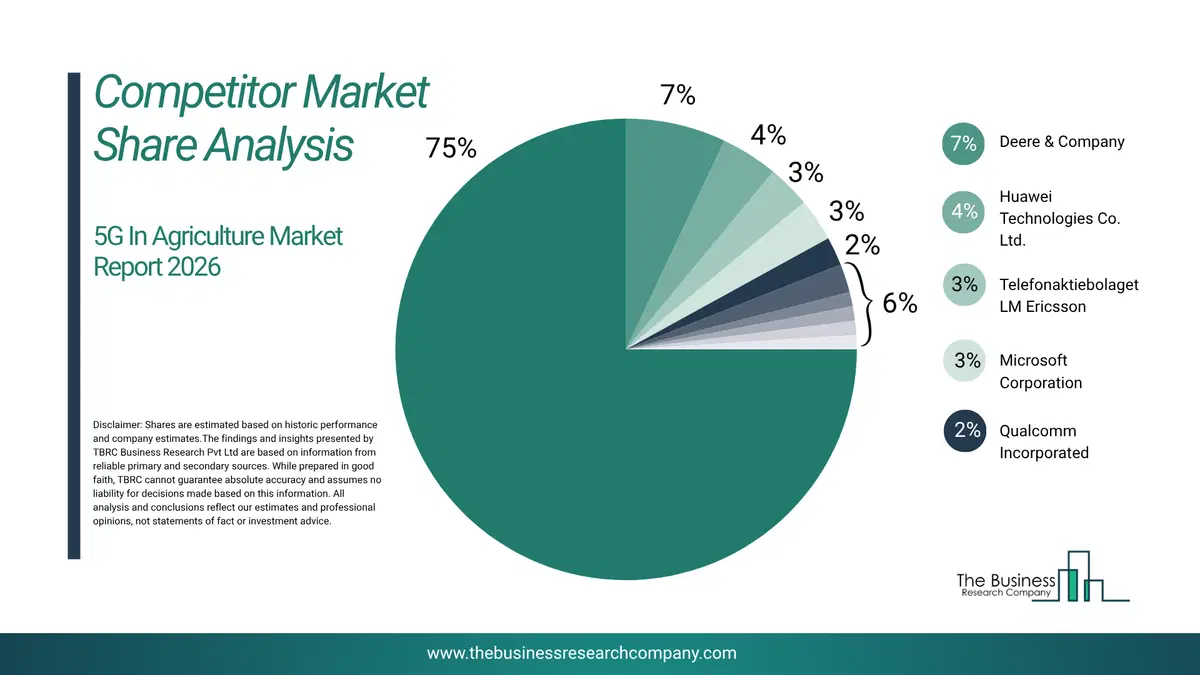
This chart is for illustrative purposes; the full report includes a detailed competitor analysis and comprehensive overview of the top 10 companies in the market.
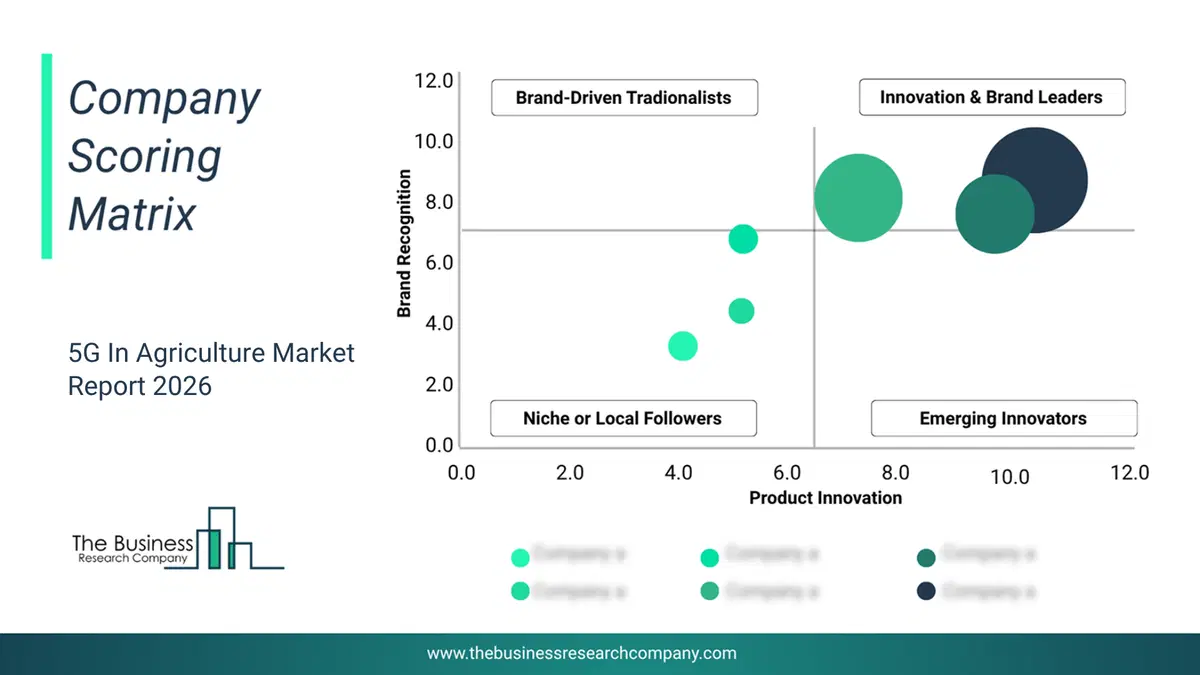
This chart maps companies by product innovation and brand strength, with bubble size indicating relative revenue, helping identify market leaders, challengers, and niche players. This is an illustrative chart; the full report provides a complete and accurate competitive analysis.
Global 5G In Agriculture Market Trends and Insights
Major companies operating in the 5G in agriculture market are focusing on launching pilot farms using drones and automated machinery, to drive modernisation, improve resource efficiency, and enhance crop management. Pilot farms refer to small-scale, experimental, or demonstration farms used to test, validate, and optimize agricultural practices, technologies, or innovations before large-scale deployment. For instance, in December 2024, Türk Telekom, a Turkey-based telecommunications company, partnered with Zhongxing Telecommunication Equipment Corporation, a China-based telecommunications company, and launched a 5G Smart Agriculture Project in Çorum, Turkey. It is a pilot project featuring an established 5G network that integrates advanced technologies such as drones and smart farming machinery. It includes automated spraying, fertilization, and precision irrigation functionalities, enabling precise and efficient field operations without relying on slower, traditional methods. It also contributes to digital transformation and modernization in agriculture, targeting significant resource savings and supporting sustainability goals for farmers and the agricultural sector.What Are Latest Mergers And Acquisitions In The 5G In Agriculture Market?
In December 2023, Ericsson, a global leader in communications technology, partnered with AgriBusiness Connect Pty Ltd to explore and develop enterprise 5G applications for Australia's agriculture sector. This partnership aims to accelerate the digital transformation and adoption of Industry 4.0 in agribusiness by combining Ericsson’s expertise in 5G network solutions with AgriBusiness Connect's knowledge of the sector and its ecosystem relationships. AgriBusiness Connect Pty Ltd is an Australia-based agribusiness networking and consultancy company.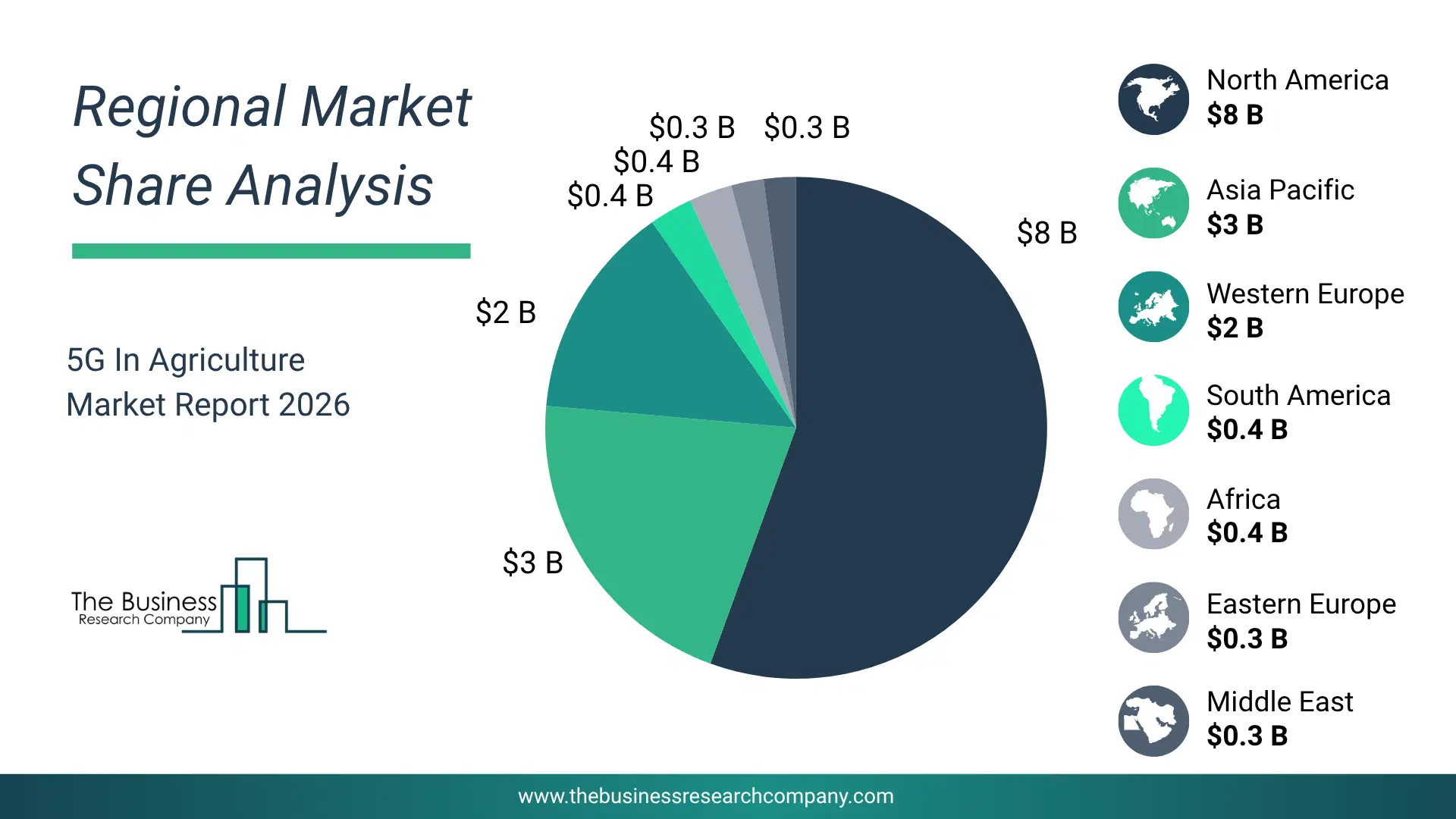
Regional Insights
North America was the largest region in the 5G in agriculture market in 2025. Asia-Pacific is expected to be the fastest-growing region in the forecast period. The regions covered in this market report are Asia-Pacific, South East Asia, Western Europe, Eastern Europe, North America, South America, Middle East, Africa. The countries covered in this market report are Australia, Brazil, China, France, Germany, India, Indonesia, Japan, Taiwan, Russia, South Korea, UK, USA, Canada, Italy, Spain.What Defines the 5G In Agriculture Market?
The 5G in agriculture market consists of revenues earned by entities by providing services such as system integration, maintenance and support, cloud services, connectivity solutions. The market value includes the value of related goods sold by the service provider or included within the service offering. The 5G in agriculture market also includes sales of sensors, drones, smart irrigation systems, and autonomous tractors. Values in this market are ‘factory gate’ values, that is, the value of goods sold by the manufacturers or creators of the goods, whether to other entities (including downstream manufacturers, wholesalers, distributors, and retailers) or directly to end customers. The value of goods in this market includes related services sold by the creators of the goods.How is Market Value Defined and Measured?
The market value is defined as the revenues that enterprises gain from the sale of goods and/or services within the specified market and geography through sales, grants, or donations in terms of the currency (in USD unless otherwise specified). The revenues for a specified geography are consumption values that are revenues generated by organizations in the specified geography within the market, irrespective of where they are produced. It does not include revenues from resales along the supply chain, either further along the supply chain or as part of other products.
This chart presents market attractiveness based on a quantitative evaluation of growth, competition, strategic alignment, and risk, offering a clear view of opportunity areas for decision-making. This chart is for illustrative purposes; the full report contains the complete analysis.

This chart highlights the Total Addressable Market (TAM) by estimating the maximum revenue opportunity using an assumption-driven approach, supporting strategic planning and opportunity sizing across markets. The chart is illustrative; the full report provides a more comprehensive analysis.
What Key Data and Analysis Are Included in the 5G In Agriculture Market Report 2026?
The 5g in agriculture market research report is one of a series of new reports from The Business Research Company that provides market statistics, including industry global market size, regional shares, competitors with the market share, detailed market segments, market trends and opportunities, and any further data you may need to thrive in the 5g in agriculture industry. The market research report delivers a complete perspective of everything you need, with an in-depth analysis of the current and future state of the industry.5G In Agriculture Market Report Forecast Analysis
| Report Attribute | Details |
|---|---|
| Market Size Value In 2026 | $5.11 billion |
| Revenue Forecast In 2030 | $15.18 billion |
| Growth Rate | CAGR of 31.6% from 2026 to 2030 |
| Base Year For Estimation | 2025 |
| Actual Estimates/Historical Data | 2020-2025 |
| Forecast Period | 2026 - 2030 |
| Market Representation | Revenue in USD Billion and CAGR from 2026 to 2030 |
| Segments Covered | Component, Connectivity Type, Deployment Mode, Application, End-User |
| Regional Scope | Asia-Pacific, Western Europe, Eastern Europe, North America, South America, Middle East, Africa |
| Country Scope | The countries covered in the report are Australia, Brazil, China, France, Germany, India, Indonesia, Japan, Taiwan, Russia, South Korea, UK, USA, Canada, Italy, Spain. |
| Key Companies Profiled | Microsoft Corporation, Intel Corporation, Samsung Electronics Co. Ltd., Deutsche Telekom AG, Verizon Communications Inc., Huawei Technologies Co. Ltd., T-Mobile US Inc., Cisco Systems Inc., Deere & Company, Vodafone Group plc, Qualcomm Incorporated, Telefonaktiebolaget LM Ericsson, Nippon Electric Company Limited, Nokia Corporation, Kubota Corporation, Zhongxing Telecommunication Equipment Corporation, AGCO Corporation, Hexagon AB, Trimble Inc., Fibocom Wireless Inc., Lindsay Corporation, u-blox Holding AG, Telit Cinterion, Quectel Wireless Solutions Co. Ltd. |
| Customization Scope | Request for Customization |
| Pricing And Purchase Options | Explore Purchase Options |