
Acrylic Rubber Market Report 2026
Global Outlook – By Type (Active Chlorine Acrylate Rubber, Carboxyl Type Acrylate Rubber), By Fabrication Process (Compression Molding, Transfer Molding, Injection Molding, Other Fabrication Process), By Application (Textiles, Adhesives, Gaskets, Coating, Plastics, Other Applications), By End Use (Automotive Industry, Chemical Industry, Oil And Gas, Manufacturing, Other End Users) – Market Size, Trends, Strategies, and Forecast to 2030
Acrylic Rubber Market Overview
• Acrylic Rubber market size has reached to $1.74 billion in 2025 • Expected to grow to $2.56 billion in 2030 at a compound annual growth rate (CAGR) of 8.1% • Growth Driver: Automobile Production Surge Fuels Acrylic Rubber Market Growth • Asia-Pacific was the largest region in 2025.What Is Covered Under Acrylic Rubber Market?
Acrylic rubber is synthetic rubber containing acrylonitrile and has excellent resistance to hot oil and oxidation. Acrylic rubber is commonly used in applications where resistance to high temperatures, oil, and chemicals is required. The main types of acrylic rubbers are active chlorine acrylate rubber, carboxyl-type acrylate rubber, dienes acrylate rubber, and epoxy acrylate rubber. Active chlorine acrylate rubber refers to a type of synthetic rubber that is derived from the chlorination of acrylate polymers. These are formed by various fabrication processes such as compression molding, transfer molding, injection molding, and others. These are applied in multiple applications such as textiles, adhesives, gaskets, coatings, plastics, and others, which are used in automotive industry, chemical industry, electrical and electronics, oil and gas, aerospace, manufacturing, textile industry, marine industry, and others.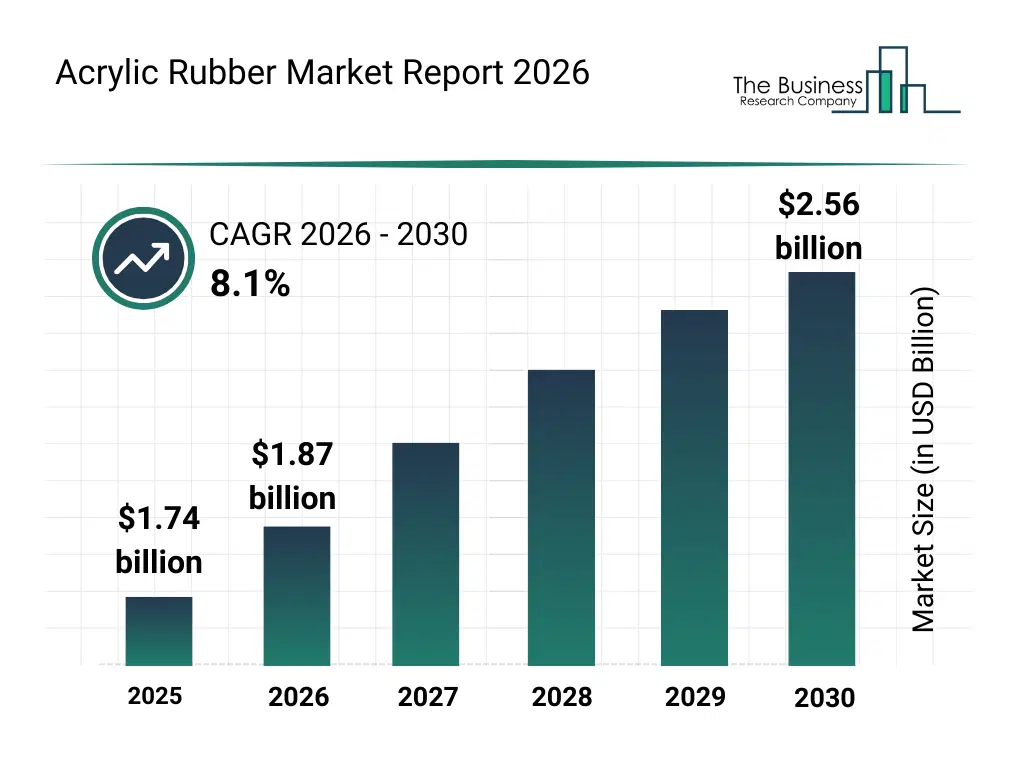
What Is The Acrylic Rubber Market Size and Share 2026?
The acrylic rubber market size has grown strongly in recent years. It will grow from $1.74 billion in 2025 to $1.87 billion in 2026 at a compound annual growth rate (CAGR) of 7.7%. The growth in the historic period can be attributed to increasing automotive production volumes, expansion of industrial machinery manufacturing, rising demand for oil-resistant materials, growth in chemical processing industries, availability of advanced synthetic rubber formulations.What Is The Acrylic Rubber Market Growth Forecast?
The acrylic rubber market size is expected to see strong growth in the next few years. It will grow to $2.56 billion in 2030 at a compound annual growth rate (CAGR) of 8.1%. The growth in the forecast period can be attributed to increasing adoption of electric vehicle components, rising demand for durable elastomers in harsh environments, expansion of lightweight material usage, growing focus on high-performance sealing solutions, increasing investments in specialty rubber production. Major trends in the forecast period include increasing demand for high-temperature resistant elastomers, growing use of acrylic rubber in automotive sealing systems, expansion of oil-resistant rubber applications, rising adoption in electrical and electronics components, enhanced focus on long-life elastomer performance.
Global Acrylic Rubber Market Segmentation
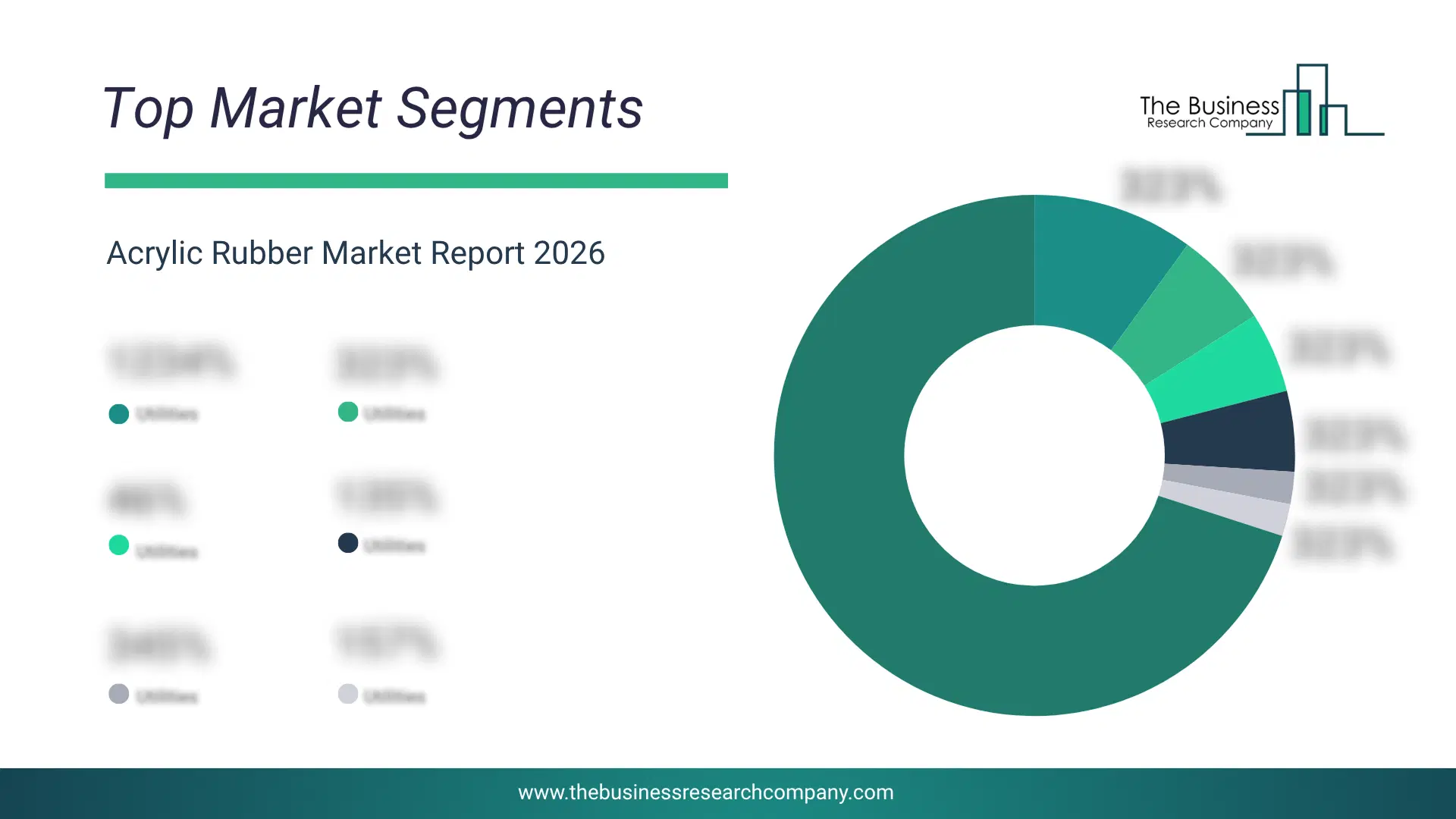
1) By Type: Active Chlorine Acrylate Rubber, Carboxyl Type Acrylate Rubber 2) By Fabrication Process: Compression Molding, Transfer Molding, Injection Molding, Other Fabrication Process 3) By Application: Textiles, Adhesives, Gaskets, Coating, Plastics, Other Applications 4) By End Use: Automotive Industry, Chemical Industry, Oil And Gas, Manufacturing, Other End Users Subsegments: 1) By Active Chlorine Acrylate Rubber: Liquid Formulations, Solid Formulations 2) By Carboxyl Type Acrylate Rubber: Thermoplastic Grades, Thermosetting GradesWhat Are The Drivers Of The Acrylic Rubber Market?
Increasing automobile production is expected to propel the growth of the acrylic rubber market. Automobiles refer to self-propelled motor vehicles, including cars, trucks, motorcycles, and others, designed for road transportation. Automotive production refers to transforming basic materials to create motor vehicles and the parts that go into making them. Acrylic rubber products are widely used in automobile components such as transmissions, bearing seals, and O-rings for their heat- and oil-resistant properties. Thus, the increasing automobile production is boosting the sales of acrylic rubber products. For instance, in May 2025, according to the European Automobile Manufacturers’ Association (ACEA), a Belgium-based motor vehicle manufacturing company, South American car production grew by 1.7% in 2024 compared to 2023, largely driven by Brazil, which experienced a 6.3% rise, producing approximately 1.9 million cars. Meanwhile, global bus production reached 362, 005 units last year, marking a 10.3% increase from 2023. Therefore, increasing automobile production is driving the growth of the acrylic rubber industry. The growing construction industry is expected to propel the growth of the acrylic rubber market going forward. The construction industry refers to the manufacturing and trade sector that is concerned with building, maintaining, and repairing infrastructure. Acrylic rubbers are used in the construction industry to provide weather-resistant protection for roofs, seal joints, and gaps in buildings and other structures. For instance, in June 2024, according to TST Europe AG, a Switzerland-based manufacturer of quick-connect couplings, in 2023, total construction spending reached $1.98 trillion, marking a 7.4% increase from the previous year. Therefore, the growing construction industry is driving the growth of the acrylic rubber industry.Key Players In The Global Acrylic Rubber Market
Major companies operating in the acrylic rubber market are DuPont de Nemours Inc., ZEON Corporation, NOK Corporation, Apcotex Industries Ltd., Synthos SA, Mitsubishi Chemical, Sumitomo Chemical, Dow Chemical, Eastman Chemical Company, Formosa Chemical & Fibre Corporation, PAR Group Ltd., Ames Rubber Manufacturing Co. Inc., Hanna Rubber Company, Fostek Corporation, Jet Rubber Company, Vanderbilt Chemicals LLC, Elder Rubber Company, Harboro Rubber, Tiger Rubber Company, Hi-Tech Polymers, Shin-Etsu Chemical Co. Ltd.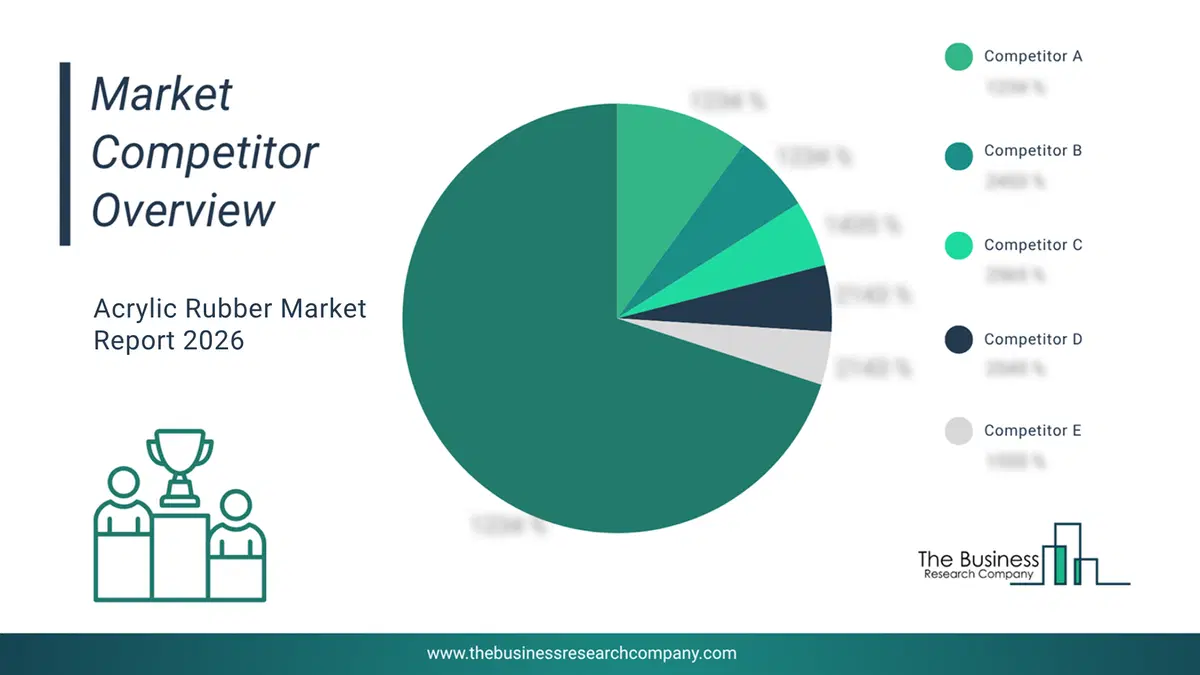
This chart is for illustrative purposes; the full report includes a detailed competitor analysis and comprehensive overview of the top 10 companies in the market.
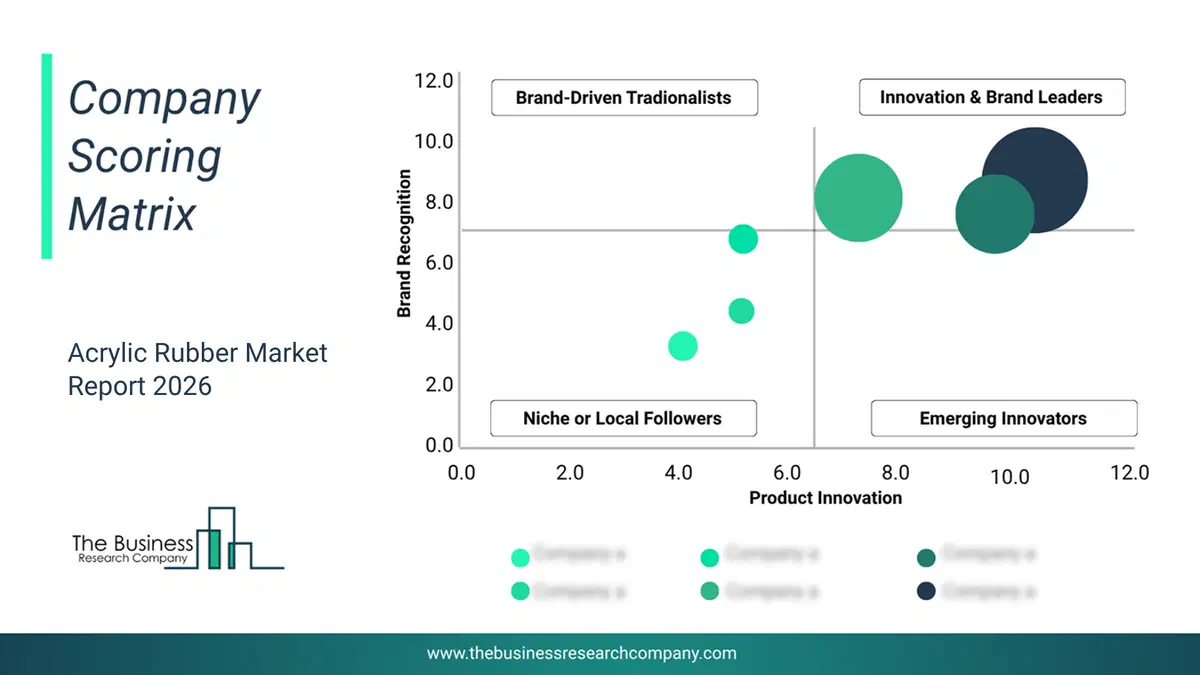
This chart maps companies by product innovation and brand strength, with bubble size indicating relative revenue, helping identify market leaders, challengers, and niche players. This is an illustrative chart; the full report provides a complete and accurate competitive analysis.
What Are Latest Mergers And Acquisitions In The Acrylic Rubber Market?
In August 2024, Trelleborg AB, a Sweden-based engineering company, acquired Baron Group for $300 million. With this acquisition, Trelleborg Group aims to strengthen its position as a global partner in the medical technology sector by expanding its manufacturing capacity and expertise in advanced precision silicone components. Baron Group is an Australia-based manufacturing company that specializes in producing advanced precision silicone components.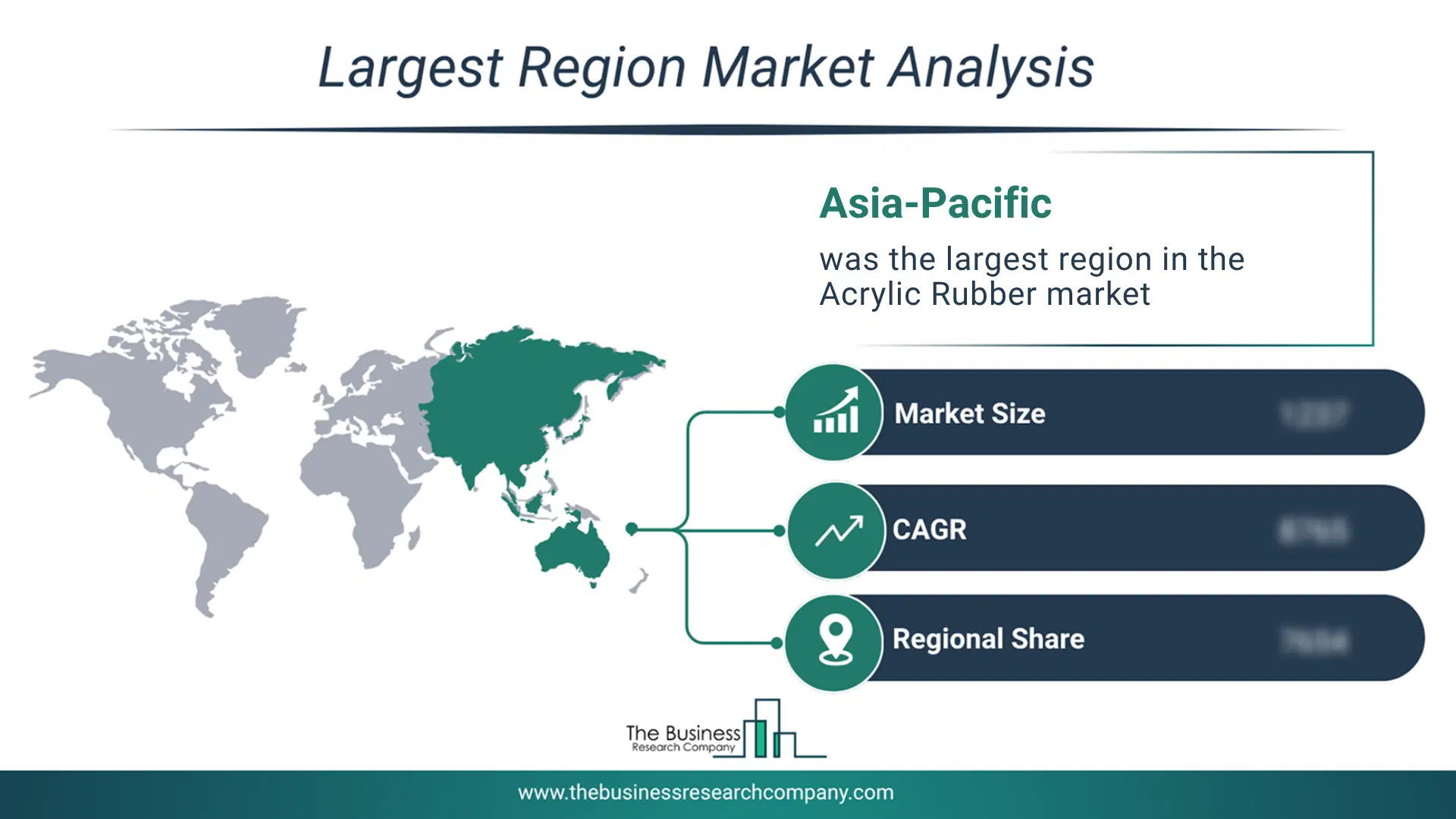
Regional Outlook
Asia-Pacific was the largest region in the acrylic rubber market in 2025. The regions covered in this market report are Asia-Pacific, South East Asia, Western Europe, Eastern Europe, North America, South America, Middle East, Africa. The countries covered in this market report are Australia, Brazil, China, France, Germany, India, Indonesia, Japan, Taiwan, Russia, South Korea, UK, USA, Canada, Italy, Spain.What Defines the Acrylic Rubber Market?
The acrylic rubber market consists of sales of butyl rubber, carboxyl nitrile rubber, fluorocarbon rubber, and neoprene rubber. Values in this market are ‘factory gate’ values, that is, the value of goods sold by the manufacturers or creators of the goods, whether to other entities (including downstream manufacturers, wholesalers, distributors, and retailers) or directly to end customers. The value of goods in this market includes related services sold by the creators of the goods.How is Market Value Defined and Measured?
The market value is defined as the revenues that enterprises gain from the sale of goods and/or services within the specified market and geography through sales, grants, or donations in terms of the currency (in USD unless otherwise specified). The revenues for a specified geography are consumption values that are revenues generated by organizations in the specified geography within the market, irrespective of where they are produced. It does not include revenues from resales along the supply chain, either further along the supply chain or as part of other products.
This chart presents market attractiveness based on a quantitative evaluation of growth, competition, strategic alignment, and risk, offering a clear view of opportunity areas for decision-making. This chart is for illustrative purposes; the full report contains the complete analysis.

This chart highlights the Total Addressable Market (TAM) by estimating the maximum revenue opportunity using an assumption-driven approach, supporting strategic planning and opportunity sizing across markets. The chart is illustrative; the full report provides a more comprehensive analysis.
What Key Data and Analysis Are Included in the Acrylic Rubber Market Report 2026?
The acrylic rubber market research report is one of a series of new reports from The Business Research Company that provides market statistics, including Market Report 2026?global market size, regional shares, competitors with the market share, detailed market segments, market trends and opportunities, and any further data you may need to thrive in the acrylic rubber Market Report 2026? The market research report delivers a complete perspective of everything you need, with an in-depth analysis of the current and future state of the Market Report 2026?Acrylic Rubber Market Report Forecast Analysis
| Report Attribute | Details |
|---|---|
| Market Size Value In 2026 | $1.87 billion |
| Revenue Forecast In 2030 | $2.56 billion |
| Growth Rate | CAGR of 7.7% from 2026 to 2030 |
| Base Year For Estimation | 2025 |
| Actual Estimates/Historical Data | 2020-2025 |
| Forecast Period | 2026 - 2030 |
| Market Representation | Revenue in USD Billion and CAGR from 2026 to 2030 |
| Segments Covered | Type, Fabrication Process, Application, End Use |
| Regional Scope | Asia-Pacific, Western Europe, Eastern Europe, North America, South America, Middle East, Africa |
| Country Scope | The countries covered in the report are Australia, Brazil, China, France, Germany, India, Indonesia, Japan, Taiwan, Russia, South Korea, UK, USA, Canada, Italy, Spain. |
| Key Companies Profiled | DuPont de Nemours Inc., ZEON Corporation, NOK Corporation, Apcotex Industries Ltd., Synthos SA, Mitsubishi Chemical, Sumitomo Chemical, Dow Chemical, Eastman Chemical Company, Formosa Chemical & Fibre Corporation, PAR Group Ltd., Ames Rubber Manufacturing Co. Inc., Hanna Rubber Company, Fostek Corporation, Jet Rubber Company, Vanderbilt Chemicals LLC, Elder Rubber Company, Harboro Rubber, Tiger Rubber Company, Hi-Tech Polymers, Shin-Etsu Chemical Co. Ltd. |
| Customization Scope | Request for Customization |
| Pricing And Purchase Options | Explore Purchase Options |