

Acrylonitrile Market Report 2026
Global Outlook – By Type (Acrylonitrile Monomer, Styrene–Acrylonitrile (SAN) Copolymers, Acrylonitrile–Butadiene–Styrene (ABS) Resins, Carbon-Fiber Precursors And Specialty Grades), By Application (Acrylic Fiber, Adiponitrile, Styrene Acrylonitrile, Acrylonitrile Butadiene Styrene, Acrylamide, Carbon Fiber, Nitrile Rubber, Other Applications), By End User (Automotive, Electrical & Electronics, Construction, Packaging, Other End Users) – Market Size, Trends, Strategies, and Forecast to 2030
Acrylonitrile Market Overview
• Acrylonitrile market size has reached to $14.97 billion in 2025 • Expected to grow to $20.72 billion in 2030 at a compound annual growth rate (CAGR) of 6.6% • Growth Driver: crylonitrile Market Thrives With Growing Construction Activities • Market Trend: Ineos Nitriles Innovation With The Sustainable Acrylonitrile Solution • Asia-Pacific was the largest region in 2025.What Is Covered Under Acrylonitrile Market?
Acrylonitrile refer to an organic compound with the formula CH₂CHCN. Acrylonitrile (CH₂=CHCN) is a toxic, colorless, pale-yellow liquid. Acrylonitrile is primarily used as a raw material in the manufacture of acrylic and modacrylic fibers. Other important applications include plastics (acrylonitrile-butadiene-styrene (ABS) and styrene-acrylonitrile (SAN)), nitrile rubbers, nitrile barrier resins, adiponitrile, and acrylamide. The main applications of acrylonitrile are acrylic fiber, adiponitrile, styrene-acrylonitrile, acrylonitrile butadiene styrene, acrylamide, carbon fiber, nitrile rubber, and others. Acrylic fibers are soft and stretchy, resulting in lightweight, lofty yarns. Acrylic fiber refers to the material made from acrylonitrile that is used as a replacement for wool in clothing and carpets. It is generally referred to as a flexible and adaptable fiber that produces fluffy and light yarns. These characteristics resemble wool quite closely. The different end-users include automotive, electrical and electronics, construction, packaging, and others.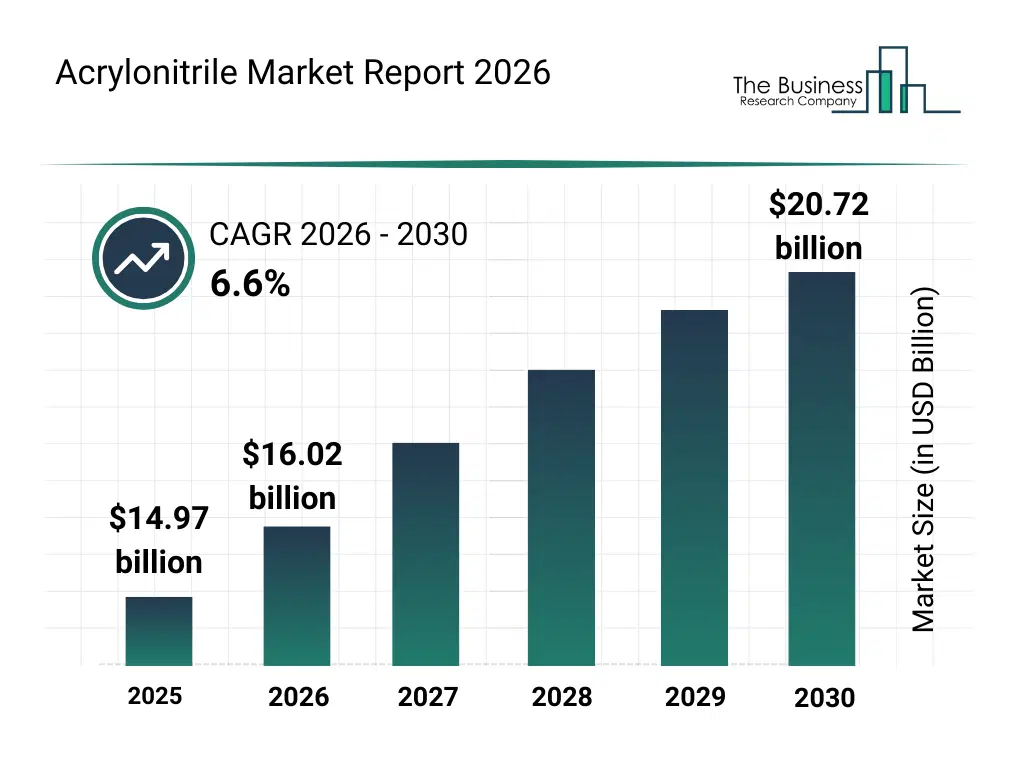
What Is The Acrylonitrile Market Size and Share 2026?
The acrylonitrile market size has grown strongly in recent years. It will grow from $14.97 billion in 2025 to $16.02 billion in 2026 at a compound annual growth rate (CAGR) of 7.0%. The growth in the historic period can be attributed to expansion of synthetic fiber manufacturing, growth in abs and san plastics production, increasing demand for nitrile rubber, availability of petrochemical infrastructure, rising industrial chemical consumption.What Is The Acrylonitrile Market Growth Forecast?
The acrylonitrile market size is expected to see strong growth in the next few years. It will grow to $20.72 billion in 2030 at a compound annual growth rate (CAGR) of 6.6%. The growth in the forecast period can be attributed to increasing adoption in electric vehicle components, expansion of carbon fiber production, rising focus on emission-efficient chemical plants, growing packaging material demand, increasing regulatory pressure on emissions. Major trends in the forecast period include expansion of high-performance polymer applications, rising demand from automotive lightweighting, increasing use in advanced plastics and fibers, growth of integrated chemical production, enhanced process optimization.
Global Acrylonitrile Market Segmentation
1) By Type: Acrylonitrile Monomer, Styrene–Acrylonitrile (SAN) Copolymers, Acrylonitrile–Butadiene–Styrene (ABS) Resins, Carbon-Fiber Precursors And Specialty Grades 2) By Application: Acrylic Fiber, Adiponitrile, Styrene Acrylonitrile, Acrylonitrile Butadiene Styrene, Acrylamide, Carbon Fiber, Nitrile Rubber, Other Applications 3) By End User: Automotive, Electrical & Electronics, Construction, Packaging, Other End Users Subsegments: 1) By Acrylonitrile Monomer: Polymer-Grade Acrylonitrile, Fiber-Grade Acrylonitrile, Chemical-Intermediate Grade Acrylonitrile 2) By Styrene–Acrylonitrile (SAN) Copolymers: General-Purpose SAN, High-Heat-Resistant SAN, High-Transparency SAN, Impact-Modified SAN 3) By Acrylonitrile–Butadiene–Styrene (ABS) Resins: Standard ABS Resins, High-Impact ABS, Flame-Retardant ABS, Heat-Resistant ABS, Electroplating-Grade ABS 4) By Carbon-Fiber Precursors and Specialty Grades: Polyacrylonitrile (PAN)-Based Carbon Fiber Precursors, High-Molecular-Weight PAN Grades, Oxidation-Stabilized PAN Fibers, Specialty PAN CopolymersWhat Is The Driver Of The Acrylonitrile Market?
The growing construction activities is expected to propel the growth of the acrylonitrile market going forward. Construction activities refer to the various tasks and operations involved in the process of constructing, renovating, or building structures such as buildings, infrastructure, and facilities. Growing construction activities are primarily driven by increasing urbanization, as more people move to cities, creating higher demand for residential, commercial, and infrastructure development. Acrylonitrile is used in construction activities production of polyvinyl chloride (PVC) pipes and fittings and for construction of insulating walls, roofs, and floors in buildings. For instance, in July 2024, according to the US Census Bureau, a US-based government agency, the value of construction operations rose from $2.01 trillion in May 2023 to $2.14 trillion in May 2024. Therefore, the growing construction activities is driving the growth of the acrylonitrile industry.Key Players In The Global Acrylonitrile Market
Major companies operating in the acrylonitrile market are BASF SE, INEOS Group Limited, Asahi Kasei Corporation, Ascend Performance Materials, Formosa Plastics Corporation, Sumitomo Chemical Co. Ltd., Mitsubishi Chemical Group Corporation, LG Chem Ltd., Sinopec Group, China National Petroleum Corporation (CNPC), AnQore BV, Taekwang Industrial Co. Ltd., Kolon Industries Inc., Jilin Petrochemical Company, Shanghai Secco Petrochemical Company Limited, Zhejiang Petrochemical Co. Ltd., Toray Industries Inc., Lotte Chemical Corporation, PetroChina Company Limited, Reliance Industries Limited, SABIC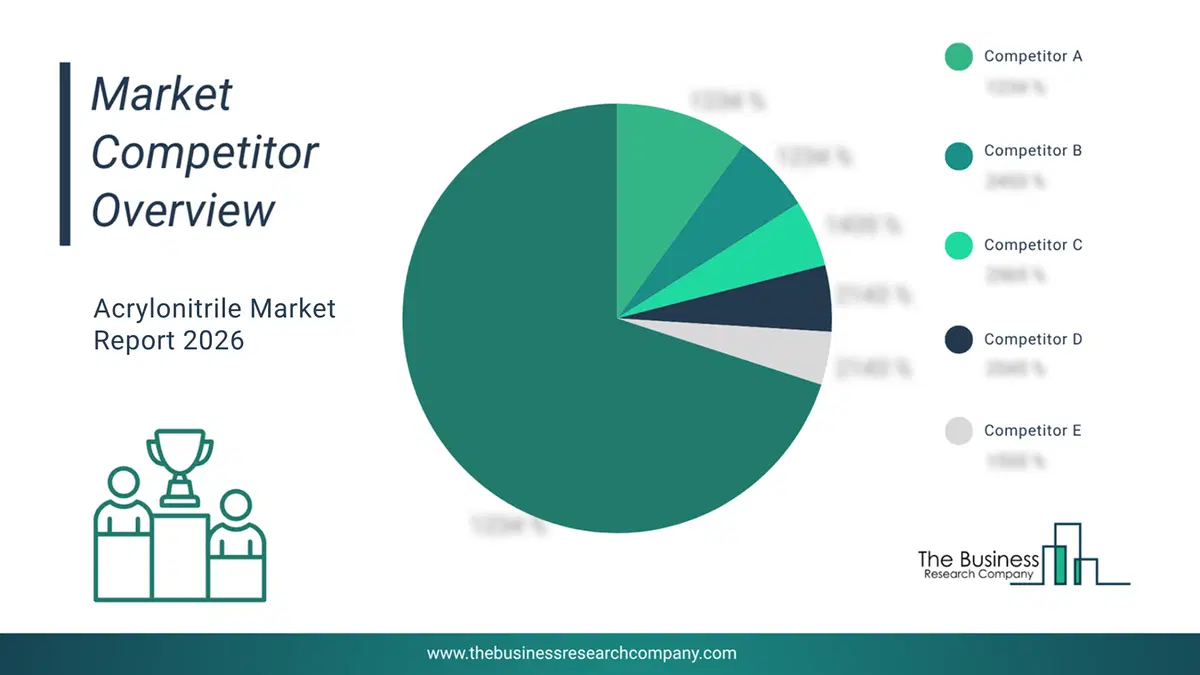
This chart is for illustrative purposes; the full report includes a detailed competitor analysis and comprehensive overview of the top 10 companies in the market.
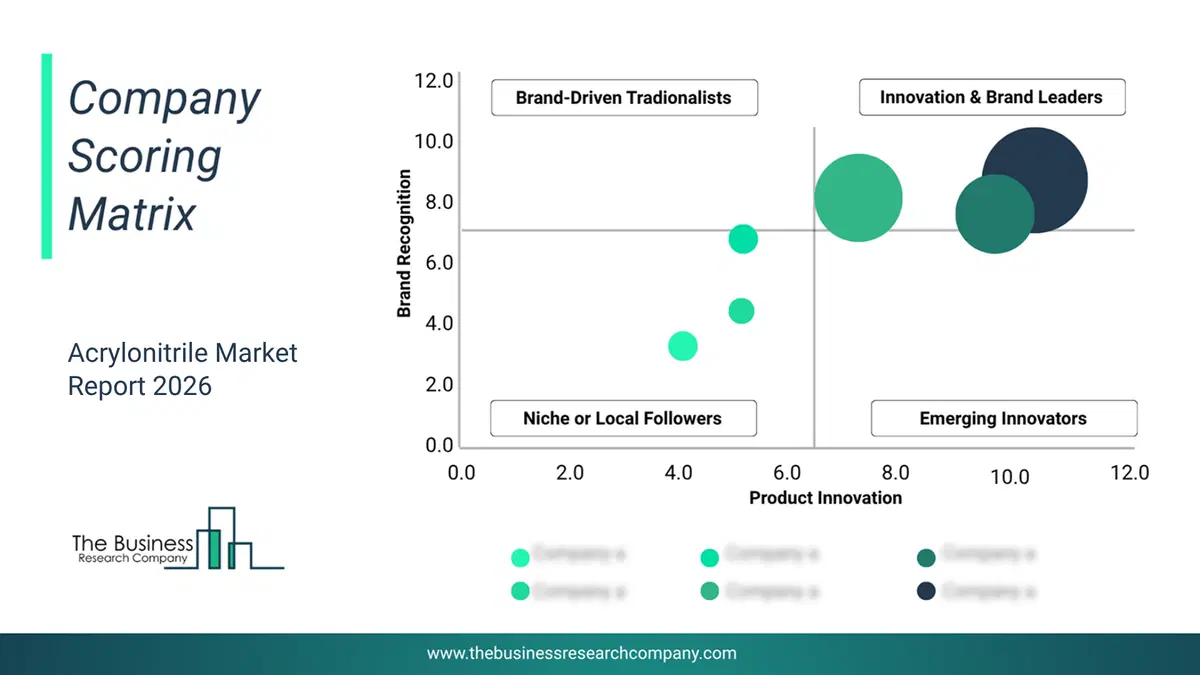
This chart maps companies by product innovation and brand strength, with bubble size indicating relative revenue, helping identify market leaders, challengers, and niche players. This is an illustrative chart; the full report provides a complete and accurate competitive analysis.
Global Acrylonitrile Market Trends and Insights
Major companies in the acrylonitrile market are focusing on innovating products, such as bio‑based acrylonitrile to reduce carbon footprint and enhance performance. Bio‑based acrylonitrile is acrylonitrile produced from renewable feedstocks instead of fossil fuels, offering the same performance with a lower carbon footprint. For instance, in June 2023, INEOS Nitriles, a UK-based manufacturer of petrochemicals, launched Invireo, a bio-attributed acrylonitrile product derived from sustainable feedstocks. Designed as a direct drop-in replacement for conventional acrylonitrile, Invireo allows manufacturers to switch without modifying existing production processes. It is utilized across various industries, including plastics, carbon-fiber precursors, and synthetic fibers, enabling companies to significantly reduce the environmental impact of their products. By incorporating Invireo into supply chains, INEOS Nitriles advances the shift toward more sustainable and low-carbon chemical manufacturing, cutting the carbon footprint of the end product by over 90%.What Are Latest Mergers And Acquisitions In The Acrylonitrile Market?
In June 2024, Trillium Renewable Chemicals, a US-based company developing sustainable chemical technologies, partnered with INEOS Nitriles to establish a demonstration plant for producing bio-based acrylonitrile at INEOS’s Green Lake facility in Texas. With this partnership, Trillium and INEOS aim to combine Trillium’s proprietary glycerol-to-acrylonitrile process with INEOS’s large-scale nitriles manufacturing infrastructure to create a lower-carbon acrylonitrile pathway that supports markets such as plastics, carbon fibre, and synthetic rubber. Ineos Group Limited is a UK-based company that provide acrylonitrile.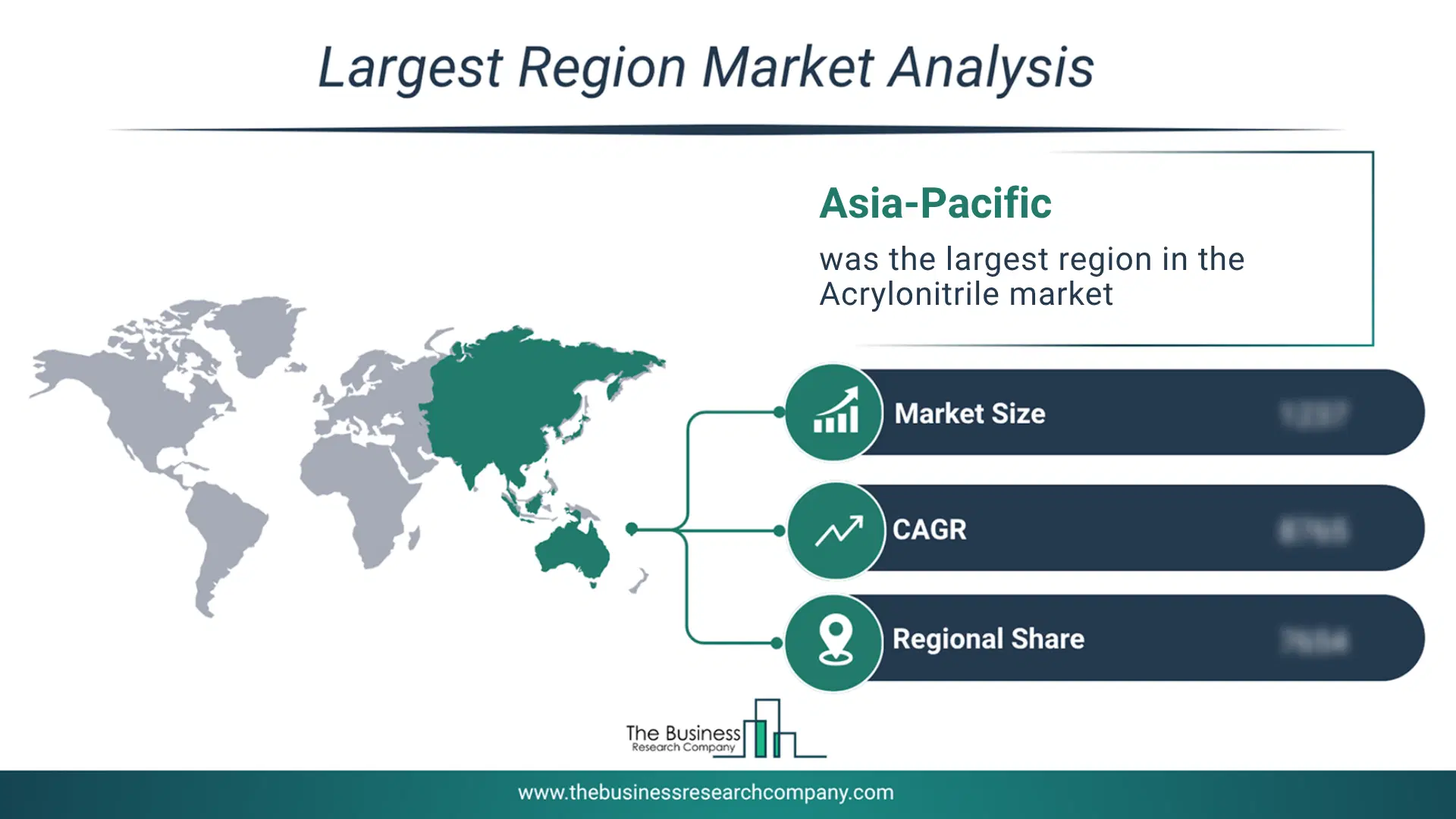
Regional Insights
Asia-Pacific was the largest region in the acrylonitrile market in 2025. North America was the second-largest region in the acrylonitrile market. The regions covered in this market report are Asia-Pacific, South East Asia, Western Europe, Eastern Europe, North America, South America, Middle East, Africa The countries covered in this market report are Australia, Brazil, China, France, Germany, India, Indonesia, Japan, Taiwan, Russia, South Korea, UK, USA, Canada, Italy, SpainWhat Defines the Acrylonitrile Market?
The acrylonitrile market consists of sales of acrylonitrile that is used in the manufacture of modacrylic fibers in textiles industry. Values in this market are ‘factory gate’ values, that is the value of goods sold by the manufacturers or creators of the goods, whether to other entities (including downstream manufacturers, wholesalers, distributors, and retailers) or directly to end customers. The value of goods in this market includes related services sold by the creators of the goods.How is Market Value Defined and Measured?
The market value is defined as the revenues that enterprises gain from the sale of goods and/or services within the specified market and geography through sales, grants, or donations in terms of the currency (in USD unless otherwise specified). The revenues for a specified geography are consumption values that are revenues generated by organizations in the specified geography within the market, irrespective of where they are produced. It does not include revenues from resales along the supply chain, either further along the supply chain or as part of other products.
This chart presents market attractiveness based on a quantitative evaluation of growth, competition, strategic alignment, and risk, offering a clear view of opportunity areas for decision-making. This chart is for illustrative purposes; the full report contains the complete analysis.

This chart highlights the Total Addressable Market (TAM) by estimating the maximum revenue opportunity using an assumption-driven approach, supporting strategic planning and opportunity sizing across markets. The chart is illustrative; the full report provides a more comprehensive analysis.
What Key Data and Analysis Are Included in the Acrylonitrile Market Report 2026?
The acrylonitrile market research report is one of a series of new reports from The Business Research Company that provides market statistics, including industry global market size, regional shares, competitors with the market share, detailed market segments, market trends and opportunities, and any further data you may need to thrive in the acrylonitrile industry. The market research report delivers a complete perspective of everything you need, with an in-depth analysis of the current and future state of the industry.Acrylonitrile Market Report Forecast Analysis
| Report Attribute | Details |
|---|---|
| Market Size Value In 2026 | $16.02 billion |
| Revenue Forecast In 2030 | $20.72 billion |
| Growth Rate | CAGR of 7.0% from 2026 to 2030 |
| Base Year For Estimation | 2025 |
| Actual Estimates/Historical Data | 2020-2025 |
| Forecast Period | 2026 - 2030 |
| Market Representation | Revenue in USD Billion and CAGR from 2026 to 2030 |
| Segments Covered | Type, Application, End User |
| Regional Scope | Asia-Pacific, Western Europe, Eastern Europe, North America, South America, Middle East, Africa |
| Country Scope | The countries covered in this market report are Australia, Brazil, China, France, Germany, India, Indonesia, Japan, Taiwan, Russia, South Korea, UK, USA, Canada, Italy, Spain |
| Key Companies Profiled | BASF SE, INEOS Group Limited, Asahi Kasei Corporation, Ascend Performance Materials, Formosa Plastics Corporation, Sumitomo Chemical Co. Ltd., Mitsubishi Chemical Group Corporation, LG Chem Ltd., Sinopec Group, China National Petroleum Corporation (CNPC), AnQore BV, Taekwang Industrial Co. Ltd., Kolon Industries Inc., Jilin Petrochemical Company, Shanghai Secco Petrochemical Company Limited, Zhejiang Petrochemical Co. Ltd., Toray Industries Inc., Lotte Chemical Corporation, PetroChina Company Limited, Reliance Industries Limited, SABIC |
| Customization Scope | Request for Customization |
| Pricing And Purchase Options | Explore Purchase Options |