
Polyacrylamide Market Report 2026
Global Outlook – By Product Type (Anionic, Cationic, Nonionic, Other Product Types), By Physical Form (Powder, Liquid, Emulsion Or Dispersions), By End User (Water Treatment, Food And Beverage, Health Care, Other End Users) – Market Size, Trends, Strategies, and Forecast to 2030
Polyacrylamide Market Overview
• Polyacrylamide market size has reached to $6.19 billion in 2025 • Expected to grow to $9.62 billion in 2030 at a compound annual growth rate (CAGR) of 9.1% • Growth Driver: Polyacrylamide Market Growth Fueled By Rising Demand For Wastewater Treatment • Market Trend: Polyacrylamide Market Witnesses Growth Through Production Capacity Expansions • Asia-Pacific was the largest region and fastest growing region.What Is Covered Under Polyacrylamide Market?
Polyacrylamide is a synthetic resin produced by polymerizing acrylamide, particularly a water-soluble polymer used to stabilize or form gels, and can be used as a clarifying or thickening agent. Polyacrylamide is used in a variety of applications, the most common of which is the separation of solids and liquids in the industrial and municipal wastewater sectors. The main types of polyacrylamides are anionic, cationic, non-ionic, and others. Anionic polyacrylamide (APAM) is a type of polyacrylamide (PAM) that works well with high concentrations of positively charged inorganic compounds as well as coarsely suspended molecules (0.01–1 mm) in neutral or alkaline solutions. Cationic polyacrylamide is a group of water-soluble polymers with a wide range of applications in industry, food processing, agriculture, and waste management. Non-ionic polyacrylamide is a high molecular weight polymer used for dispersion, thickening, and bonding purposes. Polyacrylamide is available in various physical forms such as powder, liquid, emulsion, or dispersion, and is used in different sectors such as water treatment, food and beverage, personal care, health care, and others.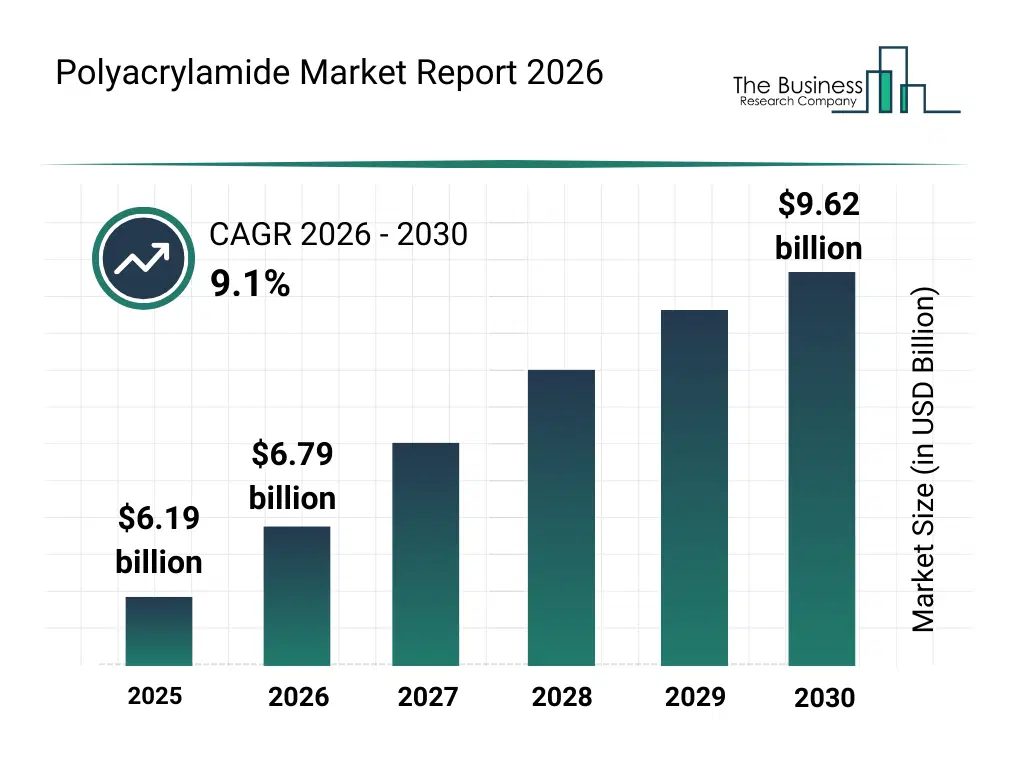
What Is The Polyacrylamide Market Size and Share 2026?
The polyacrylamide market size has grown strongly in recent years. It will grow from $6.19 billion in 2025 to $6.79 billion in 2026 at a compound annual growth rate (CAGR) of 9.7%. The growth in the historic period can be attributed to growth of wastewater treatment facilities, industrial expansion, rising environmental awareness, increasing demand for clean water, availability of acrylamide feedstock.What Is The Polyacrylamide Market Growth Forecast?
The polyacrylamide market size is expected to see strong growth in the next few years. It will grow to $9.62 billion in 2030 at a compound annual growth rate (CAGR) of 9.1%. The growth in the forecast period can be attributed to stricter water discharge regulations, expansion of urban infrastructure, growth in industrial water reuse, rising investments in wastewater treatment, advancements in polymer chemistry. Major trends in the forecast period include rising demand for water treatment chemicals, increasing use in municipal wastewater treatment, growing adoption in industrial effluent management, expansion of polyacrylamide use in sludge dewatering, rising demand for high performance flocculants.
Global Polyacrylamide Market Segmentation
1) By Product Type: Anionic, Cationic, Nonionic, Other Product Types 2) By Physical Form: Powder, Liquid, Emulsion Or Dispersions 3) By End User: Water Treatment, Food And Beverage, Health Care, Other End Users Subsegments: 1) By Anionic: Low Molecular Weight Anionic Polyacrylamide, High Molecular Weight Anionic Polyacrylamide 2) By Cationic: Low Molecular Weight Cationic Polyacrylamide, High Molecular Weight Cationic Polyacrylamide 3) By Nonionic: Low Molecular Weight Nonionic Polyacrylamide, High Molecular Weight Nonionic Polyacrylamide 4) By Other Product Types: Amphoteric Polyacrylamide, Specialty Polyacrylamide ProductsWhat Are The Drivers Of The Polyacrylamide Market?
The increasing need for wastewater treatment is expected to fuel the growth of the polyacrylamide market over the coming years. Wastewater treatment is the method of removing pollutants from wastewater or sewage and converting them to effluent that can be added to the water supply with minimal environmental effects. Polyacrylamide and its co-polymers are used as flocculants or coagulants in wastewater treatment. For instance, in September 2024, according to the World Health Organization (WHO), a Switzerland-based intergovernmental organization, reported that in 2023, cholera cases rose by 13% and fatalities surged by 71% compared to 2022, with over 4,000 lives lost to this preventable and treatable disease. Therefore, the increasing need for wastewater treatment is expected to drive the growth of the polyacrylamide materials market. An increase in demand from the oil and gas industry is expected to boost the growth of the polyacrylamide market going forward. The oil and gas industry is involved in the exploration and production of oil and gas. Polyacrylamide plays a crucial role in optimizing oil and gas production, reservoir management, and environmental stewardship within the industry. For instance, in January 2023, according to the Energy Information Administration, a US-based government agency, In 2023, U.S. crude oil production is expected to average 12.4 million barrels per day, increasing to 12.8 million barrels per day in 2024. Therefore, the increase in demand from the oil and gas industry is driving the growth of the polyacrylamide industry.Key Players In The Global Polyacrylamide Market
Major companies operating in the polyacrylamide market are Ashland Inc., BASF SE, Kemira, Solvay, PetroChina, China National Petroleum Corporation, Daqing Petrochemical Company, SNF Holding Company, Bluwat Chemicals, Black Rose Industries Ltd, Anhui Jucheng Fine Chemicals Co. Ltd, Xitao Polymer Co. Ltd, Ningxia Yongruida Carbon Co. Ltd, Beijing Hengju Oilfield Chemical Agent Co. Ltd, Anhui Tiarun Chemical, Shandong Polymer Bio-chemicals Co. Ltd, MK Chemicals of Brazil Ltda, AXCHEM Brazil Chemical Industry, Indo Jordan Chemicals Company, AECI Mining Chemicals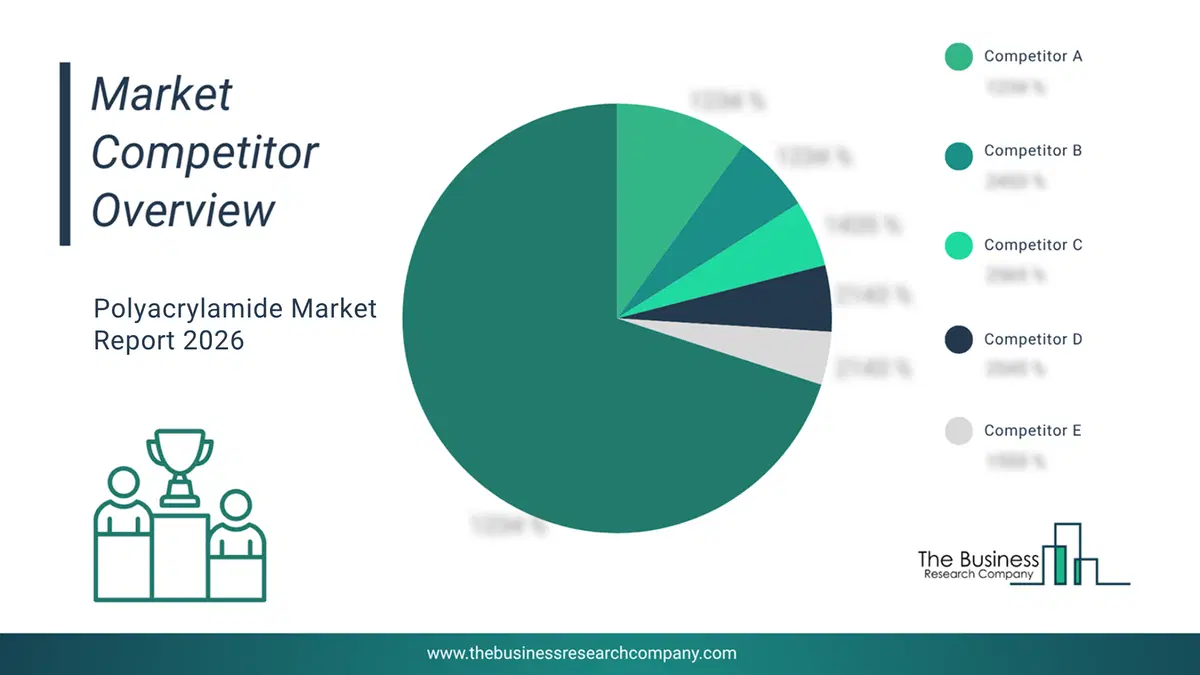
This chart is for illustrative purposes; the full report includes a detailed competitor analysis and comprehensive overview of the top 10 companies in the market.
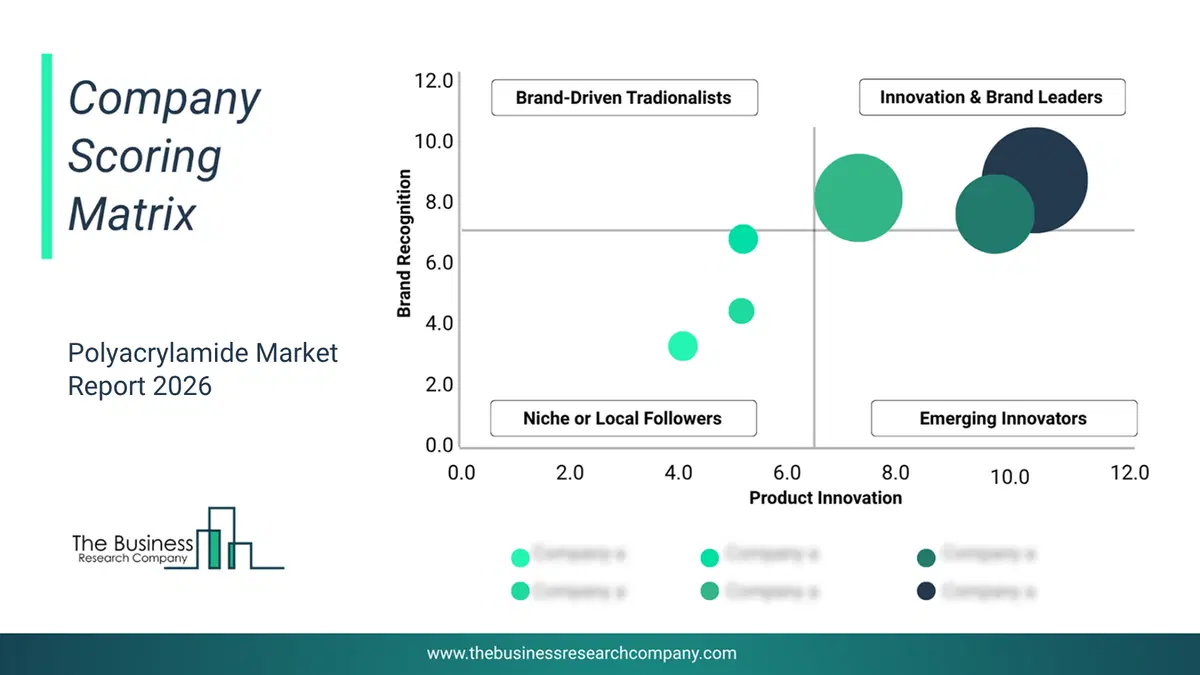
This chart maps companies by product innovation and brand strength, with bubble size indicating relative revenue, helping identify market leaders, challengers, and niche players. This is an illustrative chart; the full report provides a complete and accurate competitive analysis.
Global Polyacrylamide Market Trends and Insights
Major companies operating in the polyacrylamide market are focusing on expanding their production capacities to meet rising demand from industries such as wastewater treatment, oil and gas, and mining. Capacity expansion enables manufacturers to boost output efficiency, strengthen supply security, and enhance their global competitive positioning. For instance, in June 2024, SNF Holding Company Inc., a US-based chemicals company, invested $18 million through SNF Australia to expand its polyacrylamide manufacturing plant in Lara. The upgraded facility increases the production of essential polymers, including flocculants and coagulants, which are widely used across oil and gas, mining, agriculture, wastewater treatment, and drinking water production. The plant supports key clients such as Barwon Water and leading firms in water management and textiles, reinforcing SNF’s strengthened presence in the global polyacrylamide market.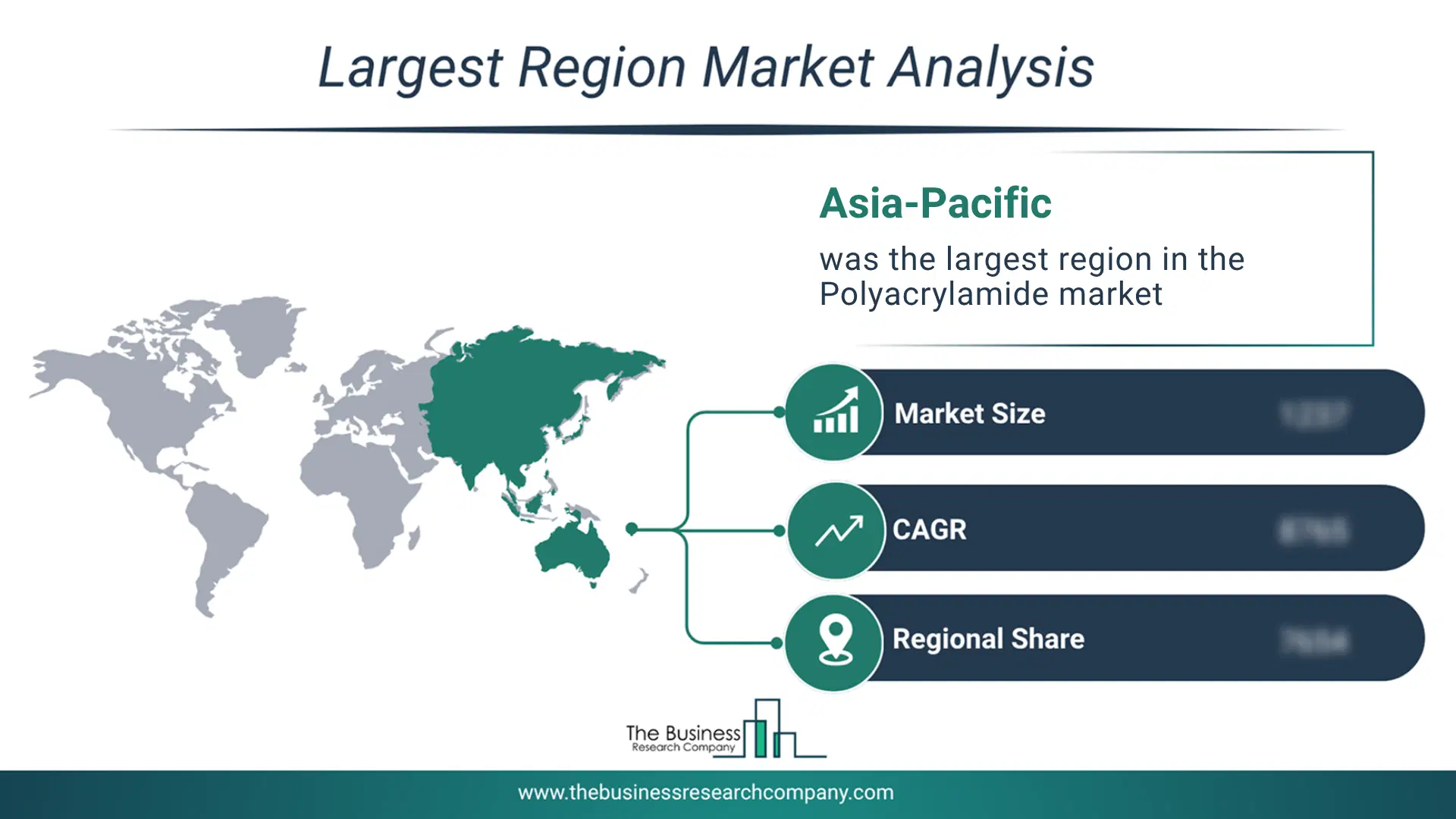
Regional Insights
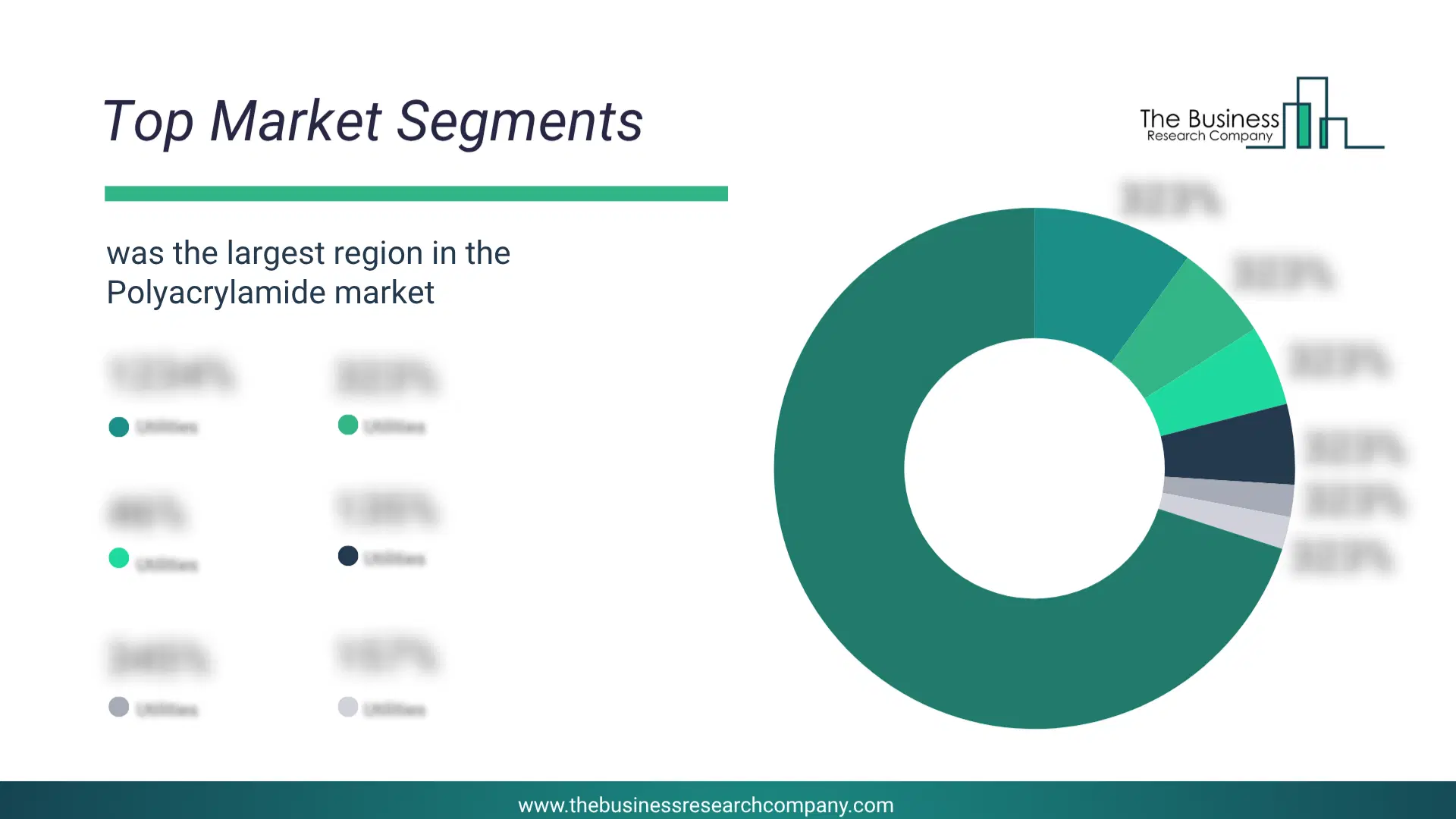
Asia-Pacific was the largest region in the polyacrylamide market in 2025. North America is expected to be the fastest-growing region in the forecast period. The regions covered in this market report are Asia-Pacific, South East Asia, Western Europe, Eastern Europe, North America, South America, Middle East, Africa The countries covered in this market report are Australia, Brazil, China, France, Germany, India, Indonesia, Japan, Taiwan, Russia, South Korea, UK, USA, Canada, Italy, SpainWhat Defines the Polyacrylamide Market?
The polyacrylamide market consists of sales of polyacrylamide by the method of synthesis, including the crosslinking method, the radical method, and the free radical polymerization method. Values in this market are ‘factory gate’ values, that is, the value of goods sold by the manufacturers or creators of the goods, whether to other entities (including downstream manufacturers, wholesalers, distributors, and retailers) or directly to end customers. The value of goods in this market includes related services sold by the creators of the goods.How is Market Value Defined and Measured?
The market value is defined as the revenues that enterprises gain from the sale of goods and/or services within the specified market and geography through sales, grants, or donations in terms of the currency (in USD unless otherwise specified). The revenues for a specified geography are consumption values that are revenues generated by organizations in the specified geography within the market, irrespective of where they are produced. It does not include revenues from resales along the supply chain, either further along the supply chain or as part of other products.
This chart presents market attractiveness based on a quantitative evaluation of growth, competition, strategic alignment, and risk, offering a clear view of opportunity areas for decision-making. This chart is for illustrative purposes; the full report contains the complete analysis.

This chart highlights the Total Addressable Market (TAM) by estimating the maximum revenue opportunity using an assumption-driven approach, supporting strategic planning and opportunity sizing across markets. The chart is illustrative; the full report provides a more comprehensive analysis.
What Key Data and Analysis Are Included in the Polyacrylamide Market Report 2026?
The polyacrylamide market research report is one of a series of new reports from The Business Research Company that provides market statistics, including industry global market size, regional shares, competitors with the market share, detailed market segments, market trends and opportunities, and any further data you may need to thrive in the polyacrylamide industry. The market research report delivers a complete perspective of everything you need, with an in-depth analysis of the current and future state of the industry.Polyacrylamide Market Report Forecast Analysis
| Report Attribute | Details |
|---|---|
| Market Size Value In 2026 | $6.79 billion |
| Revenue Forecast In 2030 | $9.62 billion |
| Growth Rate | CAGR of 9.7% from 2026 to 2030 |
| Base Year For Estimation | 2025 |
| Actual Estimates/Historical Data | 2020-2025 |
| Forecast Period | 2026 - 2030 |
| Market Representation | Revenue in USD Billion and CAGR from 2026 to 2030 |
| Segments Covered | Product Type, Physical Form, End User |
| Regional Scope | Asia-Pacific, Western Europe, Eastern Europe, North America, South America, Middle East, Africa |
| Country Scope | The countries covered in this market report are Australia, Brazil, China, France, Germany, India, Indonesia, Japan, Taiwan, Russia, South Korea, UK, USA, Canada, Italy, Spain |
| Key Companies Profiled | Ashland Inc., BASF SE, Kemira, Solvay, PetroChina, China National Petroleum Corporation, Daqing Petrochemical Company, SNF Holding Company, Bluwat Chemicals, Black Rose Industries Ltd, Anhui Jucheng Fine Chemicals Co. Ltd, Xitao Polymer Co. Ltd, Ningxia Yongruida Carbon Co. Ltd, Beijing Hengju Oilfield Chemical Agent Co. Ltd, Anhui Tiarun Chemical, Shandong Polymer Bio-chemicals Co. Ltd, MK Chemicals of Brazil Ltda, AXCHEM Brazil Chemical Industry, Indo Jordan Chemicals Company, AECI Mining Chemicals |
| Customization Scope | Request for Customization |
| Pricing And Purchase Options | Explore Purchase Options |