
Agricultural Algaecides Market Report 2026
Global Outlook – By Type (Copper Sulphate, Chelated Copper, Peroxyacetic Acid, Hydrogen Dioxide, Dyes, Colorants, Other Types), By Mode Of Action (Selective, Non-Selective ), By Category (Synthetic Algaecides, Natural Algaecides ), By Form (Solid, Liquid) – Market Size, Trends, Strategies, and Forecast to 2030
Agricultural Algaecides Market Overview
• Agricultural Algaecides market size has reached to $3.85 billion in 2025 • Expected to grow to $5.58 billion in 2030 at a compound annual growth rate (CAGR) of 7.6% • Growth Driver: Rising Agricultural Sector Fuels Growth In The Agricultural Algaecides Market • Market Trend: Shift Toward 100% Biodegradable Biological Algaecides For Sustainable Agriculture • North America was the largest region in 2025.What Is Covered Under Agricultural Algaecides Market?
Agricultural algaecides refer to a chemical material that can be used to destroy and stop the growth of algae and cyanobacteria. These are applied to stop or scale back big blooms and destroy phytoplankton. Copper sulphate, which is extremely soluble in water, is one popular algaecide. Algae will instantly begin to senesce after being injected into or sprayed with copper sulphate that has been dissolved in water. The main types of agricultural algaecides sold on the market are copper sulfate, chelated copper, peroxyacetic acid, hydrogen dioxide, dyes and colorants, and others. In both agricultural and non-agricultural environments, copper sulfate is used in fungicides, algaecides, root killers, and herbicides. Copper sulfate is a chemical compound denoted as CuSO4 and also called blue vitriol, the vitriol of copper, and bluestone. The different modes of action include selective and non-selective. The several categories include synthetic and natural algaecides that are available in both solid and liquid forms.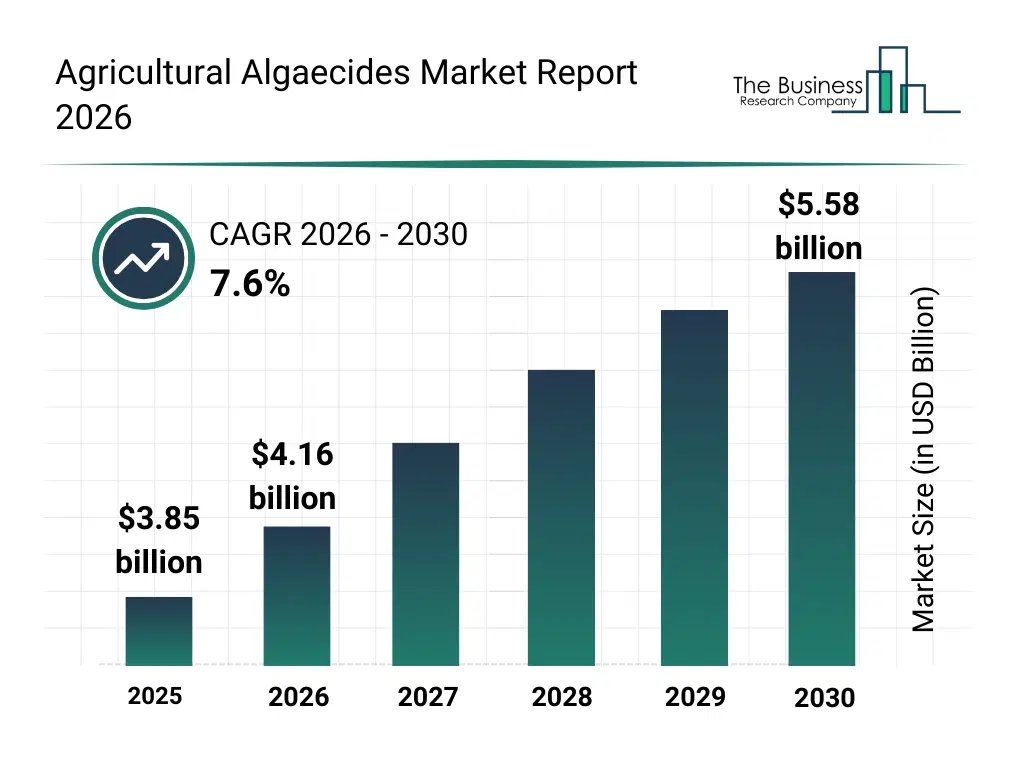
What Is The Agricultural Algaecides Market Size and Share 2026?
The agricultural algaecides market size has grown strongly in recent years. It will grow from $3.85 billion in 2025 to $4.16 billion in 2026 at a compound annual growth rate (CAGR) of 8.1%. The growth in the historic period can be attributed to widespread use of copper sulphate in agriculture, increasing frequency of algae blooms, early adoption of synthetic algaecides, rising need for phytoplankton control, demand for water quality maintenance.What Is The Agricultural Algaecides Market Growth Forecast?
The agricultural algaecides market size is expected to see strong growth in the next few years. It will grow to $5.58 billion in 2030 at a compound annual growth rate (CAGR) of 7.6%. The growth in the forecast period can be attributed to shift toward eco-friendly algaecide formulations, growing regulatory limits on chemical discharge, increasing need for large-scale bloom mitigation, advancements in enzymatic and biocontrol algaecides, expansion of precision water treatment. Major trends in the forecast period include rising adoption of copper-and-chelated-based algaecides, increasing shift toward natural and bio-based algaecides, growing use of liquid formulations for faster dissolution, expansion of large-scale algae bloom management programs, development of multi-mode algaecide combinations.
Global Agricultural Algaecides Market Segmentation
1) By Type: Copper Sulphate, Chelated Copper, Peroxyacetic Acid, Hydrogen Dioxide, Dyes, Colorants, Other Types 2) By Mode Of Action: Selective, Non-Selective 3) By Category: Synthetic Algaecides, Natural Algaecides 4) By Form: Solid, Liquid Subsegments: 1) By Copper Sulphate: Crystals, Liquid Form 2) By Chelated Copper: EDTA Chelates, DTPA Chelates, Others 3) By Peroxyacetic Acid: Industrial Grade, Food Grade 4) By Hydrogen Dioxide: Stabilized Solutions, Concentrated Solutions 5) By Dyes: Food Dyes, Industrial Dyes 6) By Colorants: Natural Colorants, Synthetic Colorants 7) By Other Types: Biocontrol Agents, Enzymatic Algaecides, Natural ExtractsWhat Is Driver Of The Agricultural Algaecides Market?
The expansion of the agricultural sector is propelling the growth of the agricultural algaecides market. The agriculture sector includes businesses whose main activities are the production of crops, the breeding of livestock, and the collection of fish and other animals from farms, ranches, or their natural habitats. The application of algaecides aids in agricultural output by aiding in weed and insect control outside farm buildings, nurseries, greenhouses, and other growing operations. The growth of agriculture directly ensures more and more use of algaecides to improve production and crop quality. For instance, in December 2024, according to the U.S. Department of Agriculture’s Economic Research Service (ERS), a U.S.-based government agency, it was reported that agriculture, food, and related industries contributed about 5.5% to the U.S. gross domestic product (GDP) in 2023, totaling approximately $1.537 trillion. Of this, the direct output of farms accounted for $222.3 billion, representing around 0.8% of U.S. GDP. Therefore, the expansion of the agricultural sector is driving the growth of the agricultural algaecides industry.Key Players In The Global Agricultural Algaecides Market
Major companies operating in the agricultural algaecides market are Dow Inc, Nufarm Agriculture Inc., Bioguard Organics Ltd., Bayer AG, Lonza Group Ltd., United Phosphorus Limited, Waterco Limited, Syngenta Group Co. Ltd., BioSafe Systems LLC, Airmax Inc., Sepro Corporation, FMC Corporation, SIPCAM-OXON GROUP, Certis USA LLC, Vanson HaloSource Inc., Brandt Consolidated Inc., Gowan Company LLC, Helena Agri-Enterprises LLC, Isagro S.p.A., Marrone Bio Innovations Inc., Valent BioSciences LLC, Wilbur-Ellis Company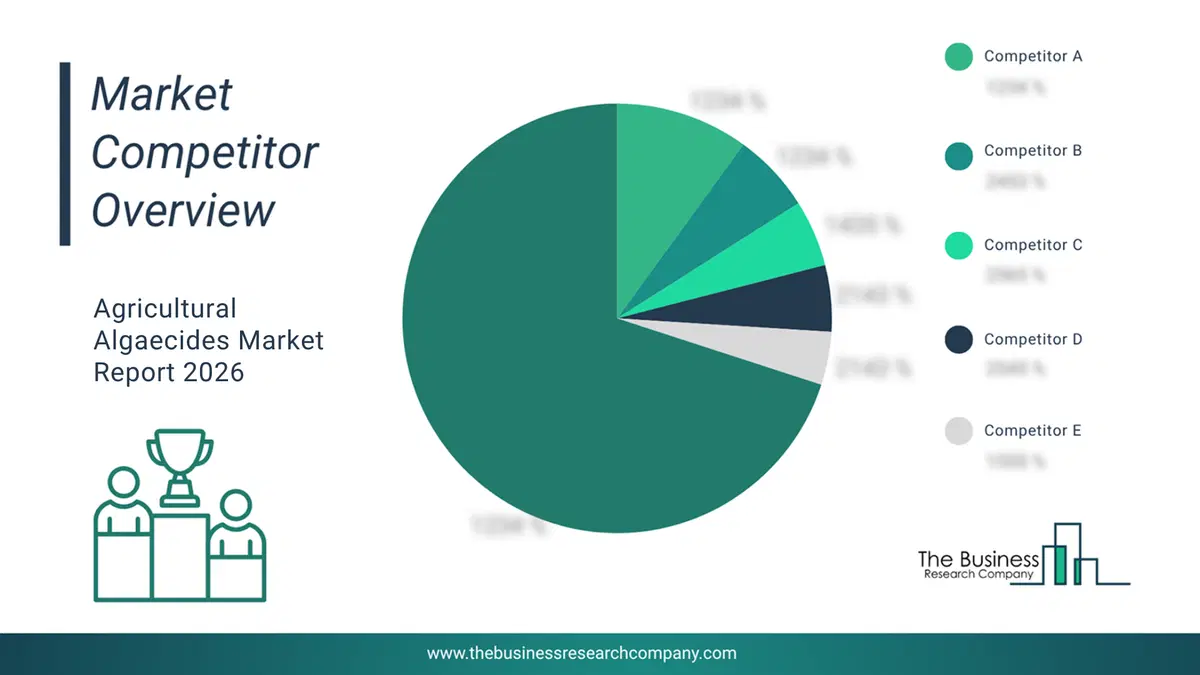
This chart is for illustrative purposes; the full report includes a detailed competitor analysis and comprehensive overview of the top 10 companies in the market.
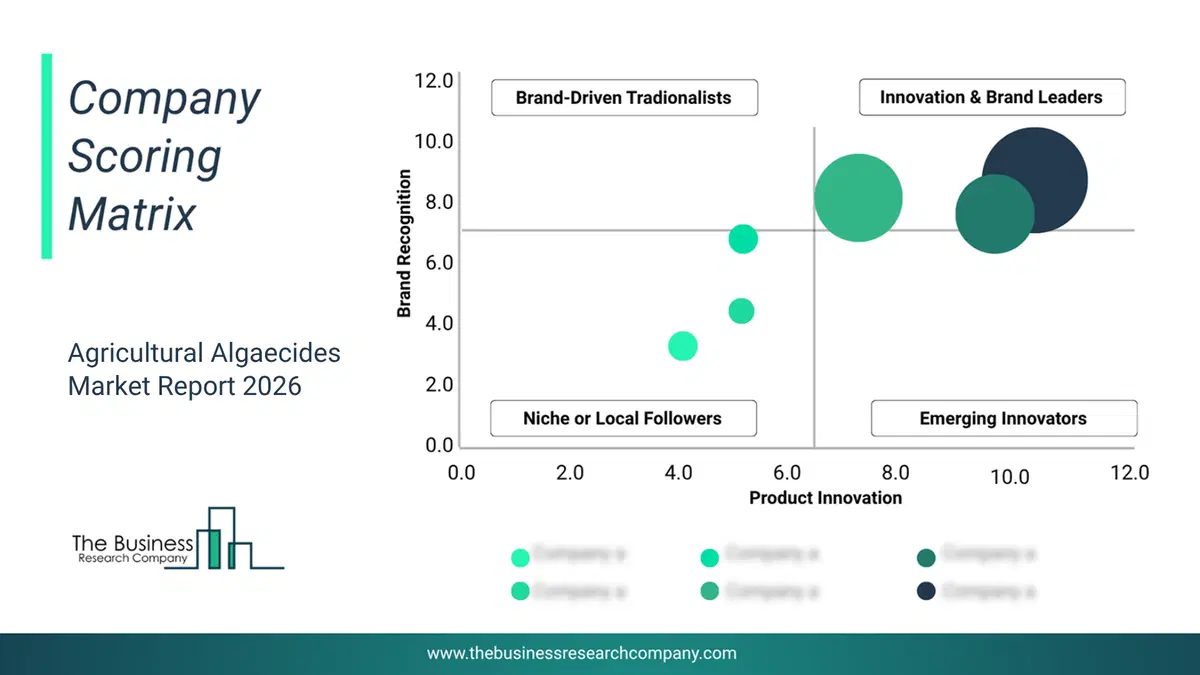
This chart maps companies by product innovation and brand strength, with bubble size indicating relative revenue, helping identify market leaders, challengers, and niche players. This is an illustrative chart; the full report provides a complete and accurate competitive analysis.
Global Agricultural Algaecides Market Trends and Insights
Major companies operating in the agricultural algaecide market are focusing on developing innovative solutions such as bioremediation to enhance water quality, reduce chemical usage, and promote sustainable algae control in irrigation systems. Bioremediation refers to the process of using microorganisms, plants, or natural enzymes to break down and remove pollutants or contaminants from soil, water, or other environments. For instance, in September 2023, Arquimea, a Spain-based biotechnology company, launched BIO100 Anti-Algae, a 100% biodegradable algaecide that combines microbial activity with a sunscreen effect to inhibit photosynthesis and algae proliferation. The innovation provides rapid and long-lasting results from the first day of application, promoting sustainable irrigation management and improving overall agricultural productivity.What Are Latest Mergers And Acquisitions In The Agricultural Algaecides Market? DE SANGOSSE Acquired Algaenergy To Enhance Agricultural Biosolutions And Sustainability
In July 2023, De Sangosse France-based crop protection, plant nutrition, and pest control products acquired AlgaEnergy for an undisclosed amount. This acquisition will strengthen DE SANGOSSE's position in the agricultural biosolutions market by leveraging AlgaEnergy's expertise in micro-algae technologies to enhance sustainable farming practices and accelerate global growth in biostimulants, biofertilizers, and biocontrol products. AlgaEnergy is a Spain-based microalgae biotechnology company including algaecides as part of its product offerings.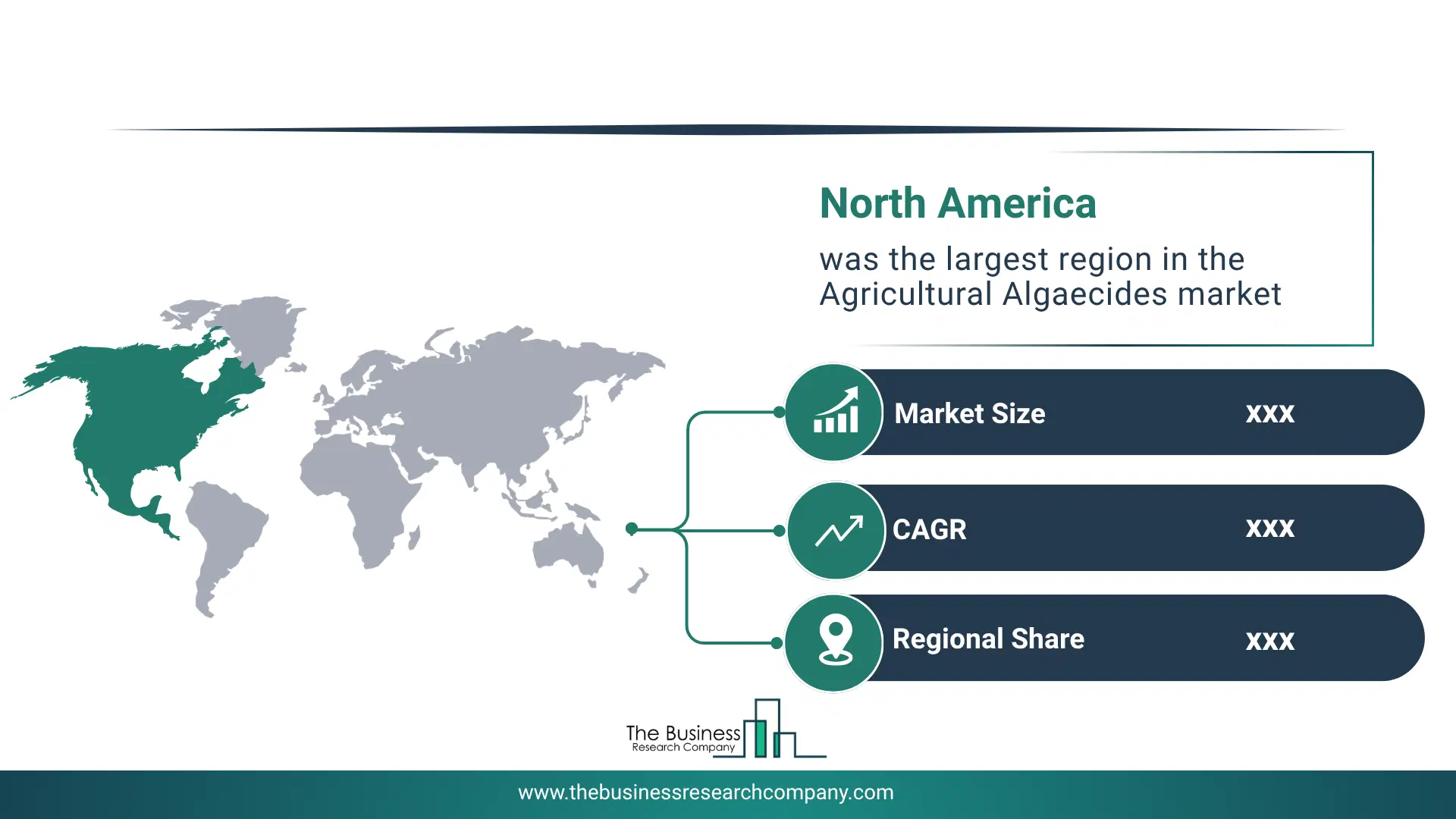
Regional Outlook
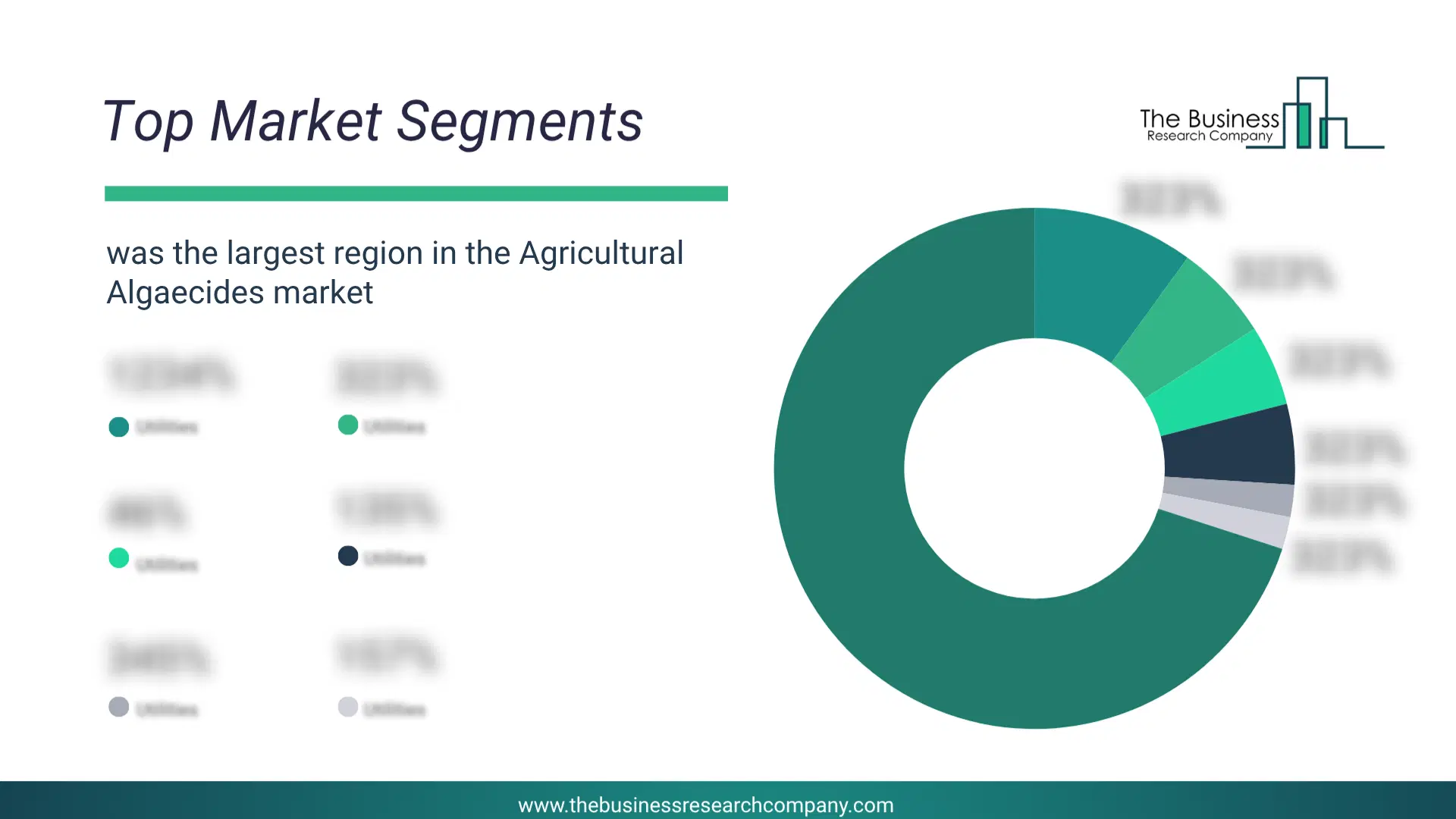
North America was the largest region in the agricultural algaecides market in 2025. The regions covered in this market report are Asia-Pacific, South East Asia, Western Europe, Eastern Europe, North America, South America, Middle East, Africa. The countries covered in this market report are Australia, Brazil, China, France, Germany, India, Indonesia, Japan, Taiwan, Russia, South Korea, UK, USA, Canada, Italy, SpainWhat Defines the Agricultural Algaecides Market?
The agricultural algaecides market consists of sales of natural algaecides, synthetic algaecides, quaternary algaecides, and polyquats algaecides. Values in this market are ‘factory gate’ values, that is the value of goods sold by the manufacturers or creators of the goods, whether to other entities (including downstream manufacturers, wholesalers, distributors and retailers) or directly to end customers. The market value includes the value of related goods sold by the service provider or included within the service offering.How is Market Value Defined and Measured?
The market value is defined as the revenues that enterprises gain from the sale of goods and/or services within the specified market and geography through sales, grants, or donations in terms of the currency (in USD unless otherwise specified). The revenues for a specified geography are consumption values that are revenues generated by organizations in the specified geography within the market, irrespective of where they are produced. It does not include revenues from resales along the supply chain, either further along the supply chain or as part of other products.
This chart presents market attractiveness based on a quantitative evaluation of growth, competition, strategic alignment, and risk, offering a clear view of opportunity areas for decision-making. This chart is for illustrative purposes; the full report contains the complete analysis.

This chart highlights the Total Addressable Market (TAM) by estimating the maximum revenue opportunity using an assumption-driven approach, supporting strategic planning and opportunity sizing across markets. The chart is illustrative; the full report provides a more comprehensive analysis.
What Key Data and Analysis Are Included in the Agricultural Algaecides Market Report 2026?
The agricultural algaecides market research report is one of a series of new reports from The Business Research Company that provides market statistics, including industry global market size, regional shares, competitors with the market share, detailed market segments, market trends and opportunities, and any further data you may need to thrive in the agricultural algaecides industry. The market research report delivers a complete perspective of everything you need, with an in-depth analysis of the current and future state of the industry.Agricultural Algaecides Market Report Forecast Analysis
| Report Attribute | Details |
|---|---|
| Market Size Value In 2026 | $4.16 billion |
| Revenue Forecast In 2030 | $5.58 billion |
| Growth Rate | CAGR of 7.6% from 2026 to 2030 |
| Base Year For Estimation | 2025 |
| Actual Estimates/Historical Data | 2020-2025 |
| Forecast Period | 2026 - 2030 |
| Market Representation | Revenue in USD Billion and CAGR from 2026 to 2030 |
| Segments Covered | Type, Mode Of Action, Category, Form |
| Regional Scope | Asia-Pacific, Western Europe, Eastern Europe, North America, South America, Middle East, Africa |
| Country Scope | The countries covered in the report are Australia, Brazil, China, France, Germany, India, Indonesia, Japan, Taiwan, Russia, South Korea, UK, USA, Canada, Italy, Spain |
| Key Companies Profiled | Dow Inc, Nufarm Agriculture Inc., Bioguard Organics Ltd., Bayer AG, Lonza Group Ltd., United Phosphorus Limited, Waterco Limited, Syngenta Group Co. Ltd., BioSafe Systems LLC, Airmax Inc., Sepro Corporation, FMC Corporation, SIPCAM-OXON GROUP, Certis USA LLC, Vanson HaloSource Inc., Brandt Consolidated Inc., Gowan Company LLC, Helena Agri-Enterprises LLC, Isagro S.p.A., Marrone Bio Innovations Inc., Valent BioSciences LLC, Wilbur-Ellis Company |
| Customization Scope | Request for Customization |
| Pricing And Purchase Options | Explore Purchase Options |