

AI Bill of Materials for Models SM Market Report 2026
Global Outlook – By Component (Software, Hardware, Services), By Model Type (Large Language Models, Computer Vision Models, Speech Recognition Models, Recommendation Models, Other Model Types), By Deployment Mode (On-Premises, Cloud), By Application (Healthcare, Finance, Retail, Manufacturing, Automotive, Information Technology and Telecommunications, Other Applications), By End-User (Enterprises, Research Institutes, Government, Other End-Users) – Market Size, Trends, Strategies, and Forecast to 2030
AI Bill of Materials for Models SM Market Overview
• AI Bill of Materials for Models SM market size has reached to $4.32 billion in 2025 • Expected to grow to $12.48 billion in 2030 at a compound annual growth rate (CAGR) of 23.7% • Growth Driver: Rising Enterprise AI Adoption Driving Growth Of The Market Due To Enhanced Efficiency, Security, And Trust In AI Deployments • Market Trend: Enhancing Transparency And Risk Management In AI Model Ecosystems • North America was the largest region in 2025 and Asia-Pacific is the fastest growing region.What Is Covered Under AI Bill of Materials for Models SM Market?
An artificial intelligence (AI) bill of materials for models refers to a structured inventory that lists all components, resources, and dependencies used in creating, training, and deploying an AI model. They are used to provide transparency, traceability, and accountability by detailing data sources, algorithms, pretrained models, libraries, hardware, and other assets involved. This helps organizations manage risk, ensure compliance with ethical and legal standards, monitor model lineage, and facilitate reproducibility and auditing of AI systems. The main components of the artificial intelligence (AI) bill of materials for models market include software, hardware, and services. Software refers to platforms and tools used to generate, manage, and maintain standardized AI model documentation, including model lineage, dependencies, training datasets, versioning, and risk reporting. The model types covered include large language models, computer vision models, speech recognition models, recommendation models, and other model types and are deployed through on-premises and cloud modes. The applications include healthcare, finance, retail, manufacturing, automotive, information technology and telecommunications, and other applications and are adopted across end-users such as enterprises, research institutes, government, and other end-users.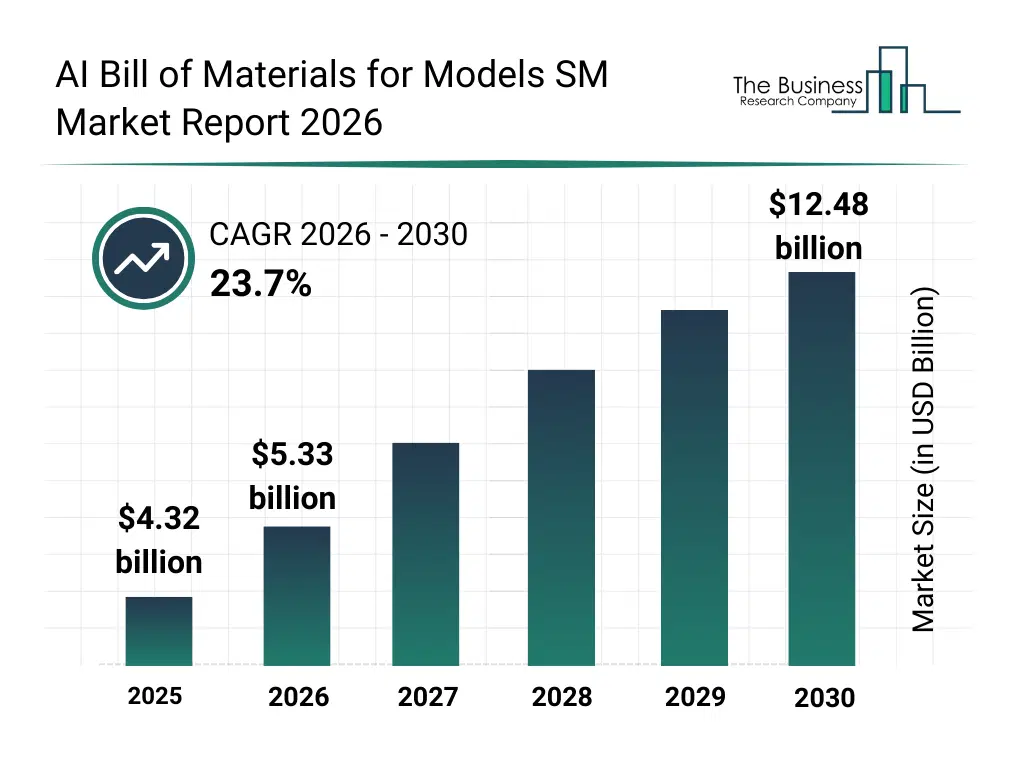
What Is The AI Bill of Materials for Models SM Market Size and Share 2026?
The ai bill of materials for models sm market size has grown exponentially in recent years. It will grow from $4.32 billion in 2025 to $5.33 billion in 2026 at a compound annual growth rate (CAGR) of 23.5%. The growth in the historic period can be attributed to growing ai adoption in enterprises, rising regulatory compliance requirements, increasing reliance on pretrained models, expansion of cloud-based deployment, rising demand for model audit and traceability.What Is The AI Bill of Materials for Models SM Market Growth Forecast?
The ai bill of materials for models sm market size is expected to see exponential growth in the next few years. It will grow to $12.48 billion in 2030 at a compound annual growth rate (CAGR) of 23.7%. The growth in the forecast period can be attributed to growth of generative ai applications, increasing adoption of explainable ai frameworks, rising need for model provenance and reproducibility, expansion of multi-cloud and hybrid deployment, increasing investment in ai governance and risk management. Major trends in the forecast period include increasing adoption of ai model inventory management platforms, rising demand for dependency mapping and tracking tools, growth in version control and governance software, expansion of risk and compliance management systems, rising focus on analytics and reporting dashboards.
Global AI Bill of Materials for Models SM Market Segmentation
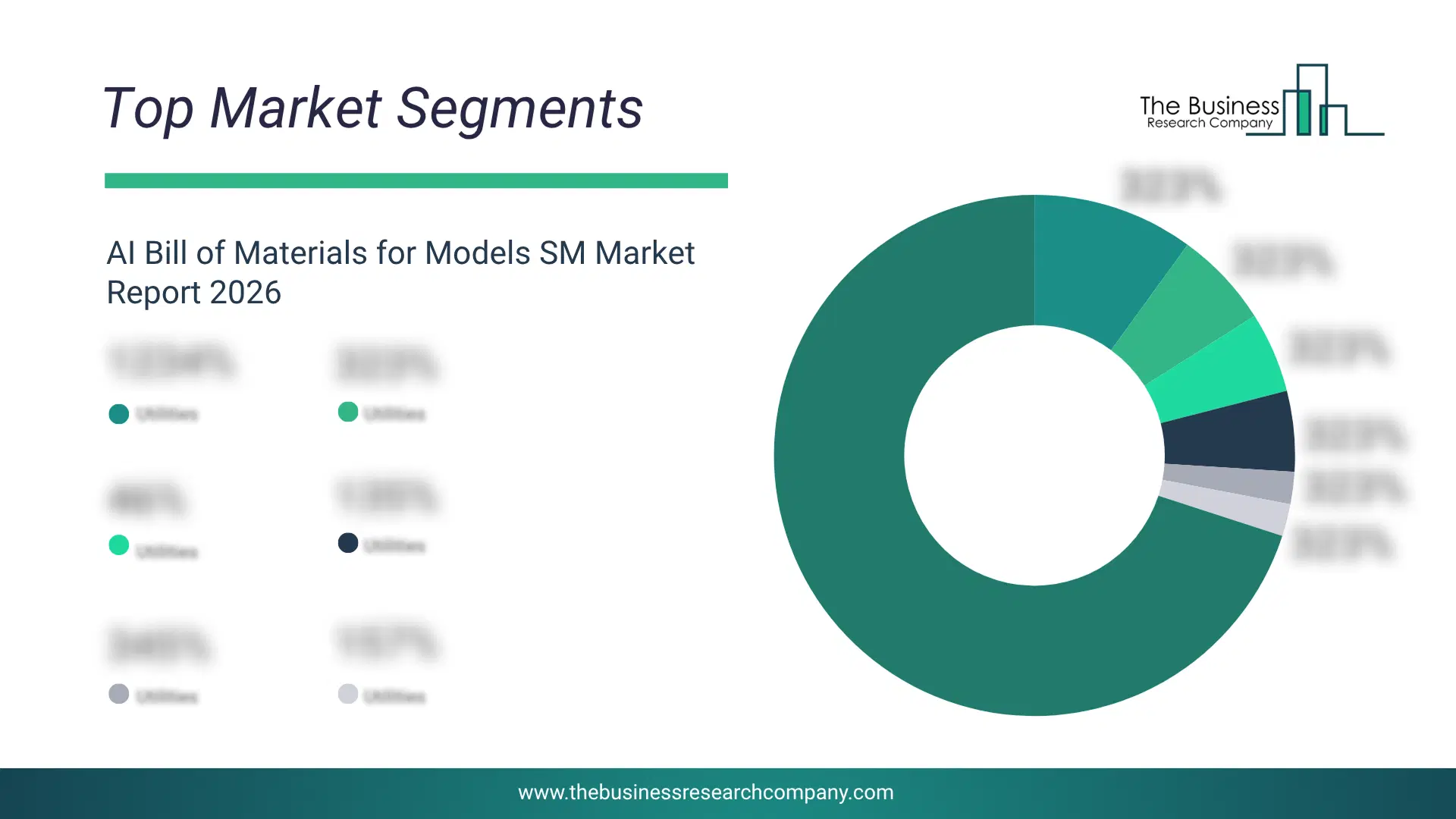
1) By Component: Software, Hardware, Services 2) By Model Type: Large Language Models, Computer Vision Models, Speech Recognition Models, Recommendation Models, Other Model Types 3) By Deployment Mode: On-Premises, Cloud 4) By Application: Healthcare, Finance, Retail, Manufacturing, Automotive, Information Technology and Telecommunications, Other Applications 5) By End-User: Enterprises, Research Institutes, Government, Other End-Users Subsegments: 1) Software: Model Inventory Management Platforms, Dependency Mapping and Tracking Tools, Version Control and Governance Software, Risk and Compliance Management Systems, Analytics and Reporting Dashboards 2) Hardware: Compute Servers, Data Storage Systems, Networking Infrastructure, Edge Processing Devices, Security Hardware Modules 3) Services: Implementation and Integration Services, Model Audit and Compliance Services, Maintenance and Support Services, Consulting and Advisory Services, Training and Enablement ServicesWhat Is The Driver Of The AI Bill of Materials for Models SM Market?
The increasing adoption of artificial intelligence in enterprises is expected to propel the growth of the artificial intelligence (AI) bill of materials for models market going forward. Artificial intelligence in enterprises refers to the use of artificial intelligence technologies to optimize business operations, enhance decision-making, and improve customer experiences. AI adoption in enterprises is increasing because it enhances operational efficiency by automating tasks, reducing errors, and enabling faster, data-driven decisions. Artificial intelligence (AI) bill of materials for models aids enterprise artificial intelligence adoption by tracking all model components and their origins, which simplifies maintenance, ensures security, and builds trust for scalable deployment. For instance, in October 2025, according to Netguru S.A., a Poland-based software development company, in 2024, the adoption of generative AI reached 71%, a sharp rise from 33% in 2023, reflecting the swift increase in business trust and reliance on these advanced technologies. Therefore, the increasing adoption of artificial intelligence in enterprises is driving the growth of the artificial intelligence (AI) bill of materials for models market. Rising Cybersecurity Concerns Driving The Market Growth Due To Enhanced Risk Management And Vulnerability Tracking The rising cybersecurity concerns are expected to propel the growth of the artificial intelligence (AI) bill of materials for models market going forward. Cybersecurity concerns are potential threats or vulnerabilities that can lead to data breaches, unauthorized access, or disruption of digital systems. Cybersecurity concerns are increasing because greater digitalization exposes more sensitive data and systems to potential cyberattacks. The artificial intelligence bill of materials (AI BoM) for models helps address cybersecurity concerns by providing a detailed inventory of all components, dependencies, and third-party elements in artificial intelligence models, enabling organizations to identify vulnerabilities, ensure secure updates, and manage risks systematically. For instance, in October 2025, according to the Australian Signals Directorate, an Australia-based government agency, in FY2024-25, the Australian Signals Directorate’s (ASD) Australian Cyber Security Centre (ACSC) received over 42,500 calls to the Australian Cyber Security Hotline, marking a 16% rise compared to FY 2023-24. Therefore, the rising cybersecurity concerns are driving the growth of the artificial intelligence (AI) bill of materials for models market.Key Players In The Global AI Bill of Materials for Models SM Market
Major companies operating in the artificial intelligence (AI) bill of materials for models market are Microsoft Corporation, Siemens AG., IBM Corporation, Oracle Corporation, SAP SE, NTT DATA Corporation, Capgemini SE, Palo Alto Networks Inc., Dassault Systèmes SE, PTC Inc., Zscaler Inc., C3 AI Inc., Snyk Ltd., Aras Corporation, Orca Security Ltd., Wiz Inc., Snorkel AI Inc., Bedrock Data Inc., Cycode Ltd., OpenBOM Inc., and Manifest Inc.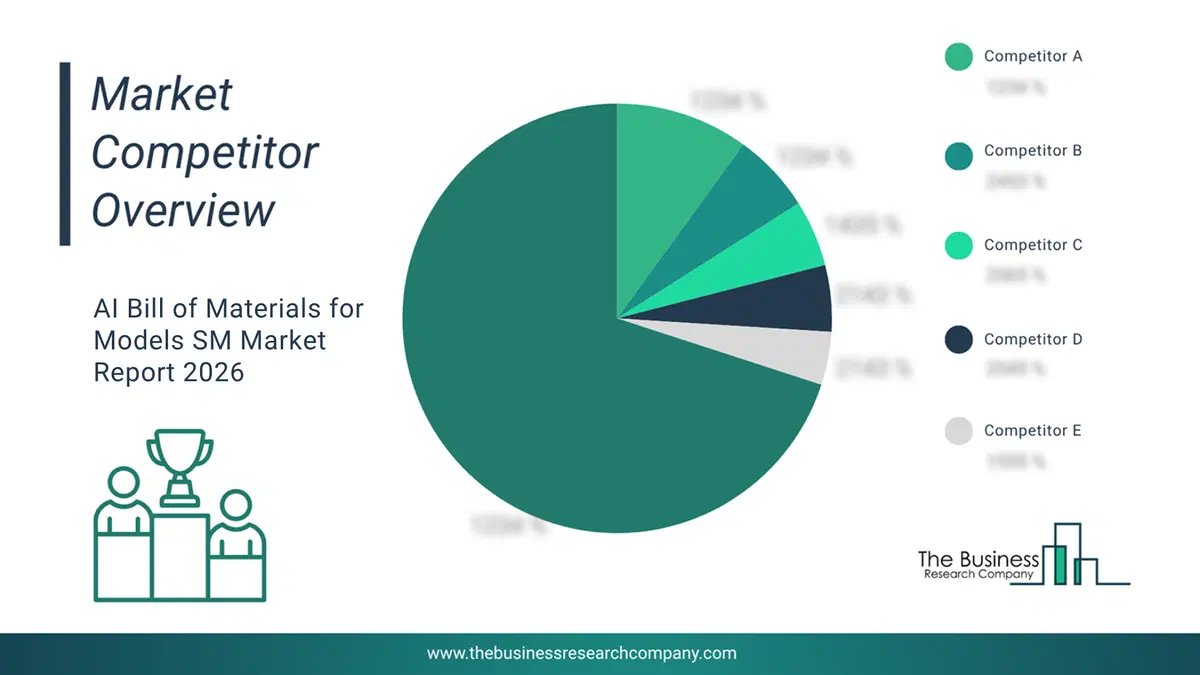
This chart is for illustrative purposes; the full report includes a detailed competitor analysis and comprehensive overview of the top 10 companies in the market.
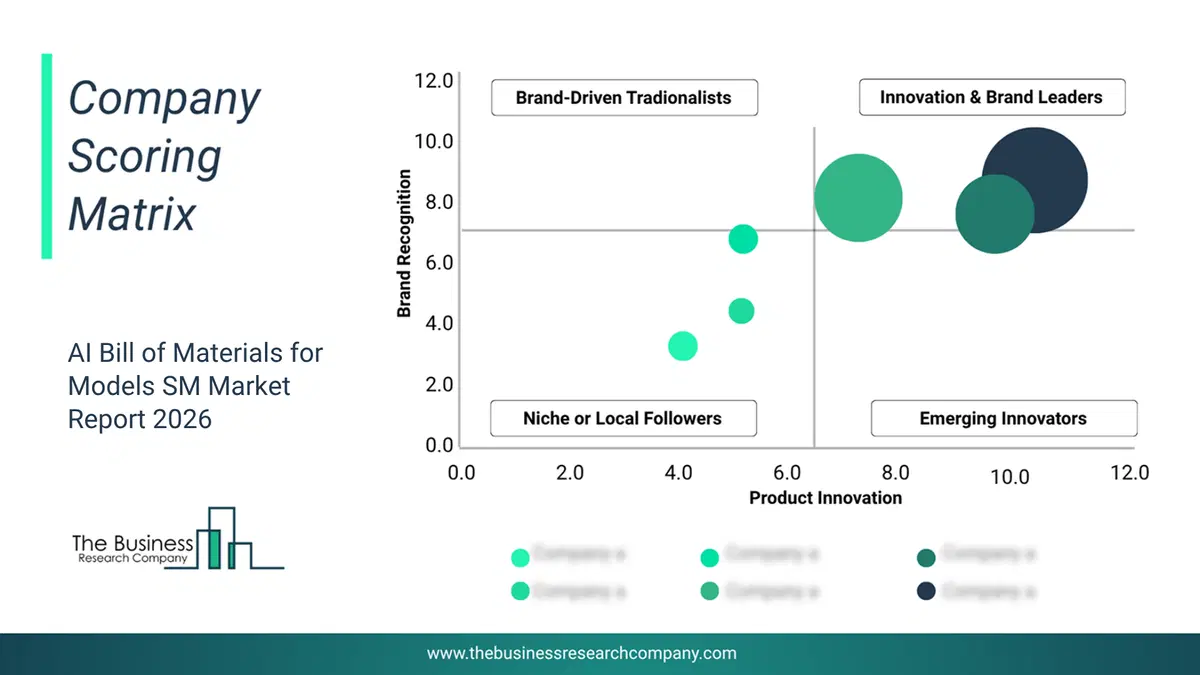
This chart maps companies by product innovation and brand strength, with bubble size indicating relative revenue, helping identify market leaders, challengers, and niche players. This is an illustrative chart; the full report provides a complete and accurate competitive analysis.
Global AI Bill of Materials for Models SM Market Trends and Insights
Major companies operating in the artificial intelligence bill of materials for models market are focusing on developing technological advancements such as agentic workflow mapping to enhance transparency, traceability, and risk assessment across AI model components and their dependencies. Agentic workflow mapping refers to a method that visualizes and tracks AI agents’ actions to ensure transparency, accountability, and efficiency in decision-making. For instance, in September 2025, SPLX AI Inc., a US-based cybersecurity company, launched AI asset management as an enterprise-grade solution for securing AI stacks. It provides enterprises with full visibility into AI stacks by generating live AI Bills of Materials, mapping agentic workflows, and scanning vulnerabilities with benchmarked risk scores. Its purpose is to eliminate blind spots in AI adoption, enabling secure scaling of complex systems through visual dependency graphs and automated compliance for standards such as OWASP LLM Top 10. Key advantages include prioritized threat analysis and faster deployments, benefiting energy sectors by safeguarding smart grid AI models and infrastructure risks.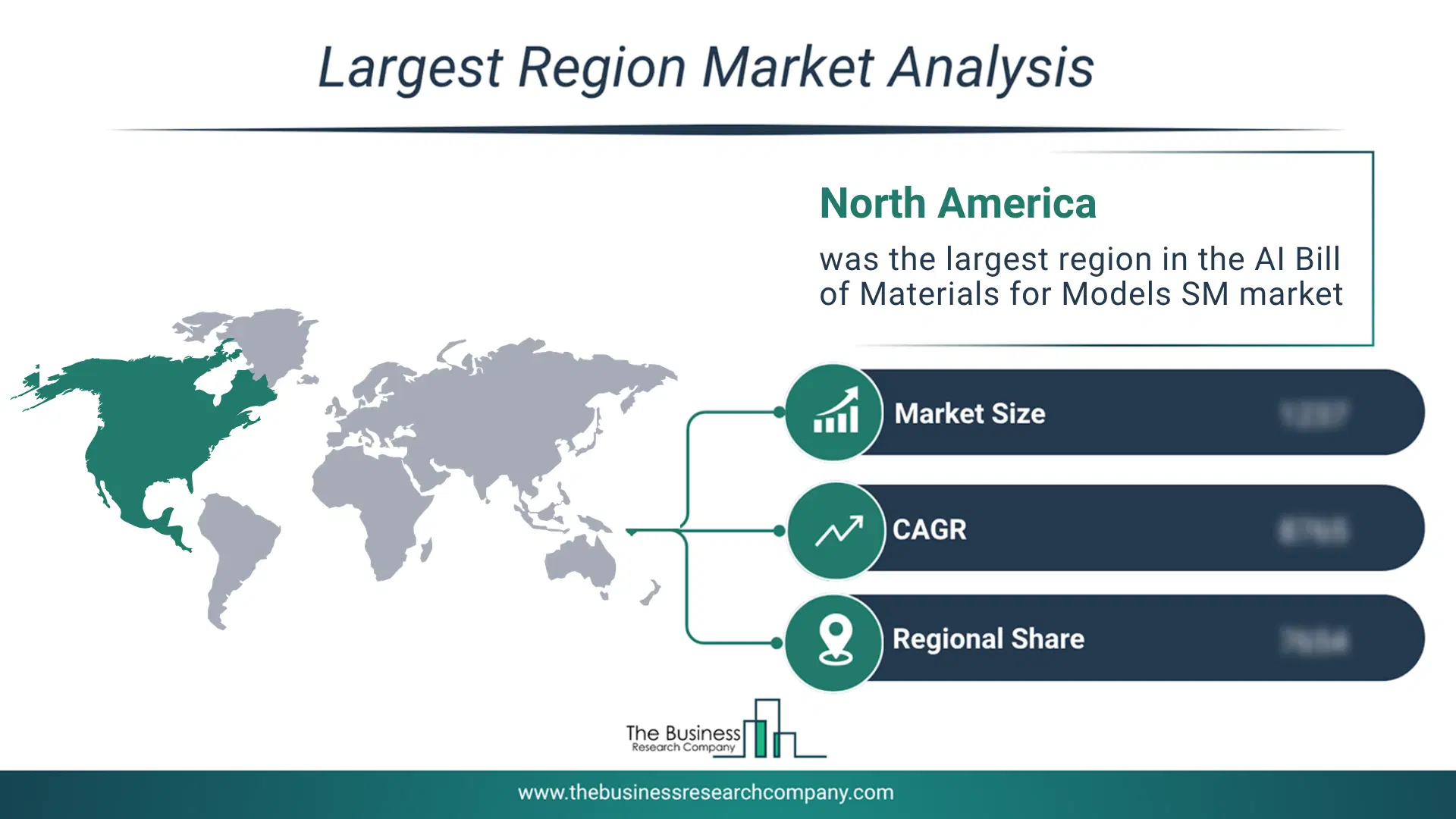
Regional Insights
North America was the largest region in the artificial intelligence (AI) bill of materials for models market in 2025. Asia-Pacific is expected to be the fastest-growing region in the forecast period. The regions covered in this market report are Asia-Pacific, South East Asia, Western Europe, Eastern Europe, North America, South America, Middle East, Africa. The countries covered in this market report are Australia, Brazil, China, France, Germany, India, Indonesia, Japan, Taiwan, Russia, South Korea, UK, USA, Canada, Italy, Spain.What Defines the AI Bill of Materials for Models SM Market?
The artificial intelligence (AI) bill of materials for the models market consists of revenues earned by entities by providing services such as tracking and documenting AI model components, maintaining datasets and software dependencies, performing model versioning and provenance management, and conducting compliance and risk audits. The market value includes the value of related goods sold by the service provider or included within the service offering. The artificial intelligence (AI) bill of materials for the models market also includes sales of reproducibility packages, dataset management tools, metadata tracking systems, compliance and audit solutions, and version control and lifecycle management tools. Values in this market are ‘factory gate’ values; that is, the value of goods sold by the manufacturers or creators of the goods, whether to other entities (including downstream manufacturers, wholesalers, distributors, and retailers) or directly to end customers. The value of goods in this market includes related services sold by the creators of the goods.How is Market Value Defined and Measured?
The market value is defined as the revenues that enterprises gain from the sale of goods and/or services within the specified market and geography through sales, grants, or donations in terms of the currency (in USD unless otherwise specified). The revenues for a specified geography are consumption values that are revenues generated by organizations in the specified geography within the market, irrespective of where they are produced. It does not include revenues from resales along the supply chain, either further along the supply chain or as part of other products.
This chart presents market attractiveness based on a quantitative evaluation of growth, competition, strategic alignment, and risk, offering a clear view of opportunity areas for decision-making. This chart is for illustrative purposes; the full report contains the complete analysis.

This chart highlights the Total Addressable Market (TAM) by estimating the maximum revenue opportunity using an assumption-driven approach, supporting strategic planning and opportunity sizing across markets. The chart is illustrative; the full report provides a more comprehensive analysis.
What Key Data and Analysis Are Included in the AI Bill of Materials for Models SM Market Report 2026?
The artificial intelligence (AI) bill of materials for models market research report is one of a series of new reports from The Business Research Company that provides artificial intelligence (AI) bill of materials for models market statistics, including artificial intelligence (AI) bill of materials for models industry global market size, regional shares, competitors with a artificial intelligence (AI) bill of materials for models market share, detailed artificial intelligence (AI) bill of materials for models market segments, market trends and opportunities, and any further data you may need to thrive in the artificial intelligence (AI) bill of materials for models industry. This artificial intelligence (AI) bill of materials for models market research report delivers a complete perspective of everything you need, with an in-depth analysis of the current and future scenario of the industry.AI Bill of Materials for Models SM Market Report Forecast Analysis
| Report Attribute | Details |
|---|---|
| Market Size Value In 2026 | $5.33 billion |
| Revenue Forecast In 2030 | $12.48 billion |
| Growth Rate | CAGR of 23.7% from 2026 to 2030 |
| Base Year For Estimation | 2025 |
| Actual Estimates/Historical Data | 2020-2025 |
| Forecast Period | 2026 - 2030 |
| Market Representation | Revenue in USD Billion and CAGR from 2026 to 2030 |
| Segments Covered | Component, Model Type, Deployment Mode, Application, End-User |
| Regional Scope | Asia-Pacific, Western Europe, Eastern Europe, North America, South America, Middle East, Africa |
| Country Scope | The Countries Covered In This Market Report Are Australia, Brazil, China, France, Germany, India, Indonesia, Japan, Taiwan, Russia, South Korea, Uk, Usa, Canada, Italy, Spain. |
| Key Companies Profiled | Microsoft Corporation, Siemens AG., IBM Corporation, Oracle Corporation, SAP SE, NTT DATA Corporation, Capgemini SE, Palo Alto Networks Inc., Dassault Systèmes SE, PTC Inc., Zscaler Inc., C3 AI Inc., Snyk Ltd., Aras Corporation, Orca Security Ltd., Wiz Inc., Snorkel AI Inc., Bedrock Data Inc., Cycode Ltd., OpenBOM Inc., and Manifest Inc. |
| Customization Scope | Request for Customization |
| Pricing And Purchase Options | Explore Purchase Options |