
Air Quality Sensors Market Report 2026
Global Outlook – By Type ( Signal-Gas Monitoring System, Multi-Gas Monitoring System), By Portability ( Portable Air Quality Sensor, Fixed Air Quality Sensor), By Pollutant ( Chemical, Particulate Matters, Biological), By User ( Government, Petrochemical, Power Plant, Residential) – Market Size, Trends, Strategies, and Forecast to 2030
Air Quality Sensors Market Overview
• Air Quality Sensors market size has reached to $5.67 billion in 2025 • Expected to grow to $8.18 billion in 2030 at a compound annual growth rate (CAGR) of 7.4% • Growth Driver: Rising Airborne Disease Concerns Drive Growth In The Air Quality Sensors Market • Market Trend: Market Key Players Embrace Air Quality Monitoring Solutions To Enhanced Market Growth • North America was the largest region in 2025 and Asia-Pacific is the fastest growing region.What Is Covered Under Air Quality Sensors Market?
Air quality sensors refer to devices designed to measure the concentration of pollutants and other harmful particles in the air. They detect various pollutants, such as particulate matter, carbon monoxide, and nitrogen dioxide, providing real-time data to monitor air quality levels and facilitate environmental assessment and management. The main types of air quality sensors are signal-gas monitoring systems and multi-gas monitoring systems. A signal-gas monitoring system refers to a technology that detects and measures specific gases or chemical compounds in the air, typically used for safety or environmental monitoring purposes. In terms of portability, there are several types, including portable air quality sensors and fixed air quality sensors, which are used for monitoring various pollutants, such as chemical, particulate matter, and biological. These are used by various users, such as government, petrochemical, power plants, and residential.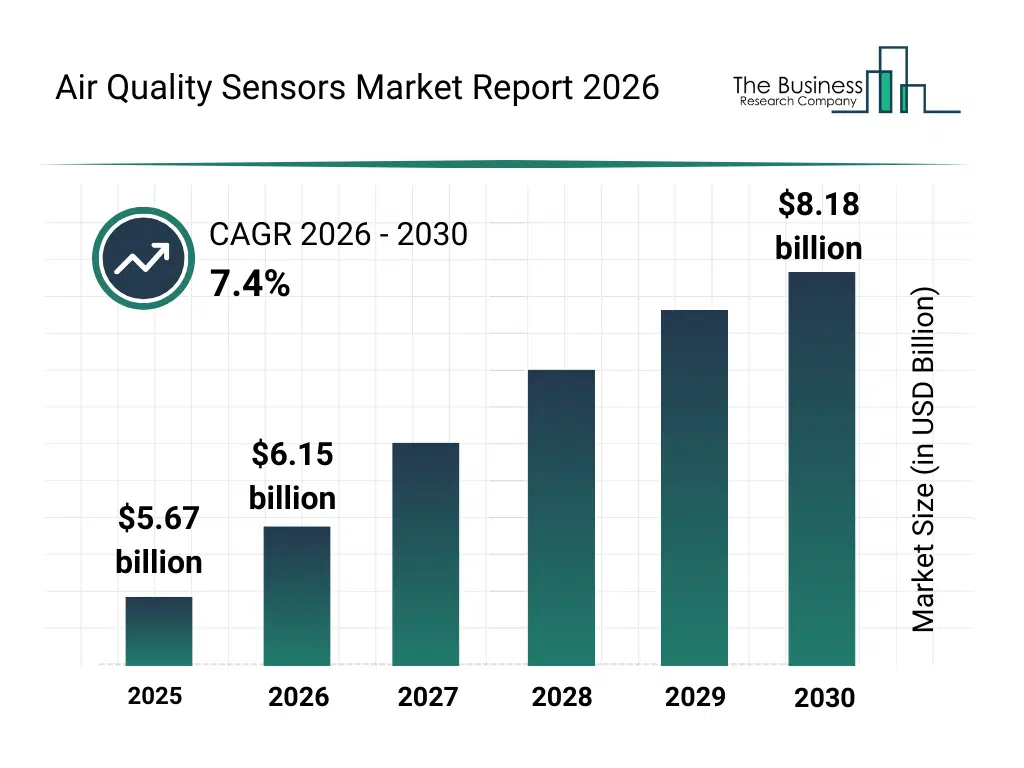
What Is The Air Quality Sensors Market Size 2026 And Growth Rate?
The air quality sensors market size has grown strongly in recent years. It will grow from $5.67 billion in 2025 to $6.15 billion in 2026 at a compound annual growth rate (CAGR) of 8.5%. The growth in the historic period can be attributed to rising urban air pollution levels, implementation of early environmental monitoring regulations, growth in industrial emissions monitoring, increasing public health awareness, expansion of government-led air quality programs.What Is The Air Quality Sensors Market Growth Forecast?
The air quality sensors market size is expected to see strong growth in the next few years. It will grow to $8.18 billion in 2030 at a compound annual growth rate (CAGR) of 7.4%. The growth in the forecast period can be attributed to stricter global air quality regulations, growing adoption of smart city infrastructure, increasing deployment of iot-based sensors, rising demand for real-time environmental data, expansion of indoor air quality monitoring. Major trends in the forecast period include ai-enabled real-time air quality analytics, iot-integrated smart air monitoring networks, data-driven environmental compliance systems, automated industrial emissions monitoring, cloud-based environmental data platforms.
Global Air Quality Sensors Market Segmentation
1) By Type: Signal-Gas Monitoring System, Multi-Gas Monitoring System 2) By Portability: Portable Air Quality Sensor, Fixed Air Quality Sensor 3) By Pollutant: Chemical, Particulate Matters, Biological 4) By User: Government, Petrochemical, Power Plant, Residential Subsegments: 1) By Signal-Gas Monitoring System: Carbon Dioxide (Co2) Monitoring, Carbon Monoxide (Co) Monitoring, Nitrogen Dioxide (No2) Monitoring, Ozone (O3) Monitoring, Sulfur Dioxide (So2) Monitoring 2) By Multi-Gas Monitoring System: Portable Multi-Gas Monitors, Fixed Multi-Gas Monitoring Systems, Indoor Air Quality Multi-Gas Sensors, Outdoor Air Quality Multi-Gas SensorsWhat Is The Driver Of The Air Quality Sensors Market?
The increasing number of airborne diseases and fatalities is expected to propel the growth of the air quality sensors market going forward. Airborne diseases refer to bacteria or viruses that primarily spread through tiny respiratory droplets. The growth of airborne diseases is influenced by various factors, such as higher population density, international travel and migration, and the emergence of antimicrobial-resistant strains. Air quality sensors are used to detect airborne pollutant concentrations, as these devices are engineered to identify and display levels of a specific pollutant, such as particulate matter (PM), within indoor environments. For instance, in September 2024, the Institute for Health Metrics and Evaluation, a US-based health research organization, reported that by 2050, AMR could directly cause 1.91 million deaths, an almost 70% annual increase compared to 2022. Therefore, the increasing number of airborne diseases and fatalities is driving the growth of the air quality sensors industry.Key Players In The Global Air Quality Sensors Market
Major companies operating in the air quality sensors market are Bosch Sensortec GmbH, Siemens AG, Haier Group Corporation, Schneider Electric SE, Valeo AG, Amphenol Corporation, Renesas Electronics Corporation, SUEZ SA, Honeywell International Inc., Sensata Technologies Inc., Vaisala Corporation, Sensirion AG, FIGARO Engineering Inc., Paragon AG, Purelogic Labs , Alphasense Ltd., MetOne Instruments Inc., Eltako GmbH, Birdi Inc., AireBeam Communications, Kaiterra Inc., Foobot, AirGuard HK Ltd, PurpleAir Inc., Aeroqual Limited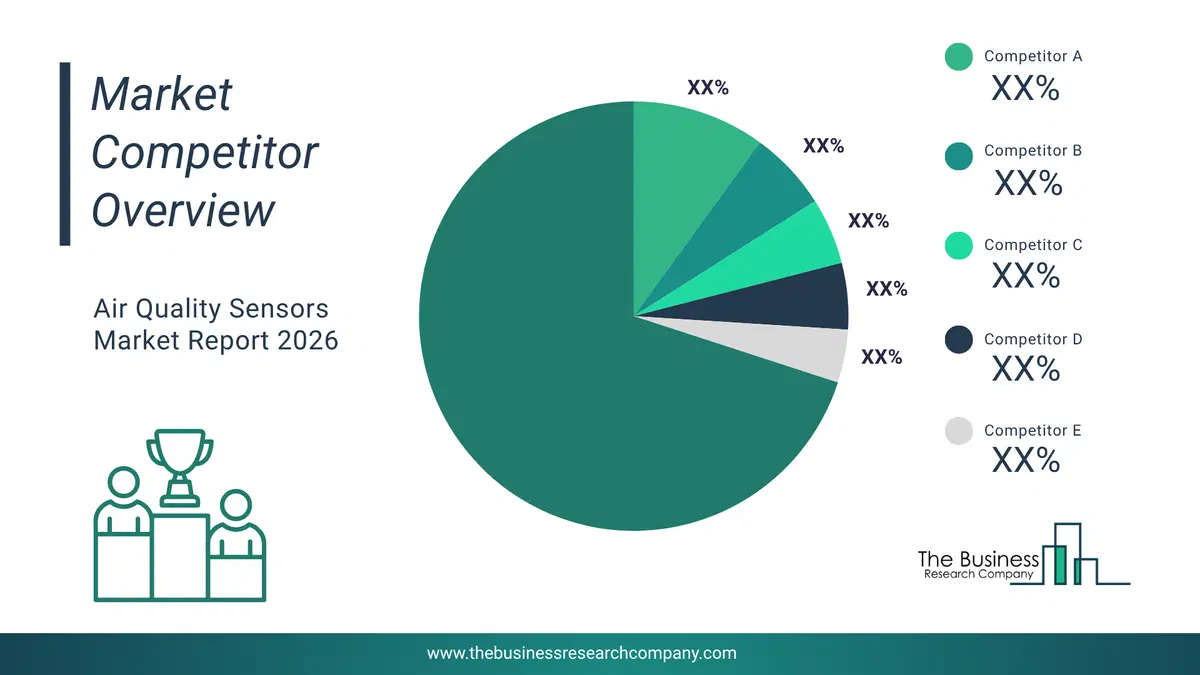
This chart is for illustrative purposes; the full report includes a detailed competitor analysis and comprehensive overview of the top 10 companies in the market.
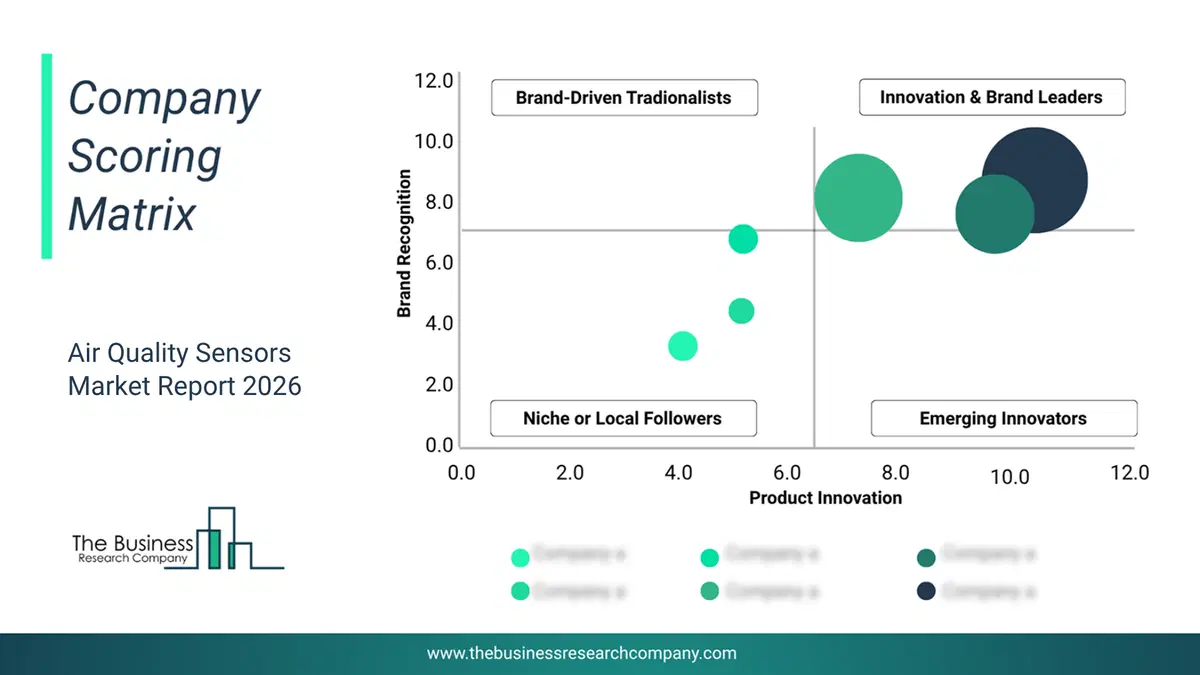
This chart maps companies by product innovation and brand strength, with bubble size indicating relative revenue, helping identify market leaders, challengers, and niche players. This is an illustrative chart; the full report provides a complete and accurate competitive analysis.
Global Air Quality Sensors Market Trends and Insights
Major companies operating in the air quality sensors market are focusing on developing advanced solutions, such as outdoor air quality monitoring platforms, to gain a competitive edge in the market. Air quality monitoring platforms refer to comprehensive systems that integrate various air quality sensors, data collection methods, and analysis tools to continuously monitor and assess the quality of ambient air in specific locations or across larger geographical areas. For instance, in March 2023, Attune Inc., a US-based company offering a flexible sensor platform for air quality, announced the launch of an air quality monitoring (OAQ) kit, a new sensor-based platform for outdoor air quality monitoring. The OAQ Kit is a versatile technology solution with multiple sensors that is ready to use and adaptable to various outdoor air quality monitoring needs. It detects a wide range of outdoor air pollutants, including but not limited to temperature, relative humidity, volatile organic compounds (VOCs), particulate matter (PM0.3–1.0), PM2.5, PM10, carbon dioxide (CO2), carbon monoxide (CO), hydrogen sulfide (H2S), nitrogen dioxide (NO2), ozone (O3), and sulfur dioxide (SO2), and can be customized according to specific customer requirements.What Are Latest Mergers And Acquisitions In The Air Quality Sensors Market?
In November 2023, Groupe TERA, a France based real time air quality measurement and analysis company, acquired a major stake in OMWAVE for an undisclosed amount. With this acquisition, Groupe TERA’s aim is to strengthen its sensor value chain from design through production and increase capacity for OEM air quality sensors. OMWAVE is a France based company that is involved in providing solutions that relate to air quality.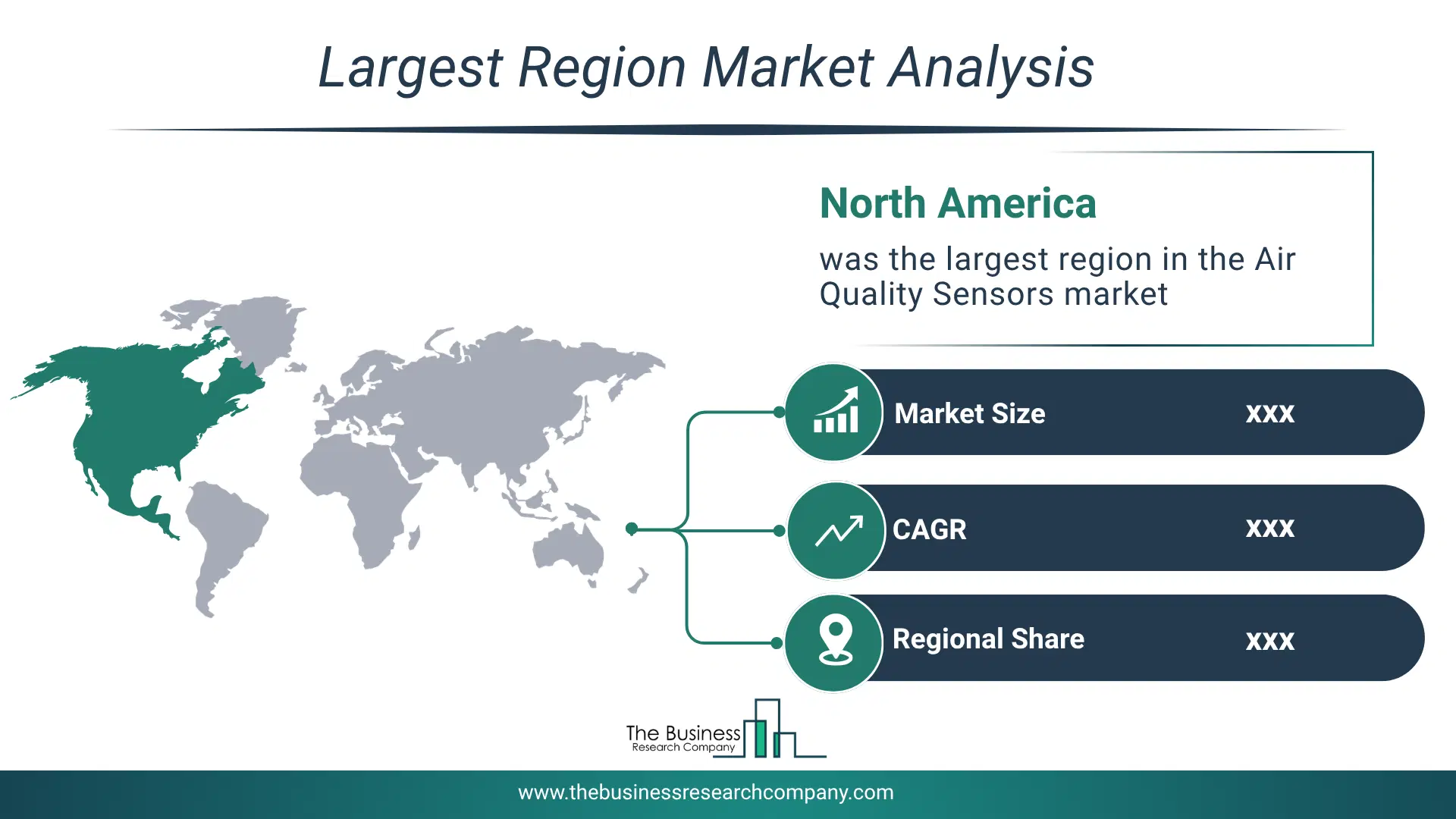
Regional Outlook
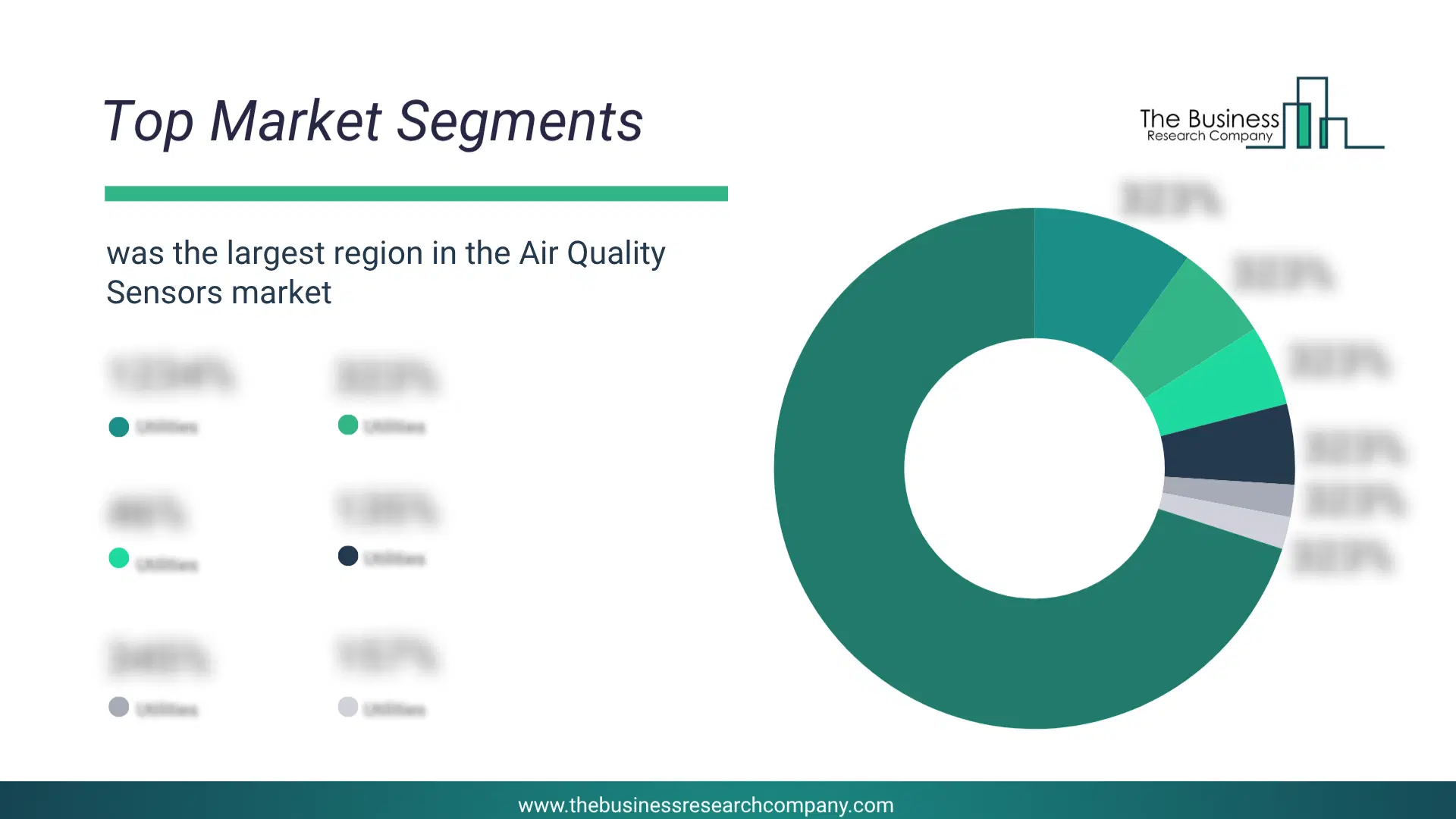
North America was the largest region in the air quality sensors market in 2025. Asia-Pacific is expected to be the fastest-growing region in the forecast period. The regions covered in this market report are Asia-Pacific, South East Asia, Western Europe, Eastern Europe, North America, South America, Middle East, Africa. The countries covered in this market report are Australia, Brazil, China, France, Germany, India, Indonesia, Japan, Taiwan, Russia, South Korea, UK, USA, Canada, Italy, Spain.What Defines the Air Quality Sensors Market?
The air quality sensors market consists of sales of particulate matter (PM) sensors, gas sensors, volatile organic compound (VOC) sensors, and ozone sensors. Values in this market are ‘factory gate’ values, that is the value of goods sold by the manufacturers or creators of the goods, whether to other entities (including downstream manufacturers, wholesalers, distributors, and retailers) or directly to end customers. The value of goods in this market includes related services sold by the creators of the goods.How is Market Value Defined and Measured?
The market value is defined as the revenues that enterprises gain from the sale of goods and/or services within the specified market and geography through sales, grants, or donations in terms of the currency (in USD unless otherwise specified). The revenues for a specified geography are consumption values that are revenues generated by organizations in the specified geography within the market, irrespective of where they are produced. It does not include revenues from resales along the supply chain, either further along the supply chain or as part of other products.
This chart presents market attractiveness based on a quantitative evaluation of growth, competition, strategic alignment, and risk, offering a clear view of opportunity areas for decision-making. This chart is for illustrative purposes; the full report contains the complete analysis.

This chart highlights the Total Addressable Market (TAM) by estimating the maximum revenue opportunity using an assumption-driven approach, supporting strategic planning and opportunity sizing across markets. The chart is illustrative; the full report provides a more comprehensive analysis.
What Key Data and Analysis Are Included in the Air Quality Sensors Market Report 2026?
The air quality sensors market research report is one of a series of new reports from The Business Research Company that provides market statistics, including industry global market size, regional shares, competitors with the market share, detailed market segments, market trends and opportunities, and any further data you may need to thrive in the air quality sensors industry. The market research report delivers a complete perspective of everything you need, with an in-depth analysis of the current and future state of the industry.Air Quality Sensors Market Report Forecast Analysis
| Report Attribute | Details |
|---|---|
| Market Size Value In 2026 | $6.15 billion |
| Revenue Forecast In 2030 | $8.18 billion |
| Growth Rate | CAGR of 7.4% from 2026 to 2030 |
| Base Year For Estimation | 2025 |
| Actual Estimates/Historical Data | 2020-2025 |
| Forecast Period | 2026 - 2030 |
| Market Representation | Revenue in USD Billion and CAGR from 2026 to 2030 |
| Segments Covered | Type, Portability, Pollutant, User |
| Regional Scope | Asia-Pacific, Western Europe, Eastern Europe, North America, South America, Middle East, Africa |
| Country Scope | The countries covered in the report are Australia, Brazil, China, France, Germany, India, Indonesia, Japan, Taiwan, Russia, South Korea, UK, USA, Canada, Italy, Spain. |
| Key Companies Profiled | Bosch Sensortec GmbH, Siemens AG, Haier Group Corporation, Schneider Electric SE, Valeo AG, Amphenol Corporation, Renesas Electronics Corporation, SUEZ SA, Honeywell International Inc., Sensata Technologies Inc., Vaisala Corporation, Sensirion AG, FIGARO Engineering Inc., Paragon AG, Purelogic Labs , Alphasense Ltd., MetOne Instruments Inc., Eltako GmbH, Birdi Inc., AireBeam Communications, Kaiterra Inc., Foobot, AirGuard HK Ltd, PurpleAir Inc., Aeroqual Limited |
| Customization Scope | Request for Customization |
| Pricing And Purchase Options | Explore Purchase Options |