
Gas Sensors Market Report 2026
Global Outlook – By Gas Type ( Carbon Monoxide, Methane, Hydrogen, Ammonia, Oxygen, Other Gas Types ), By Technology ( Infrared Gas Sensor, Photo Ionization Sensors, Electrochemical Gas Sensors, Thermal Conductivity Gas Sensors, Metal Oxide-Based Gas Sensor, Catalytic Gas Sensor, Other Technologies ), By End Use ( Defense And Military, Healthcare, Consumer Electronics, Automotive And Transportation, Industrial, Other End Users ) – Market Size, Trends, Strategies, and Forecast to 2030
Gas Sensors Market Overview
• Gas Sensors market size has reached to $2.55 billion in 2025 • Expected to grow to $3.81 billion in 2030 at a compound annual growth rate (CAGR) of 8.3% • Growth Driver: Rise In Air Pollution Fueling The Growth Of The Market Due To Increasing Need For Monitoring Harmful Emissions And Ensuring Safety • Market Trend: Adoption Of Advanced Photoionization Detector (PID) Technology To Enhance Gas Detection Accuracy • Asia-Pacific was the largest region in 2025.Market Gains By 2030 – Top Opportunities By Segment
Market Gain identifies the most promising market opportunities by highlighting the segments or products expected to generate the highest incremental revenue growth over the next five years.
What Is Covered Under Gas Sensors Market?
Gas sensors detect the concentration and presence of a wide range of hazardous gases and vapors, such as volatile organic compounds (VOCs), humidity, and odors. It is crucial for the effective detection and monitoring of dangerous inert gases in a variety of sectors. The main gas types of gas sensors are carbon monoxide, methane, hydrogen, ammonia, oxygen and others. Carbon monoxide is a colorless odorless toxic gas that is formed as a product of the incomplete combustion of carbon or a carbon compound. The various technologies involved are infrared gas sensors, photoionization sensors, electrochemical gas sensors, thermal conductivity gas sensors, metal oxide-based gas sensors, catalytic gas sensors and others, that are used by various industries such as defense and military, healthcare, consumer electronics, automotive and transportation, industrial and others.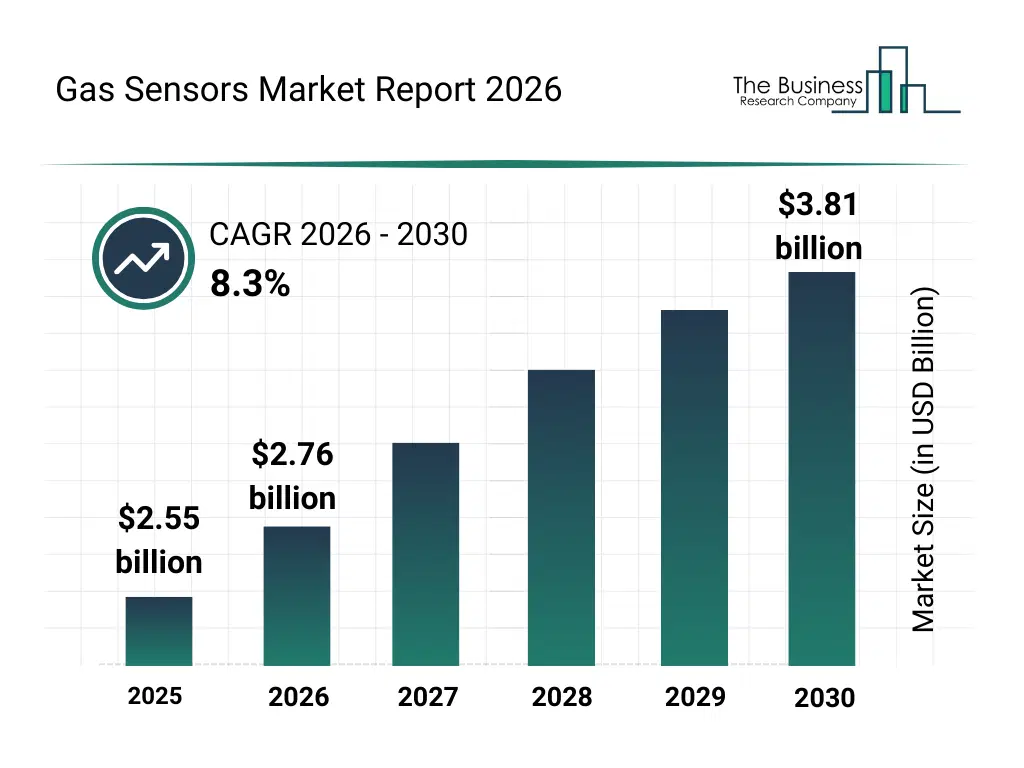
What Is The Gas Sensors Market Size 2026 And Growth Rate?
The gas sensors market size has grown strongly in recent years. It will grow from $2.55 billion in 2025 to $2.76 billion in 2026 at a compound annual growth rate (CAGR) of 8.6%. The growth in the historic period can be attributed to growth in industrial safety monitoring, early adoption in environmental detection systems, expansion in automotive emissions sensing, reliance on basic chemical sensors, increased use in consumer electronics.What Is The Gas Sensors Market Growth Forecast?
The gas sensors market size is expected to see strong growth in the next few years. It will grow to $3.81 billion in 2030 at a compound annual growth rate (CAGR) of 8.3%. The growth in the forecast period can be attributed to increasing demand for workplace safety compliance, rising use in smart home ecosystems, growth in connected automotive sensing, expansion in healthcare diagnostics, development of high-sensitivity multi-gas detection technologies. Major trends in the forecast period include adoption of IoT-enabled real-time gas monitoring, expansion of intelligent automated detection platforms, development of AI-based hazard prediction systems, advancement of robotics-assisted gas sensing, integration of energy-efficient eco-friendly sensor designs.
Global Gas Sensors Market Segmentation
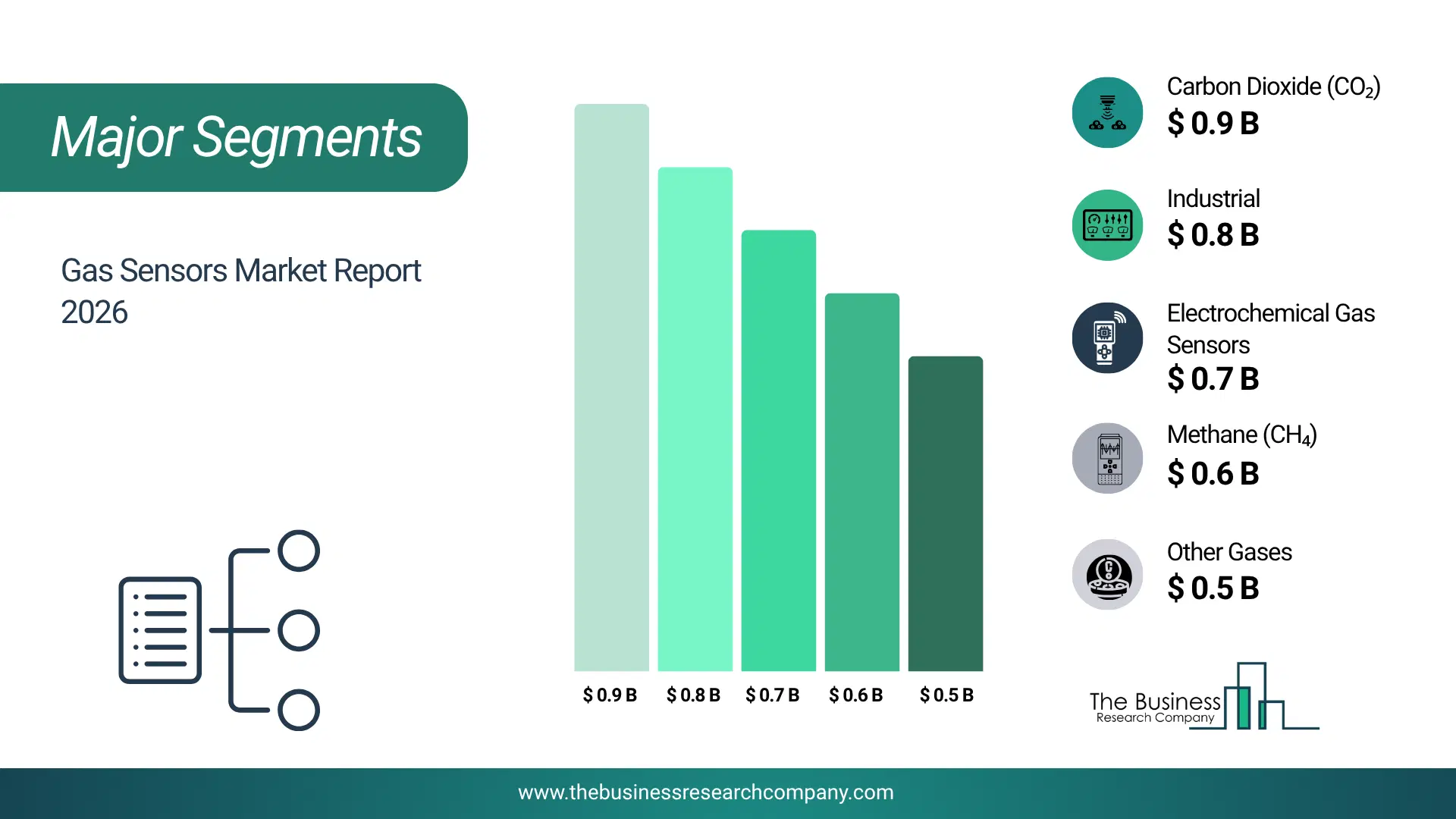
1) By Gas Type: Carbon Monoxide, Methane, Hydrogen, Ammonia, Oxygen, Other Gas Types 2) By Technology: Infrared Gas Sensor, Photo Ionization Sensors, Electrochemical Gas Sensors, Thermal Conductivity Gas Sensors, Metal Oxide-Based Gas Sensor, Catalytic Gas Sensor, Other Technologies 3) By End Use: Defense And Military, Healthcare, Consumer Electronics, Automotive And Transportation, Industrial, Other End Users Subsegments: 1) By Carbon Monoxide: Electrochemical Sensors, Infrared Sensors 2) By Methane: Catalytic Sensors, Infrared Sensors 3) By Hydrogen: Metal Oxide Sensors, Electrochemical Sensors 4) By Ammonia: Solid-State Sensors, Electrochemical Sensors 5) By Oxygen: Electrochemical Sensors, Zirconia Sensors 6) By Other Gas Types: Nitrogen Dioxide (NO2), Sulfur Dioxide (SO2), Volatile Organic Compounds (VOCs) The top segments in the gas sensors market will be: • Carbon Dioxide (CO₂) will reach $968.22 Million by 2025. • Industrial will reach $870.07 Million by 2025. • Electrochemical Gas Sensors will reach $765.09 Million by 2025. • Methane (CH₄) will reach $670.74 Million by 2025. • Other Gases will reach $533.77 Million by 2025.What Is The Driver Of The Gas Sensors Market?
The growing air pollution is expected to propel the growth of the gas sensor market going forward. Air pollution refers to the presence of harmful substances in the air that can have negative impacts on human health and the environment. Air pollution is increasing due to the rapid growth of industrialization and vehicle emissions. Gas sensors are devices that are used to detect the presence and concentration of certain gases in the air. They can also be used to detect gas leaks and help prevent dangerous situations.For instance, in October 2025, according to the World Meteorological Organization (WMO), a Switzerland-based specialized agency reported that the global average atmospheric CO2 concentration reached 423.9 parts per million (ppm) in 2024, marking an increase of 3.5 ppm from 2023, the largest annual rise ever recorded Therefore, the increasing air pollution is driving the growth of the gas sensor industry.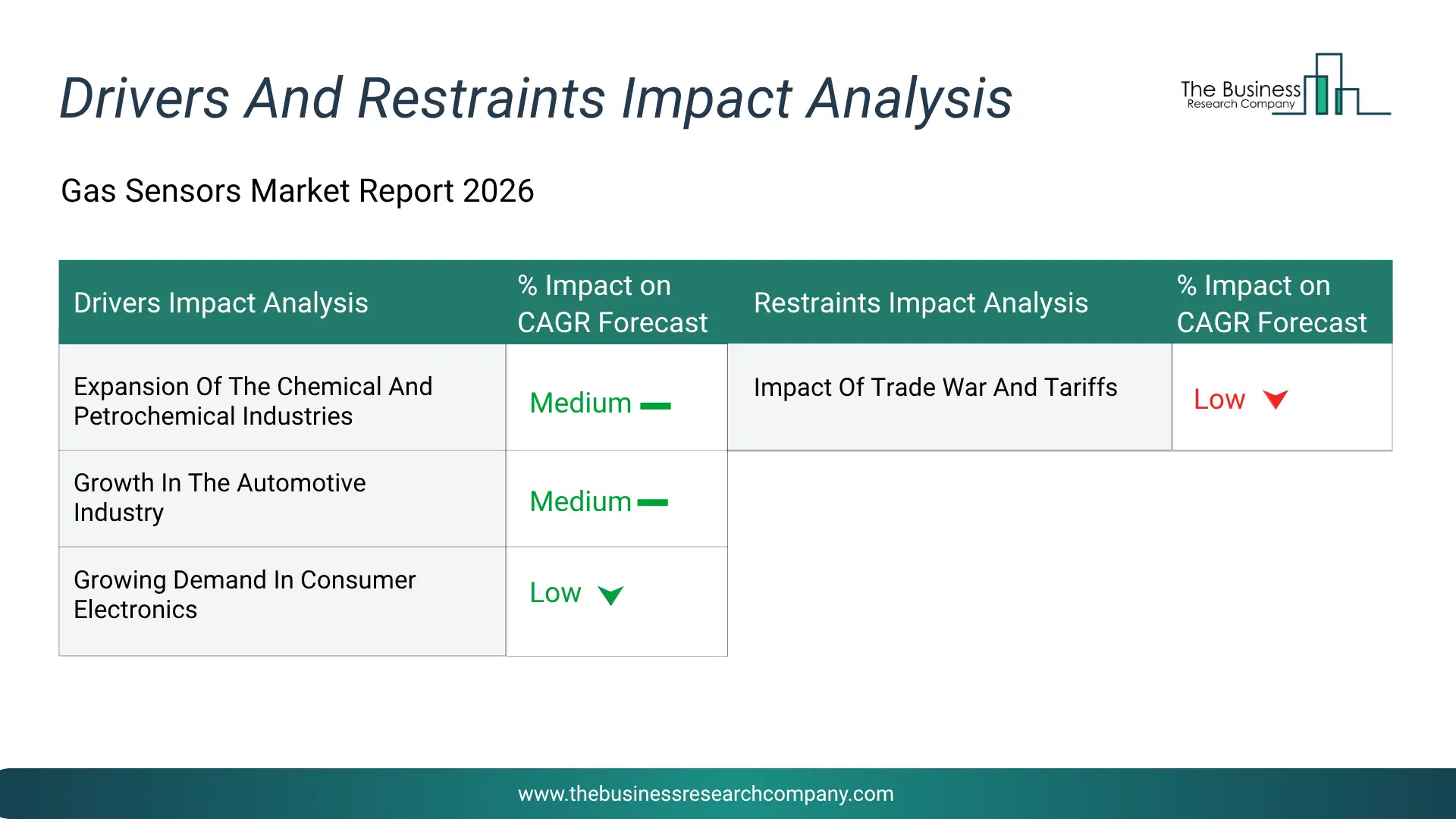
Infographic Chart Showing Key Market Drivers Analysis And Restraints For Gas Sensors Market
The chart presents an impact analysis of key drivers and restraints, quantifying their relative influence on the market's growth rate and helping assess the balance between growth enablers and limiting factors. This chart offers a high-level perspective; the full report contains more detailed insights.
How Will The Drivers Impact Growth In The Global Gas Sensors Market?
• Expansion Of The Chemical And Petrochemical Industries (Medium) – The expansion of the chemical and petrochemical industries will become a key driver of growth in the gas sensors market by 2030. As the scale of chemical and petrochemical operations grows, so does the risk of gas leaks, emissions and potential explosions, making reliable gas detection systems indispensable. Gas sensors are deployed throughout production, storage and transportation processes to detect toxic and flammable gases such as methane, carbon monoxide and volatile organic compounds. Stricter government regulations and heightened safety standards in these industries further drive the adoption of advanced gas sensor technologies, including IoT-enabled and MEMS-based solutions, to enable real-time monitoring and predictive maintenance. As a result, the expansion of the chemical and petrochemical industries is anticipated to contributing to a 2.0% annual growth in the market. • Growth In The Automotive Industry (Medium) – The growth in the automotive industry will emerge as a major factor driving the expansion of the gas sensors market by 2030. As automakers face increasingly stringent global emission regulations, the demand for advanced gas sensors that can accurately monitor, and control vehicle emissions is rising sharply. Additionally, the rapid adoption of electric and hybrid vehicles introduces new requirements for gas sensors, such as monitoring battery gases and fuel cell operations, while the integration of advanced driver-assistance systems (ADAS) and enhanced safety features—like alcohol detection and fuel leak sensors—further boosts the need for sophisticated gas sensing technologies. The ongoing shift toward vehicle electrification, automation and stricter safety standards means that automakers are investing heavily in innovative sensor solutions to ensure compliance, reliability and consumer safety, making gas sensors a critical component in the modern automotive landscape. Consequently, the growth in the automotive industry capabilities is projected to contributing to a 1.5% annual growth in the market. • Growing Demand In Consumer Electronics (Low) – The growing demand in consumer electronics within digital manufacturing processes will serve as a key growth catalyst for the gas sensors market by 2030. As consumer electronics devices such as smartphones, wearables and smart home systems become more prevalent, the integration of gas sensors has become essential for enhancing user safety and environmental awareness. These sensors are increasingly embedded in devices to monitor indoor air quality, detect hazardous gases like carbon monoxide and volatile organic compounds (VOCs) and ensure compliance with health and safety regulations. Technological advancements have led to the development of miniaturized, low-power gas sensors that can be seamlessly incorporated into compact consumer devices without compromising performance. Therefore, this growing demand in consumer electronics across digital manufacturing operations is projected to supporting to a 1.0% annual growth in the market. • Favorable Government Investment (Medium) – The favorable government investment will become a significant driver contributing to the growth of the gas sensors market by 2030. Governments worldwide are investing heavily in smart infrastructure initiatives, especially in rapidly urbanizing regions like Asia-Pacific, to address rising concerns about air quality and public health. These investments support the integration of gas sensors into urban environments for real-time monitoring and management of air pollutants, which is critical for effective and responsive environmental controls. Additionally, government-backed regulations and programs such as India’s National Clean Air Program and the European Union’s stringent emissions standards mandate the use of gas sensors across industries to ensure compliance, further boosting demand. As a result, government investment not only accelerates technological innovation and deployment of gas sensors but also ensures their widespread adoption in both residential and industrial applications, solidifying their role in modern infrastructure and public safety. Consequently, the favorable government investment strategies is projected to contributing to a 0.5% annual growth in the market.How Will The Restraints Impact Growth In The Global Gas Sensors Market?
• High Setting Costs Of Gas Sensors (Medium) – High Setting Costs Of Gas Sensors will restrict the growth of the Gas Sensors market during the forecast period. Gas sensor systems involve significant costs for equipment, installation, calibration, and integration with monitoring systems. The high upfront investment creates barriers for smaller facilities and budget-constrained applications. Cost constraints can affect adoption rates and limit the deployment of gas sensors in certain market segments. • Maintenance And Replacement Needs (Medium) – Maintenance And Replacement Needs will restrict the growth of the Gas Sensors market during the forecast period. Gas sensors require regular calibration, maintenance, and periodic replacement to maintain accuracy and reliability. Harsh operating conditions can accelerate sensor degradation, increasing maintenance frequency and costs. Maintenance requirements affect total cost of ownership and may discourage adoption in cost-sensitive applications, limiting market growth. • Impact Of Trade War And Tariffs (Low) – Impact Of Trade War And Tariffs will restrict the growth of the Gas Sensors market during the forecast period. Gas sensors rely on imported semiconductor materials, MEMS components, and electronic modules. Trade tariffs and restrictions can increase production costs and affect product availability. Supply chain disruptions from trade tensions can lead to component shortages and delivery delays, impacting sensor production and pricing.Key Players In The Global Gas Sensors Market
Major companies operating in the gas sensors market are Honeywell International Inc, Amphenol Corporation, Figaro Engineering Inc, Dynament, Membrapor AG, Nemoto & Co. Ltd., Robert Bosch GmbH, Sensirion AG, Asea Brown Boveri Ltd, Teledyne FLIR LLC, Siemens AG, City Technology Ltd., GfG Gas Detection UK Ltd., Senseair, Gastec Corporation, austriamicrosystems AG, AlphaSense Inc., NevadaNano, MicroSensor Corporation, Dryad, Pendar Technologies, Alphasense Ltd., Aeroqual Ltd., Kapitalgesellschaft, Winsen Electronics Technology Co. Ltd., MSA Safety Incorporated, Cubic Sensor and Instrument Co. Ltd, Yokogawa Electric Corporation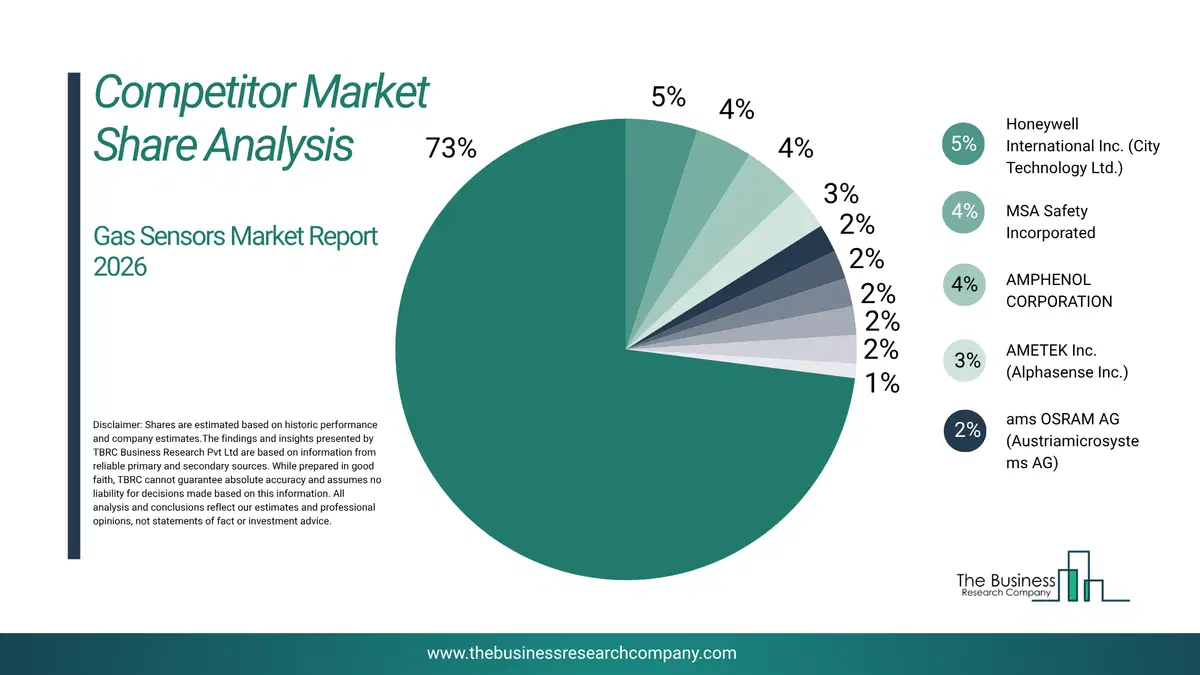
This chart is for illustrative purposes; the full report includes a detailed competitor analysis and comprehensive overview of the top 10 companies in the market.
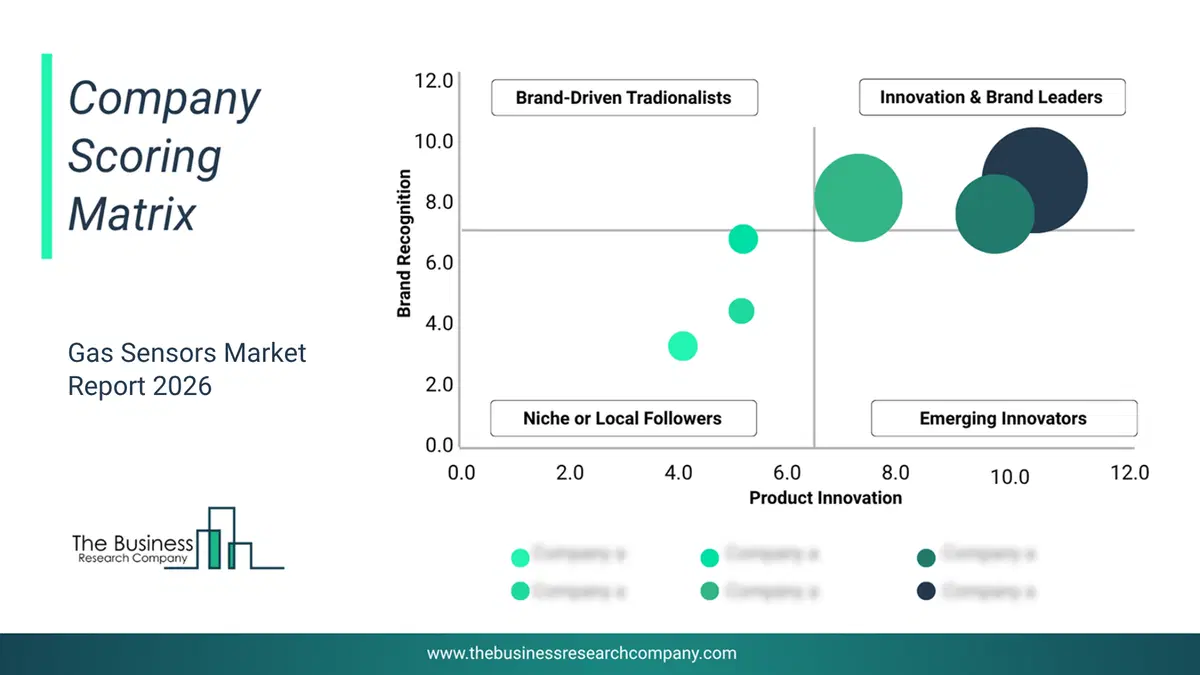
This chart maps companies by product innovation and brand strength, with bubble size indicating relative revenue, helping identify market leaders, challengers, and niche players. This is an illustrative chart; the full report provides a complete and accurate competitive analysis.
Global Gas Sensors Market Trends and Insights
Major companies are operating in the gas sensors market focusing on developing innovative solutions such as photoionization detector (PID) sensors to achieve ultra-sensitive detection of volatile organic compounds (VOCs) and toxic gases for industrial safety and environmental monitoring applications. A PID sensor uses ultraviolet (UV) light to ionize gas molecules, generating a current proportional to the gas concentration offering higher sensitivity, faster response, and broader detection range compared to traditional electrochemical or metal-oxide sensors. For instance, in October 2024, Alphasense Ltd., a UK–based gas sensor manufacturer, launched the PIDX series, an advanced range of PID sensors designed for precise VOC measurement. The product features multiple detection ranges from 0–4 ppm to 0–10,000 ppm, improved baseline stability across temperature and humidity variations, enhanced sensor repeatability, and integrated fault detection for maintenance alerts, making it ideal for portable and fixed gas detection systems.What Are Latest Mergers And Acquisitions In The Gas Sensors Market?
In December 2023, Amphenol Corporation, a US-based electronic connector manufacturing company, acquired PCTEL for an undisclosed amount. This acquisition aims to enhance Amphenol's portfolio in wireless technology solutions, including IoT devices, antenna systems, and test and measurement products, by integrating PCTEL's expertise into its global operations. PCTEL is a US-based test and measurement products and antenna systems company that offers gas sensors as a part of their Industrial IoT products.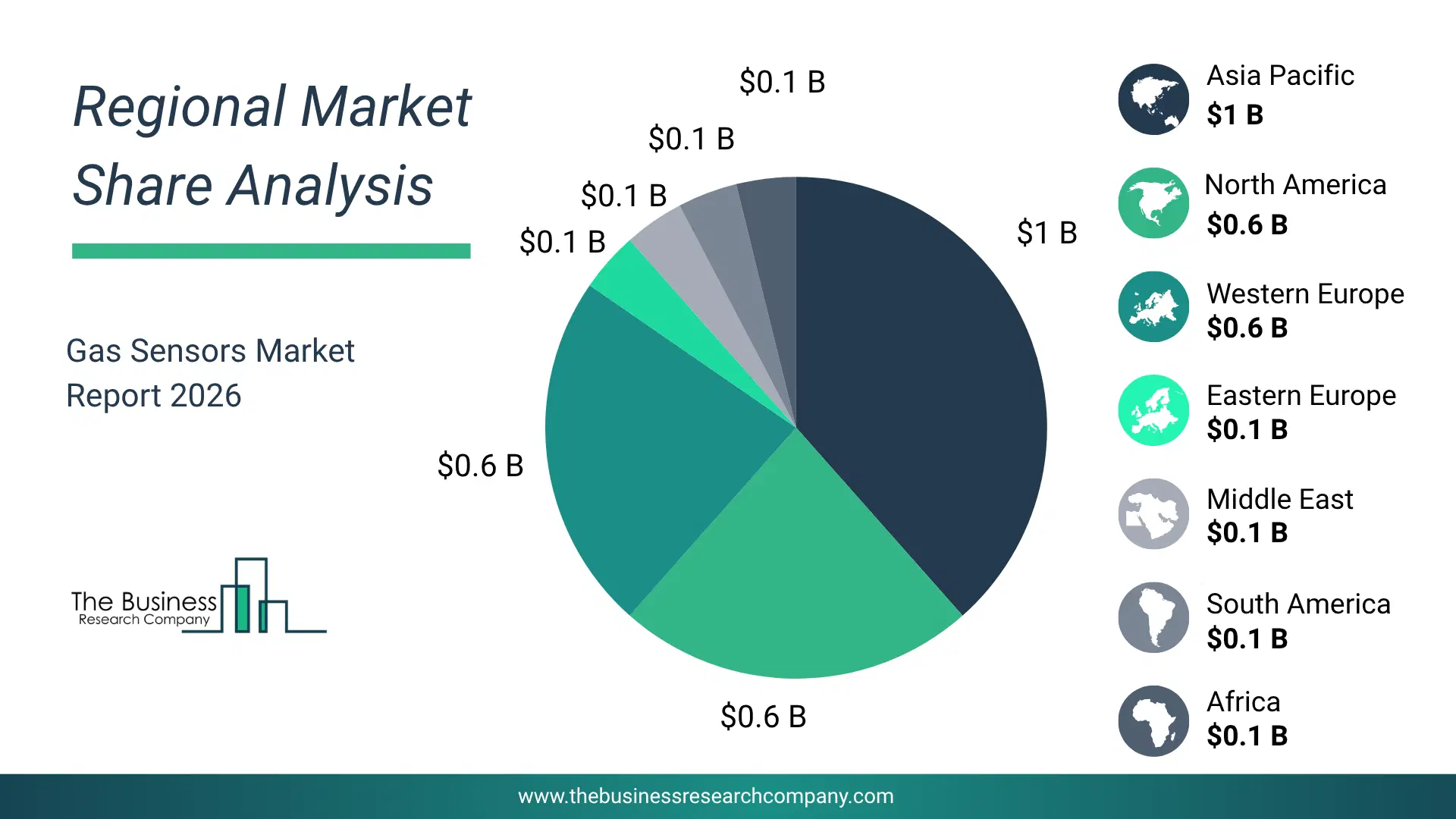
Regional Outlook
Asia-Pacific was the largest region in the gas sensor market in 2025. The regions covered in this market report are Asia-Pacific, South East Asia, Western Europe, Eastern Europe, North America, South America, Middle East, Africa. The countries covered in this market report are Australia, Brazil, China, France, Germany, India, Indonesia, Japan, Taiwan, Russia, South Korea, UK, USA, Canada, Italy, Spain.What Defines the Gas Sensors Market?
The gas sensor market consists of sales of wired and wireless sensors, gas sensing layer, heater coil, electrode line, tubular ceramic. Values in this market are ‘factory gate’ values, that is the value of goods sold by the manufacturers or creators of the goods, whether to other entities (including downstream manufacturers, wholesalers, distributors, and retailers) or directly to end customers. The value of goods in this market includes related services sold by the creators of the goods.How is Market Value Defined and Measured?
The market value is defined as the revenues that enterprises gain from the sale of goods and/or services within the specified market and geography through sales, grants, or donations in terms of the currency (in USD unless otherwise specified). The revenues for a specified geography are consumption values that are revenues generated by organizations in the specified geography within the market, irrespective of where they are produced. It does not include revenues from resales along the supply chain, either further along the supply chain or as part of other products.
This chart presents market attractiveness based on a quantitative evaluation of growth, competition, strategic alignment, and risk, offering a clear view of opportunity areas for decision-making. This chart is for illustrative purposes; the full report contains the complete analysis.

This chart highlights the Total Addressable Market (TAM) by estimating the maximum revenue opportunity using an assumption-driven approach, supporting strategic planning and opportunity sizing across markets. The chart is illustrative; the full report provides a more comprehensive analysis.
What Key Data and Analysis Are Included in the Gas Sensors Market Report 2026?
The gas sensors market research report is one of a series of new reports from The Business Research Company that provides market statistics, including industry global market size, regional shares, competitors with the market share, detailed market segments, market trends and opportunities, and any further data you may need to thrive in the gas sensors industry. The market research report delivers a complete perspective of everything you need, with an in-depth analysis of the current and future state of the industry.Gas Sensors Market Report 2026 Market Report Forecast Analysis
| Report Attribute | Details |
|---|---|
| Market Size Value In 2026 | $2.76 billion |
| Revenue Forecast In 2030 | $3.81 billion |
| Growth Rate | CAGR of 8.6% from 2026 to 2030 |
| Base Year For Estimation | 2025 |
| Actual Estimates/Historical Data | 2020-2025 |
| Forecast Period | 2026 - 2030 |
| Market Representation | Revenue in USD Billion and CAGR from 2026 to 2030 |
| Segments Covered | Gas Type, Technology, End Use |
| Regional Scope | Asia-Pacific, Western Europe, Eastern Europe, North America, South America, Middle East, Africa |
| Country Scope | The countries covered in the report are Australia, Brazil, China, France, Germany, India, Indonesia, Japan, Taiwan, Russia, South Korea, UK, USA, Canada, Italy, Spain. |
| Key Companies Profiled | Honeywell International Inc, Amphenol Corporation, Figaro Engineering Inc, Dynament, Membrapor AG, Nemoto & Co. Ltd., Robert Bosch GmbH, Sensirion AG, Asea Brown Boveri Ltd, Teledyne FLIR LLC, Siemens AG, City Technology Ltd., GfG Gas Detection UK Ltd., Senseair, Gastec Corporation, austriamicrosystems AG, AlphaSense Inc., NevadaNano, MicroSensor Corporation, Dryad, Pendar Technologies, Alphasense Ltd., Aeroqual Ltd., Kapitalgesellschaft, Winsen Electronics Technology Co. Ltd., MSA Safety Incorporated, Cubic Sensor and Instrument Co. Ltd, Yokogawa Electric Corporation |
| Customization Scope | Request for Customization |
| Pricing And Purchase Options | Explore Purchase Options |