
Aircraft Auxiliary Power Unit Market Report 2026
Global Outlook – By Product (Battery Power, Electric Ground Power), By Aircraft Type (Fixed Wind, Wide Body, Narrow Body, Rotary Wing, Unmanned Aerial Vehicle, Other Types), By End User (Military Aircrafts, Commercial Aircrafts, General Aviation) – Market Size, Trends, Strategies, and Forecast to 2030
Aircraft Auxiliary Power Unit Market Overview
• Aircraft Auxiliary Power Unit market size has reached to $3.5 billion in 2025 • Expected to grow to $4.11 billion in 2030 at a compound annual growth rate (CAGR) of 3.3% • Growth Driver: Rising Aircraft Deliveries Fuel Expansion In Aircraft Auxiliary Power Unit Market • Market Trend: Innovations In Energy-Efficient Aircraft Power Systems For Improved Performance • North America was the largest region in 2025 and Asia-Pacific is the fastest growing region.What Is Covered Under Aircraft Auxiliary Power Unit Market?
An aircraft auxiliary power unit refers to a device on aircraft that allows an aircraft to function independently without needing ground support tools like a ground power unit, an external air-conditioning unit, or a high-pressure air start cart. APU supplies critical electric power for aviation systems and is typically utilized to start one of the main engines on an airliner. It is also used to bleed air to start the main engines. The main products of aircraft auxiliary power unit are battery power and electric ground power. The aircraft auxiliary power unit is used in various types of aircraft, such as fixed-wing, wide-body, narrow-body, rotary-wing, unmanned aerial vehicle, and others. A fixed-wing aircraft refers to an aircraft that flies using wings and the shape of the wings. These are used by several end users, such as military aircraft, commercial aircraft, and general aviation.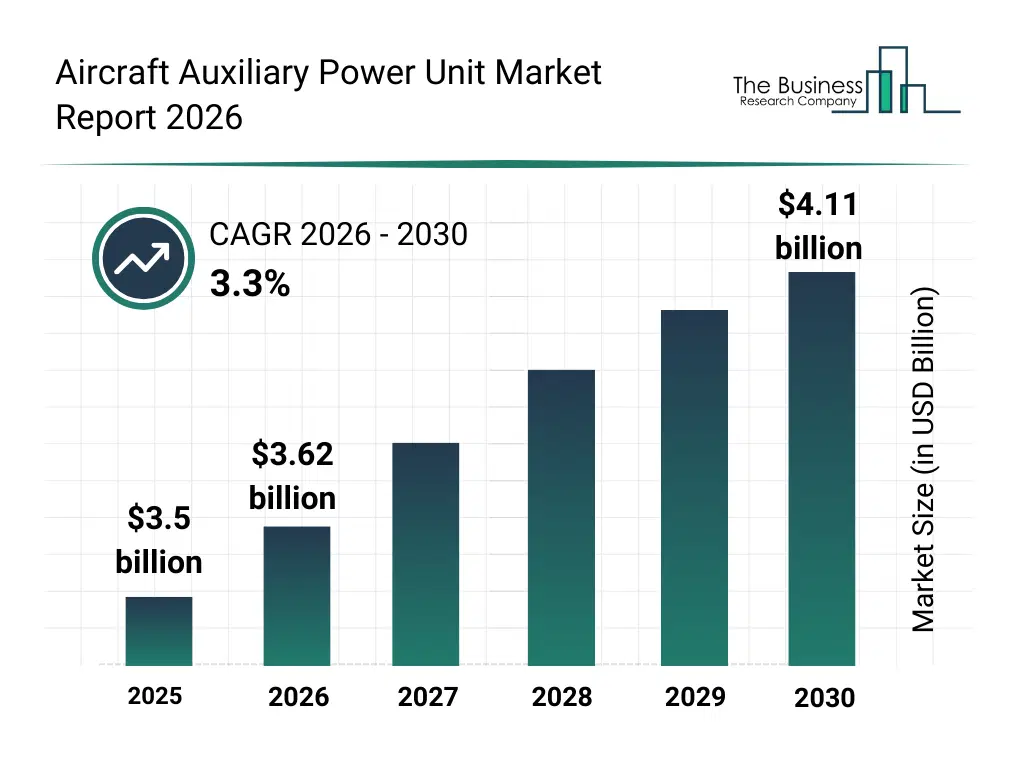
What Is The Aircraft Auxiliary Power Unit Market Size and Share 2026?
The aircraft auxiliary power unit market size has grown steadily in recent years. It will grow from $3.5 billion in 2025 to $3.62 billion in 2026 at a compound annual growth rate (CAGR) of 3.4%. The growth in the historic period can be attributed to early adoption of auxiliary power units to enable independent aircraft operation without ground support, increasing demand for reliable electric power supply for onboard aviation systems, development of combustion engine–based APUs using diesel, gas, or propane fuels, rising use of batteries and hydraulic accumulators to support engine starting functions, expansion of commercial aircraft fleets driving standardized installation of APUs.What Is The Aircraft Auxiliary Power Unit Market Growth Forecast?
The aircraft auxiliary power unit market size is expected to see steady growth in the next few years. It will grow to $4.11 billion in 2030 at a compound annual growth rate (CAGR) of 3.3%. The growth in the forecast period can be attributed to growing demand for fuel-efficient and low-emission apu technologies, increasing adoption of hybrid and electric APUs to reduce operational costs, rising aircraft production and modernization programs requiring advanced auxiliary power systems, technological advancements enhancing apu reliability, noise reduction, and thermal efficiency, expansion of regulatory emphasis on reducing ground emissions and improving energy efficiency in aviation. Major trends in the forecast period include demand for efficient auxiliary power units, lightweight and compact apu designs, integration of hybrid and fuel-efficient engines, increased focus on safety and redundancy systems, expansion in unmanned aerial vehicle apus.
Global Aircraft Auxiliary Power Unit Market Segmentation
1) By Product: Battery Power, Electric Ground Power 2) By Aircraft Type: Fixed Wind, Wide Body, Narrow Body, Rotary Wing, Unmanned Aerial Vehicle, Other Types 3) By End User: Military Aircrafts, Commercial Aircrafts, General Aviation Subsegments: 1) By Battery Power: Lithium-Ion Battery Systems, Nickel-Cadmium Battery Systems 2) By Electric Ground Power: Ground Power Units (GPU), Mobile Ground Power UnitsWhat Is Driver Of The Aircraft Auxiliary Power Unit Market?
The increasing number of aircraft deliveries is expected to propel the growth of the aircraft auxiliary power unit market going forward. Aircraft deliveries refer to the process of manufacturing, assembly, and delivery of aircraft to customers, which can include airlines, private owners, or military organizations. The APU provides energy to the aircraft's electrical and pneumatic systems, allowing the aircraft to operate independently on the ground or during maintenance work. This reduces the reliance on external power sources and provides greater flexibility for the airline. For instance, in January 2024, according to the Airbus SE, a France-based aerospace and defense company, in 2023, Airbus delivered 735 commercial aircraft, marking an 11% increase compared to 2022. The company recorded 2,319 gross orders (2,094 net), which included 1,835 A320 Family aircraft and 300 A350 Family aircraft. Therefore, the increasing number of aircraft deliveries is driving the aircraft auxiliary power unit industry.Key Players In The Global Aircraft Auxiliary Power Unit Market
Major companies operating in the aircraft auxiliary power unit market are Honeywell International Inc., Hamilton Sundstrand Corporation, Technodinamika, Kinetics Ltd., Rolls-Royce PLC, AEGIS Power Systems Inc., Pratt & Whitney Canada Corp., Safran Power Units SAS, United Technologies Corporation, The Dewey Electronics Corporation, Liebherr-Aerospace Lindenberg GmbH, General Electric Company, BAE Systems plc., Raytheon Technologies Corporation, BOSA S.A., JSC NPP Aerosila, PBS Group a. s., Microturbo, Falck Schmidt Defence Systems A/S, Hartzell Aerospace, The Marvin Group, AMETEK Airtechnology Group, Behlman Electronics Inc., Tecknowledgey, UTC Aerospace Systems, Aerospace Turbine Rotables Inc., AeroVironment Inc., Airborne Systems North America, Aircraft Electronics Associatio
This chart is for illustrative purposes; the full report includes a detailed competitor analysis and comprehensive overview of the top 10 companies in the market.
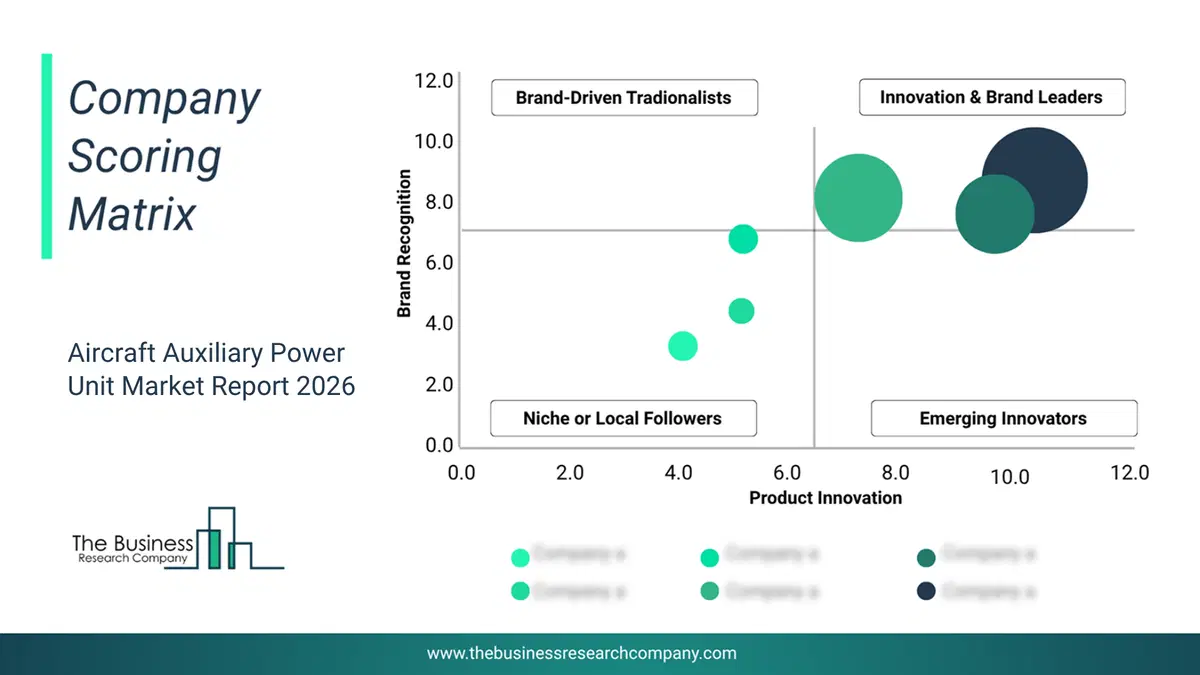
This chart maps companies by product innovation and brand strength, with bubble size indicating relative revenue, helping identify market leaders, challengers, and niche players. This is an illustrative chart; the full report provides a complete and accurate competitive analysis.
Global Aircraft Auxiliary Power Unit Market Trends and Insights
Major companies operating in the aircraft auxiliary power unit market are focusing on developing innovative products such as energy-efficient units to reduce fuel consumption, lower emissions, and enhance aircraft performance. Energy-efficient units are devices designed to use less fuel or power while delivering the same output, helping reduce operating costs, lower greenhouse gas emissions, minimize environmental impact, and improve overall aircraft performance and reliability, making them essential for modern commercial and military aviation. For instance, in September 2025, Pratt & Whitney, a US-based aerospace manufacturing company, partnered with PBS Group, a Czech Republic-based technology company, to develop a next-generation auxiliary power unit (APU) aimed at delivering higher power density, reduced weight, and enhanced efficiency for both commercial and military aircraft. Leveraging the technological expertise of both companies, the APUs can rapidly start, operate at high altitudes, and support advanced aircraft systems, ultimately contributing to lower fuel consumption, reduced emissions, and improved overall aircraft performance. The new APU is also expected to enable greater flexibility in aircraft design by minimizing space and weight requirements, while providing additional electrical power, enhanced thermal management, and support for electronic warfare systems in defense applications.What Are Latest Mergers And Acquisitions In The Aircraft Auxiliary Power Unit Market? Snow Peak Capital, Llc Acquires Turbineaero, Inc. To Expand Global Apu Mro Capabilities
In October 2024, Snow Peak Capital LLC, a US-based private equity firm, acquired TurbineAero Inc. for an undisclosed amount. With this acquisition, Snow Peak Capital aims to invest in TurbineAero’s next phase of growth, strengthen its market leadership, enhance operational capabilities, and support the company in delivering expanded, world-class APU MRO services and aeroengine component solutions to a diverse and global customer base across both commercial and military aerospace sectors. TurbineAero Inc. is a US-based manufacturing company that specializes in providing aircraft auxiliary power units (APUs).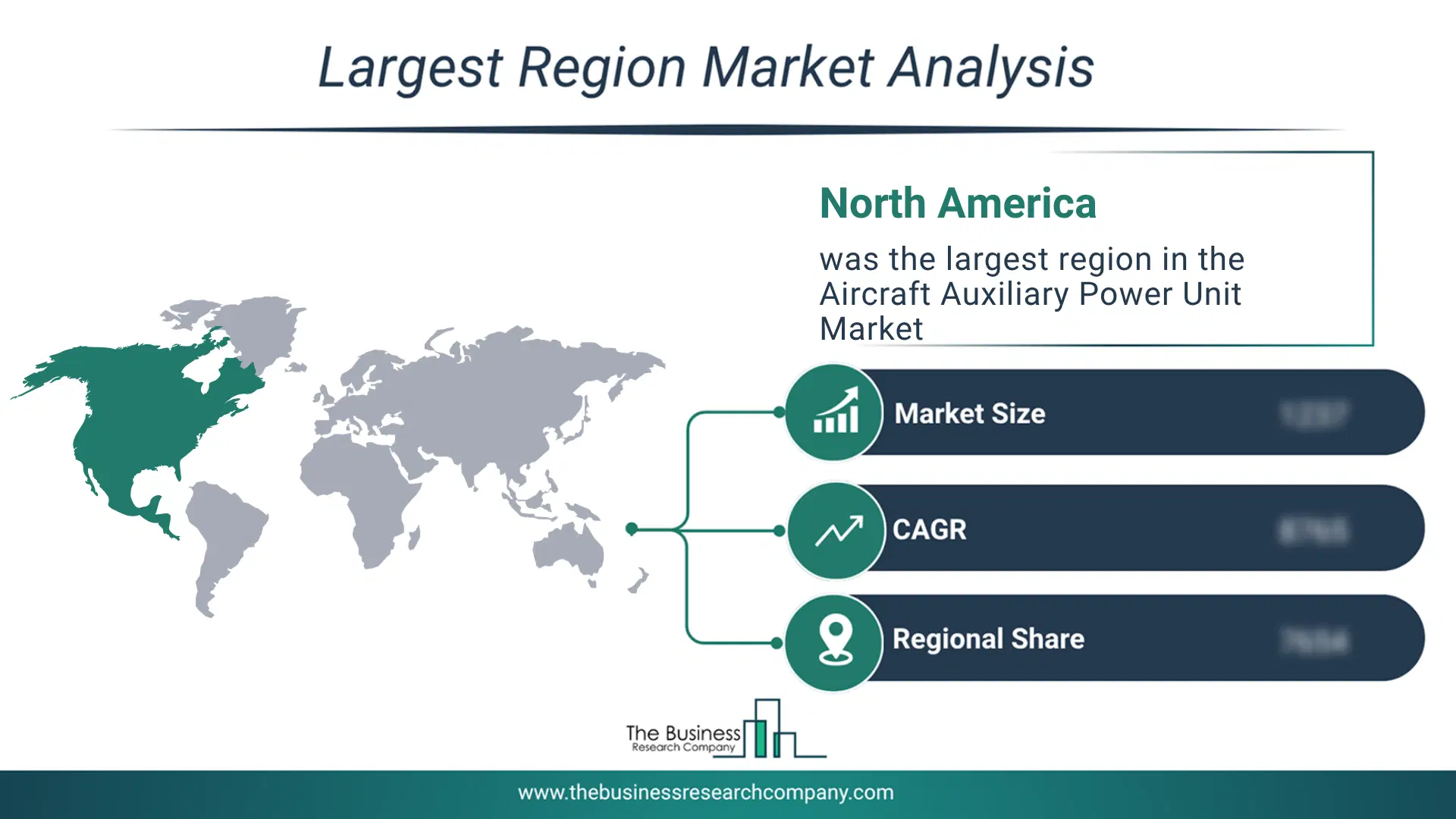
Regional Insights
North America was the largest region in the aircraft auxiliary power unit market in 2025. Asia-Pacific is expected to be the fastest-growing region in the global aircraft auxiliary power unit market report during the forecast period. The regions covered in this market report are Asia-Pacific, South East Asia, Western Europe, Eastern Europe, North America, South America, Middle East, Africa. The countries covered in this market report are Australia, Brazil, China, France, Germany, India, Indonesia, Japan, Taiwan, Russia, South Korea, UK, USA, Canada, Italy, SpainWhat Defines the Aircraft Auxiliary Power Unit Market?
The aircraft auxiliary power unit market consists of sales of battery, hydraulic accumulator, and combustion engines using diesel, gas, or propane fuel. Values in this market are ‘factory gate’ values, that is the value of goods sold by the manufacturers or creators of the goods, whether to other entities (including downstream manufacturers, wholesalers, distributors, and retailers) or directly to end customers. The value of goods in this market includes related services sold by the creators of the goods.How is Market Value Defined and Measured?
The market value is defined as the revenues that enterprises gain from the sale of goods and/or services within the specified market and geography through sales, grants, or donations in terms of the currency (in USD unless otherwise specified). The revenues for a specified geography are consumption values that are revenues generated by organizations in the specified geography within the market, irrespective of where they are produced. It does not include revenues from resales along the supply chain, either further along the supply chain or as part of other products.
This chart presents market attractiveness based on a quantitative evaluation of growth, competition, strategic alignment, and risk, offering a clear view of opportunity areas for decision-making. This chart is for illustrative purposes; the full report contains the complete analysis.

This chart highlights the Total Addressable Market (TAM) by estimating the maximum revenue opportunity using an assumption-driven approach, supporting strategic planning and opportunity sizing across markets. The chart is illustrative; the full report provides a more comprehensive analysis.
What Key Data and Analysis Are Included in the Aircraft Auxiliary Power Unit Market Report 2026?
The aircraft auxiliary power unit market research report is one of a series of new reports from The Business Research Company that provides market statistics, including industry global market size, regional shares, competitors with the market share, detailed market segments, market trends and opportunities, and any further data you may need to thrive in the aircraft auxiliary power unit industry. The market research report delivers a complete perspective of everything you need, with an in-depth analysis of the current and future state of the industry.Aircraft Auxiliary Power Unit Market Report Forecast Analysis
| Report Attribute | Details |
|---|---|
| Market Size Value In 2026 | $3.62 billion |
| Revenue Forecast In 2030 | $4.11 billion |
| Growth Rate | CAGR of 3.3% from 2026 to 2030 |
| Base Year For Estimation | 2025 |
| Actual Estimates/Historical Data | 2020-2025 |
| Forecast Period | 2026 - 2030 |
| Market Representation | Revenue in USD Billion and CAGR from 2026 to 2030 |
| Segments Covered | Product, Aircraft Type, End User |
| Regional Scope | Asia-Pacific, Western Europe, Eastern Europe, North America, South America, Middle East, Africa |
| Country Scope | The countries covered in the aircraft auxiliary power unit market report are Australia, Brazil, China, France, Germany, India, Indonesia, Japan, Taiwan, Russia, South Korea, UK, USA, Canada, Italy, Spain |
| Key Companies Profiled | Honeywell International Inc., Hamilton Sundstrand Corporation, Technodinamika, Kinetics Ltd., Rolls-Royce PLC, AEGIS Power Systems Inc., Pratt & Whitney Canada Corp., Safran Power Units SAS, United Technologies Corporation, The Dewey Electronics Corporation, Liebherr-Aerospace Lindenberg GmbH, General Electric Company, BAE Systems plc., Raytheon Technologies Corporation, BOSA S.A., JSC NPP Aerosila, PBS Group a. s., Microturbo, Falck Schmidt Defence Systems A/S, Hartzell Aerospace, The Marvin Group, AMETEK Airtechnology Group, Behlman Electronics Inc., Tecknowledgey, UTC Aerospace Systems, Aerospace Turbine Rotables Inc., AeroVironment Inc., Airborne Systems North America, Aircraft Electronics Associatio |
| Customization Scope | Request for Customization |
| Pricing And Purchase Options | Explore Purchase Options |