
Autonomous Military Aircraft Market Report 2026
Global Outlook – By Type (Fighter Aircrafts, Bombers, Reconnaissance And Surveillance Aircrafts, Airborne Early Warning Aircrafts, Others ), By Component (Flight Management Computers, Air Data Inertial Reference Units, Sensors, Actuation Systems, Software, Intelligent Servos, Cameras, Radars And Transponders, Propulsion Systems), By Technology (Remotely Operated, Semi-Autonomous, Autonomous) – Market Size, Trends, Strategies, and Forecast to 2030
Autonomous Military Aircraft Market Overview
• Autonomous Military Aircraft market size has reached to $4.61 billion in 2025 • Expected to grow to $6.54 billion in 2030 at a compound annual growth rate (CAGR) of 7.3% • Growth Driver: Growing Demand For Unmanned Aerial Vehicles (Uavs) Driving The Market Growth Due To Their Ability To Enhance Surveillance, Reconnaissance, And Combat Operations Safely • Market Trend: Technological Advancements In Autonomous Military Aircraft Market Growth • Asia-Pacific was the largest region in 2025 and Western Europe is the fastest growing region.What Is Covered Under Autonomous Military Aircraft Market?
Autonomous military aircraft refers to aircraft guided autonomously from the ground, designed to attack surface targets with bombs or missiles and destroy enemy targets in warfare. They carry sensors, target designators, offensive ordnance, and electronic transmitters, among others. The main technological types of autonomous military aircraft market are remotely operated, semi-autonomous, and autonomous. The various types of aircraft include fighter aircraft, bombers, reconnaissance and surveillance aircraft, airborne early warning aircraft, and others, and the components used are flight management computers, air data inertial reference units, sensors, actuation systems, software, intelligent servos, cameras, radars, and transponders. A fighter aircraft is a fixed-wing aircraft designed for air-to-air combat against other aircraft.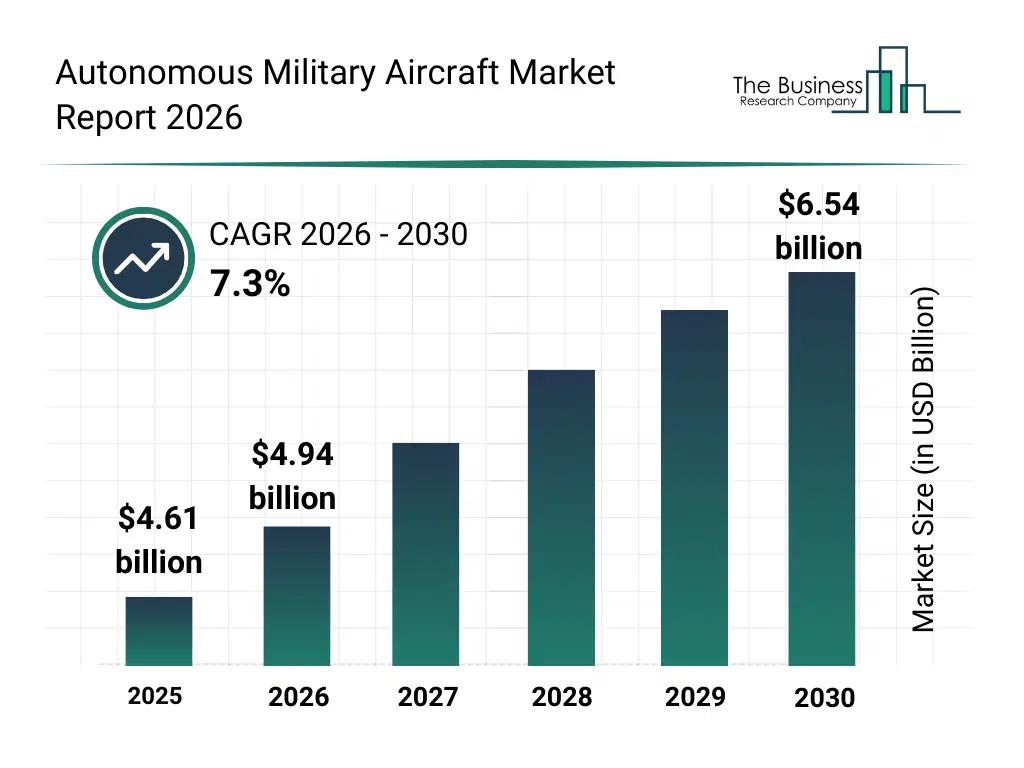
What Is The Autonomous Military Aircraft Market Size and Share 2026?
The autonomous military aircraft market size has grown strongly in recent years. It will grow from $4.61 billion in 2025 to $4.94 billion in 2026 at a compound annual growth rate (CAGR) of 7.1%. The growth in the historic period can be attributed to development of early unmanned combat aerial vehicle (ucav) technologies, adoption of autonomous aircraft for surveillance and strike missions, advancements in targeting and sensor systems, government investment in defense R&D programs, integration of electronic warfare and communication systems in autonomous military aircraft.What Is The Autonomous Military Aircraft Market Growth Forecast?
The autonomous military aircraft market size is expected to see strong growth in the next few years. It will grow to $6.54 billion in 2030 at a compound annual growth rate (CAGR) of 7.3%. The growth in the forecast period can be attributed to increasing deployment of autonomous combat aircraft in modern warfare, advancements in AI-driven target recognition and mission planning, growth in long-range and stealth autonomous military aircraft, rising defense budgets for next-generation autonomous weaponry, integration of swarming and coordinated autonomous attack capabilities. Major trends in the forecast period include advanced targeting systems, precision-guided weapon integration, enhanced electronic warfare capabilities, long-endurance autonomous missions, adaptive flight control and navigation systems.
Global Autonomous Military Aircraft Market Segmentation
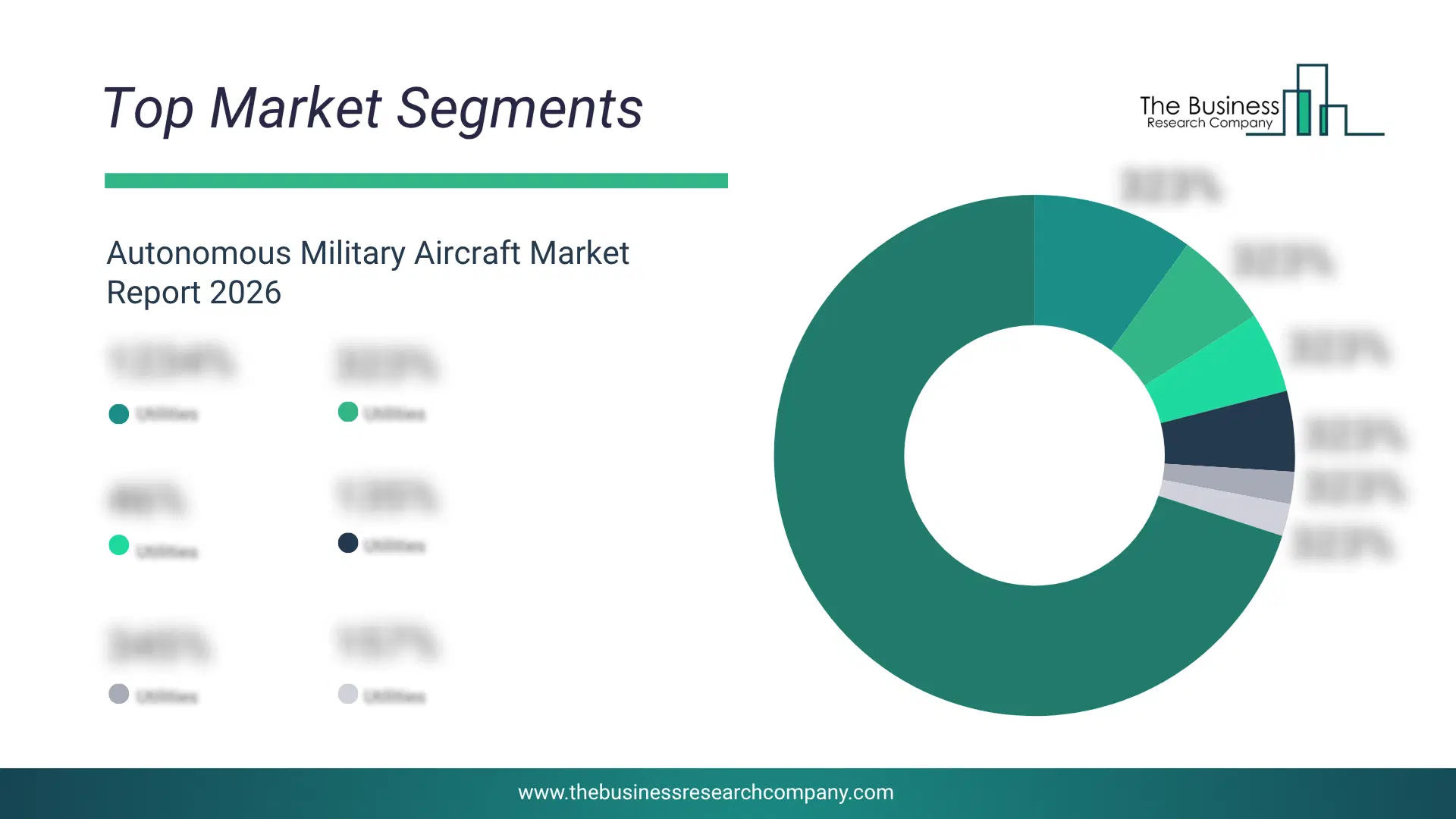
1) By Type: Fighter Aircrafts, Bombers, Reconnaissance And Surveillance Aircrafts, Airborne Early Warning Aircrafts, Others 2) By Component: Flight Management Computers, Air Data Inertial Reference Units, Sensors, Actuation Systems, Software, Intelligent Servos, Cameras, Radars And Transponders, Propulsion Systems 3) By Technology: Remotely Operated, Semi-Autonomous, Autonomous Subsegments: 1) By Fighter Aircrafts: Autonomous Combat Aircraft, Unmanned Combat Aerial Vehicles (UCAVs) 2) By Bombers: Autonomous Strategic Bombers, Autonomous Tactical Bombers 3) By Reconnaissance And Surveillance Aircrafts: Autonomous Reconnaissance Drones, Surveillance UAVs (Unmanned Aerial Vehicles) 4) By Airborne Early Warning Aircrafts: Autonomous AWACS (Airborne Warning and Control System), Autonomous AEWAndC (Airborne Early Warning And Control) Aircraft 5) By Others: Autonomous Tankers, Autonomous Transport Aircraft, Autonomous Electronic Warfare AircraftWhat Is Driver Of The Autonomous Military Aircraft Market?
The growing demand for unmanned aerial vehicles (UAVs) is expected to propel the growth of the autonomous military aircraft market going forward. Unmanned aerial vehicles (UAVs) refer to aircraft that operate without a human pilot onboard and can be controlled remotely or fly autonomously using onboard systems. The adoption of UAVs is increasing due to their ability to perform surveillance, reconnaissance, and combat missions without risking human lives, offering significant advantages in modern warfare. The increasing demand for unmanned aerial vehicles (UAVs) supports the growth of autonomous military aircraft by driving the development and deployment of advanced, pilotless systems that can efficiently perform surveillance, reconnaissance, and combat operations while minimizing risks to human personnel. For instance, in June 2025, according to the Ministry of Defence, a UK-based government ministry, in 2025, the UK is investing a record £350 million (about $473 million USD) to boost Ukraine’s drone supply, with the aim of increasing the number of drones sent from 10,000 in 2024 to 100,000 in 2025. Therefore, the growing demand for unmanned aerial vehicles (UAVs) is driving the growth of the autonomous military aircraft industry.Key Players In The Global Autonomous Military Aircraft Market
Major companies operating in the autonomous military aircraft market are The Boeing Company, Lockheed Martin Corporation, GE Aviation, Northrop Grumman Corporation, BAE Systems plc, Israel Aerospace Industries Ltd. (IAI), Elbit Systems Ltd., Dassault Aviation S.A., Denel Dynamics (Pty) Ltd, Airbus SE, United Technologies Corporation, General Dynamics Corporation, Raytheon Technologies Corporation, Safran S.A., Rolls-Royce Holdings plc, China Aerospace Science and Technology Corporation, Kratos Defense & Security Solutions Inc., Textron Inc., Anduril Industries, Shield AI Inc., Thales Group, Cobham Limited, QinetiQ Group plc, Endeavor Robotics (formerly known as iRobot Defense and Security), AeroVironment Inc., General Atomics Aeronautical Systems Inc., Aurora Flight Sciences a Boeing Company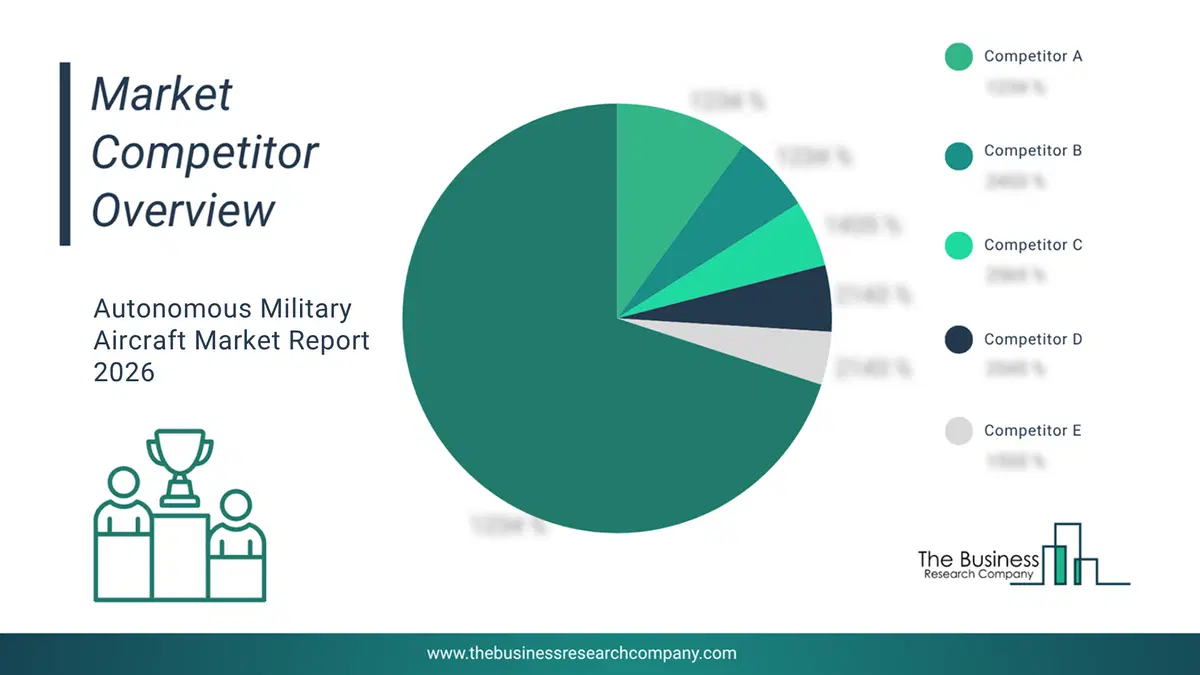
This chart is for illustrative purposes; the full report includes a detailed competitor analysis and comprehensive overview of the top 10 companies in the market.
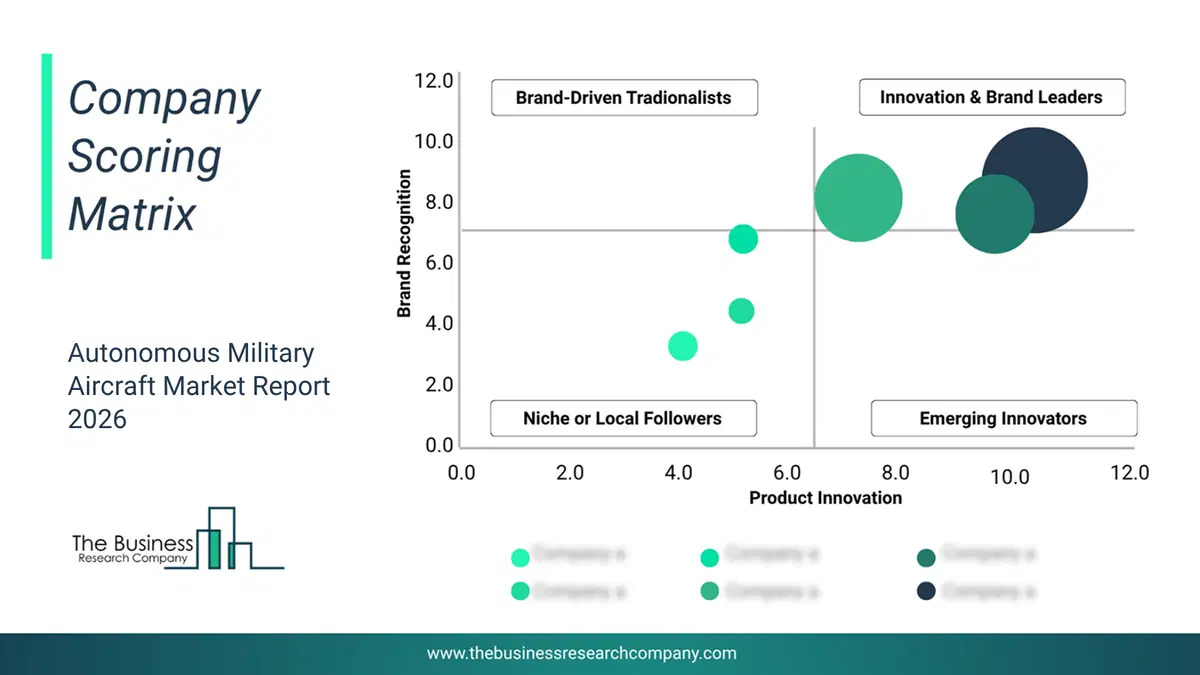
This chart maps companies by product innovation and brand strength, with bubble size indicating relative revenue, helping identify market leaders, challengers, and niche players. This is an illustrative chart; the full report provides a complete and accurate competitive analysis.
Global Autonomous Military Aircraft Market Trends and Insights
Major companies operating in the autonomous military aircraft market are focusing on developing advanced solutions, such as drone swarming technology, to enhance conventional deterrence in modern warfare. Drone swarming technology refers to the use of multiple autonomous or semi-autonomous drones that operate in coordination with each other to accomplish a shared goal or mission. For instance, in October 2023, Shield AI, a US-based aerospace and defense company, launched V-BAT Teams, a new product designed to enable multiple V-BAT unmanned aircraft systems (UAS) to operate autonomously in electronically contested environments. It offers unique features such as autonomous mission execution, real-time adaptation to adversaries, and cost-effective scalability for enhanced operational effectiveness in contested environments.What Are Latest Mergers And Acquisitions In The Autonomous Military Aircraft Market? Anduril Industries Acquisition Of Blue Force Technologies
In September 2023, Anduril Industries Inc., a US-based manufacturer of autonomous systems, acquired Blue Force Technologies for an undisclosed amount. With the acquisition, Anduril is expected to expand and strengthen its existing autonomous capabilities into the Group 5 autonomous aircraft space. Blue Force Technologies, a US-based manufacturer of autonomous aircraft.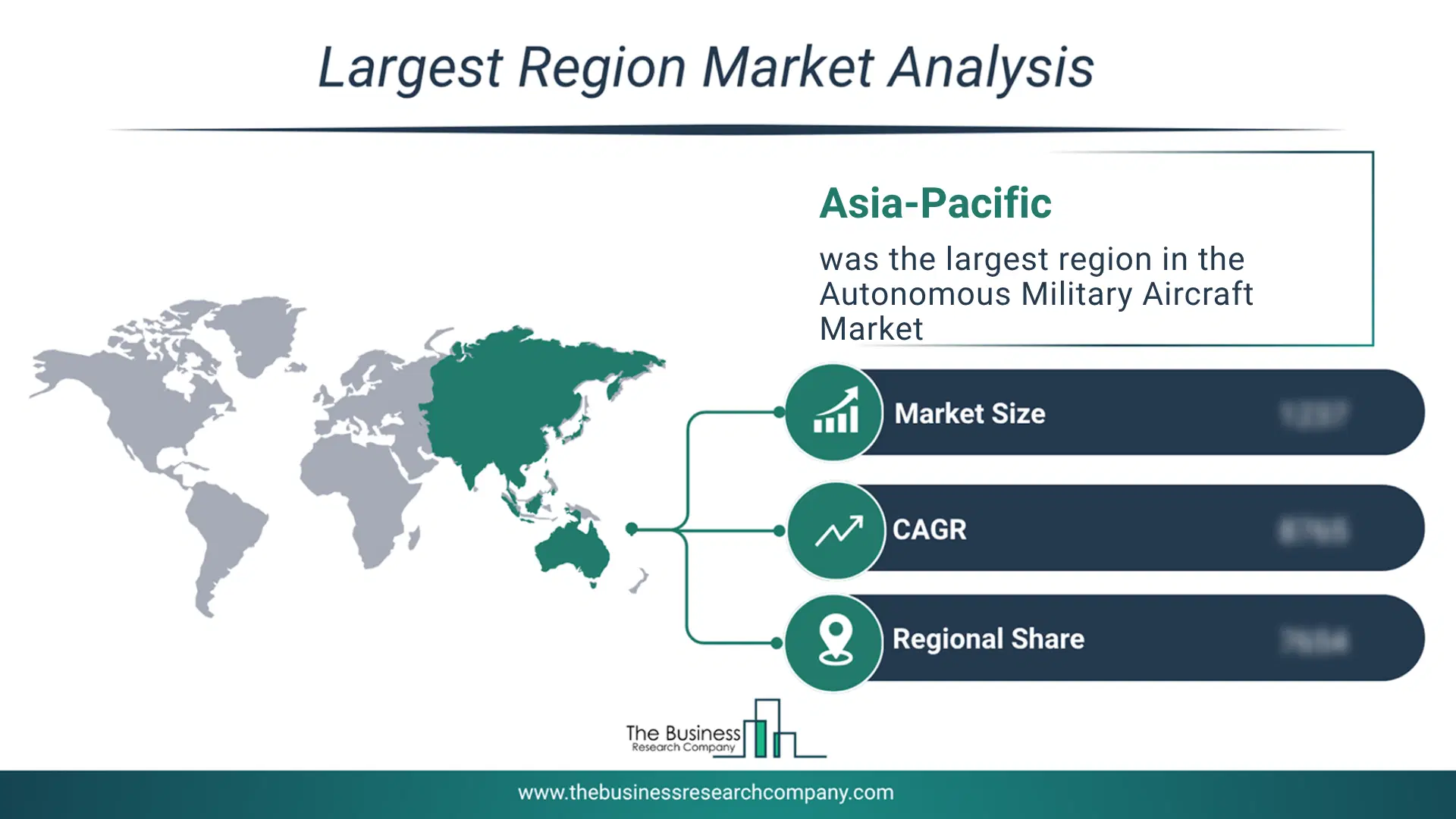
Regional Insights
Asia-Pacific was the largest region in autonomous military aircraft market in 2025. Western Europe is expected to be the fastest-growing region in the autonomous military aircraft market during the forecast period. The regions covered in this market report are Asia-Pacific, South East Asia, Western Europe, Eastern Europe, North America, South America, Middle East, Africa. The countries covered in this market report are Australia, Brazil, China, France, Germany, India, Indonesia, Japan, Taiwan, Russia, South Korea, UK, USA, Canada, Italy, SpainWhat Defines the Autonomous Military Aircraft Market?
The autonomous military aircraft market consists of sales of automatic aerial vehicles such as autonomous fighters for military applications to carry weapons and destroy the targets. Values in this market are factory gate values, that is the value of goods sold by the manufacturers or creators of the goods, whether to other entities (including downstream manufacturers, wholesalers, distributors, and retailers) or directly to end customers. The value of goods in this market includes related services sold by the creators of the goods.How is Market Value Defined and Measured?
The market value is defined as the revenues that enterprises gain from the sale of goods and/or services within the specified market and geography through sales, grants, or donations in terms of the currency (in USD unless otherwise specified). The revenues for a specified geography are consumption values that are revenues generated by organizations in the specified geography within the market, irrespective of where they are produced. It does not include revenues from resales along the supply chain, either further along the supply chain or as part of other products.
This chart presents market attractiveness based on a quantitative evaluation of growth, competition, strategic alignment, and risk, offering a clear view of opportunity areas for decision-making. This chart is for illustrative purposes; the full report contains the complete analysis.

This chart highlights the Total Addressable Market (TAM) by estimating the maximum revenue opportunity using an assumption-driven approach, supporting strategic planning and opportunity sizing across markets. The chart is illustrative; the full report provides a more comprehensive analysis.
What Key Data and Analysis Are Included in the Autonomous Military Aircraft Market Report 2026?
The autonomous military aircraft market research report is one of a series of new reports from The Business Research Company that provides market statistics, including industry global market size, regional shares, competitors with the market share, detailed market segments, market trends and opportunities, and any further data you may need to thrive in the autonomous military aircraft industry. The market research report delivers a complete perspective of everything you need, with an in-depth analysis of the current and future state of the industry.Autonomous Military Aircraft Market Report Forecast Analysis
| Report Attribute | Details |
|---|---|
| Market Size Value In 2026 | $4.94 billion |
| Revenue Forecast In 2030 | $6.54 billion |
| Growth Rate | CAGR of 7.3% from 2026 to 2030 |
| Base Year For Estimation | 2025 |
| Actual Estimates/Historical Data | 2020-2025 |
| Forecast Period | 2026 - 2030 |
| Market Representation | Revenue in USD Billion and CAGR from 2026 to 2030 |
| Segments Covered | Type, Component, Technology |
| Regional Scope | Asia-Pacific, Western Europe, Eastern Europe, North America, South America, Middle East, Africa |
| Country Scope | The countries covered in the autonomous military aircraft market report are Australia, Brazil, China, France, Germany, India, Indonesia, Japan, Taiwan, Russia, South Korea, UK, USA, Canada, Italy, Spain |
| Key Companies Profiled | The Boeing Company, Lockheed Martin Corporation, GE Aviation, Northrop Grumman Corporation, BAE Systems plc, Israel Aerospace Industries Ltd. (IAI), Elbit Systems Ltd., Dassault Aviation S.A., Denel Dynamics (Pty) Ltd, Airbus SE, United Technologies Corporation, General Dynamics Corporation, Raytheon Technologies Corporation, Safran S.A., Rolls-Royce Holdings plc, China Aerospace Science and Technology Corporation, Kratos Defense & Security Solutions Inc., Textron Inc., Anduril Industries, Shield AI Inc., Thales Group, Cobham Limited, QinetiQ Group plc, Endeavor Robotics (formerly known as iRobot Defense and Security), AeroVironment Inc., General Atomics Aeronautical Systems Inc., Aurora Flight Sciences a Boeing Company |
| Customization Scope | Request for Customization |
| Pricing And Purchase Options | Explore Purchase Options |