
Airport Robots Market Report 2026
Global Outlook – By Type (Humanoid, Non-Humanoid), By Application (Landside, Terminal), By End User (Airport Security, Boarding Pass Scanning, Airport Baggage Handling System, Passenger Guidance, Other End Users) – Market Size, Trends, Strategies, and Forecast to 2030
Airport Robots Market Overview
• Airport Robots market size has reached to $1.7 billion in 2025 • Expected to grow to $3.67 billion in 2030 at a compound annual growth rate (CAGR) of 16.7% • Growth Driver: Rising Passenger Numbers Fuel The Expansion Of Airport Robot Adoption • Market Trend: Automation-Driven Solutions For Modern Airport Emergency Response • North America was the largest region in 2025 and Asia-Pacific is the fastest growing region.What Is Covered Under Airport Robots Market?
Airport robots are devices built to carry out various duties at an airport, including helping travelers with their baggage, offering information and directions, and doing security checks. Airport robots are used for various tasks such as towing airplanes, passenger assistance, baggage handling, and other applications. The main types of airport robots include humanoid and non-humanoid. A humanoid is a robot that resembles humans in appearance and is programmed to perform the tasks of humans. They are used in applications such as landslide and terminal in end-users including airport security, boarding pass scanning, airport baggage handling system, passenger guidance and other end-users.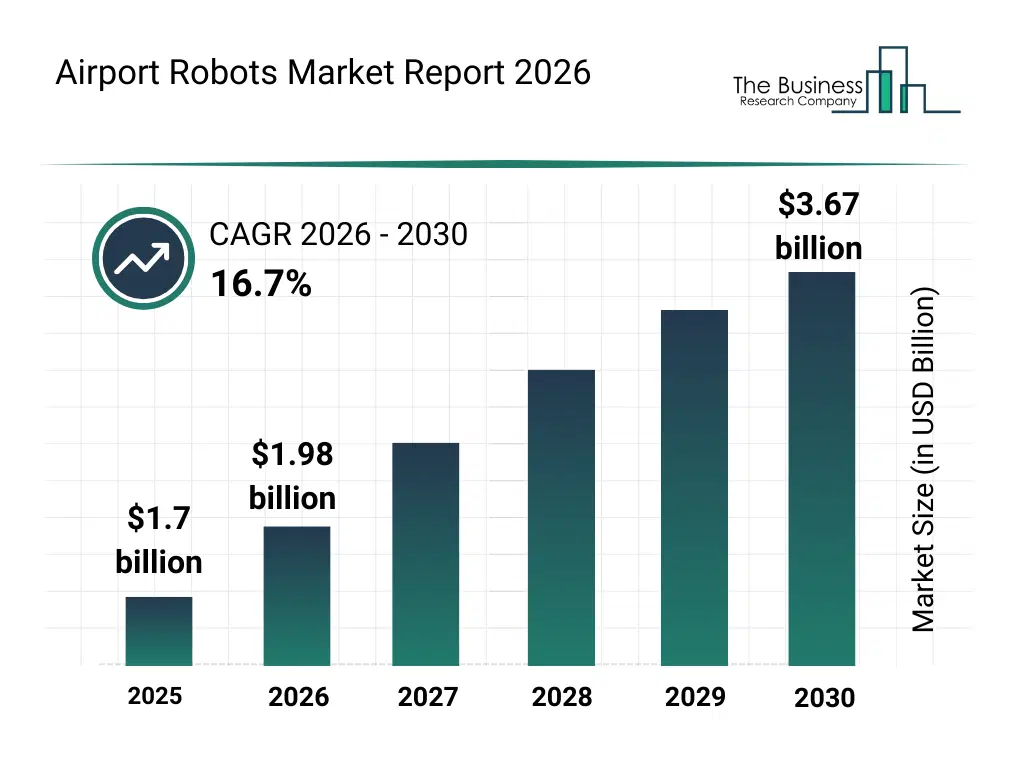
What Is The Airport Robots Market Size and Share 2026?
The airport robots market size has grown rapidly in recent years. It will grow from $1.7 billion in 2025 to $1.98 billion in 2026 at a compound annual growth rate (CAGR) of 16.8%. The growth in the historic period can be attributed to early adoption of airport robots to enhance passenger assistance and streamline airport operations, growing use of automated tugs for towing airplanes and supporting ground logistics, rising deployment of greeter devices to provide navigation and information services, expansion of baggage handling automation requiring robotic support, increasing adoption of cleaning robots to maintain hygiene in high-traffic airport areas.What Is The Airport Robots Market Growth Forecast?
The airport robots market size is expected to see rapid growth in the next few years. It will grow to $3.67 billion in 2030 at a compound annual growth rate (CAGR) of 16.7%. The growth in the forecast period can be attributed to growing demand for multilingual passenger guidance and language translation robot services, increasing integration of ai and machine learning to enhance autonomous airport robot functions, rising investment in valet and personal assistance robots to improve passenger experience, expansion of smart airport initiatives driving wider deployment of robotic systems, technological advancements enabling safer, more efficient, and collaborative airport robot operations. Major trends in the forecast period include increased adoption of automated airport tugs and greeters, enhanced passenger experience through robotics assistance, integration of security and surveillance capabilities in robots, growing demand for cleaning and sanitation robots in airports, expansion of airport robot services to regional and smaller airports.
Global Airport Robots Market Segmentation
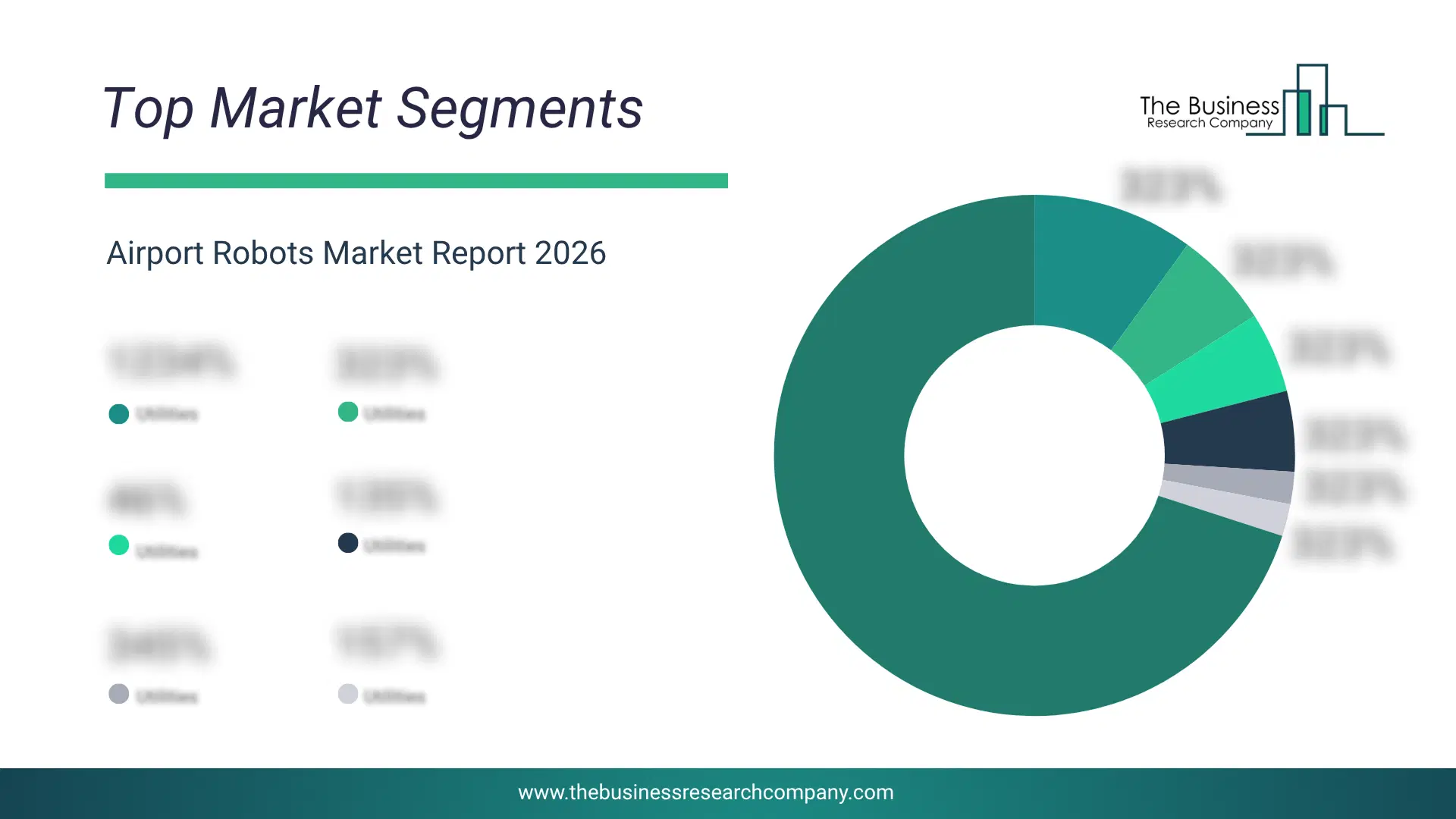
1) By Type: Humanoid, Non-Humanoid 2) By Application: Landside, Terminal 3) By End User: Airport Security, Boarding Pass Scanning, Airport Baggage Handling System, Passenger Guidance, Other End Users Subsegments: 1) By Humanoid: Service Robots, Security Robots 2) By Non-Humanoid: Baggage Handling Robots, Cleaning Robots, Delivery RobotsWhat Is Driver Of The Airport Robots Market?
Increasing passengers for air travel is expected to propel the growth of the airport robot market going forward. Air passengers refer to people who travel by air on commercial airlines or private aircraft for a variety of reasons. Airport robots play a crucial role in enhancing passengers' experiences by providing efficient and contactless services, such as delivering goods directly to gates, streamlining processes, and contributing to an overall improved travel journey. For instance, in December 2024, according to the Eurostat, a Luxembourg-based government agency, in 2023, a total of 973 million passengers traveled by air within the EU, representing a 19.3% increase compared with 2022, when 816 million passengers were recorded. The data indicate that every EU member state experienced an increase in air passenger numbers compared with the previous year. Therefore, increasing passengers for air travel is driving the growth of the airport robot industry.Key Players In The Global Airport Robots Market
Major companies operating in the airport robots market are ABB Ltd., Avidbots Corp., Cyberdyne Inc., ECA Group, LG Corporation, SITA, SoftBank Group Corp., UVD Robots, Advanced Navigation and Positioning Corporation, Elenium Automation Pty Ltd., Fives Group, GreyOrange Pte. Ltd., Honeywell International Inc., NEC Corporation, Secom Co. Ltd., Vanderlande Industries B.V., Stanley Robotics, YUJIN ROBOT Co. Ltd., Aero Sentinel, Airport Robotics, Omron Corporation, RoboCV LLC, Aviabotics, Blue Ocean Robotics, Boston Dynamics, Clearpath Robotics, Simbe Robotics, F Robotics AG, Incheon International Airport Corporation, Knightscope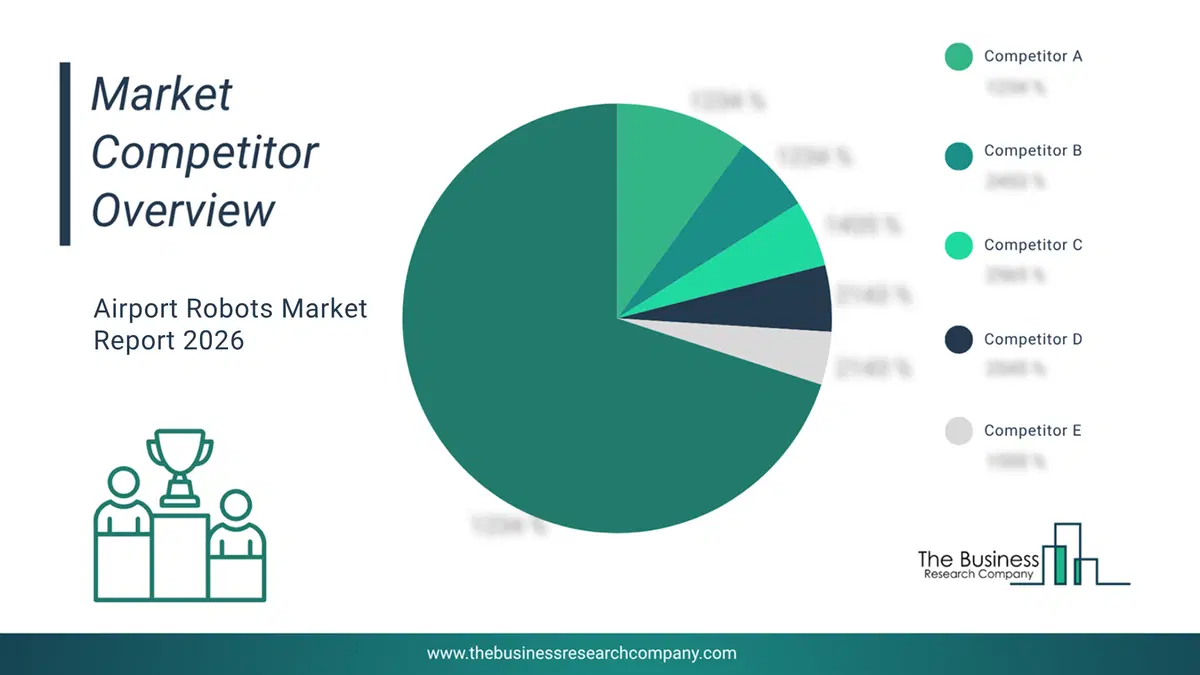
This chart is for illustrative purposes; the full report includes a detailed competitor analysis and comprehensive overview of the top 10 companies in the market.
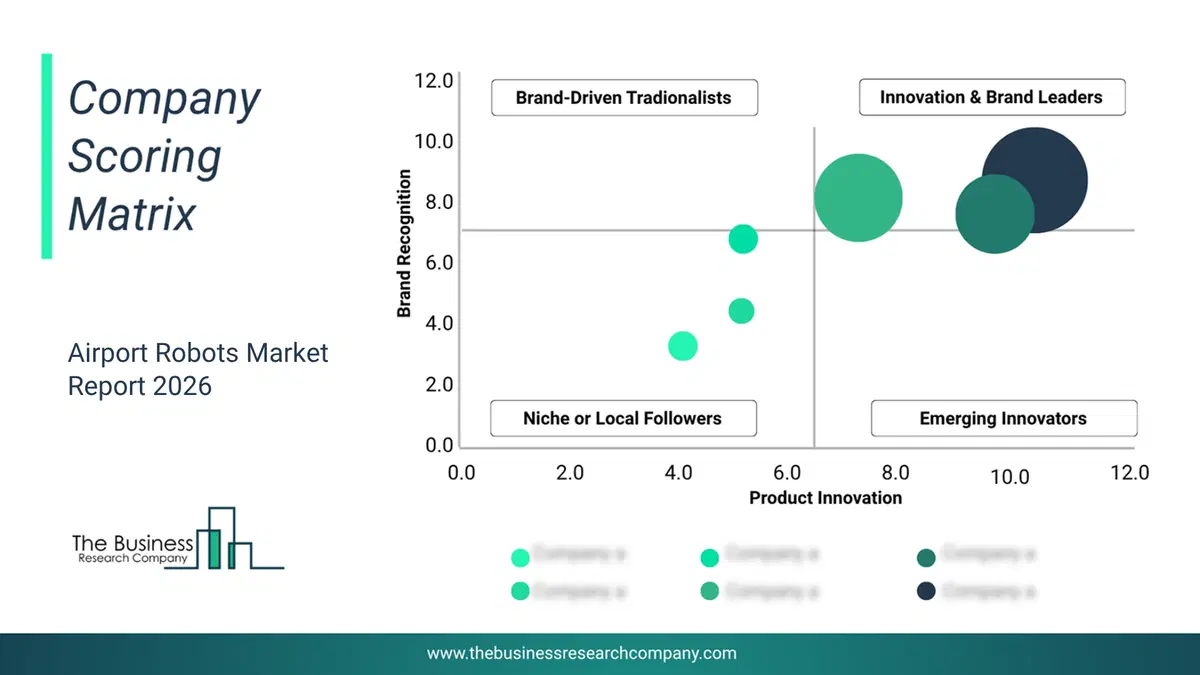
This chart maps companies by product innovation and brand strength, with bubble size indicating relative revenue, helping identify market leaders, challengers, and niche players. This is an illustrative chart; the full report provides a complete and accurate competitive analysis.
Global Airport Robots Market Trends and Insights
Major companies operating in the airport robots market are focusing on developing innovative products such as advanced firefighting and rescue robots to enhance safety, efficiency, and automation in airport operations. Advanced firefighting and rescue robots are remote-controlled, heat-resistant machines equipped with cameras and sensors to detect hazards, suppress fires, and perform high-risk rescues, helping reduce human exposure to danger and improve response speed and operational efficiency. For instance, in June 2025, Cochin International Airport Ltd (Cial), an India-based airport operator, introduced a next-generation firefighting robot as part of its Airport Rescue and Fire Fighting (ARFF) initiatives. The robot features a durable chassis for high-temperature resistance, remote control operation, integrated cameras for surveillance, and flexible maneuverability across complex airport terrains. Its applications include fire suppression, high-risk rescue missions, and hazard monitoring, significantly reducing human exposure to danger and improving operational efficiency.What Are Latest Mergers And Acquisitions In The Airport Robots Market? HL Robotics SAS Acquires Stanley Robotics SAS To Expand Autonomous Parking Solutions
In October 2024, HL Robotics SAS, a France-based robotics company, acquired Stanley Robotics SAS for an undisclosed amount. With this acquisition, HL Robotics aims to strengthen its position in the autonomous parking market and expand its robotic solutions portfolio by integrating Stanley Robotics’ expertise in autonomous valet parking, including its advanced Fleet Management System, intelligent automatic charging capabilities, and proven deployments in European and North American markets, so it can accelerate development of autonomous parking technologies, scale robotic solutions to meet growing urban mobility demands, and offer innovative automated parking and logistics solutions worldwide. Stanley Robotics SAS is a France-based deep tech company that specializes in providing airport robots.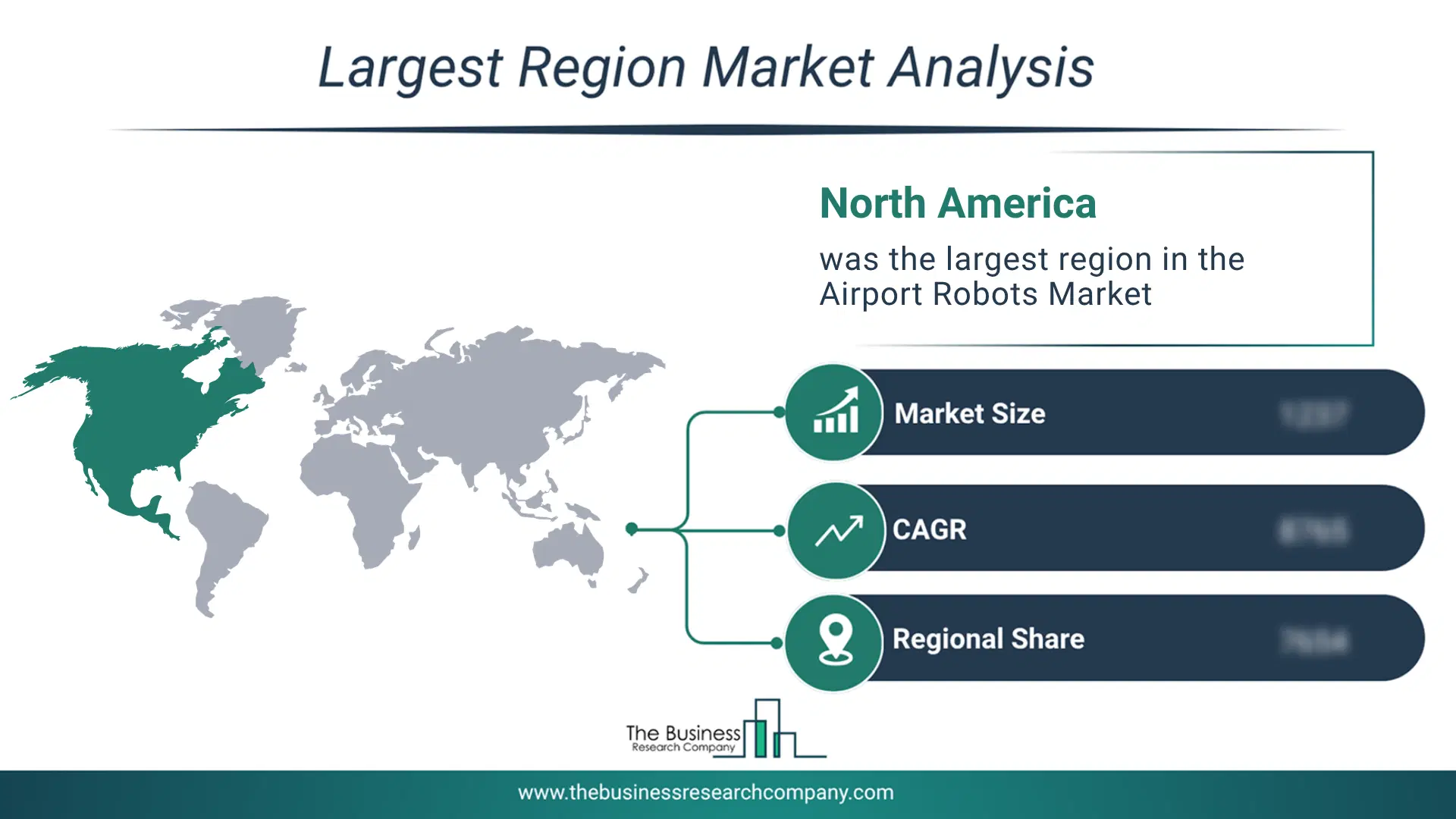
Regional Insights
North America was the largest region in the airport robots market in 2025.Asia-Pacific is expected to be the fastest-growing region in the global airport robot market report during the forecast period. The regions covered in this market report are Asia-Pacific, South East Asia, Western Europe, Eastern Europe, North America, South America, Middle East, Africa. The countries covered in this market report are Australia, Brazil, China, France, Germany, India, Indonesia, Japan, Taiwan, Russia, South Korea, UK, USA, Canada, Italy, SpainWhat Defines the Airport Robots Market?
The airport robots market consists of revenues earned by entities by providing passenger guidance services, language translation services and personal assistance services. The market value includes the value of related goods sold by the service provider or included within the service offering. The airport robots market also includes sales of automated tug, greeter devices, valet cars, and cleaning robots which are used in providing airport robot services. Values in this market are ‘factory gate’ values, that is, the value of goods sold by the manufacturers or creators of the goods, whether to other entities (including downstream manufacturers, wholesalers, distributors and retailers) or directly to end customers. The value of goods in this market includes related services sold by the creators of the goods.How is Market Value Defined and Measured?
The market value is defined as the revenues that enterprises gain from the sale of goods and/or services within the specified market and geography through sales, grants, or donations in terms of the currency (in USD unless otherwise specified). The revenues for a specified geography are consumption values that are revenues generated by organizations in the specified geography within the market, irrespective of where they are produced. It does not include revenues from resales along the supply chain, either further along the supply chain or as part of other products.
This chart presents market attractiveness based on a quantitative evaluation of growth, competition, strategic alignment, and risk, offering a clear view of opportunity areas for decision-making. This chart is for illustrative purposes; the full report contains the complete analysis.

This chart highlights the Total Addressable Market (TAM) by estimating the maximum revenue opportunity using an assumption-driven approach, supporting strategic planning and opportunity sizing across markets. The chart is illustrative; the full report provides a more comprehensive analysis.
What Key Data and Analysis Are Included in the Airport Robots Market Report 2026?
The airport robots market research report is one of a series of new reports from The Business Research Company that provides market statistics, including industry global market size, regional shares, competitors with the market share, detailed market segments, market trends and opportunities, and any further data you may need to thrive in the airport robots industry. The market research report delivers a complete perspective of everything you need, with an in-depth analysis of the current and future state of the industry.Airport Robots Market Report Forecast Analysis
| Report Attribute | Details |
|---|---|
| Market Size Value In 2026 | $1.98 billion |
| Revenue Forecast In 2030 | $3.67 billion |
| Growth Rate | CAGR of 16.7% from 2026 to 2030 |
| Base Year For Estimation | 2025 |
| Actual Estimates/Historical Data | 2020-2025 |
| Forecast Period | 2026 - 2030 |
| Market Representation | Revenue in USD Billion and CAGR from 2026 to 2030 |
| Segments Covered | Type, Application, End User |
| Regional Scope | Asia-Pacific, Western Europe, Eastern Europe, North America, South America, Middle East, Africa |
| Country Scope | The countries covered in the airport robots market report are Australia, Brazil, China, France, Germany, India, Indonesia, Japan, Taiwan, Russia, South Korea, UK, USA, Canada, Italy, Spain |
| Key Companies Profiled | ABB Ltd., Avidbots Corp., Cyberdyne Inc., ECA Group, LG Corporation, SITA, SoftBank Group Corp., UVD Robots, Advanced Navigation and Positioning Corporation, Elenium Automation Pty Ltd., Fives Group, GreyOrange Pte. Ltd., Honeywell International Inc., NEC Corporation, Secom Co. Ltd., Vanderlande Industries B.V., Stanley Robotics, YUJIN ROBOT Co. Ltd., Aero Sentinel, Airport Robotics, Omron Corporation, RoboCV LLC, Aviabotics, Blue Ocean Robotics, Boston Dynamics, Clearpath Robotics, Simbe Robotics, F Robotics AG, Incheon International Airport Corporation, Knightscope |
| Customization Scope | Request for Customization |
| Pricing And Purchase Options | Explore Purchase Options |