

Allergy Point-Of-Care Testing Market Report 2026
Global Outlook – By Product Type (Rapid Specific Immunoglobulin E Kits, Skin Prick Testing Kits, Rapid Anaphylaxis Kits, Sample Collection Devices, Analyzers), By Sample Type (Blood, Serum Or Plasma, Fingerstick Whole Blood), By Allergen Type (Food Allergens, Environmental Allergens, Drug And Insect Venom Allergens), By Application Focus (Primary Care Triage, Pediatric Clinic Workups, Emergency Care Support, Occupational Health Screening, Pharmacy Led Testing), By End User (Specialty Clinics, Hospitals, Retail Pharmacies, Occupational Health Providers, Direct To Consumer) – Market Size, Trends, Strategies, and Forecast to 2035
Allergy Point-Of-Care Testing Market Overview
• Allergy Point-Of-Care Testing market size has reached to $1.33 billion in 2025 • Expected to grow to $2.34 billion in 2030 at a compound annual growth rate (CAGR) of 12% • Growth Driver: Increasing Prevalence Of Allergic Conditions Driving The Market Growth Due To Rising Need For Rapid Diagnosis And Management • Market Trend: Technological Progress Streamlines Allergy Diagnosis And Patient Care • North America was the largest region in 2025 and Asia-Pacific is the fastest growing region.What Is Covered Under Allergy Point-Of-Care Testing Market?
Allergy point-of-care testing refers to rapid diagnostic procedures performed at or near the site of patient evaluation to detect allergic sensitizations. These tests provide immediate results by measuring specific immunoglobulin E (IgE) antibodies or other biomarkers related to allergic reactions. They enable timely clinical decision-making and management of allergic conditions without the need for centralized laboratory processing. The main product types of allergy point-of-care testing include rapid specific immunoglobulin e kits, skin prick testing kits, rapid anaphylaxis kits, sample collection devices, and analyzers. Rapid specific immunoglobulin e kits refer to diagnostic tools used to detect allergen-specific antibodies in patient samples for quick allergy identification. These products are designed for sample types including blood, serum or plasma, and fingerstick whole blood and are used for allergen types such as food allergens, environmental allergens, and drug and insect venom allergens. The various applications involved are primary care triage, pediatric clinic workups, emergency care support, occupational health screening, and pharmacy led testing, and they are used by several end users such as specialty clinics, hospitals, retail pharmacies, occupational health providers, and direct to consumer.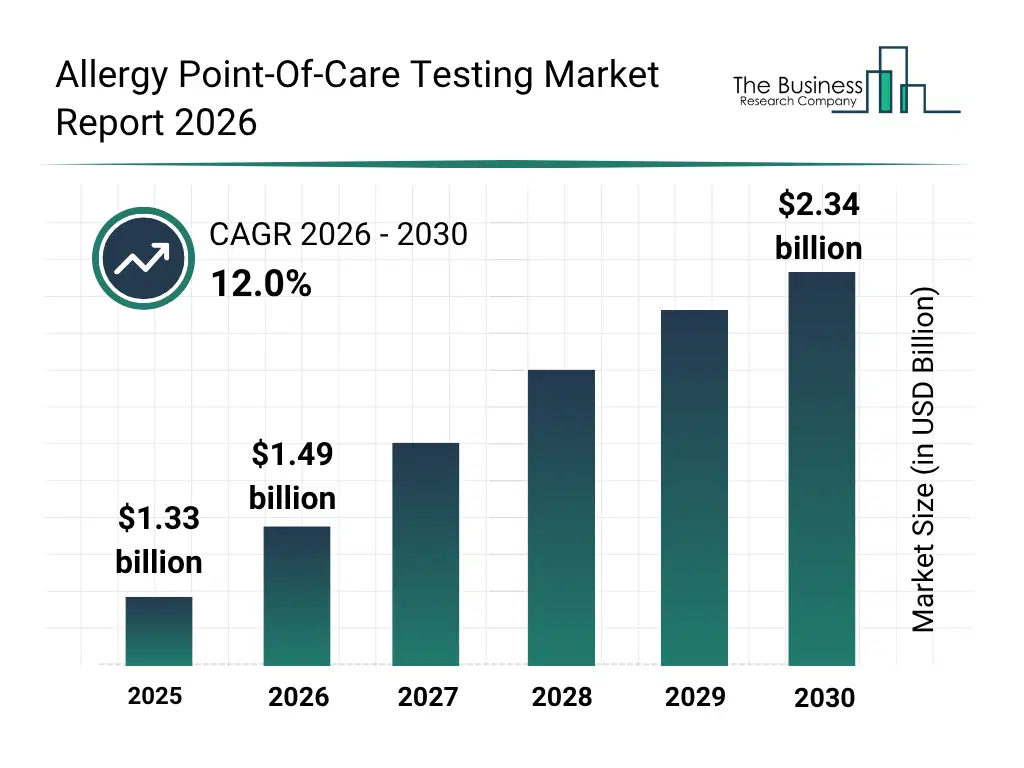
What Is The Allergy Point-Of-Care Testing Market Size and Share 2026?
The allergy point-of-care testing market size has grown rapidly in recent years.It will grow from $1.33 billion in 2025 to $1.49 billion in 2026 at a compound annual growth rate (CAGR) of 11.8%. The growth in the historic period can be attributed to rising prevalence of allergic disorders globally, increasing clinical awareness of early allergy diagnosis, expansion of immunoassay technologies in diagnostics, growth in hospital based laboratory testing infrastructure, increasing pediatric allergy cases.What Is The Allergy Point-Of-Care Testing Market Growth Forecast?
The allergy point-of-care testing market size is expected to see rapid growth in the next few years.It will grow to $2.34 billion by 2030 at a compound annual growth rate (CAGR) of 12.0%. The growth in the forecast period can be attributed to expansion of point of care diagnostic adoption, growth in personalized medicine approaches for allergy management, increasing demand for rapid home based testing solutions, integration of ai enabled diagnostic interpretation tools, rising healthcare decentralization and outpatient care expansion.Major trends in the forecast period include increasing adoption of rapid immunoglobulin e based allergy diagnostics, rising demand for portable point of care testing devices, expansion of decentralized allergy screening in primary care settings, growth in immunoassay based rapid allergy detection kits, increasing integration of digital health platforms in allergy testing workflows.
Global Allergy Point-Of-Care Testing Market Segmentation
1) By Product Type: Rapid Specific Immunoglobulin E Kits, Skin Prick Testing Kits, Rapid Anaphylaxis Kits, Sample Collection Devices, Analyzers 2) By Sample Type: Blood, Serum Or Plasma, Fingerstick Whole Blood 3) By Allergen Type: Food Allergens, Environmental Allergens, Drug And Insect Venom Allergens 4) By Application Focus: Primary Care Triage, Pediatric Clinic Workups, Emergency Care Support, Occupational Health Screening, Pharmacy Led Testing 5) By End User: Specialty Clinics, Hospitals, Retail Pharmacies, Occupational Health Providers, Direct To Consumer Subsegments: 1) By Rapid Specific Immunoglobulin E Kits: Food Allergy Kits, Inhalant Allergy Kits, Drug Allergy Kits, Environmental Allergy Kits 2) By Skin Prick Testing Kits: Standard Allergen Panels, Custom Allergen Panels, Pediatric Testing Kits, Adult Testing Kits 3) By Rapid Anaphylaxis Kits: Epinephrine Auto Injectors, Immediate Reaction Detection Kits, Allergic Response Monitoring Kits, Emergency Response Kits 4) By Sample Collection Devices: Blood Collection Devices, Saliva Collection Devices, Skin Prick Sampling Devices, Capillary Sampling Devices 5) By Analyzers: Immunoassay Analyzers, Chemiluminescence Analyzers, Integrated Analyzer Systems, Portable Point Of Care AnalyzersWhat Are The Drivers Of The Allergy Point-Of-Care Testing Market?
The increasing prevalence of allergic conditions is expected to propel the growth of the allergy point of care testing market going forward.Allergic conditions are immune system disorders in which the body overreacts to harmless substances, leading to symptoms such as sneezing, rashes, and respiratory distress.The prevalence of allergic conditions is rising due to increased exposure to environmental allergens, such as pollen, dust, and pollution, which trigger immune system overreactions in susceptible individuals.Allergy point‑of‑care testing enables rapid and convenient detection of specific allergens, allowing healthcare providers to quickly identify triggers, guide personalized treatment plans, and help individuals manage and reduce the impact of allergic conditions effectively.For instance, in November 2025, according to Asthma Australia, an Australia-based non-profit organization, 322 women died from asthma last year compared with 156 men, which is more than twice as many.This pattern has remained unchanged since 2023, with half of the 478 total deaths occurring in women aged 75 and over.Therefore, the increasing prevalence of allergic conditions is driving the growth of the allergy point of care testing market. The rising healthcare expenditure is expected to propel the growth of the allergy point-of-care testing industry going forward.Healthcare expenditure refers to the total amount of financial resources spent on health services, medical products, public health initiatives, and healthcare infrastructure by governments, private organizations, and individuals.Healthcare expenditure is growing due to increasing demand for medical services, as more patients require consultations, treatments, and diagnostic tests, which drives higher overall healthcare spending.Healthcare expenditure drives the growth of allergy point-of-care (POC) testing by enabling investment in advanced diagnostic technologies, facilitating rapid testing at or near patient care sites, reducing reliance on centralized laboratories, and improving efficiency and overall healthcare outcomes.For instance, in January 2026, according to the Centers for Medicare & Medicaid Services, a US-based government agency, in 2024, National Health Expenditure (NHE) increased by 7.2% to reach $5.3 trillion, averaging $15,474 per person, and represented 18.0% of the Gross Domestic Product (GDP).Therefore, the rising healthcare expenditure is driving the growth of the allergy point-of-care testing industry.Key Players In The Global Allergy Point-Of-Care Testing Market
Major companies operating in the allergy point-of-care testing market are Siemens Healthineers AG, F. Hoffmann‑La Roche Ltd, Hitachi Chemical Diagnostic Inc., Thermo Fisher Scientific Inc., Abbott Laboratories, Eurofins Scientific SE, bioMérieux SA, Quidel Corporation, EUROIMMUN Medizinische Labordiagnostika AG, R-Biopharm AG, HOB Biotech Group Corp. Ltd., Hycor Biomedical Inc., Omega Diagnostics Ltd, Lincoln Diagnostics Inc., Alerchek Inc., Abionic SA, Kenota Health Inc.Global Allergy Point-Of-Care Testing Market Trends and Insights
Major companies operating in the allergy point-of-care testing market are focusing on developing innovative products such as semi-quantitative point-of-care diagnostic devices to deliver rapid, accurate allergy test results in clinical settings. Semi-quantitative point-of-care diagnostic devices are tools that measure approximate levels of specific biomarkers, such as IgE, directly at the clinic, providing rapid, reliable results that enable healthcare providers to quickly assess the severity of allergic responses and make immediate, informed treatment decisions without waiting for traditional laboratory tests. For instance, in June 2024, Kenota Health, a Canada-based medical technology company, received U. S. Food and Drug Administration (FDA) clearance and a CLIA waiver for the Kenota 1 Total IgE test system, enabling its use in point-of-care clinical settings. The Kenota 1 system is a semi-quantitative diagnostic device that measures total IgE levels from a minimal fingerstick blood sample, delivering results in under 30 minutes with automated operation, unlike traditional laboratory IgE tests that require venous blood draws and several days for results. The system is designed for rapid, in-office allergy assessment, offering features such as a small blood volume requirement of 4. 5 microliters per test, easy-to-use operation, and the capacity to run 15–60 tests per session. Its applications include supporting the diagnosis of IgE-mediated allergic disorders and enabling clinicians to make immediate patient care decisions, streamlining allergy management and improving patient outcomes.Regional Insights
North America was the largest region in the allergy point-of-care testing market in 2025. Asia-Pacific is expected to be the fastest-growing region in the forecast period. The regions covered in this market report are Asia-Pacific, South East Asia, Western Europe, Eastern Europe, North America, South America, Middle East and Africa. The countries covered in this market report are Australia, Brazil, China, France, Germany, India, Indonesia, Japan, Taiwan, Russia, South Korea, UK, USA, Canada, Italy, Spain.What Defines the Allergy Point-Of-Care Testing Market?
The allergy point-of-care testing market consists of revenues earned by entities by providing services such as allergy screening, rapid diagnostic testing, patient sample collection, immunoassay analysis, result interpretation, counseling and consultation, allergy monitoring. The market value includes the value of related goods sold by the service provider or included within the service offering. The allergy point-of-care testing market also includes sales of point-of-care test kits, lancets, test strips, immunoassay devices, blood collection devices, skin prick test devices, lateral flow assay cassettes, analyzers, sample collection tubes, and diagnostic reagents. Values in this market are ‘factory gate’ values, that is the value of goods sold by the manufacturers or creators of the goods, whether to other entities (including downstream manufacturers, wholesalers, distributors and retailers) or directly to end customers. The value of goods in this market includes related services sold by the creators of the goods.What is the Market Assessment and Strategic Outlook for the Allergy Point-Of-Care Testing Industry?
The allergy point-of-care testing market research report is one of a series of new reports from The Business Research Company that provides market statistics, including industry global market size, regional shares, competitors with the market share, detailed market segments, market trends and opportunities, and any further data you may need to thrive in the allergy point-of-care testing industry. The market research report delivers a complete perspective of everything you need, with an in-depth analysis of the current and future state of the industry.What is the Market Assessment and Strategic Outlook for the Allergy Point-Of-Care Testing Market Report 2026?
The allergy point-of-care testing market research report is one of a series of new reports from The Business Research Company that provides allergy point-of-care testing market statistics, including allergy point-of-care testing industry global market size, regional shares, competitors with a allergy point-of-care testing market share, detailed allergy point-of-care testing market segments, market trends and opportunities, and any further data you may need to thrive in the allergy point-of-care testing industry. This allergy point-of-care testing market research report delivers a complete perspective of everything you need, with an in-depth analysis of the current and future scenario of the industry.Allergy Point-Of-Care Testing Market Report Forecast Analysis
| Report Attribute | Details |
|---|---|
| Market Size Value In 2026 | $1.49 billion |
| Revenue Forecast In 2035 | $2.34 billion |
| Growth Rate | CAGR of 12.0% from 2026 to 2035 |
| Base Year For Estimation | 2025 |
| Actual Estimates/Historical Data | 2020-2025 |
| Forecast Period | 2026 - 2030 - 2035 |
| Market Representation | Revenue in USD Billion and CAGR from 2026 to 2035 |
| Segments Covered | Product Type, Sample Type, Allergen Type, Application Focus, End User |
| Regional Scope | Asia-Pacific, Western Europe, Eastern Europe, North America, South America, Middle East, Africa |
| Country Scope | The countries covered in the report are Australia, Brazil, China, France, Germany, India, Indonesia, Japan, Taiwan, Russia, South Korea, UK, USA, Canada, Italy, Spain. |
| Key Companies Profiled | Siemens Healthineers AG, F. Hoffmann‑La Roche Ltd, Hitachi Chemical Diagnostic Inc., Thermo Fisher Scientific Inc., Abbott Laboratories, Eurofins Scientific SE, bioMérieux SA, Quidel Corporation, EUROIMMUN Medizinische Labordiagnostika AG, R-Biopharm AG, HOB Biotech Group Corp. Ltd., Hycor Biomedical Inc., Omega Diagnostics Ltd, Lincoln Diagnostics Inc., Alerchek Inc., Abionic SA, Kenota Health Inc. |
| Customization Scope | Request for Customization |
| Pricing And Purchase Options | Explore Purchase Options |