
Alumina Trihydrate Market Report 2026
Global Outlook – By Type (Ground, Wet, Dry, Precipitate), By Application (Flame Retardant, Filler, Antacid), By End-Use Industry (Plastic, Building and Construction, Paints And Coatings, Pharmaceuticals) – Market Size, Trends, Strategies, and Forecast to 2030
Alumina Trihydrate Market Overview
• Alumina Trihydrate market size has reached to $2.25 billion in 2025 • Expected to grow to $3.03 billion in 2030 at a compound annual growth rate (CAGR) of 6% • Growth Driver: Rising Demand For Flame Retardants From Construction Industry Propels Growth Of Alumina Trihydrate Market • Market Trend: Hindalco's Strategic Investment in Expanding Battery-Grade Aluminum Foil Production to Meet Growing Demand • North America was the largest region in 2025 and Asia-Pacific is the fastest growing region.What Is Covered Under Alumina Trihydrate Market?
Alumina trihydrate refers to a solid, odorless, powdery, and white substance used as a flame retardant and filler in glass, ceramics, inks, detergents, cosmetics, and plastics. This is extracted from bauxite ore using the Bayer process, with an average particle diameter of 80–100 microns. Its primary application is in the production of aluminum metal. The main types of alumina trihydrate are ground, wet, dry, and precipitate. The term ‘ground alumina trihydrate’ refers to ground alumina trihydrate that is used in the paper industry as a whitening agent in place of titanium dioxide and as a filler material, flame retardant, and smoke suppressor. Ground alumina trihydrate is a white crystalline powder with a low impurity content, good stability, uniform particle size, and excellent dispensability. The alumina trihydrate finds its application in flame retardants, fillers, and antacids that are suitable for the plastic, building and construction, paints and coatings, and pharmaceuticals sectors.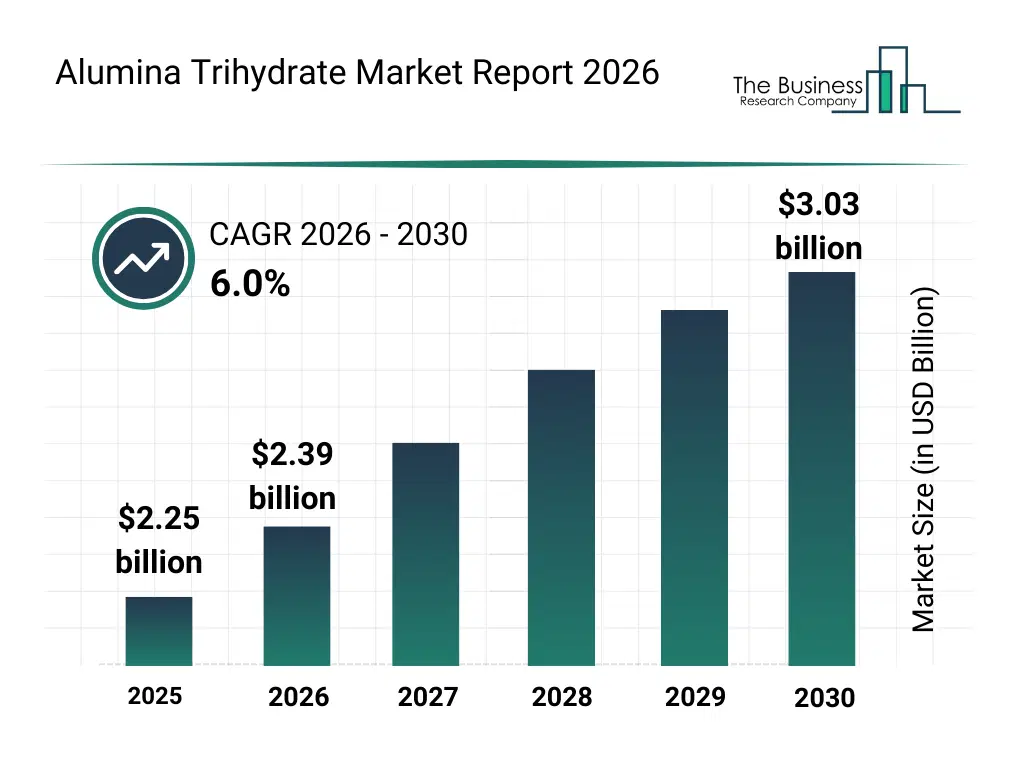
What Is The Alumina Trihydrate Market Size and Share 2026?
The alumina trihydrate market size has grown strongly in recent years. It will grow from $2.25 billion in 2025 to $2.39 billion in 2026 at a compound annual growth rate (CAGR) of 6.4%. The growth in the historic period can be attributed to growth in aluminum production, rising demand for flame retardant materials, expansion of plastics and polymer industries, increased use of fillers in paints and coatings, availability of bauxite reserves and refining capacity.What Is The Alumina Trihydrate Market Growth Forecast?
The alumina trihydrate market size is expected to see strong growth in the next few years. It will grow to $3.03 billion in 2030 at a compound annual growth rate (CAGR) of 6.0%. The growth in the forecast period can be attributed to increasing fire safety regulations across industries, growing demand for halogen-free flame retardants, expansion of construction and infrastructure activities, rising consumption of plastics in electrical and electronic applications, technological advancements in alumina processing. Major trends in the forecast period include rising use of alumina trihydrate as a halogen-free flame retardant, increasing demand for high-purity and fine-particle grades, growing adoption of alumina trihydrate as a functional filler in plastics, expansion of usage in building and construction materials, increasing focus on consistent particle size and product quality.
Global Alumina Trihydrate Market Segmentation
1) By Type: Ground, Wet, Dry, Precipitate 2) By Application: Flame Retardant, Filler, Antacid 3) By End-Use Industry: Plastic, Building and Construction, Paints And Coatings, Pharmaceuticals Subsegments: 1) By Ground: Fine Ground Alumina Trihydrate, Coarse Ground Alumina Trihydrate 2) By Wet: Slurry Form, Suspension Form 3) By Dry: Powdered Form, Granulated Form 4) By Precipitate: Co-Precipitated Alumina Trihydrate, Gel-Derived Alumina TrihydrateWhat Is The Driver Of The Alumina Trihydrate Market?
The rising demand for flame retardants from the construction industry is expected to propel the growth of the alumina trihydrate market. The increasing number of commercial and residential establishments has increased the possibilities of explosions and fire-related accidents. Non-halogenated flame retardants form a protective char in the condensed phase or release free radicals in the event of ignition to slow fire spread. Several countries have made strict fire safety regulations and protocols mandatory. As a result, to meet government regulations, nonflammable retardants are increasingly being used in buildings, thus increasing the demand for alumina trihydrate. For instance, in June 2024, according to TST Europe, a Switzerland-based manufacturer specializing in quick-release couplings and coupling systems, total construction spending in the U.S. reached $1.98 trillion in 2023, reflecting a 7.4% increase from the previous year. The number of construction businesses in the U.S. stood at approximately 745,000 as of 2023. Therefore, the increasing demand for non-halogenated flame retardants is driving the growth of the alumina trihydrate industry.Key Players In The Global Alumina Trihydrate Market
Major companies operating in the alumina trihydrate market report are Aluminum Corporation of China Limited, J.M. Huber Corporation, LKAB Minerals AB, MAL-Hungarian Aluminum Producer and Trading Co., Nabaltec AG, National Aluminium Company Limited, SHOWA DENKO K.K., Sumitomo Chemical Co. Ltd., Jinan Chenxu Chemical Co. Ltd., KC Corporation, Hayashi Kasei Co. Ltd., Dadco Group, Alumina Chemicals & Castables, Hindalco Industries Ltd., Southern Ionics Incorporated, SCR Sibelco NV, R.J. Marshall Company, Alteo, Solvay S.A., Chemtura Corporation, Imerys SA, BASF SE, Eastman Chemical Company
This chart is for illustrative purposes; the full report includes a detailed competitor analysis and comprehensive overview of the top 10 companies in the market.
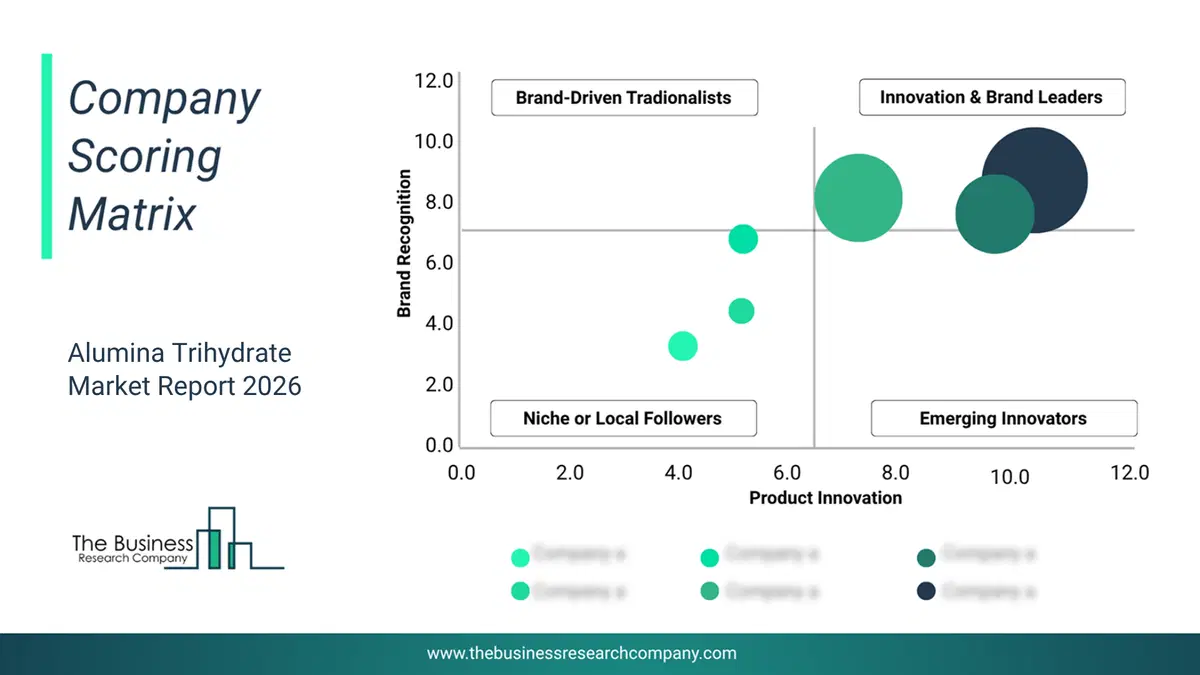
This chart maps companies by product innovation and brand strength, with bubble size indicating relative revenue, helping identify market leaders, challengers, and niche players. This is an illustrative chart; the full report provides a complete and accurate competitive analysis.
Global Alumina Trihydrate Market Trends and Insights
Major companies operating in the alumina trihydrate market are focusing on strategic investments and advanced manufacturing solutions to support the rapidly growing electric vehicle and energy storage sectors. Battery-grade aluminium foil, a critical material for lithium-ion and sodium-ion cells, requires high precision and durability to ensure efficient battery performance and longevity. For instance, in 2023, Hindalco Industries, a India-based mining company, expanding its manufacturing capacity of fine quality aluminium foil. The company is investing Rs. 800 crores to establish a new facility near Sambalpur in Odisha, which will initially produce 25,000 tonnes of resilient material essential for Lithium-ion and Sodium-ion cells. By 2030, the demand for battery-grade aluminum foil in India is projected to increase significantly to 40,000 tonnes, fueled by the rapid expansion of gigafactories focused on advanced cell production.What Are Latest Mergers And Acquisitions In The Alumina Trihydrate Market?
In August 2023, Cimbar Resources Inc., a US-based mining company, acquired Almatis, Inc. specialty alumina manufacturing assets in Rocky Face, GA for an undisclosed amount. The acquisition of the Rocky Face, GA site bolsters Cimbar's alumina trihydrate portfolio, enhancing product quality and supply continuity from multiple locations, ensuring consistent delivery to customers. Almatis, Inc. is a Germany-based chemical manufacturing company specializes in manufacturing alumina trihydrate.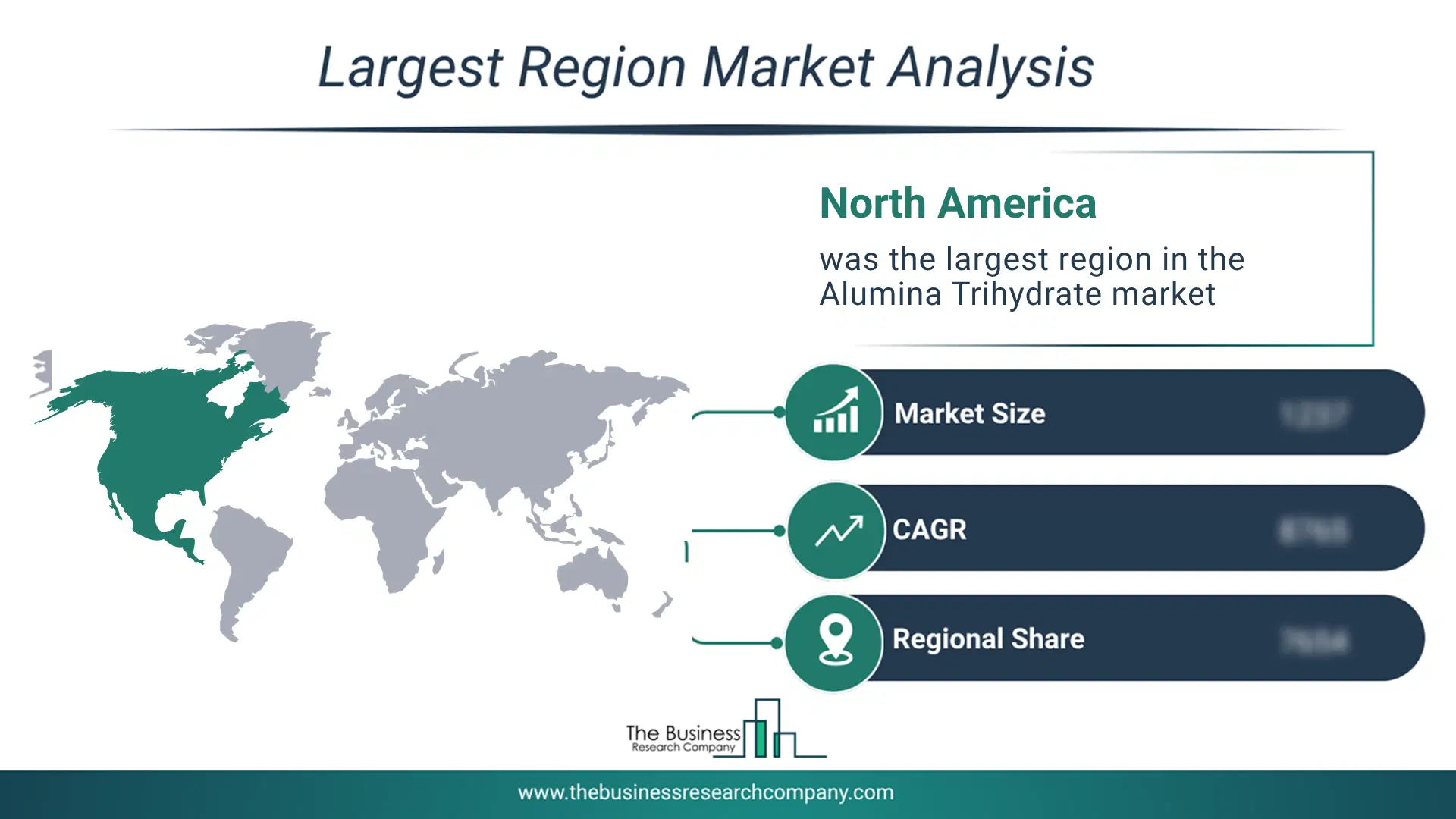
Regional Outlook
North America was the largest region in the alumina trihydrate market in 2025. Asia-Pacific is expected to be the fastest-growing region in the forecast period. The regions covered in the alumina trihydrate market are Asia-Pacific, South East Asia, Western Europe, Eastern Europe, North America, South America, Middle East, Africa. The countries covered in the alumina trihydrate market are Australia, Brazil, China, France, Germany, India, Indonesia, Japan, Taiwan, Russia, South Korea, UK, USA, Canada, Italy, Spain.What Defines the Alumina Trihydrate Market?
The alumina trihydrate market consists of sales of halogen-containing flame retardants, inorganic flame retardants, and phosphorus-containing flame retardants. Values in this market are ‘factory gate’ values, that is, the value of goods sold by the manufacturers or creators of the goods, whether to other entities (including downstream manufacturers, wholesalers, distributors, and retailers) or directly to end customers. The value of goods in this market includes related services sold by the creators of the goods.How is Market Value Defined and Measured?
The market value is defined as the revenues that enterprises gain from the sale of goods and/or services within the specified market and geography through sales, grants, or donations in terms of the currency (in USD unless otherwise specified). The revenues for a specified geography are consumption values that are revenues generated by organizations in the specified geography within the market, irrespective of where they are produced. It does not include revenues from resales along the supply chain, either further along the supply chain or as part of other products.
This chart presents market attractiveness based on a quantitative evaluation of growth, competition, strategic alignment, and risk, offering a clear view of opportunity areas for decision-making. This chart is for illustrative purposes; the full report contains the complete analysis.

This chart highlights the Total Addressable Market (TAM) by estimating the maximum revenue opportunity using an assumption-driven approach, supporting strategic planning and opportunity sizing across markets. The chart is illustrative; the full report provides a more comprehensive analysis.
What Key Data and Analysis Are Included in the Alumina Trihydrate Market Report 2026?
The alumina trihydrate market research report is one of a series of new reports from The Business Research Company that provides market statistics, including Market Report 2026?global market size, regional shares, competitors with the market share, detailed market segments, market trends and opportunities, and any further data you may need to thrive in the alumina trihydrate Market Report 2026? The market research report delivers a complete perspective of everything you need, with an in-depth analysis of the current and future state of the Market Report 2026?Alumina Trihydrate Market Report Forecast Analysis
| Report Attribute | Details |
|---|---|
| Market Size Value In 2026 | $2.39 billion |
| Revenue Forecast In 2030 | $3.03 billion |
| Growth Rate | CAGR of 6.4% from 2026 to 2030 |
| Base Year For Estimation | 2025 |
| Actual Estimates/Historical Data | 2020-2025 |
| Forecast Period | 2026 - 2030 |
| Market Representation | Revenue in USD Billion and CAGR from 2026 to 2030 |
| Segments Covered | Type, Application, End-Use Industry |
| Regional Scope | Asia-Pacific, Western Europe, Eastern Europe, North America, South America, Middle East, Africa |
| Country Scope | The countries covered in the report are Australia, Brazil, China, France, Germany, India, Indonesia, Japan, Taiwan, Russia, South Korea, UK, USA, Canada, Italy, Spain. |
| Key Companies Profiled | Aluminum Corporation of China Limited, J.M. Huber Corporation, LKAB Minerals AB, MAL-Hungarian Aluminum Producer and Trading Co., Nabaltec AG, National Aluminium Company Limited, SHOWA DENKO K.K., Sumitomo Chemical Co. Ltd., Jinan Chenxu Chemical Co. Ltd., KC Corporation, Hayashi Kasei Co. Ltd., Dadco Group, Alumina Chemicals & Castables, Hindalco Industries Ltd., Southern Ionics Incorporated, SCR Sibelco NV, R.J. Marshall Company, Alteo, Solvay S.A., Chemtura Corporation, Imerys SA, BASF SE, Eastman Chemical Company |
| Customization Scope | Request for Customization |
| Pricing And Purchase Options | Explore Purchase Options |