

Anti-Amyloid Antibodies Market Report 2026
Global Outlook – By Product Type (Monoclonal Antibodies, Polyclonal Antibodies, Other Product Types), By Target Type (Amyloid Beta Plaques, Soluble Amyloid Beta Oligomers, Protofibrils, Amyloid Precursors), By Distribution Channel (Direct Sales, Online Pharmacies, Retail Pharmacies, Other Distribution Channels), By Application (Alzheimer’s Disease, Parkinson’s Disease, Amyloidosis, Other Application Types), By End User (Hospitals, Clinics, Research Institutes, Other End Users) – Market Size, Trends, Strategies, and Forecast to 2030
Anti-Amyloid Antibodies Market Overview
• Anti-Amyloid Antibodies market size has reached to $3.27 billion in 2025 • Expected to grow to $6.54 billion in 2030 at a compound annual growth rate (CAGR) of 14.9% • Growth Driver: Rising Prevalence Of Neurodegenerative Disorders Fueling The Growth Of The Market Due To Increasing Demand For Alzheimer’s Disease Management Therapies • Market Trend: Regulatory Approvals For Anti-Amyloid Antibodies Expand Treatment Options For Alzheimer’s Disease • North America was the largest region in 2025 and Asia-Pacific is the fastest growing region.What Is Covered Under Anti-Amyloid Antibodies Market?
Anti-amyloid antibodies refer to monoclonal antibodies or immunotherapeutic agents designed to target amyloid proteins, particularly amyloid-beta (Aβ) plaques that accumulate in the brain and are associated with Alzheimer's disease. These antibodies work by binding to amyloid aggregates to promote their clearance, reduce plaque buildup, and potentially slow neurodegeneration and cognitive decline. The main product types of anti-amyloid antibodies include monoclonal antibodies, polyclonal antibodies, and other product types. Monoclonal antibodies refer to highly specific laboratory-produced antibodies designed to target amyloid-related proteins in neurological disorders. These products are categorized by target type including amyloid beta plaques, soluble amyloid beta oligomers, protofibrils, and amyloid precursors and are distributed through direct sales, online pharmacies, retail pharmacies, and other distribution channels. The various applications involved are Alzheimer’s disease, Parkinson’s disease, amyloidosis, and others, and they are used by several end users such as hospitals, clinics, research institutes, and others.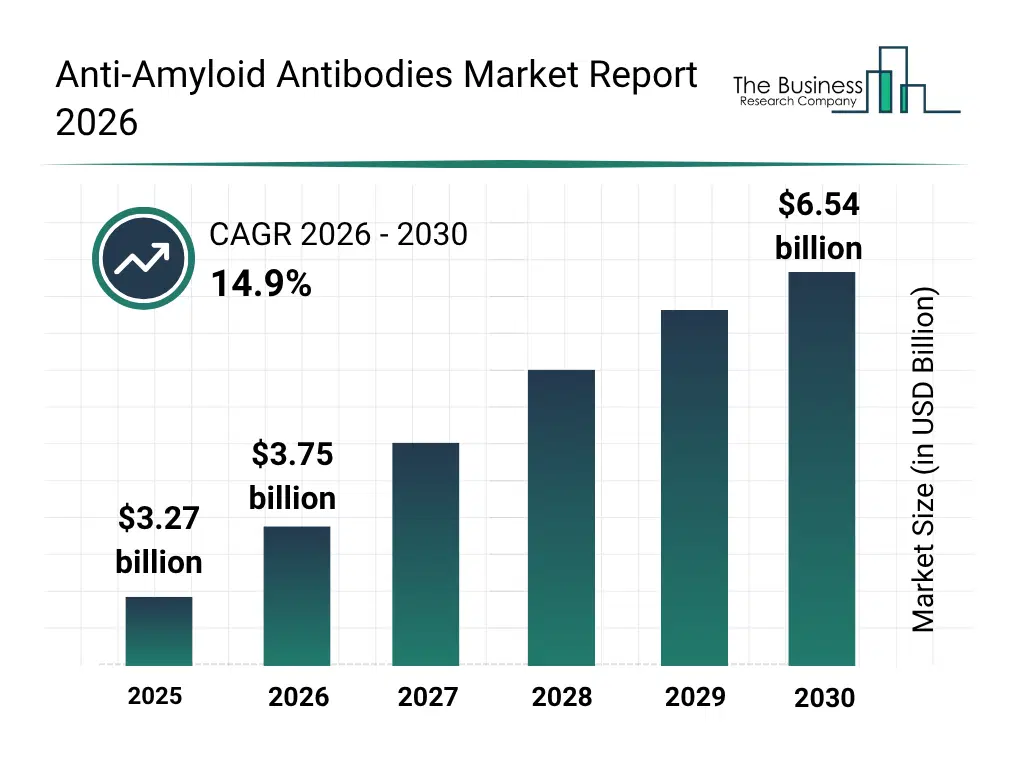
What Is The Anti-Amyloid Antibodies Market Size and Share 2026?
The anti-amyloid antibodies market size has grown rapidly in recent years. It will grow from $3.27 billion in 2025 to $3.75 billion in 2026 at a compound annual growth rate (CAGR) of 14.7%. The growth in the historic period can be attributed to rising prevalence of alzheimer’s disease globally, limited effectiveness of symptomatic treatments for neurodegeneration, increasing research funding for amyloid hypothesis, advancements in monoclonal antibody technology, growing aging population base worldwide.What Is The Anti-Amyloid Antibodies Market Growth Forecast?
The anti-amyloid antibodies market size is expected to see rapid growth in the next few years. It will grow to $6.54 billion in 2030 at a compound annual growth rate (CAGR) of 14.9%. The growth in the forecast period can be attributed to rising approval of disease-modifying alzheimer’s therapies, expansion of early diagnostic biomarker screening programs, increasing investment in neuroimmunology research, growing adoption of personalized precision medicine approaches, advancement in next-generation antibody engineering technologies. Major trends in the forecast period include AI-driven biomarker discovery for amyloid-beta aggregation mapping, precision medicine approaches for targeted anti-amyloid antibody therapy, digital health integration for alzheimer’s disease monitoring and progression tracking, cloud-based clinical trial data analysis for neurodegenerative disease drug development, advanced biomanufacturing and scalable monoclonal antibody production platforms.
Global Anti-Amyloid Antibodies Market Segmentation
1) By Product Type: Monoclonal Antibodies, Polyclonal Antibodies, Other Product Types 2) By Target Type: Amyloid Beta Plaques, Soluble Amyloid Beta Oligomers, Protofibrils, Amyloid Precursors 3) By Distribution Channel: Direct Sales, Online Pharmacies, Retail Pharmacies, Other Distribution Channels 4) By Application: Alzheimer’s Disease, Parkinson’s Disease, Amyloidosis, Other Application Types 5) By End User: Hospitals, Clinics, Research Institutes, Other End Users Subsegments: 1) By Monoclonal Antibodies: Human Monoclonal Antibodies, Humanized Monoclonal Antibodies, Murine Monoclonal Antibodies, Chimeric Monoclonal Antibodies, Recombinant Monoclonal Antibodies, Bispecific Monoclonal Antibodies 2) By Polyclonal Antibodies: Primary Polyclonal Antibodies, Secondary Polyclonal Antibodies, Rabbit Derived Polyclonal Antibodies, Goat Derived Polyclonal Antibodies, Sheep Derived Polyclonal Antibodies 3) By Other Product Types: Antibody Fragments, Nanobodies, Antibody Drug Conjugates, Biosimilar Antibodies, Fusion Proteins, Synthetic Antibody Products, Recombinant Protein Based TherapeuticsWhat Is The Driver Of The Anti-Amyloid Antibodies Market?
The rising prevalence of neurodegenerative disorders is expected to propel the growth of the anti-amyloid antibodies market going forward. Neurodegenerative disorders are chronic conditions characterized by the progressive degeneration and loss of nerve cells in the brain and nervous system, leading to cognitive, behavioral, and motor impairments over time. The prevalence of neurodegenerative disorders is increasing due to the rapidly aging global population, as older adults face a significantly higher risk of developing neurological conditions associated with cognitive decline. Anti-amyloid antibodies support neurodegenerative disease management by helping reduce amyloid plaque accumulation in the brain, enabling earlier therapeutic intervention and slowing disease progression in affected patients. For instance, in March 2024, according to the Alzheimer’s Association, a US-based nonprofit health organization, the number of Americans aged 65 and above living with Alzheimer’s disease is projected to reach 13.8 million by 2060, demonstrating a substantial rise in neurodegenerative disorder prevalence over time. Therefore, the rising prevalence of neurodegenerative disorders is driving the growth of the anti-amyloid antibodies industry.Key Players In The Global Anti-Amyloid Antibodies Market
Major companies operating in the anti-amyloid antibodies market are Roche Holding AG, AbbVie Inc., Eli Lilly and Company, Biogen Inc., Eisai Co. Ltd., Prothena Corporation plc, AC Immune SA, Neurimmune AG, SciNeuro Pharmaceuticals, ALZpath Inc., Araclon Biotech S.L., BioArctic AB, Acumen Pharmaceuticals Inc., AstraZeneca plc, Attralus Inc.Global Anti-Amyloid Antibodies Market Trends and Insights
Major companies operating in the anti-amyloid antibodies market are focusing on gaining regulatory approvals for innovative Alzheimer’s disease therapies to expand treatment availability, improve patient outcomes, and strengthen their market presence. Regulatory approvals are official authorizations granted by government health agencies confirming that a product meets required safety, efficacy, and quality standards for market use. For instance, in July 2024, Eli Lilly and Company, a US-based pharmaceutical company, received approval from the U.S. Food and Drug Administration for Kisunla (donanemab), an anti-amyloid antibody treatment for adults with Alzheimer’s disease. The therapy is intended for patients with early symptomatic Alzheimer’s disease, including mild cognitive impairment and mild dementia stages. It works by targeting and clearing amyloid plaques in the brain, helping slow cognitive and functional decline.What Are Latest Mergers And Acquisitions In The Anti-Amyloid Antibodies Market?
In December 2024, AbbVie Inc., a US-based provider of neuroscience therapies, biologics, monoclonal antibodies, and pharmaceutical treatments for neurological disorders, acquired Aliada Therapeutics for an undisclosed amount. Through this acquisition, AbbVie aimed to strengthen its neuroscience research capabilities, expand its Alzheimer’s disease pipeline, and enhance its development of next-generation anti-amyloid antibody therapies using advanced blood-brain barrier-crossing technology. Aliada Therapeutics is a US-based biotechnology company that provides anti-pyroglutamate amyloid beta (3pE-Aβ) antibodies for the treatment of Alzheimer’s disease and other neurological disorders.Regional Outlook
North America was the largest region in the anti-amyloid antibodies market in 2025. Asia-Pacific is expected to be the fastest-growing region in the forecast period. The regions covered in this market report are Australia, Brazil, China, France, Germany, India, Indonesia, Japan, Taiwan, Russia, South Korea, UK, USA, Canada, Italy, Spain. The countries covered in this market report are Australia, Brazil, China, France, Germany, India, Indonesia, Japan, Taiwan, Russia, South Korea, UK, USA, Canada, Italy, Spain.What Defines the Anti-Amyloid Antibodies Market?
The anti-amyloid antibodies market consists of sales of amyloid-beta-targeting immunotherapies, diagnostic anti-amyloid antibodies, recombinant anti-amyloid antibodies, and investigational Alzheimer’s disease antibody therapeutics. Values in this market are ‘factory gate’ values, that is, the value of goods sold by the manufacturers or creators of the goods, whether to other entities (including downstream manufacturers, wholesalers, distributors, and retailers) or directly to end customers. The value of goods in this market includes related services sold by the creators of the goods.How is Market Value Defined and Measured?
The market value is defined as the revenues that enterprises gain from the sale of goods and/or services within the specified market and geography through sales, grants, or donations in terms of the currency (in USD unless otherwise specified). The revenues for a specified geography are consumption values that are revenues generated by organizations in the specified geography within the market, irrespective of where they are produced. It does not include revenues from resales along the supply chain, either further along the supply chain or as part of other products.What Key Data and Analysis Are Included in the Anti-Amyloid Antibodies Market Report 2026?
The anti-amyloid antibodies market research report is one of a series of new reports from The Business Research Company that provides anti-amyloid antibodies market statistics, including anti-amyloid antibodies industry global market size, regional shares, competitors with a anti-amyloid antibodies market share, detailed anti-amyloid antibodies market segments, market trends and opportunities, and any further data you may need to thrive in the anti-amyloid antibodies industry. This anti-amyloid antibodies market research report delivers a complete perspective of everything you need, with an in-depth analysis of the current and future scenario of the industry.Anti-Amyloid Antibodies Market Report Forecast Analysis
| Report Attribute | Details |
|---|---|
| Market Size Value In 2026 | $3.75 billion |
| Revenue Forecast In 2030 | $6.54 billion |
| Growth Rate | CAGR of 14.9% from 2026 to 2030 |
| Base Year For Estimation | 2025 |
| Actual Estimates/Historical Data | 2020-2025 |
| Forecast Period | 2026 - 2030 |
| Market Representation | Revenue in USD Billion and CAGR from 2026 to 2030 |
| Segments Covered | Product Type, Target Type, Distribution Channel, Application, End User |
| Regional Scope | Asia-Pacific, Western Europe, Eastern Europe, North America, South America, Middle East, Africa |
| Country Scope | The countries covered in the anti-amyloid antibodies market report are Australia, Brazil, China, France, Germany, India, Indonesia, Japan, Taiwan, Russia, South Korea, UK, USA, Canada, Italy, Spain. |
| Key Companies Profiled | Roche Holding AG, AbbVie Inc., Eli Lilly and Company, Biogen Inc., Eisai Co. Ltd., Prothena Corporation plc, AC Immune SA, Neurimmune AG, SciNeuro Pharmaceuticals, ALZpath Inc., Araclon Biotech S.L., BioArctic AB, Acumen Pharmaceuticals Inc., AstraZeneca plc, Attralus Inc. |
| Customization Scope | Request for Customization |
| Pricing And Purchase Options | Explore Purchase Options |