
Artificial Cartilage Implant Market Report 2026
Global Outlook – By Type Of Implant (Biological Implants, Synthetic Implants, Composite Implants, Smart Implants), By Product Type (Upper Extremity Joints, Lower Extremity Joints, Vertebral Joints), By Distribution Channel (Direct Sales, Online Retail, Distributors, Specialty Clinics), By Application (Knee Replacement, Hip Replacement, Shoulder Reconstruction, Ankle Replacement), By End-User (Hospitals, Orthopedic Clinics, Ambulatory Surgical Centers, Research Institutes, Other End-Users) – Market Size, Trends, Strategies, and Forecast to 2030
Artificial Cartilage Implant Market Overview
• Artificial Cartilage Implant market size has reached to $1.54 billion in 2025 • Expected to grow to $2.45 billion in 2030 at a compound annual growth rate (CAGR) of 9.7% • Growth Driver: Surge In Osteoarthritis Cases Prompts Development Of Advanced Cartilage Interventions • Market Trend: Advanced 3D-Printed Knee Implants For Enhanced Cartilage Restoration • North America was the largest region in 2025 and Asia-Pacific is the fastest growing region.What Is Covered Under Artificial Cartilage Implant Market?
An artificial cartilage implant is a synthetic medical device designed to mimic the structure and function of natural cartilage. It offers a durable, biocompatible layer between bones in a joint, reducing friction, absorbing impact, and restoring mobility. These implants help relieve pain and enhance joint function in patients with cartilage damage from injury or degenerative conditions. The main types of artificial cartilage implants are biological implants, synthetic implants, composite implants, and smart implants. Biological implants are medical devices made from natural tissues or biomaterials designed to replace or support damaged body parts. It includes different product types such as upper extremity joints, lower extremity joints, and vertebral joints and is sold through various distribution channels such as direct sales, online retail, distributors, and specialty clinics. It is applied in several various applications, including knee replacement, hip replacement, shoulder reconstruction, and ankle replacement, and is used by various end users, such as hospitals, orthopedic clinics, ambulatory surgical centers, research institutes, and others.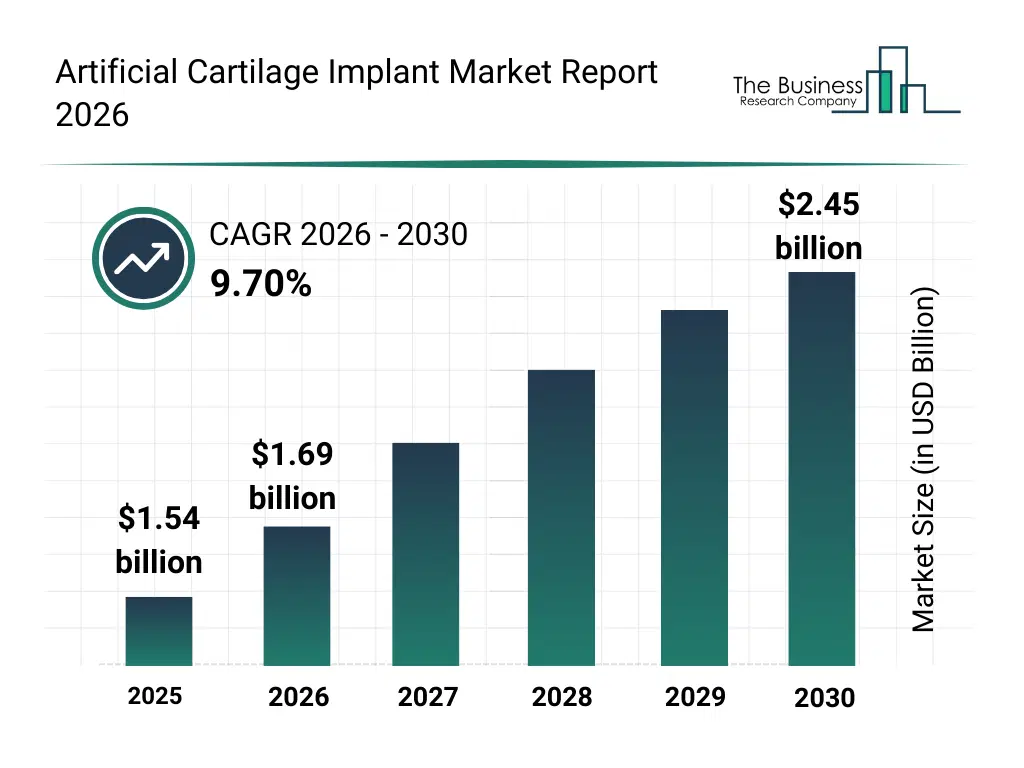
What Is The Artificial Cartilage Implant Market Size and Share 2026?
The artificial cartilage implant market size has grown strongly in recent years. It will grow from $1.54 billion in 2025 to $1.69 billion in 2026 at a compound annual growth rate (CAGR) of 9.7%. The growth in the historic period can be attributed to limited availability of advanced cartilage implant materials, rising orthopedic surgical procedures, increasing awareness of joint health, lack of local manufacturing capabilities, dependency on imported implants.What Is The Artificial Cartilage Implant Market Growth Forecast?
The artificial cartilage implant market size is expected to see strong growth in the next few years. It will grow to $2.45 billion in 2030 at a compound annual growth rate (CAGR) of 9.7%. The growth in the forecast period can be attributed to innovations in synthetic and smart implants, growing demand for knee and hip replacements, expansion of ambulatory surgical centers, rising adoption of 3d-printed patient-specific implants, increasing investment in orthopedic research and clinical applications. Major trends in the forecast period include rising incidence of osteoarthritis and joint degeneration, increasing adoption of minimally invasive orthopedic procedures, growing demand for biocompatible and durable implants, expansion of orthopedic research and clinical trials, customization and patient-specific implant solutions.
Global Artificial Cartilage Implant Market Segmentation
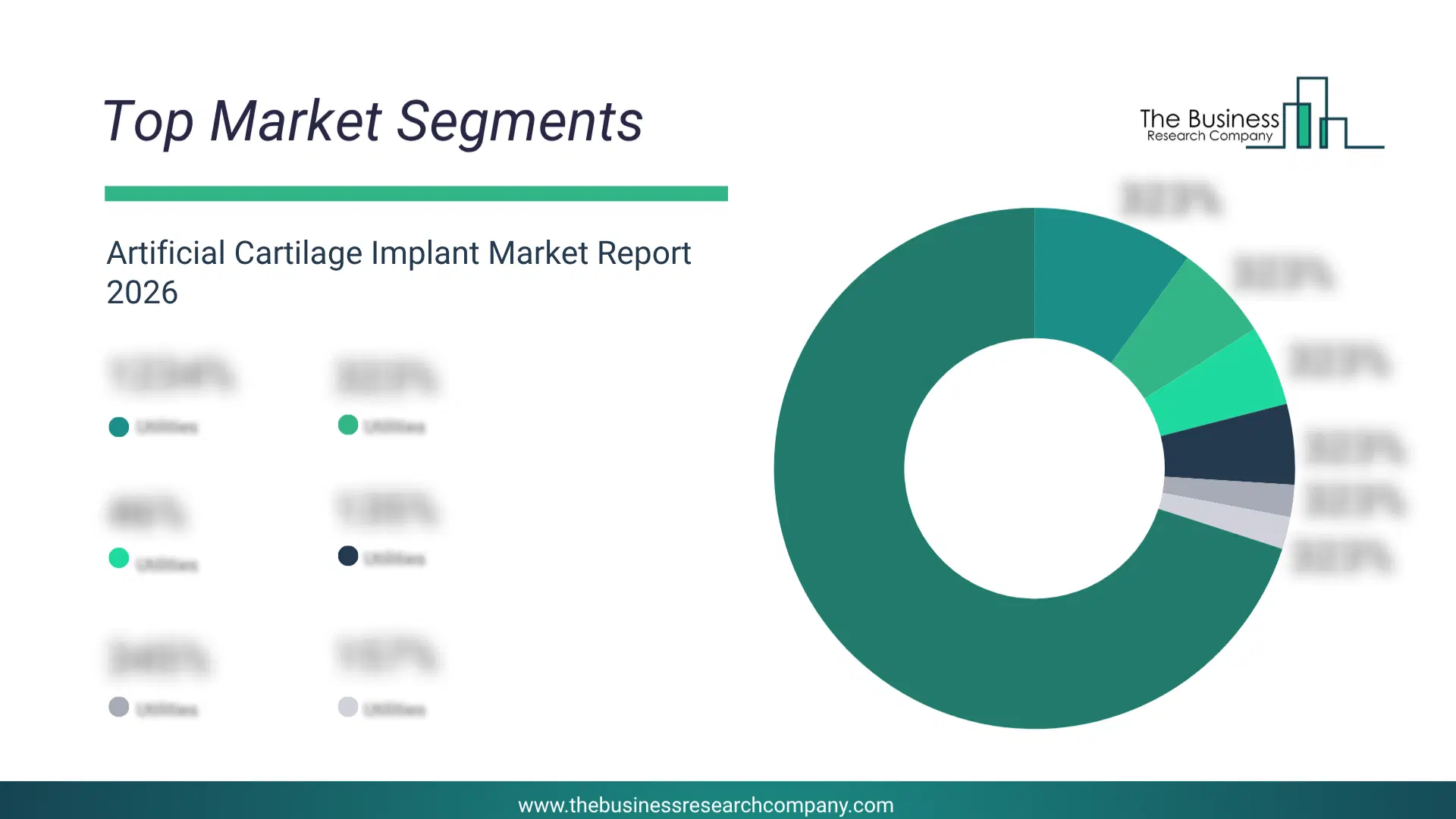
1) By Type Of Implant: Biological Implants, Synthetic Implants, Composite Implants, Smart Implants 2) By Product Type: Upper Extremity Joints, Lower Extremity Joints, Vertebral Joints 3) By Distribution Channel: Direct Sales, Online Retail, Distributors, Specialty Clinics 4) By Application: Knee Replacement, Hip Replacement, Shoulder Reconstruction, Ankle Replacement 5) By End-User: Hospitals, Orthopedic Clinics, Ambulatory Surgical Centers, Research Institutes, Other End-Users Subsegments: 1) By Biological Implants: Autografts, Allografts, Xenografts, Tissue-Engineered Implants 2) By Synthetic Implants: Polymer-Based Implants, Hydrogel Implants, Silicone Implants, Polyurethane Implants 3) By Composite Implants: Polymer-Ceramic Composites, Polymer-Metal Composites, Hydrogel-Ceramic Composites, Bioactive Glass Composites 4) By Smart Implants: Sensor-Integrated Implants, Drug-Eluting Implants, Shape-Memory Implants, Stimuli-Responsive ImplantsWhat Is The Driver Of The Artificial Cartilage Implant Market?
The rising incidence of osteoarthritis is expected to propel the growth of the artificial cartilage implant market going forward. Osteoarthritis is a degenerative joint disease characterized by the gradual breakdown of cartilage, leading to pain, stiffness, and reduced mobility. The rise in osteoarthritis is due to growing obesity, which puts extra pressure on joints, speeding up cartilage breakdown and joint deterioration. Artificial cartilage implants replace damaged cartilage to restore smooth joint surfaces and reduce friction, alleviating pain and improving mobility while slowing joint degeneration. For instance, in August 2023, according to the Institute for Health Metrics and Evaluation, a US-based health research center, by 2050, nearly 1 billion people are projected to have osteoarthritis. The most common spots for osteoarthritis are knees and hands. By 2050, osteoarthritis of the knee will increase by 75%, and osteoarthritis of the hand by 50%. Therefore, a rising incidence of osteoarthritis is driving the growth of the artificial cartilage implant industry.Key Players In The Global Artificial Cartilage Implant Market
Major companies operating in the artificial cartilage implant market are Johnson & Johnson, B. Braun Melsungen AG, Medtronic plc, Zimmer Biomet Holdings Inc., Smith & Nephew plc, Stryker Corporation, Arthrex Inc., Conmed Corporation, Orthofix Medical, Corin Group, Anika Therapeutics Inc., Vericel Corporation, Tissue Regenix Group plc, Nusurface, Uteshiya Medicare Inc., Sparta Biomedical Inc., BioPoly LLC, Orthocell Ltd, Sartorius CellGenix GmbH, CytoSeek Limited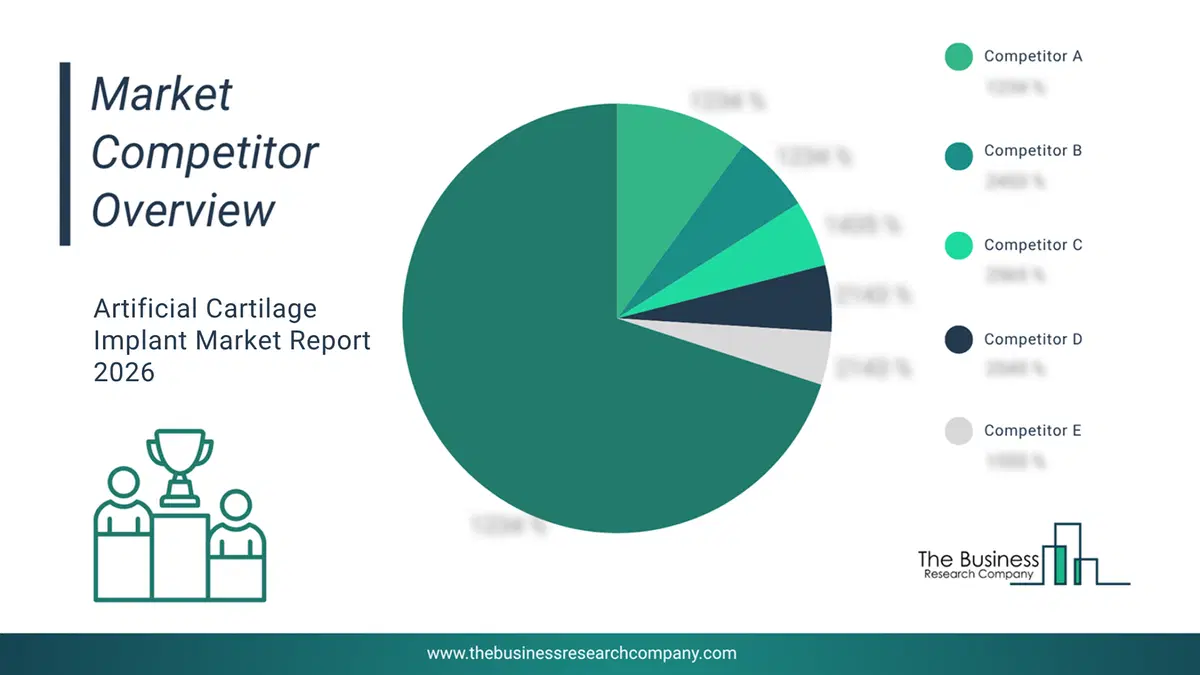
This chart is for illustrative purposes; the full report includes a detailed competitor analysis and comprehensive overview of the top 10 companies in the market.
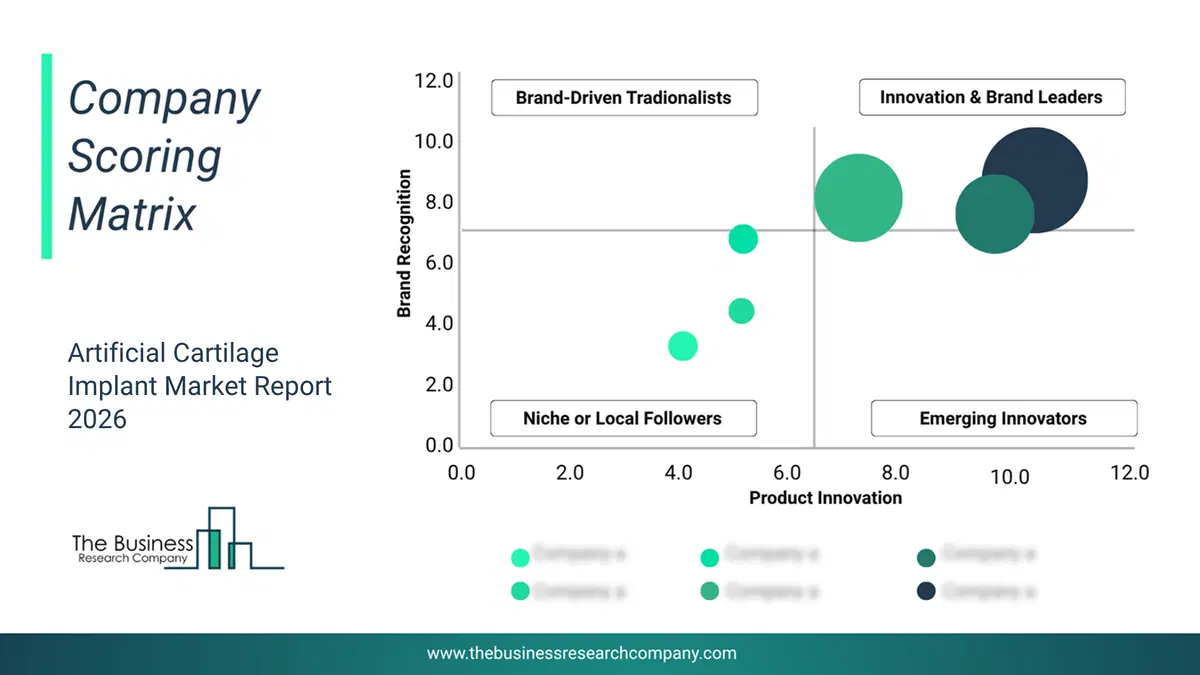
This chart maps companies by product innovation and brand strength, with bubble size indicating relative revenue, helping identify market leaders, challengers, and niche players. This is an illustrative chart; the full report provides a complete and accurate competitive analysis.
Global Artificial Cartilage Implant Market Trends and Insights
Major companies operating in the artificial cartilage implant market are focusing on developing advanced products such as three-dimensional (3D) printed knee implants to enhance joint compatibility and provide long-lasting solutions for osteoarthritis. Three-dimensional (3D) printed knee implants are patient-specific joint replacements built layer by layer using advanced 3D printing technology, offering precise anatomical fit and enhanced joint function while supporting faster recovery. For instance, in July 2025, Nanochon, a US-based medical device startup, launched Chondrograft, which received approval from Health Canada. It is specifically designed to replace lost or damaged cartilage in the knee using a synthetic, high-performance material. The implant mimics the porosity and structure of natural cartilage, allowing it to integrate with the body and promote new tissue growth. This off-the-shelf solution provides a minimally invasive alternative to traditional treatments like knee replacement and is intended for restoring knee cartilage function and delaying or avoiding the need for more invasive procedures.What Are Latest Mergers And Acquisitions In The Artificial Cartilage Implant Market?
In November 2023, Smith+Nephew, a UK-based medical technology company, acquired CartiHeal Ltd. for $330 million. With this acquisition, Smith+Nephew bolstered its orthopedic and sports medicine portfolio by incorporating CartiHeal’s advanced cartilage repair technologies. This deal enhances minimally invasive joint preservation treatments, addressing early-stage cartilage damage and meeting rising demand for innovative osteoarthritis solutions. CartiHeal Ltd. is an Israel-based company that manufactures artificial cartilage implants.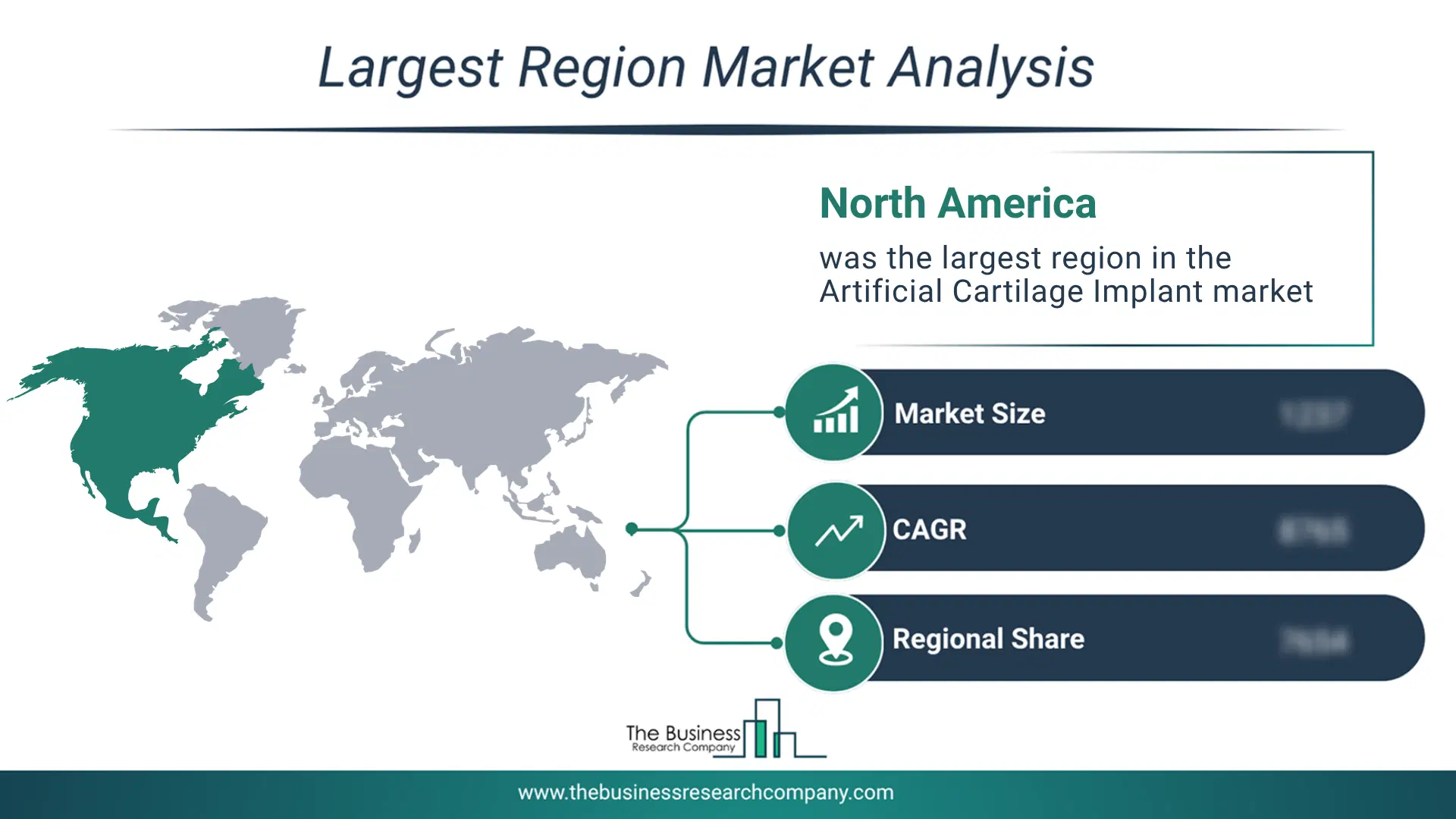
Regional Outlook
North America was the largest region in the artificial cartilage implant market in 2025. Asia-Pacific is expected to be the fastest-growing region in the forecast period. The regions covered in this market report are Asia-Pacific, South East Asia, Western Europe, Eastern Europe, North America, South America, Middle East, Africa. The countries covered in this market report are Australia, Brazil, China, France, Germany, India, Indonesia, Japan, Taiwan, Russia, South Korea, UK, USA, Canada, Italy, SpainWhat Defines the Artificial Cartilage Implant Market?
The artificial cartilage implant market consists of sales of hydrogel-based implants, three-dimensional (3D) bioprinted implants, hybrid implants, and nanostructured implants. Values in this market are ‘factory gate’ values; that is, the value of goods sold by the manufacturers or creators of the goods, whether to other entities (including downstream manufacturers, wholesalers, distributors, and retailers) or directly to end customers. The value of goods in this market includes related services sold by the creators of the goods.How is Market Value Defined and Measured?
The market value is defined as the revenues that enterprises gain from the sale of goods and/or services within the specified market and geography through sales, grants, or donations in terms of the currency (in USD unless otherwise specified). The revenues for a specified geography are consumption values that are revenues generated by organizations in the specified geography within the market, irrespective of where they are produced. It does not include revenues from resales along the supply chain, either further along the supply chain or as part of other products.
This chart presents market attractiveness based on a quantitative evaluation of growth, competition, strategic alignment, and risk, offering a clear view of opportunity areas for decision-making. This chart is for illustrative purposes; the full report contains the complete analysis.

This chart highlights the Total Addressable Market (TAM) by estimating the maximum revenue opportunity using an assumption-driven approach, supporting strategic planning and opportunity sizing across markets. The chart is illustrative; the full report provides a more comprehensive analysis.
What Key Data and Analysis Are Included in the Artificial Cartilage Implant Market Report 2026?
The artificial cartilage implant market research report is one of a series of new reports from The Business Research Company that provides market statistics, including industry global market size, regional shares, competitors with the market share, detailed market segments, market trends and opportunities, and any further data you may need to thrive in the artificial cartilage implant industry. The market research report delivers a complete perspective of everything you need, with an in-depth analysis of the current and future state of the industry.Artificial Cartilage Implant Market Report Forecast Analysis
| Report Attribute | Details |
|---|---|
| Market Size Value In 2026 | $1.69 billion |
| Revenue Forecast In 2030 | $2.45 billion |
| Growth Rate | CAGR of 9.7% from 2026 to 2030 |
| Base Year For Estimation | 2025 |
| Actual Estimates/Historical Data | 2020-2025 |
| Forecast Period | 2026 - 2030 |
| Market Representation | Revenue in USD Billion and CAGR from 2026 to 2030 |
| Segments Covered | Type Of Implant, Product Type, Distribution Channel, Application, End-User |
| Regional Scope | Asia-Pacific, Western Europe, Eastern Europe, North America, South America, Middle East, Africa |
| Country Scope | The countries covered in the report are Australia, Brazil, China, France, Germany, India, Indonesia, Japan, Taiwan, Russia, South Korea, UK, USA, Canada, Italy, Spain. |
| Key Companies Profiled | Johnson & Johnson, B. Braun Melsungen AG, Medtronic plc, Zimmer Biomet Holdings Inc., Smith & Nephew plc, Stryker Corporation, Arthrex Inc., Conmed Corporation, Orthofix Medical, Corin Group, Anika Therapeutics Inc., Vericel Corporation, Tissue Regenix Group plc, Nusurface, Uteshiya Medicare Inc., Sparta Biomedical Inc., BioPoly LLC, Orthocell Ltd, Sartorius CellGenix GmbH, CytoSeek Limited |
| Customization Scope | Request for Customization |
| Pricing And Purchase Options | Explore Purchase Options |