
Artificial Intelligence (AI) In Self-Driving Cars Market Report 2026
Global Outlook – By Component (Hardware, Software, Services), By Technology (Computer Vision, Natural Language Processing (NLP), Machine Learning And Deep Learning, Sensor Fusion AI, Others), By Application (Perception, Localization And Mapping, Decision-Making And Path Planning, Driver Monitoring Systems, Predictive Maintenance, Traffic And Navigation Assistance, Others), By Vehicle Type (Passenger Cars, Light Commercial Vehicles (LCVs), Heavy Commercial Vehicles (HCVs)) – Market Size, Trends, Strategies, and Forecast to 2030
Artificial Intelligence (AI) In Self-Driving Cars Market Overview
• Artificial Intelligence (AI) In Self-Driving Cars market size has reached to $6.05 billion in 2025 • Expected to grow to $54.13 billion in 2030 at a compound annual growth rate (CAGR) of 54.9% • Growth Driver: Rising Urbanization And Traffic Congestion Fueling The Growth Of The Market Due To Increasing Need For Autonomous, Efficient, And Safer Transportation Systems • Market Trend: Empowering Commuters With Autonomous Driving, Enhanced Safety, And Intelligent Transportation Services • North America was the largest region in 2025 and Asia-Pacific is the fastest growing region.Market Gains By 2030 – Top Opportunities By Segment
Market Gain identifies the most promising market opportunities by highlighting the segments or products expected to generate the highest incremental revenue growth over the next five years.
What Is Covered Under Artificial Intelligence (AI) In Self-Driving Cars Market?
Artificial intelligence (AI) in self-driving cars refers to the use of advanced algorithms and machine learning models that enable vehicles to perceive their surroundings and make driving decisions autonomously. It processes data from sensors, cameras, and onboard systems to identify objects, predict movements, and determine safe driving actions. This technology enhances efficiency and safety by allowing vehicles to navigate, respond to real-time conditions, and operate with minimal human intervention. The main components of AI in self-driving cars are hardware, software, and services. AI in self-driving cars hardware refers to the physical computing and sensing components embedded within autonomous vehicles that enable artificial intelligence functions to operate directly inside the vehicle. The various technology involved are computer vision, natural language processing (NLP), machine learning and deep learning, sensor fusion AI, and others which are used for the perception, localization and papping, decision-making and path planning, driver monitoring systems, predictive maintenance, traffic and navigation assistance, and others. The various vehicles types involved are passenger cars, light commercial vehicles (LCVs), and heavy commercial vehicles (HCVs).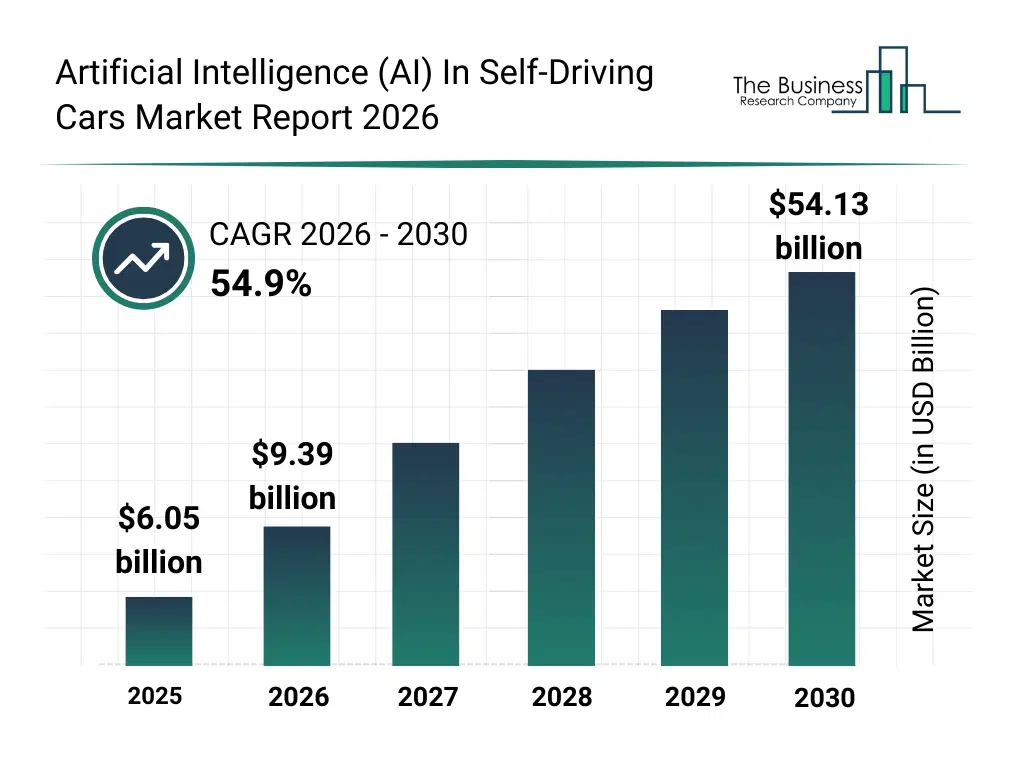
What Is The Artificial Intelligence (AI) In Self-Driving Cars Market Size and Share 2026?
The artificial intelligence (AI) in self-driving cars market size has grown exponentially in recent years. It will grow from $6.05 billion in 2025 to $9.39 billion in 2026 at a compound annual growth rate (CAGR) of 55.2%. The growth in the historic period can be attributed to advances in sensor technology, growth in computing power, increasing data availability, government funding and research, progress in machine learning, and demand for road safety.What Is The Artificial Intelligence (AI) In Self-Driving Cars Market Growth Forecast?
The artificial intelligence (AI) in self-driving cars market size is expected to see exponential growth in the next few years. It will grow to $54.13 billion in 2030 at a compound annual growth rate (CAGR) of 54.9%. The growth in the forecast period can be attributed to regulatory approvals, declining sensor costs, expansion of smart infrastructure, rising demand for autonomous mobility services, partnerships between automakers and tech firms, improvements in AI algorithms. Major trends in the forecast period include higher levels of vehicle autonomy, integration of generative ai, vehicle to everything communication, growth of robotaxi services, increased use of simulation and digital twins, and focus on ethical and explainable AI.
Global Artificial Intelligence (AI) In Self-Driving Cars Market Segmentation
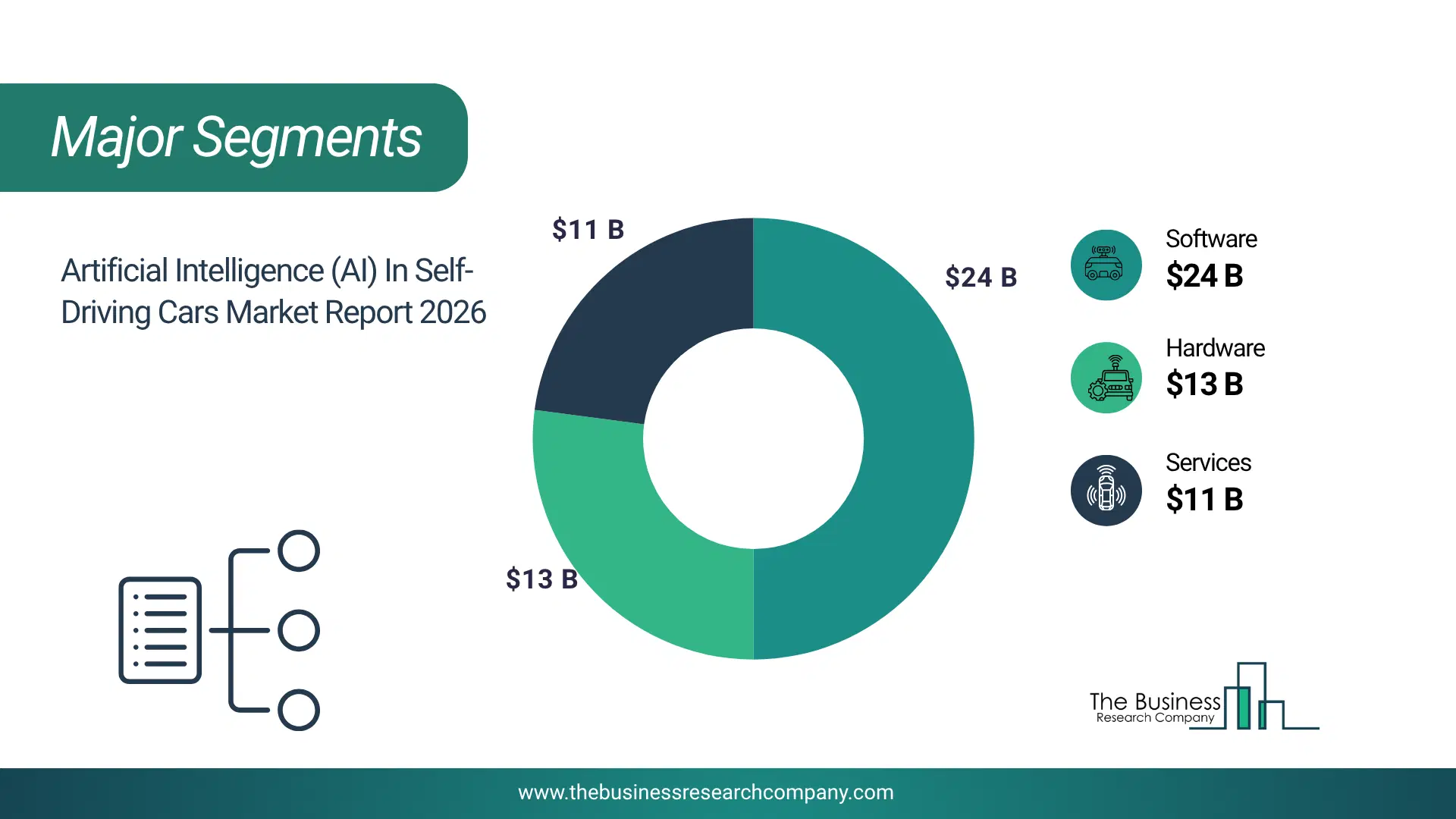
1) By Component: Hardware, Software, Services 2) By Technology: Computer Vision, Natural Language Processing (NLP), Machine Learning And Deep Learning, Sensor Fusion AI, Others 3) By Application: Perception, Localization And Mapping, Decision-Making And Path Planning, Driver Monitoring Systems, Predictive Maintenance, Traffic And Navigation Assistance, Others 4) By Vehicle Type: Passenger Cars, Light Commercial Vehicles (LCVs), Heavy Commercial Vehicles (HCVs) Subsegments: 1) By Hardware: Sensors, Processors, On-board Computing Units 2) By Software: AI Algorithms, Sensor Fusion Modules, Decision-Making Systems 3) By Services: Data Labeling And Annotation, Cloud Support And Integration, Maintenance And Testing The top segments in the artificial intelligence (ai) in self-driving cars market will be: • Software will reach $24.41 Billion by 2030. • Hardware will reach $13.19 Billion by 2030. • Services will reach $11.03 Billion by 2030.What Is The Driver Of The Artificial Intelligence (AI) In Self-Driving Cars Market?
The rising urbanization and traffic congestion are expected to propel the growth of the artificial intelligence (AI) in self-driving cars market going forward. Urbanization and traffic congestion refer to the increasing movement of people into cities, resulting in higher population density, overcrowded roads, longer travel times, and greater transportation inefficiencies. The rise in urbanization and traffic congestion is due to rapid population growth in cities that increases private vehicle ownership and overwhelms existing road and public transport capacity. Artificial intelligence (AI) in self-driving cars helps address these challenges by enabling autonomous navigation, real-time traffic prediction, adaptive route optimization, and enhanced safety through advanced sensor fusion and decision-making algorithms, reducing congestion and improving mobility. For instance, in November 2025, according to the United Nations Department of Economic and Social Affairs (UNDESA), a US-based intergovernmental organization, cities were home to 45 per cent of the world’s 8.2 billion people in 2025, and projections indicated that two thirds of global population growth through 2050 would occur in urban areas. Therefore, the rising urbanization and traffic congestion are driving the growth of the artificial intelligence (AI) in self-driving cars industry.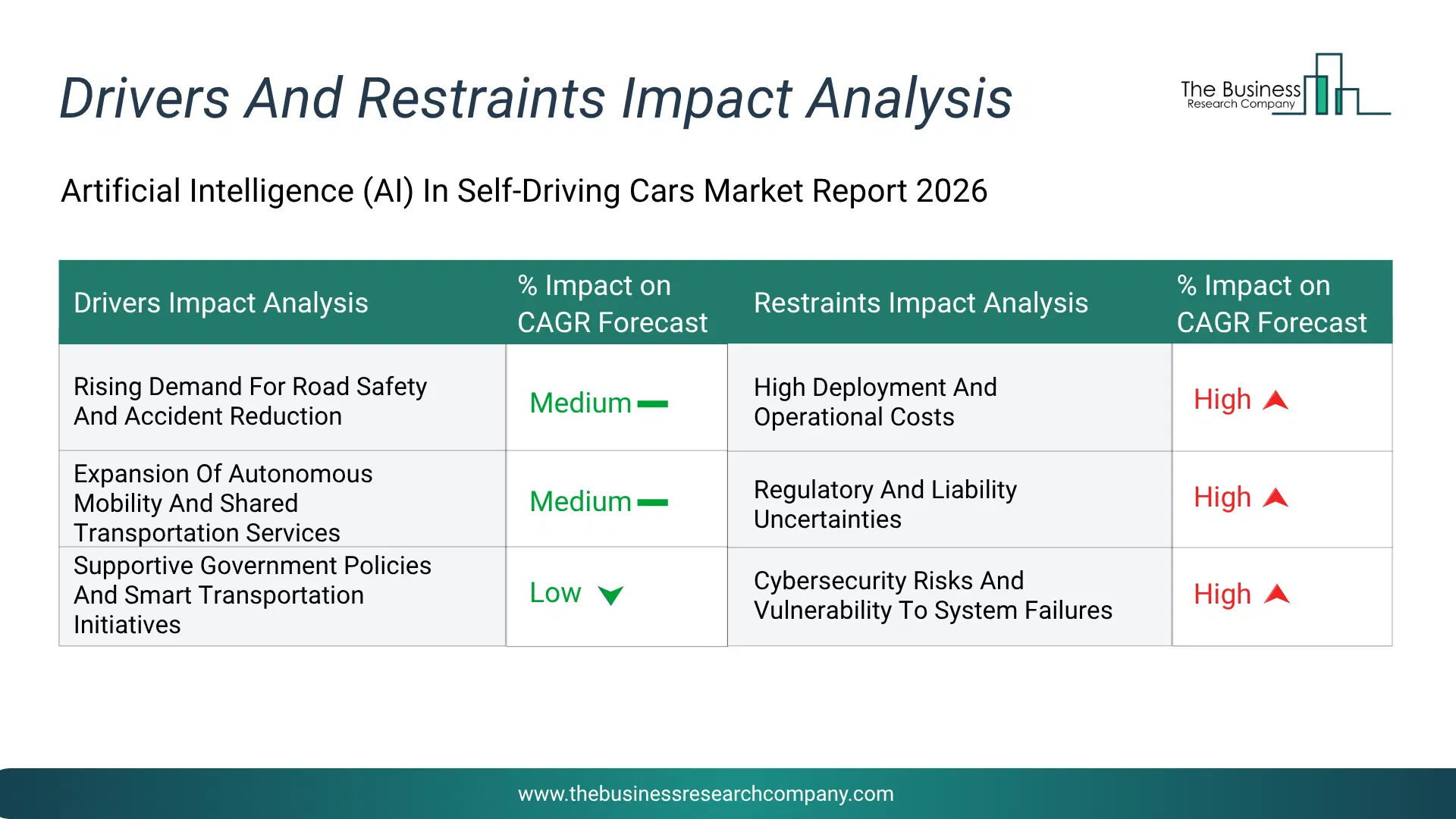
Infographic Chart Showing Key Market Drivers Analysis And Restraints For Artificial Intelligence (Ai) In Self-Driving Cars Market
The chart presents an impact analysis of key drivers and restraints, quantifying their relative influence on the market's growth rate and helping assess the balance between growth enablers and limiting factors. This chart offers a high-level perspective; the full report contains more detailed insights.
How Will The Drivers Impact Growth In The Global Artificial Intelligence (AI) In Self-Driving Cars Market?
• Rising Demand For Road Safety And Accident Reduction (Medium) – During the forecast period, the rising demand for road safety and accident reduction is expected to become a key growth driver for the artificial intelligence (AI) In self-driving cars market by 2030. Rising demand for road safety and accident reduction is accelerating the adoption of artificial intelligence in self-driving cars as governments, fleet operators, and consumers seek to minimize human driving errors. Artificial intelligence-powered autonomous systems continuously monitor surroundings, detect hazards, and support safer navigation decisions. The growing economic and social costs associated with road accidents are encouraging investments in autonomous mobility solutions. Increasing emphasis on reducing fatalities and improving transportation safety standards is further strengthening market demand. This trend is creating favorable conditions for the deployment of self-driving vehicle technologies across multiple transportation segments. • Expansion Of Autonomous Mobility And Shared Transportation Services (Medium) – During the forecast period, the expansion of autonomous mobility and shared transportation services is expected to emerge as a major factor driving the expansion of the artificial intelligence (AI) in self-driving cars market by 2030. Expansion of autonomous mobility and shared transportation services is driving market growth by increasing the need for intelligent vehicle navigation and decision-making capabilities. Mobility service providers are investing in self-driving vehicles to improve operational efficiency and reduce dependency on human drivers. Artificial intelligence enables vehicles to operate continuously while optimizing route planning and traffic management. Growing urbanization and demand for convenient transportation solutions are supporting the adoption of autonomous fleets. As shared mobility ecosystems expand globally, demand for artificial intelligence-enabled self-driving systems continues to increase. • Supportive Government Policies And Smart Transportation Initiatives (Low) – During the forecast period, the supportive government policies and smart transportation initiatives is expected to act as a key growth catalyst for the artificial intelligence (AI) in self-driving cars market by 2030. Supportive government policies and smart transportation initiatives are encouraging the development and deployment of self-driving vehicles across various regions. Governments are allocating funding for autonomous vehicle testing programs, intelligent transportation infrastructure, and connected mobility projects. Regulatory support is helping manufacturers and service providers accelerate commercialization efforts. Public sector initiatives aimed at improving traffic efficiency and reducing congestion are creating favorable market conditions. Such policy-driven support is strengthening investments throughout the artificial intelligence in self-driving cars value chain.How Will The Restraints Impact Growth In The Global Artificial Intelligence (AI) In Self-Driving Cars Market?
• High Deployment And Operational Costs (Medium) – During the forecast period, the high deployment and operational costs is limiting market adoption due to the substantial expenditure required for autonomous vehicle systems and supporting infrastructure. Self-driving vehicles rely on multiple components, including lidar sensors, radar modules, cameras, onboard computing systems, and communication units. The integration, maintenance, and continuous monitoring of these systems increase overall ownership costs. Many organizations face challenges in achieving cost-effective large-scale deployment. These financial barriers can delay adoption, particularly in cost-sensitive markets and emerging economies. • Regulatory And Liability Uncertainties (Medium) – During the forecast period, the regulatory and liability uncertainties is restricting market growth because legal frameworks governing autonomous vehicle operations remain inconsistent across jurisdictions. Questions related to accident responsibility, insurance coverage, and compliance requirements continue to create uncertainty for industry participants. Companies often face lengthy approval processes before commercial deployment can occur. Differences in regional regulations can complicate expansion strategies and increase operational risks. These uncertainties may slow investment decisions and delay widespread adoption of self-driving vehicle technologies. • Cybersecurity Risks And Vulnerability To System Failures (Low) – During the forecast period, the cybersecurity risks and vulnerability to system failures are expected to restrain the growth of the artificial intelligence (AI) in self-driving cars market. Self-driving vehicles rely on artificial intelligence, connected sensors, cloud platforms, vehicle-to-everything (V2X) communication, and over-the-air software updates to operate safely and efficiently. These connected systems create potential entry points for cyberattacks, unauthorized access, and malicious manipulation of critical vehicle functions. Security breaches could compromise navigation, braking, steering, or communication systems, posing significant safety risks to passengers and other road users. In addition, software bugs, sensor malfunctions, or AI decision-making errors can affect vehicle reliability and reduce public confidence in autonomous driving technologies. Automotive manufacturers must invest heavily in cybersecurity frameworks, continuous software validation, and real-time threat detection to mitigate these risks, increasing development and operational costs. Concerns regarding system reliability and cyber resilience may delay consumer acceptance and regulatory approvals for fully autonomous vehicles. Consequently, cybersecurity risks and vulnerability to system failures remain significant restraints on the growth of the artificial intelligence (AI) in self-driving cars market.Key Players In The Global Artificial Intelligence (AI) In Self-Driving Cars Market
Major companies operating in the artificial intelligence (AI) in self-driving cars market are Tesla Inc., NVIDIA Corporation, Mobileye Vision Technologies Ltd., Waymo LLC, Motional LLC, WeRide.ai, Wayve Ltd., Nuro Inc., Oxbotica Ltd., May Mobility Inc., AImotive Ltd., Gatik Inc., Pony.ai Inc., Luminar Technologies Inc., Einride AB, EasyMile SA, Avride Inc., Momenta Inc., AutoX Technology Co. Ltd., Innoviz Technologies Ltd., Aurora Innovation Inc., TuSimple Holdings Inc., Velodyne Lidar Inc.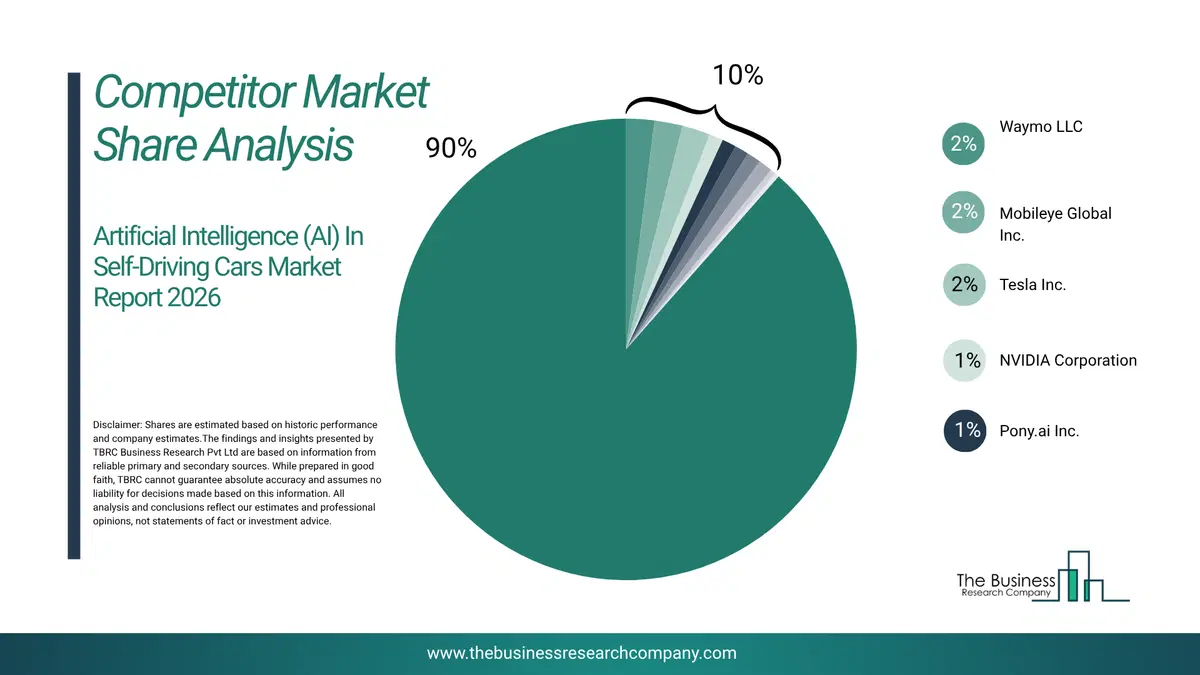
This chart is for illustrative purposes; the full report includes a detailed competitor analysis and comprehensive overview of the top 10 companies in the market.
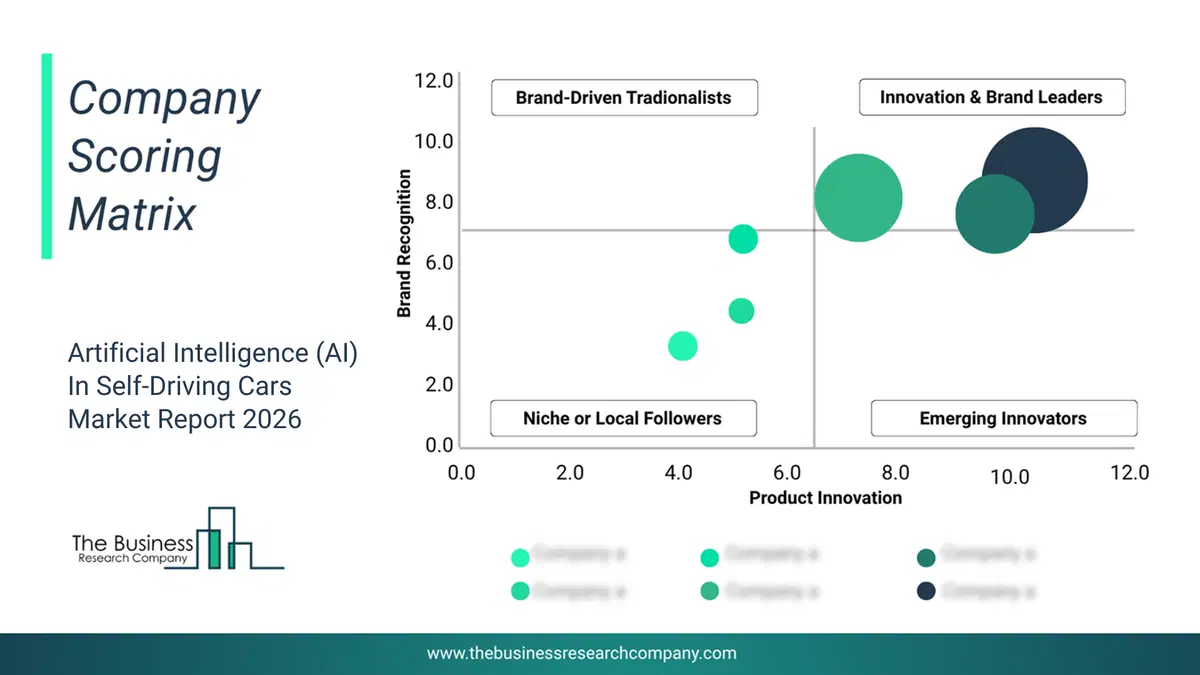
This chart maps companies by product innovation and brand strength, with bubble size indicating relative revenue, helping identify market leaders, challengers, and niche players. This is an illustrative chart; the full report provides a complete and accurate competitive analysis.
What Are Latest Mergers And Acquisitions In The Artificial Intelligence (AI) In Self-Driving Cars Market?
In April 2024, Microchip Technology Inc., a US-based semiconductor manufacturer, acquired Vehicle Systems Integration Ltd.(VSI) for an undisclosed amount. Through this acquisition, Microchip Technology Inc. aims to strengthen its artificial intelligence (AI)-enabled solutions for self-driving cars by integrating VSI’s expertise in advanced driver-assistance systems (ADAS) connectivity and digital cockpit integration, enabling enhanced communication between vehicle sensors, control units, and AI processors to support safer and more intelligent autonomous driving experiences. Vehicle Systems Integration Ltd.(VSI) is a UK-based provider of automotive connectivity and integration technology within self-driving cars.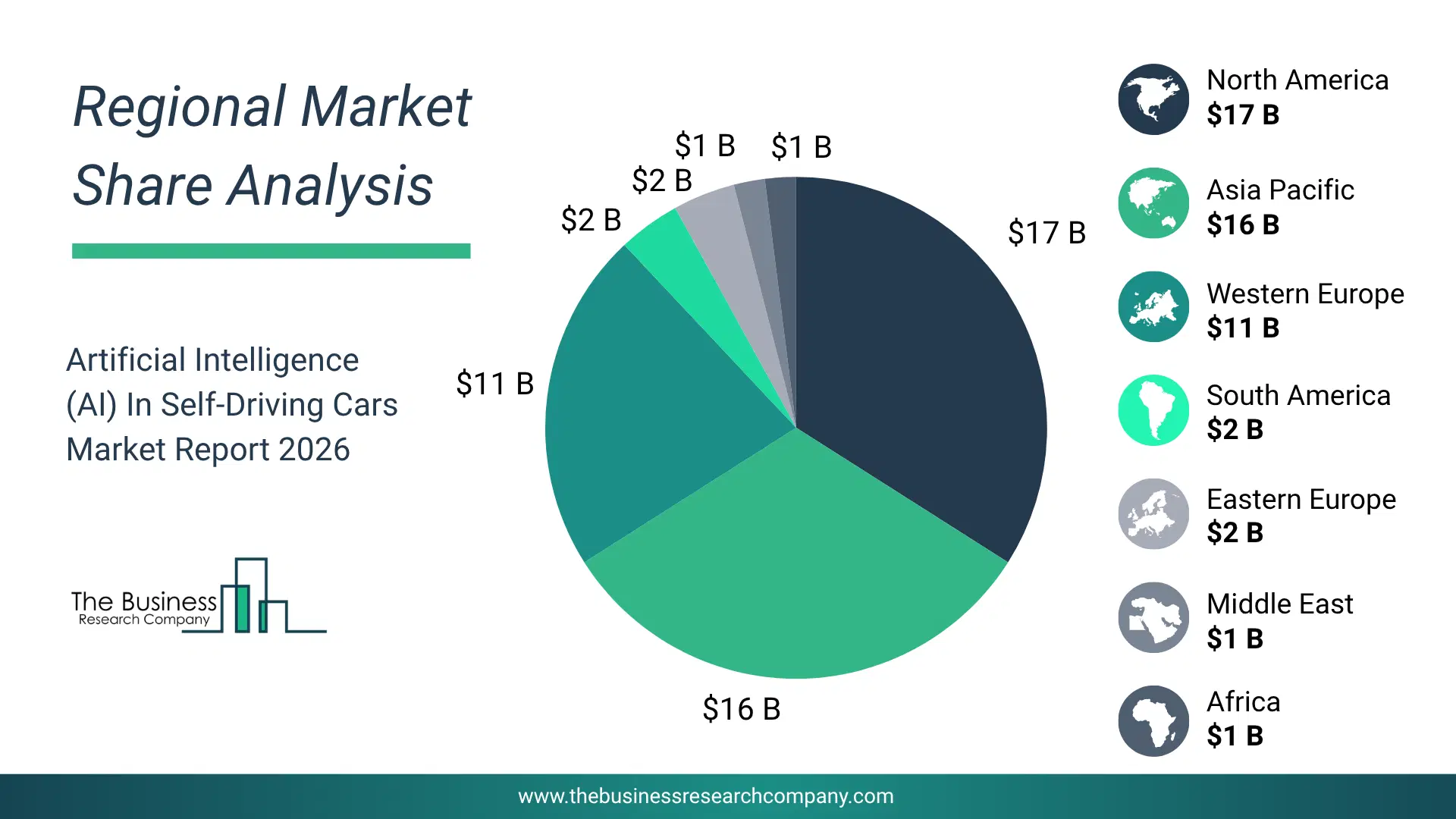
Regional Insights
North America was the largest region in the artificial intelligence (AI) in self-driving cars market in 2025. Asia-Pacific is expected to be the fastest-growing region in the forecast period. The regions covered in this market report are Asia-Pacific, South East Asia, Western Europe, Eastern Europe, North America, South America, Middle East, Africa. The countries covered in this market report are Australia, Brazil, China, France, Germany, India, Indonesia, Japan, Taiwan, Russia, South Korea, UK, USA, Canada, Italy, Spain.What Defines the Artificial Intelligence (AI) In Self-Driving Cars Market?
The artificial intelligence (AI) in self-driving cars market consists of revenues earned by entities by providing services such as autonomous driving software integration services, sensor data processing services, real-time decision-making services, ai model training services, vehicle-to-everything communication services. The market value includes the value of related goods sold by the service provider or included within the service offering. The artificial intelligence (AI) in self-driving cars market also includes sales of lidar sensors, radar modules, ultrasonic sensors, onboard computing systems, autonomous driving cameras, vehicle communication units. Values in this market are ‘factory gate’ values, that is the value of goods sold by the manufacturers or creators of the goods, whether to other entities (including downstream manufacturers, wholesalers, distributors and retailers) or directly to end customers. The value of goods in this market includes related services sold by the creators of the goods.How is Market Value Defined and Measured?
The market value is defined as the revenues that enterprises gain from the sale of goods and/or services within the specified market and geography through sales, grants, or donations in terms of the currency (in USD unless otherwise specified). The revenues for a specified geography are consumption values that are revenues generated by organizations in the specified geography within the market, irrespective of where they are produced. It does not include revenues from resales along the supply chain, either further along the supply chain or as part of other products.
This chart presents market attractiveness based on a quantitative evaluation of growth, competition, strategic alignment, and risk, offering a clear view of opportunity areas for decision-making. This chart is for illustrative purposes; the full report contains the complete analysis.

This chart highlights the Total Addressable Market (TAM) by estimating the maximum revenue opportunity using an assumption-driven approach, supporting strategic planning and opportunity sizing across markets. The chart is illustrative; the full report provides a more comprehensive analysis.
What Key Data and Analysis Are Included in the Artificial Intelligence (AI) In Self-Driving Cars Market Report 2026?
The artificial intelligence (ai) in self-driving cars market research report is one of a series of new reports from The Business Research Company that provides market statistics, including industry global market size, regional shares, competitors with the market share, detailed market segments, market trends and opportunities, and any further data you may need to thrive in the artificial intelligence (ai) in self-driving cars industry. The market research report delivers a complete perspective of everything you need, with an in-depth analysis of the current and future state of the industry.Artificial Intelligence (AI) In Self-Driving Cars Market Report Forecast Analysis
| Report Attribute | Details |
|---|---|
| Market Size Value In 2026 | $9.39 billion |
| Revenue Forecast In 2030 | $54.13 billion |
| Growth Rate | CAGR of 55.2% from 2026 to 2030 |
| Base Year For Estimation | 2025 |
| Actual Estimates/Historical Data | 2020-2025 |
| Forecast Period | 2026 - 2030 |
| Market Representation | Revenue in USD Billion and CAGR from 2026 to 2030 |
| Segments Covered | Component, Technology, Application, Vehicle Type |
| Regional Scope | Asia-Pacific, Western Europe, Eastern Europe, North America, South America, Middle East, Africa |
| Country Scope | The countries covered in the report are Australia, Brazil, China, France, Germany, India, Indonesia, Japan, Taiwan, Russia, South Korea, UK, USA, Canada, Italy, Spain. |
| Key Companies Profiled | Tesla Inc., NVIDIA Corporation, Mobileye Vision Technologies Ltd., Waymo LLC, Motional LLC, WeRide.ai, Wayve Ltd., Nuro Inc., Oxbotica Ltd., May Mobility Inc., AImotive Ltd., Gatik Inc., Pony.ai Inc., Luminar Technologies Inc., Einride AB, EasyMile SA, Avride Inc., Momenta Inc., AutoX Technology Co. Ltd., Innoviz Technologies Ltd., Aurora Innovation Inc., TuSimple Holdings Inc., Velodyne Lidar Inc. |
| Customization Scope | Request for Customization |
| Pricing And Purchase Options | Explore Purchase Options |