
Artificial Intelligence (AI)-Powered Autonomous Defense System Market Report 2026
Global Outlook – By Component (Hardware, Software, Services), By Platform Type (Unmanned Aerial Vehicles, Unmanned Surface Vessels, Unmanned Ground Vehicles, Autonomous Electronic Warfare Systems), By Technology (Artificial Intelligence Mission Autonomy Software, Swarm Intelligence, Autonomous Navigation, Electronic Battle Management), By End User (Defense Agencies, Armed Forces, Homeland Security, Intelligence Organizations, Naval Forces, Other End Users) – Market Size, Trends, Strategies, and Forecast to 2035
Artificial Intelligence (AI)-Powered Autonomous Defense System Market Overview
• Artificial Intelligence (AI)-Powered Autonomous Defense System market size has reached to $13.77 billion in 2025 • Expected to grow to $34.02 billion in 2030 at a compound annual growth rate (CAGR) of 19.9% • Growth Driver: Rising Security Threats Fueling The Growth Of The Market Due To Increasing Cyberattacks And Real-time Threat Detection Needs • Market Trend: AI-Powered Interception Systems Strengthening Modern Aerial Defense Capabilities • North America was the largest region in 2025 and Asia-Pacific is the fastest growing region.What Is Covered Under Artificial Intelligence (AI)-Powered Autonomous Defense System Market?
Artificial intelligence (AI)-powered autonomous defense system refers to advanced defense technologies that utilize artificial intelligence (AI), machine learning (ML), sensor fusion, and autonomous decision-making algorithms to detect, analyze, and respond to threats without or with minimal human intervention. these systems integrate radar, electro-optical/infrared sensors, communication networks, and real-time data analytics to enable automated surveillance, threat identification, and response across land, air, sea, and cyber domains. The main components of artificial intelligence (AI)-powered autonomous defense system include hardware, software, and services. Hardware refers to physical defense infrastructure such as sensors, computing units, and autonomous platforms that enable real-time mission execution. These systems are available in platform types such as unmanned aerial vehicles, unmanned surface vessels, unmanned ground vehicles, and autonomous electronic warfare systems. They operate using technologies including artificial intelligence mission autonomy software, swarm intelligence, autonomous navigation, and electronic battle management, while the end-use includes united states department of defense, north atlantic treaty organization allies, intelligence agencies, and allied naval forces.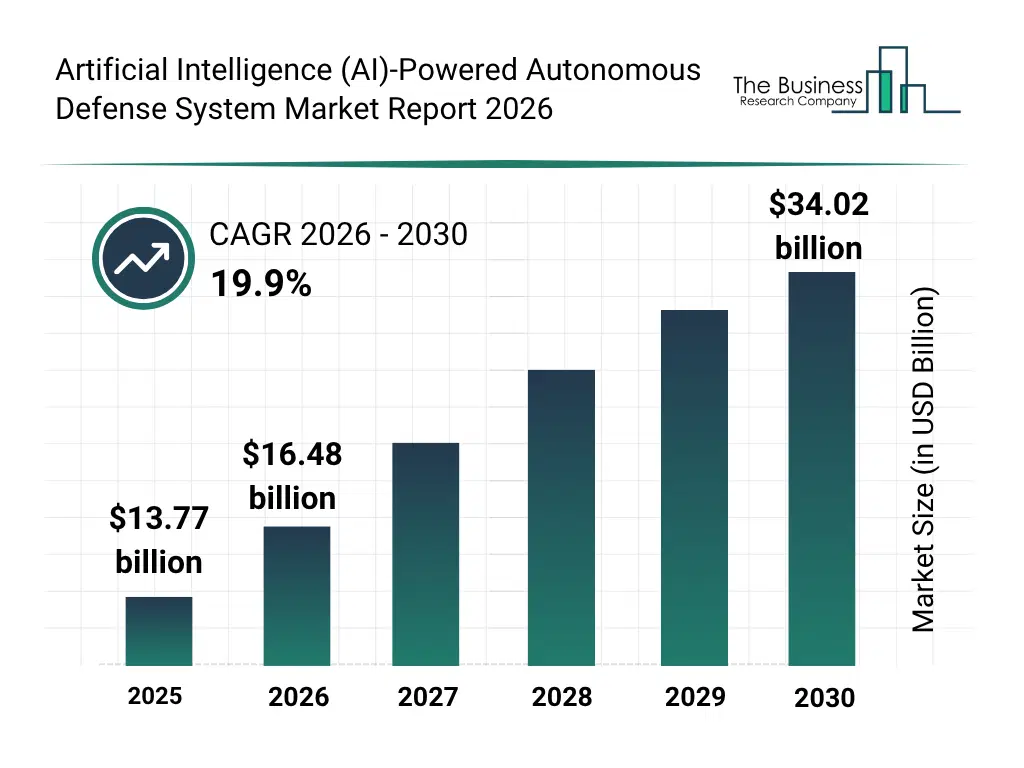
What Is The Artificial Intelligence (AI)-Powered Autonomous Defense System Market Size and Share 2026?
The artificial intelligence (AI)-powered autonomous defense system market size has grown rapidly in recent years. It will grow from $13.77 billion in 2025 to $16.48 billion in 2026 at a compound annual growth rate (CAGR) of 19.6%. The growth in the historic period can be attributed to increasing modernization of conventional defense systems, rising cross-border security threats, early adoption of radar-based surveillance networks, growth in defense electronics spending, increasing reliance on human-operated command systems.What Is The Artificial Intelligence (AI)-Powered Autonomous Defense System Market Growth Forecast?
The artificial intelligence (AI)-powered autonomous defense system market size is expected to see rapid growth in the next few years. It will grow to $34.02 billion in 2030 at a compound annual growth rate (CAGR) of 19.9%. The growth in the forecast period can be attributed to rising geopolitical instability driving autonomous defense adoption, increasing demand for unmanned multi-domain warfare systems, expansion of defense automation and AI integration programs, growing investment in intelligent battlefield decision systems, increasing focus on cyber-resilient autonomous defense infrastructure. Major trends in the forecast period include increasing deployment of fully autonomous multi-domain defense platforms for real-time threat neutralization, rising adoption of sensor fusion-based battlefield awareness systems for enhanced situational intelligence, growing integration of AI-driven command and control systems for automated mission execution, expansion of autonomous electronic warfare systems for adaptive threat suppression, increasing use of swarm-enabled autonomous defense units for distributed combat operations.
Global Artificial Intelligence (AI)-Powered Autonomous Defense System Market Segmentation
1) By Component: Hardware, Software, Services 2) By Platform Type: Unmanned Aerial Vehicles, Unmanned Surface Vessels, Unmanned Ground Vehicles, Autonomous Electronic Warfare Systems 3) By Technology: Artificial Intelligence Mission Autonomy Software, Swarm Intelligence, Autonomous Navigation, Electronic Battle Management 4) By End User: Defense Agencies, Armed Forces, Homeland Security, Intelligence Organizations, Naval Forces, Other End Users Subsegments: 1) By Hardware: Sensors, Radar Systems, Cameras, Light Detection And Ranging Systems, Processors, Communication Devices 2) By Software: Threat Detection Software, Mission Planning Software, Navigation Software, Data Analytics Software, Command And Control Software, Cybersecurity Software 3) By Services: System Integration Services, Consulting Services, Training Services, Maintenance Services, Repair Services, Software Upgrade Services, Remote Monitoring ServicesWhat Is The Driver Of The Artificial Intelligence (AI)-Powered Autonomous Defense System Market?
The rising security threats are expected to propel the growth of the artificial intelligence (AI)-powered autonomous defense system market going forward. Security threats refer to potential risks posed by hostile entities, including cyberattacks, terrorism, and unmanned or autonomous weapon systems, which can compromise national security and critical infrastructure. Rapid digitalization has expanded the number of connected systems and devices, increasing vulnerabilities and creating more opportunities for cyberattacks. AI-powered autonomous defense systems are used to automatically detect, analyze, and respond to security threats in real time, enabling faster and more accurate threat mitigation with minimal human intervention. For instance, in April 2025, according to the Department for Science, Innovation and Technology (DSIT), a UK-based government department, the share of businesses experiencing ransomware incidents over the past 12 months rose from under 0.5% in 2024 to 1% in 2025, representing approximately 19,000 affected businesses in 2025. Therefore, the rising security threats are driving the growth of the artificial intelligence (AI)-powered autonomous defense system industry.Key Players In The Global Artificial Intelligence (AI)-Powered Autonomous Defense System Market
Major companies operating in the artificial intelligence (ai)-powered autonomous defense system market are The Boeing Company, Northrop Grumman Corporation, L3Harris Technologies Inc., General Atomics, Palantir Technologies Inc., Anduril Industries Inc., AeroVironment Inc., Saronic Technologies Inc., Shield AI Inc., Skydio Inc., Helsing GmbH, Kraken Robotics Inc., Rebellion Defense Inc., Applied Intuition Inc., Accrete AI Inc., Overland AI Inc., Second Front Systems Inc., Swarm Aero Pty Ltd., CyberLux Corporation, Kratos Defense & Security Solutions Inc., Draganfly Inc., Hadean Supercomputing Ltd., AndrenaM Inc., PteroDynamics Inc., Red Cat Holdings Inc.Global Artificial Intelligence (AI)-Powered Autonomous Defense System Market Trends and Insights
Major companies operating in the artificial intelligence (AI)-powered autonomous defense system market are focusing on developing advanced solutions, such as autonomous interception systems that leverage onboard artificial intelligence to detect, track, and neutralize hostile unmanned aerial vehicles (UAVs) in real time, improving threat response speed and operational efficiency. Autonomous interception systems are AI-enabled defense systems designed to independently detect, track, and neutralize incoming threats such as missiles, drones, or aircraft without requiring real-time human intervention. For instance, in August 2025, SkyDefense LLC, a US-based defense technology company specializing in autonomous aerial security systems, unveiled its CobraJet AI-powered eVTOL fighter drone and interceptor, designed for counter-unmanned aerial system (C-UAS) operations, which features real-time detection, tracking, identification, and neutralization of enemy drones at speeds exceeding 200 mph, and utilizes onboard AI for autonomous decision-making and coordinated swarm operations, enabling rapid and precise defense against evolving drone threats in modern warfare scenarios.What Are Latest Mergers And Acquisitions In The Artificial Intelligence (AI)-Powered Autonomous Defense System Market?
In May 2026, Electro Optic Systems, an Australia-based provider of remote weapons systems and defense electro-optics solutions, acquired the counter-UAS business of MARSS Group for an undisclosed amount. With this acquisition, EOS aims to enhance its AI-powered autonomous defense capabilities by integrating MARSS’ NiDAR command-and-control platform, enabling sensor fusion, automated threat detection, and real-time drone interception. MARSS is a UK-based provider of AI-enabled counter-drone command-and-control systems for defense applications.Regional Outlook/Insights
North America was the largest region in the artificial intelligence (AI)-powered autonomous defense system market in 2025. Asia-Pacific is expected to be the fastest-growing region in the forecast period. The regions covered in this market report are Asia-Pacific, South East Asia, Western Europe, Eastern Europe, North America, South America, Middle East, Africa. The countries covered in this market report are Australia, Brazil, China, France, Germany, India, Indonesia, Japan, Taiwan, Russia, South Korea, UK, USA, Canada, Italy, Spain.What Defines the Artificial Intelligence (AI)-Powered Autonomous Defense System Market?
The artificial intelligence (AI)-powered autonomous defense system market consists of revenues earned by entities by providing services such as autonomous surveillance and reconnaissance, threat detection and assessment, target tracking, mission planning and decision-support, swarm coordination management, border and perimeter security monitoring, and predictive maintenance. The market value includes the value of related goods sold by the service provider or included within the service offering. The artificial intelligence (AI)-powered autonomous defense system market also includes sales of autonomous drones, robotic defense systems, and AI-powered radar systems. values in this market are ‘factory gate’ values, that is, the value of goods sold by the manufacturers or creators of the goods, whether to other entities (including downstream manufacturers, wholesalers, distributors and retailers) or directly to end customers. the value of goods in this market includes related services sold by the creators of the goods.How is Market Value Defined and Measured?
The market value is defined as the revenues that enterprises gain from the sale of goods and/or services within the specified market and geography through sales, grants, or donations in terms of the currency (in USD unless otherwise specified). The revenues for a specified geography are consumption values that are revenues generated by organizations in the specified geography within the market, irrespective of where they are produced. It does not include revenues from resales along the supply chain, either further along the supply chain or as part of other products.What Key Data and Analysis Are Included in the Artificial Intelligence (AI)-Powered Autonomous Defense System Market Report 2026?
The artificial intelligence (ai)-powered autonomous defense system market research report is one of a series of new reports from The Business Research Company that provides market statistics, including industry global market size, regional shares, competitors with the market share, detailed market segments, market trends and opportunities, and any further data you may need to thrive in the artificial intelligence (ai)-powered autonomous defense system industry. The market research report delivers a complete perspective of everything you need, with an in-depth analysis of the current and future state of the industry.Artificial Intelligence (AI)-Powered Autonomous Defense System Market Report Forecast Analysis
| Report Attribute | Details |
|---|---|
| Market Size Value In 2026 | $16.48 billion |
| Revenue Forecast In 2035 | $34.02 billion |
| Growth Rate | CAGR of 19.9% from 2026 to 2035 |
| Base Year For Estimation | 2025 |
| Actual Estimates/Historical Data | 2020-2025 |
| Forecast Period | 2026 - 2030 - 2035 |
| Market Representation | Revenue in USD Billion and CAGR from 2026 to 2035 |
| Segments Covered | Component, Platform Type, Technology, End User |
| Regional Scope | Asia-Pacific, Western Europe, Eastern Europe, North America, South America, Middle East, Africa |
| Country Scope | The countries covered in the report are Australia, Brazil, China, France, Germany, India, Indonesia, Japan, Taiwan, Russia, South Korea, UK, USA, Canada, Italy, Spain. |
| Key Companies Profiled | The Boeing Company, Northrop Grumman Corporation, L3Harris Technologies Inc., General Atomics, Palantir Technologies Inc., Anduril Industries Inc., AeroVironment Inc., Saronic Technologies Inc., Shield AI Inc., Skydio Inc., Helsing GmbH, Kraken Robotics Inc., Rebellion Defense Inc., Applied Intuition Inc., Accrete AI Inc., Overland AI Inc., Second Front Systems Inc., Swarm Aero Pty Ltd., CyberLux Corporation, Kratos Defense & Security Solutions Inc., Draganfly Inc., Hadean Supercomputing Ltd., AndrenaM Inc., PteroDynamics Inc., Red Cat Holdings Inc. |
| Customization Scope | Request for Customization |
| Pricing And Purchase Options | Explore Purchase Options |