

Artificial Intelligence (AI)-Powered Robot Picker Market Report 2026
Global Outlook – By Component (Hardware, Software, Services), By Picking Object Types (Fixed Robotic Arm Picking Workstation, Automated Guided Vehicle Plus Robotic Arm Integrated Picking Robot, Collaborative Robotic Arm), By Perception And Algorithm Technology (2D Vision Plus Barcode Recognition, 3D Vision Recognition Plus Posture Estimation, Vision Plus Force Control Fusion Type), By Sales Channel (Direct Sales, System Integrators, Value-Added Resellers, Original Equipment Manufacturers), By End Use Industry (Manufacturing, Automotive, Electronics, Logistics And Warehousing, Healthcare, Retail) – Market Size, Trends, Strategies, and Forecast to 2030
Artificial Intelligence (AI)-Powered Robot Picker Market Overview
• Artificial Intelligence (AI)-Powered Robot Picker market size has reached to $1.81 billion in 2025 • Expected to grow to $4.6 billion in 2030 at a compound annual growth rate (CAGR) of 20.5% • Growth Driver: Intensifying Labor Shortages And Rising Wage Pressures Fueling The Growth Of The Market Due To Increasing Need For Automated Picking And Workforce Cost Optimization • Market Trend: Development Of AI-Enabled Robotic Item Pickers To Automate Unstructured Warehouse Picking Tasks • North America was the largest region in 2025 and Asia-Pacific is the fastest growing region.Market Gains By 2030 – Top Opportunities By Segment
Market Gain identifies the most promising market opportunities by highlighting the segments or products expected to generate the highest incremental revenue growth over the next five years.
What Is Covered Under Artificial Intelligence (AI)-Powered Robot Picker Market?
Artificial intelligence-powered robot pickers refers to automated robotic systems that use artificial intelligence, machine vision, and advanced algorithms to identify, select, and handle items accurately within warehouses or industrial environments. Their main purpose is to increase picking speed and accuracy, reduce labor dependency, lower operational costs, and improve overall efficiency in material handling and order fulfillment operations. The main components of artificial intelligence-powered robot pickers include hardware, software, and services. Hardware refers to the physical robotic systems and mechanical components that enable automated picking operations with high precision, speed, and reliability in industrial environments. The various applications involved include fixed robotic arm picking workstations, automated guided vehicle plus robotic arm integrated picking robots, and collaborative robotic arms, supported by perception and algorithm technologies such as two-dimensional vision plus barcode recognition, three-dimensional vision recognition plus posture estimation, and vision plus force control fusion type, and are distributed through sales channels such as direct sales, system integrators, value-added resellers, and original equipment manufacturers, and are adopted by end users including manufacturing, automotive, and electronics companies, as well as logistics and warehousing, healthcare, and retail industries.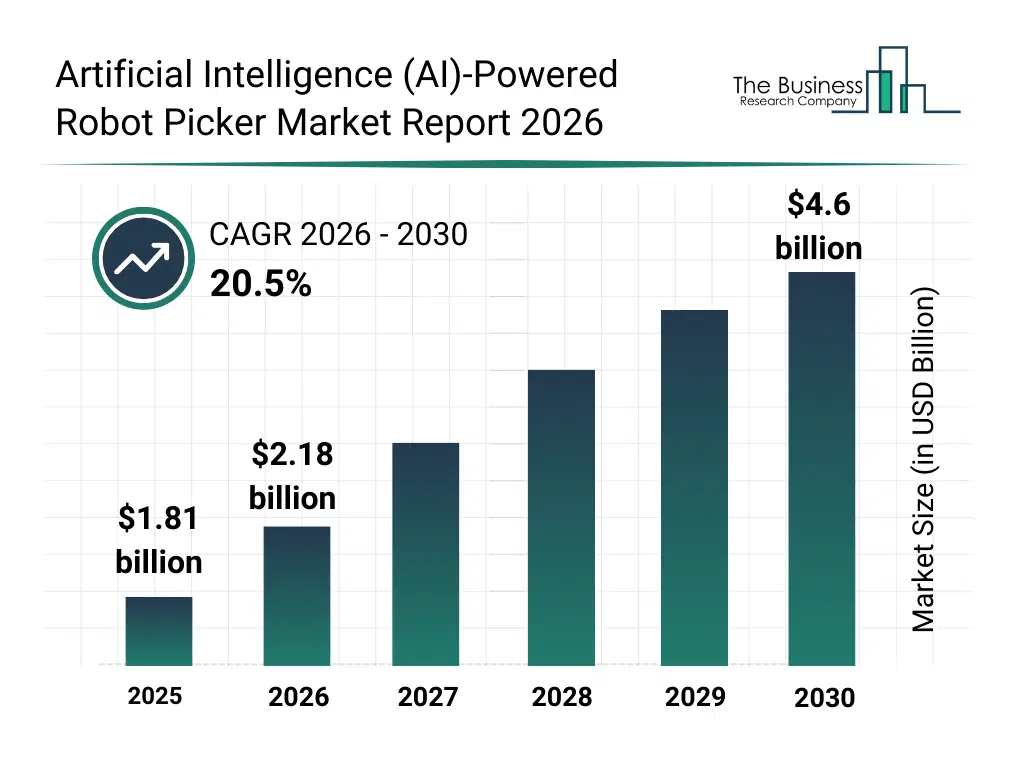
What Is The Artificial Intelligence (AI)-Powered Robot Picker Market Size and Share 2026?
The artificial intelligence (AI)-powered robot picker market size has grown exponentially in recent years. It will grow from $1.81 billion in 2025 to $2.18 billion in 2026 at a compound annual growth rate (CAGR) of 20.3%. The growth in the historic period can be attributed to warehouse automation adoption, rising labor shortages, growth in e-commerce fulfillment, early robotics integration, cost reduction initiatives.What Is The Artificial Intelligence (AI)-Powered Robot Picker Market Growth Forecast?
The artificial intelligence (AI)-powered robot picker market size is expected to see exponential growth in the next few years. It will grow to $4.6 billion in 2030 at a compound annual growth rate (CAGR) of 20.5%. The growth in the forecast period can be attributed to AI perception improvements, smart warehouse investments, demand for faster fulfillment, flexible manufacturing adoption, robotics-as-a-service models. Major trends in the forecast period include vision-based item recognition, autonomous robotic picking systems, ai-driven grasp optimization, high-speed order fulfillment automation, human-robot collaborative picking.
Global Artificial Intelligence (AI)-Powered Robot Picker Market Segmentation
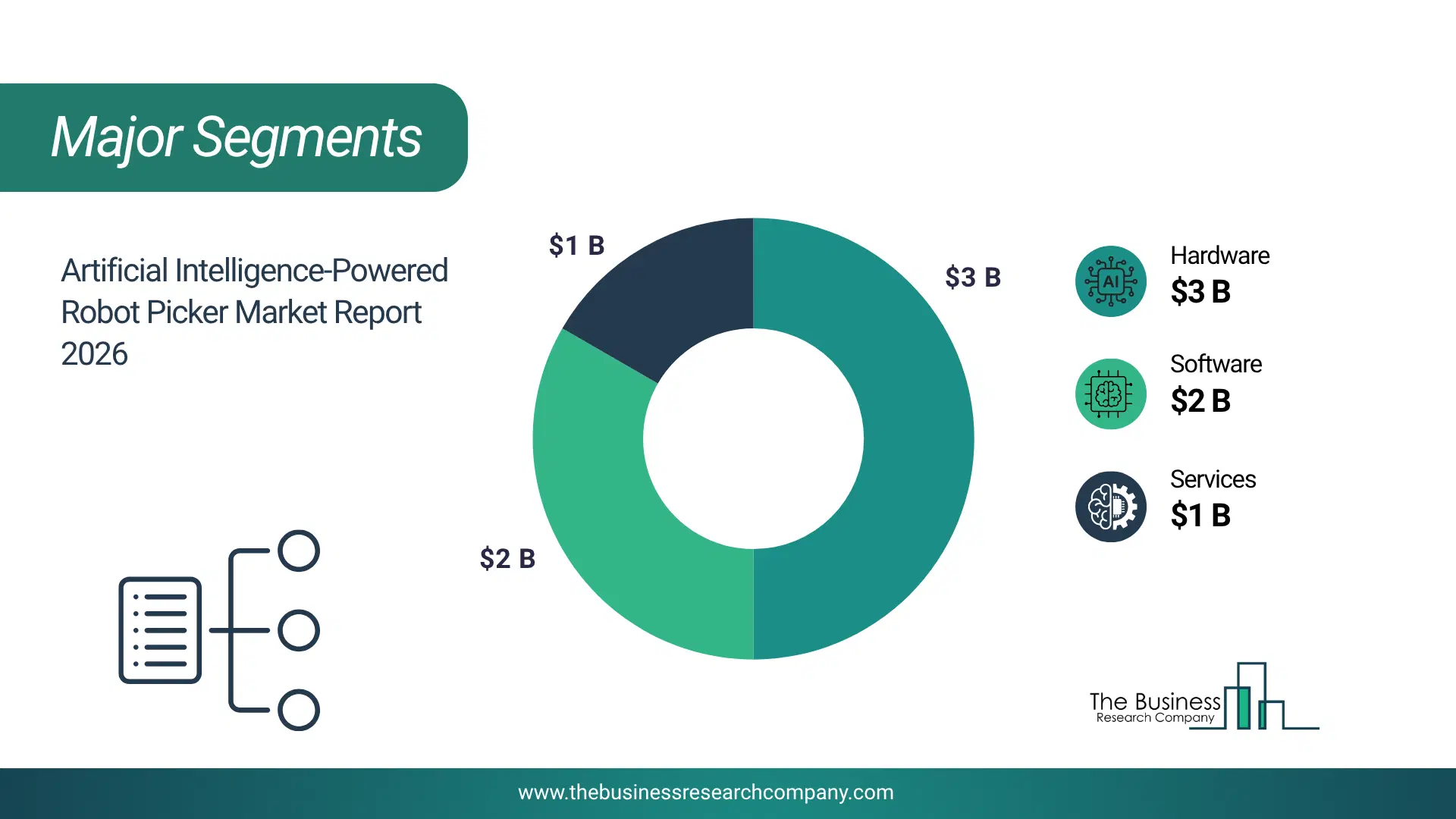
1) By Component: Hardware, Software, Services 2) By Picking Object Types: Fixed Robotic Arm Picking Workstation, Automated Guided Vehicle Plus Robotic Arm Integrated Picking Robot, Collaborative Robotic Arm 3) By Perception And Algorithm Technology: 2D Vision Plus Barcode Recognition, 3D Vision Recognition Plus Posture Estimation, Vision Plus Force Control Fusion Type 4) By Sales Channel: Direct Sales, System Integrators, Value-Added Resellers, Original Equipment Manufacturers 5) By End Use Industry: Manufacturing, Automotive, Electronics, Logistics And Warehousing, Healthcare, Retail Subsegments: 1) By Hardware: Robotic Arms, Grippers And End Effectors, Sensors And Cameras, Actuators, Control Units 2) By Software: Navigation Software, Vision Processing Software, Machine Learning Algorithms, Task Scheduling Software, Fleet Management Software 3) By Services: Installation And Setup Services, Maintenance And Support Services, Training And Consultation Services, Integration Services, Software Update And Optimization Services The top segments in the artificial intelligence-powered robot picker market will be: • Hardware will reach $2.98 Billion by 2030. • Software will reach $1.77 Billion by 2030. • Services will reach $0.78 Billion by 2030.What Is The Driver Of The Artificial Intelligence (AI)-Powered Robot Picker Market?
The intensifying labor shortages and rising wage pressures are expected to propel the growth of the artificial intelligence-powered robot picker market going forward. Labor shortages and rising wage pressures refer to the insufficient availability of workers in warehousing and logistics roles alongside increasing compensation costs for these positions. Intensifying labor shortages and rising wage pressures are increasing due to the shrinking availability of skilled workers relative to growing demand across logistics, manufacturing, and service industries. Artificial intelligence-powered robot pickers help address intensifying labor shortages and rising wage pressures by automating repetitive picking tasks, reducing reliance on manual labor, and enabling consistent productivity with lower long-term labor costs. For instance, in December 2025, according to the U.S. Bureau of Labor Statistics, a US-based government agency, warehousing employment remained largely stagnant at 1,816.4 thousand seasonally adjusted, showing little net change since April 2025 after peaking near 1,823.2 thousand in August 2025, highlighting persistent labor supply constraints. Therefore, the intensifying labor shortages and rising wage pressures are driving the growth of the artificial intelligence-powered robot picker market.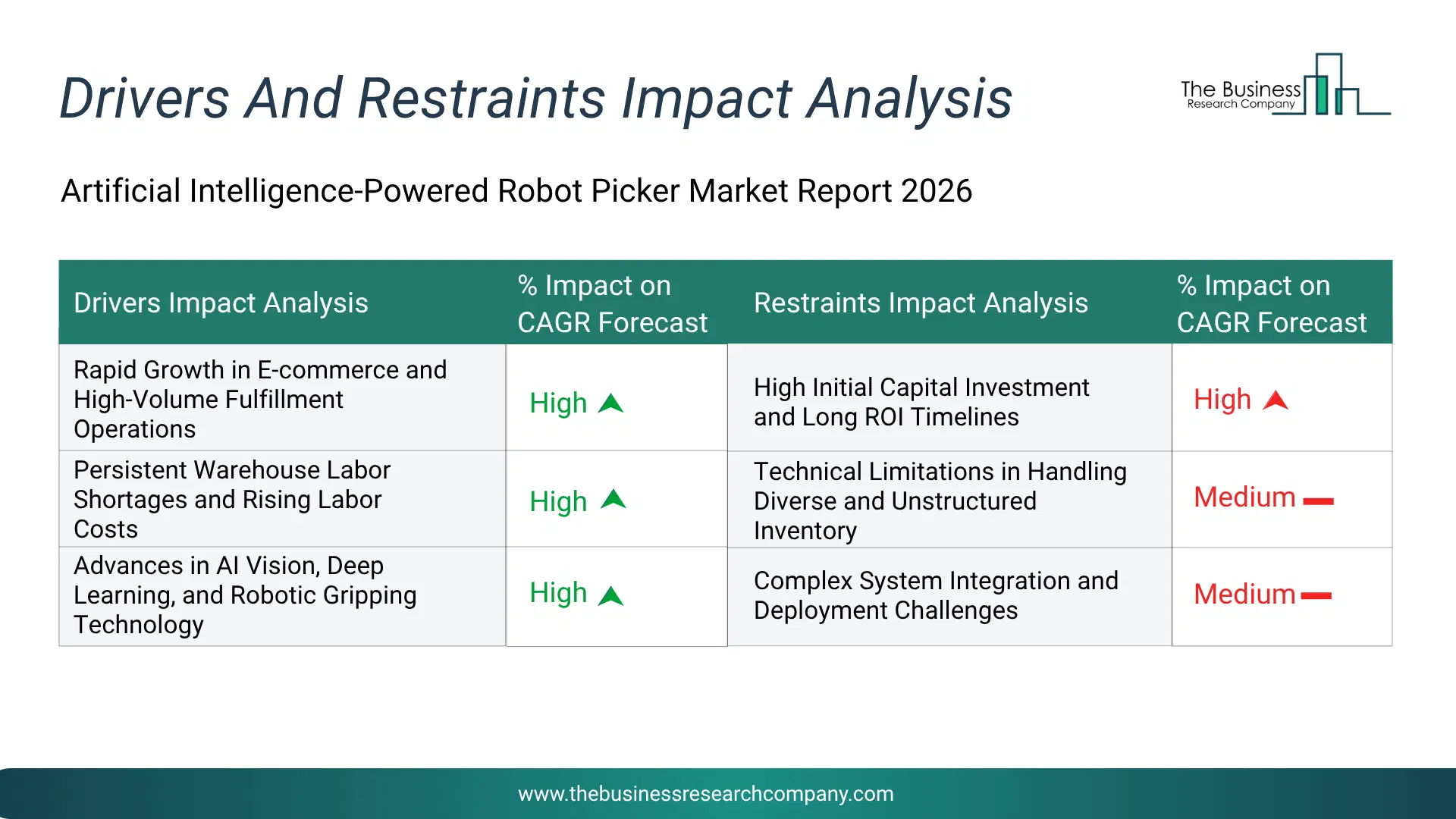
Infographic Chart Showing Key Market Drivers Analysis And Restraints For Artificial Intelligence (Ai)-Powered Robot Picker Market
The chart presents an impact analysis of key drivers and restraints, quantifying their relative influence on the market's growth rate and helping assess the balance between growth enablers and limiting factors. This chart offers a high-level perspective; the full report contains more detailed insights.
How Will The Drivers Impact Growth In The Global Artificial Intelligence-Powered Robot Picker Market?
• Rapid Growth in E-commerce and High-Volume Fulfillment Operations (High) – During the forecast period, the rapid growth in e-commerce and high-volume fulfillment operations is expected to become a key growth driver for the AI- powered robot picker market by 2030. The increasing volume of online orders is creating demand for faster and more accurate picking processes across warehouses and distribution centers. Businesses are deploying AI-powered robotic picking systems to improve throughput, reduce order processing times, and manage peak demand periods efficiently. These solutions enable continuous operations while supporting large-scale inventory handling requirements. As fulfillment networks continue to expand globally, adoption of intelligent robotic picking technologies is expected to accelerate significantly. • Persistent Warehouse Labor Shortages and Rising Labor Costs (High) – During the forecast period, the persistent warehouse labor shortages and rising labor costs are expected to emerge as a major factor driving the expansion of the AI- powered robot picker market by 2030. Distribution centers and manufacturing facilities are increasingly facing challenges in recruiting and retaining workers for repetitive picking tasks. AI-powered robot pickers provide a scalable alternative by automating labor-intensive operations while maintaining consistent performance and productivity. Organizations are therefore investing in robotic automation to reduce dependency on manual labor and improve operational resilience. • Advances in AI Vision, Deep Learning, and Robotic Gripping Technology (High) – During the forecast period, the advances in AI vision, deep learning, and robotic gripping technology are expected to act as a key growth catalyst for the AI- powered robot picker market by 2030. Continuous improvements in machine perception, object recognition, and adaptive gripping capabilities are enabling robots to handle a wider variety of products with greater accuracy. Modern AI algorithms allow robotic systems to identify, locate, and pick complex objects in dynamic environments with minimal human intervention. These technological advancements are expanding deployment opportunities across industries with diverse inventory profiles and operational requirements.How Will The Restraints Impact Growth In The Global Artificial Intelligence-Powered Robot Picker Market?
• High Initial Capital Investment and Long ROI Timelines (High) – During the forecast period, the AI-powered robotic picking solutions require substantial upfront investment in robotics hardware, AI software, integration, sensors, and infrastructure modifications. Small and mid-sized warehouses often hesitate due to uncertain return on investment and long deployment payback periods. • Technical Limitations in Handling Diverse and Unstructured Inventory (High) – During the forecast period, the despite technological progress, robot pickers still face challenges when handling highly irregular, deformable, transparent, reflective, or tightly packed items. Performance limitations in dynamic, unstructured picking environments can reduce reliability compared with human workers in certain applications. • Complex System Integration and Deployment Challenges (High) – During the forecast period, the deploying AI-powered robot pickers often requires integration with existing warehouse management systems, ERP platforms, conveyors, and automation infrastructure. Implementation complexity, workflow redesign, and operational downtime during deployment can slow adoption.Key Players In The Global Artificial Intelligence (AI)-Powered Robot Picker Market
Major companies operating in the artificial intelligence (AI)-powered robot picker market are Fanuc Crop., Yaskawa Electric Corporation, Knapp AG, Kardex Remstar LLC, Addverb Technologies Pvt. Ltd., Exotec SAS, Kawasaki Robotics, Mobile Industrial Robots A/S, Locus Robotics Inc., 6 River Systems Inc., Sanctuary AI Corporation, Agility Robotics Inc., Brightpick Robotics Inc., Apptronik Inc., Vecna Robotics Inc., RightHand Robotics Inc., Plus One Robotics Inc., inVia Robotics Inc., XYZ Robotics Inc., EVS Tech Co. Ltd.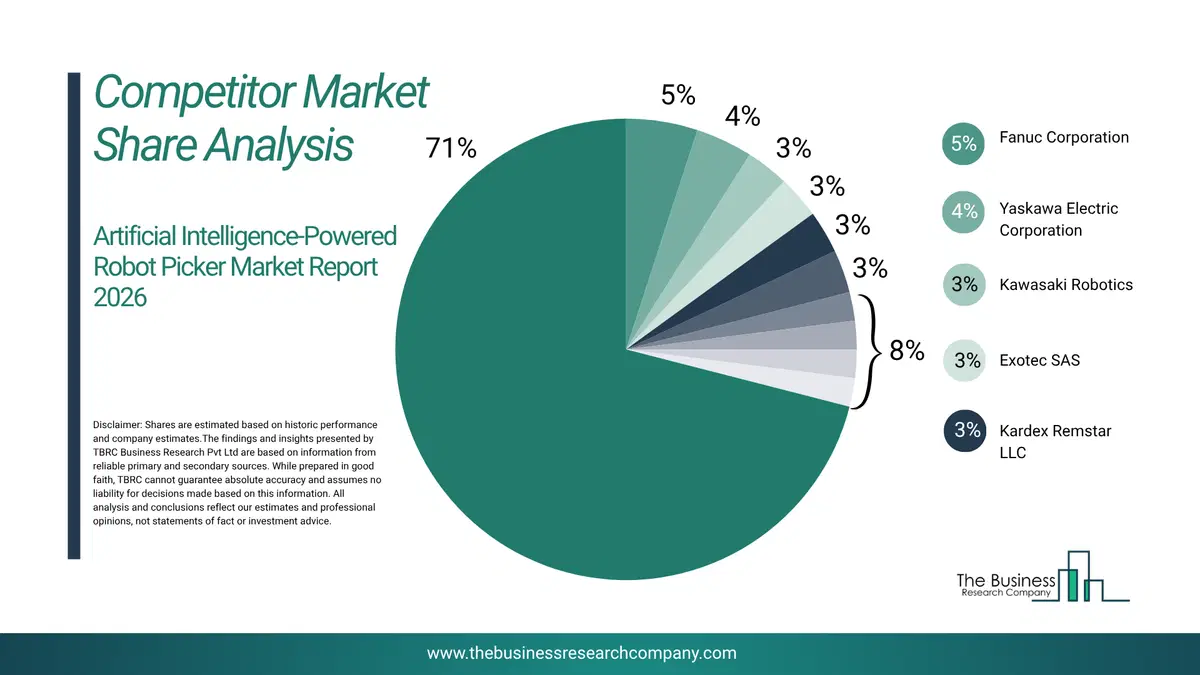
This chart is for illustrative purposes; the full report includes a detailed competitor analysis and comprehensive overview of the top 10 companies in the market.
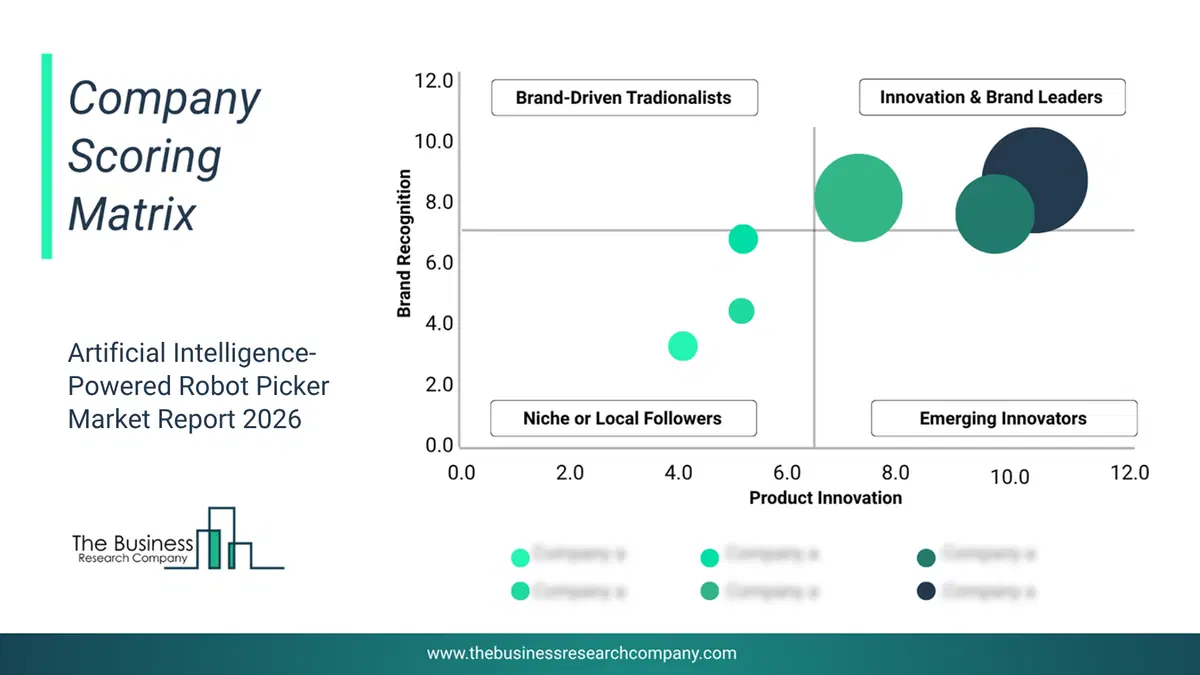
This chart maps companies by product innovation and brand strength, with bubble size indicating relative revenue, helping identify market leaders, challengers, and niche players. This is an illustrative chart; the full report provides a complete and accurate competitive analysis.
Global Artificial Intelligence (AI)-Powered Robot Picker Market Trends and Insights
Major companies operating in the artificial intelligence-powered robot picker market are focusing on developing advanced solutions, such as AI-enabled robotic item pickers, to automate unstructured picking tasks in warehouse environments. AI-enabled robotic item pickers refer to vision-based robotic systems that combine machine learning algorithms with intelligent grippers, such as suction-based end effectors, to identify, grasp, and place a wide variety of items without requiring prior item-specific data. For instance, in May 2023, ABB Robotics, a Switzerland-based automation company, launched its Robotic Item Picker solution, an AI-enabled robotic picking system designed for warehousing and logistics operations. The solution uses advanced computer vision and machine learning to accurately identify and pick a wide range of items at high speed. It features adaptive gripping technology that enables reliable handling of mixed, irregular, and fragile objects. Additionally, the system integrates seamlessly with existing warehouse management and automation systems, supporting flexible and scalable deployment.What Are Latest Mergers And Acquisitions In The Artificial Intelligence (AI)-Powered Robot Picker Market?
In October 2025, SoftBank Group, a Japan-based investment company, acquired the Robotics division of ABB Ltd. for approximately $5.4 billion. Through this acquisition, SoftBank aims to expand its footprint in AI-driven robotics by integrating ABB’s industrial and autonomous robotics technologies into its broader “Physical AI” strategy, strengthening its capabilities in advanced automation applications such as e-commerce, logistics, and warehouse material handling. ABB’s Robotics division is a Switzerland-based provider of industrial and autonomous robots, sensors, and control systems that serve manufacturing, logistics, and warehouse automations.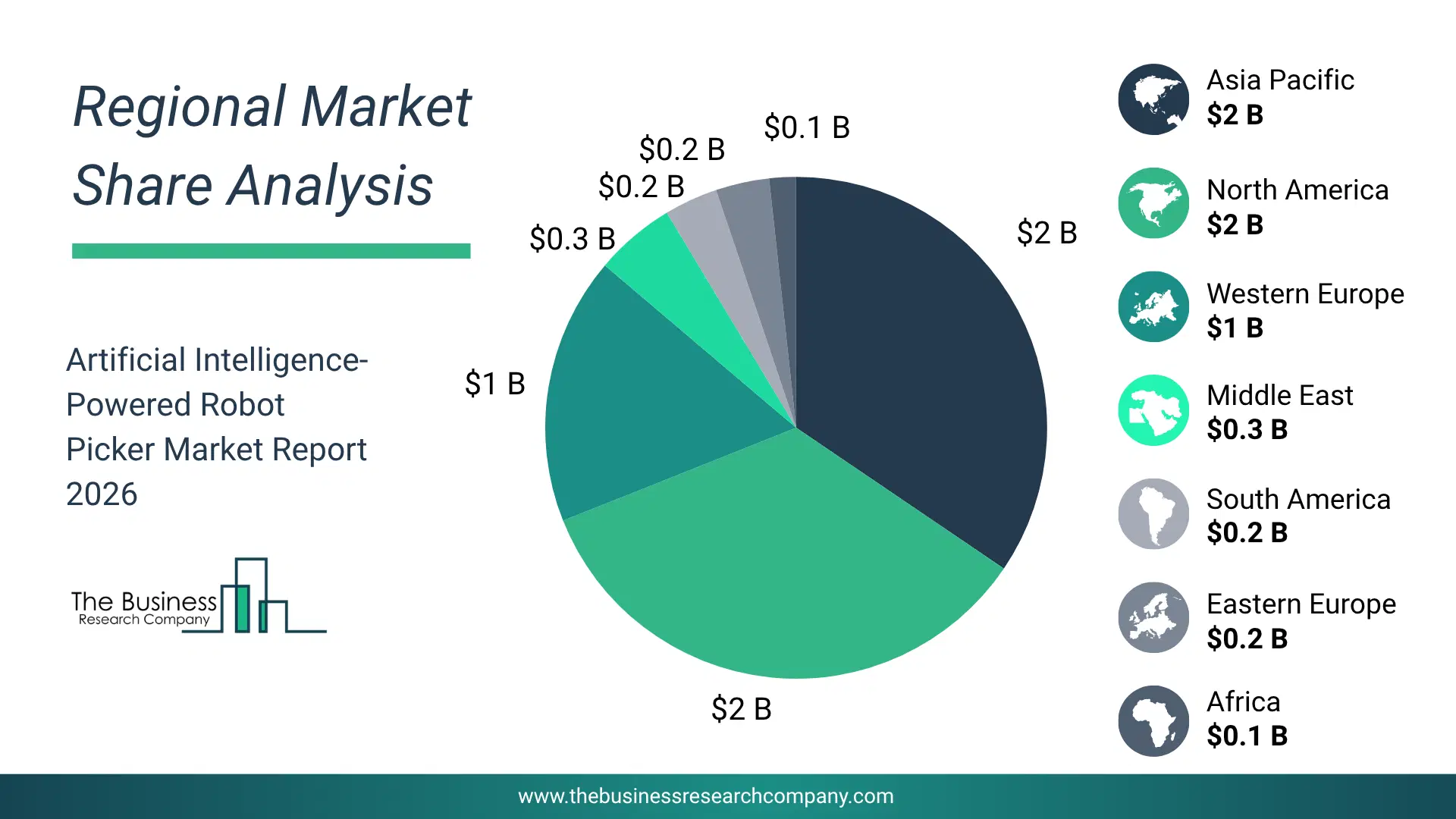
Regional Outlook
North America was the largest region in the artificial intelligence-powered robot picker market in 2025. Asia-Pacific is expected to be the fastest-growing region in the forecast period. The regions covered in this market report are Asia-Pacific, South East Asia, Western Europe, Eastern Europe, North America, South America, Middle East, Africa. The countries covered in this market report are Australia, Brazil, China, France, Germany, India, Indonesia, Japan, Taiwan, Russia, South Korea, UK, USA, Canada, Italy, Spain.What Defines the Artificial Intelligence (AI)-Powered Robot Picker Market?
The artificial intelligence-powered robot picker market consists of revenues earned by entities by providing services such as robotic system integration, warehouse automation consulting, deployment and commissioning services, software configuration and optimization, and maintenance and technical support. The market value includes the value of related goods sold by the service provider or included within the service offering. The artificial intelligence-powered robot picker market also includes sales of robotic picking systems, machine vision modules, artificial intelligence control software, robotic arms and grippers, and automated material handling units. Values in this market are ‘factory gate’ values, that is, the value of goods sold by the manufacturers or creators of the goods, whether to other entities (including downstream manufacturers, wholesalers, distributors, and retailers) or directly to end customers. The value of goods in this market includes related services sold by the creators of the goods.How is Market Value Defined and Measured?
The market value is defined as the revenues that enterprises gain from the sale of goods and/or services within the specified market and geography through sales, grants, or donations in terms of the currency (in USD unless otherwise specified). The revenues for a specified geography are consumption values that are revenues generated by organizations in the specified geography within the market, irrespective of where they are produced. It does not include revenues from resales along the supply chain, either further along the supply chain or as part of other products.
This chart presents market attractiveness based on a quantitative evaluation of growth, competition, strategic alignment, and risk, offering a clear view of opportunity areas for decision-making. This chart is for illustrative purposes; the full report contains the complete analysis.

This chart highlights the Total Addressable Market (TAM) by estimating the maximum revenue opportunity using an assumption-driven approach, supporting strategic planning and opportunity sizing across markets. The chart is illustrative; the full report provides a more comprehensive analysis.
What Key Data and Analysis Are Included in the Artificial Intelligence (AI)-Powered Robot Picker Market Report 2026?
The artificial intelligence (ai)-powered robot picker market research report is one of a series of new reports from The Business Research Company that provides market statistics, including industry global market size, regional shares, competitors with the market share, detailed market segments, market trends and opportunities, and any further data you may need to thrive in the artificial intelligence (ai)-powered robot picker industry. The market research report delivers a complete perspective of everything you need, with an in-depth analysis of the current and future state of the industry.Artificial Intelligence (AI)-Powered Robot Picker Market Report Forecast Analysis
| Report Attribute | Details |
|---|---|
| Market Size Value In 2026 | $2.18 billion |
| Revenue Forecast In 2030 | $4.6 billion |
| Growth Rate | CAGR of 20.3% from 2026 to 2030 |
| Base Year For Estimation | 2025 |
| Actual Estimates/Historical Data | 2020-2025 |
| Forecast Period | 2026 - 2030 |
| Market Representation | Revenue in USD Billion and CAGR from 2026 to 2030 |
| Segments Covered | Component, Picking Object Types, Perception And Algorithm Technology, Sales Channel, End Use Industry |
| Regional Scope | Asia-Pacific, Western Europe, Eastern Europe, North America, South America, Middle East, Africa |
| Country Scope | The countries covered in the report are Australia, Brazil, China, France, Germany, India, Indonesia, Japan, Taiwan, Russia, South Korea, UK, USA, Canada, Italy, Spain. |
| Key Companies Profiled | Fanuc Crop., Yaskawa Electric Corporation, Knapp AG, Kardex Remstar LLC, Addverb Technologies Pvt. Ltd., Exotec SAS, Kawasaki Robotics, Mobile Industrial Robots A/S, Locus Robotics Inc., 6 River Systems Inc., Sanctuary AI Corporation, Agility Robotics Inc., Brightpick Robotics Inc., Apptronik Inc., Vecna Robotics Inc., RightHand Robotics Inc., Plus One Robotics Inc., inVia Robotics Inc., XYZ Robotics Inc., EVS Tech Co. Ltd. |
| Customization Scope | Request for Customization |
| Pricing And Purchase Options | Explore Purchase Options |