
Artificial Intelligence In Disaster Response And Emergency Management Market Report 2026
Global Outlook – By Type (Natural Language Processing (NLP), Machine Learning, Computer Vision, Robotics, Speech Recognition), By Technology (Remote Sensing, Internet of Things (IOT) Sensors, Geographic Information Systems (GIS), Drones And Unmanned Aerial Vehicles (UAVs), Cloud Computing, Big Data Analytics), By Application (Earthquake Prediction And Monitoring, Flood Detection And Management, Wildfire Monitoring And Prediction And Rescue Operations, Damage Assessment And Recovery Planning), By End-User (Government Agencies And Authorities, Non-Governmental Organizations (NGOs), Research Institutions And Universities, Disaster Response Teams, Emergency Management Agencies) – Market Size, Trends, Strategies, and Forecast to 2030
Artificial Intelligence In Disaster Response And Emergency Management Market Overview
• Artificial Intelligence In Disaster Response And Emergency Management market size has reached to $152.95 billion in 2025 • Expected to grow to $224.73 billion in 2030 at a compound annual growth rate (CAGR) of 7.7% • Growth Driver: The Increasing Frequency and Severity of Disasters Fueling the Growth of the Market Due to Climate Change and Human Activities • Market Trend: Innovations in Artificial Intelligence (AI) Technology Accelerate Disaster Damage Assessment and Infrastructure Recovery • North America was the largest region in 2025.What Is Covered Under Artificial Intelligence In Disaster Response And Emergency Management Market?
Artificial intelligence in disaster response and emergency management refers to the utilization of AI technologies such as machine learning, natural language processing, and computer vision to enhance preparedness, response, and recovery efforts in the face of natural disasters, humanitarian crises, and other emergencies. AI enables emergency responders, government agencies, and humanitarian organizations to leverage data-driven insights and adaptive strategies to mitigate the impact of disasters, protect lives, and minimize damage to infrastructure and communities. The main types of artificial intelligence in disaster response and emergency management are natural language processing (NLP), machine learning, computer vision, robotics, and speech recognition. Natural language processing (NLP) refers to a branch of artificial intelligence that focuses on enabling computers to understand, interpret, and generate human language for tasks like text analysis and language translation. The various technologies used are remote sensing, internet of things (IoT) sensors, geographic information systems (GIS), drones and unmanned aerial vehicles (UAVs), cloud computing, and big data analytics, which are used for earthquake prediction and monitoring, flood detection and management, wildfire monitoring and prediction, hurricane and cyclone tracking, tsunami early warning systems, search and rescue operations, and damage assessment and recovery planning applications. The end users are government agencies and authorities, non-governmental organizations (NGOs), research institutions and universities, disaster response teams, and emergency management agencies.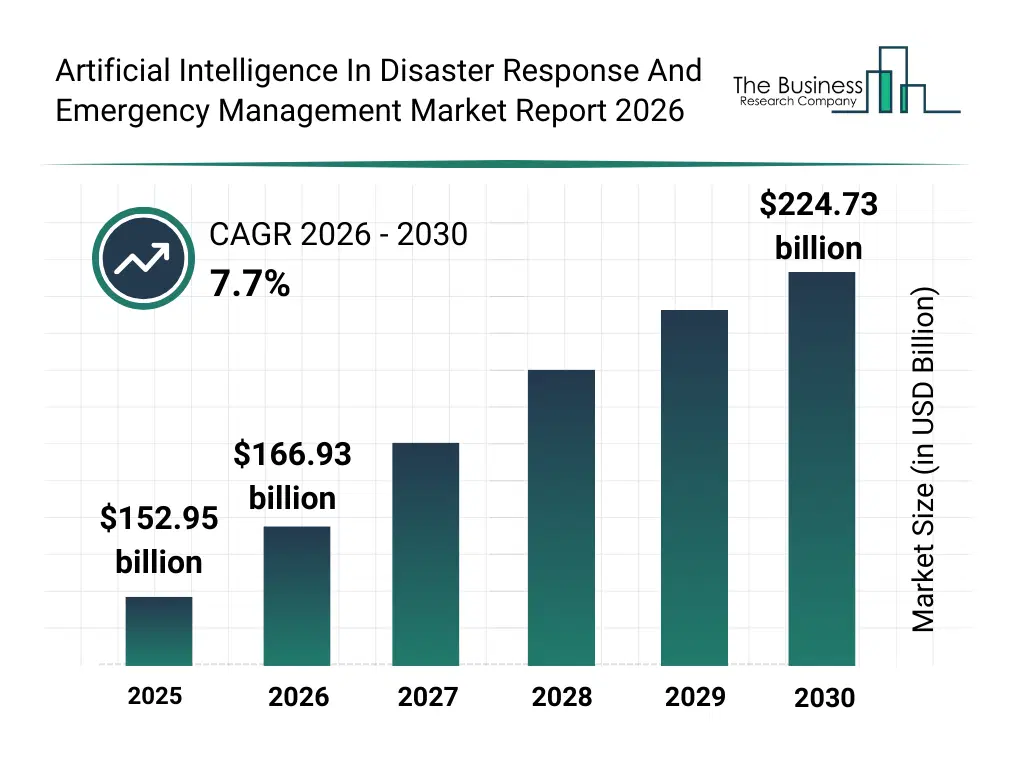
What Is The Artificial Intelligence In Disaster Response And Emergency Management Market Size and Share 2026?
The artificial intelligence in disaster response and emergency management market size has grown strongly in recent years. It will grow from $152.95 billion in 2025 to $166.93 billion in 2026 at a compound annual growth rate (CAGR) of 9.1%. The growth in the historic period can be attributed to increasing frequency of natural disasters, limited manual disaster response capabilities, rising demand for rapid emergency management, adoption of geospatial and sensor technologies, need for efficient humanitarian aid distribution.What Is The Artificial Intelligence In Disaster Response And Emergency Management Market Growth Forecast?
The artificial intelligence in disaster response and emergency management market size is expected to see strong growth in the next few years. It will grow to $224.73 billion in 2030 at a compound annual growth rate (CAGR) of 7.7%. The growth in the forecast period can be attributed to integration of AI with drones and robotics, adoption of cloud-based disaster management platforms, growth in predictive analytics for emergency planning, increased government and ngo investments, expansion of iot-enabled disaster monitoring systems. Major trends in the forecast period include predictive disaster analytics, real-time emergency monitoring, ai-based damage assessment, automated search and rescue operations, crisis communication optimization.
Global Artificial Intelligence In Disaster Response And Emergency Management Market Segmentation
1) By Type: Natural Language Processing (NLP), Machine Learning, Computer Vision, Robotics, Speech Recognition 2) By Technology: Remote Sensing, Internet of Things (IOT) Sensors, Geographic Information Systems (GIS), Drones And Unmanned Aerial Vehicles (UAVs), Cloud Computing, Big Data Analytics 3) By Application: Earthquake Prediction And Monitoring, Flood Detection And Management, Wildfire Monitoring And Prediction, Hurricane And Cyclone Tracking, Tsunami Early Warning Systems, Search And Rescue Operations, Damage Assessment And Recovery Planning 4) By End-User: Government Agencies And Authorities, Non-Governmental Organizations (NGOs), Research Institutions And Universities, Disaster Response Teams, Emergency Management Agencies Subsegments: 1) By Natural Language Processing (NLP): Text Analysis And Summarization, Sentiment Analysis, Chatbots For Emergency Support 2) By Machine Learning: Predictive Analytics For Disaster Preparedness, Disaster Pattern Recognition, Risk Assessment Models 3) By Computer Vision: Damage Detection And Assessment, Surveillance And Monitoring, Object Recognition in Affected Areas 4) By Robotics: Autonomous Search And Rescue Drones, Robotic Disaster Response Units, Robotics For Hazardous Material Handling 5) By Speech Recognition: Voice-Based Emergency Response Systems, Voice Command Systems For Crisis Management, Emergency Call Management SystemsWhat Is The Driver Of The Artificial Intelligence In Disaster Response And Emergency Management Market?
The increasing frequency and severity of disasters are expected to propel the growth of the artificial intelligence in the disaster response and emergency management market going forward. A disaster is a sudden, catastrophic event that causes significant harm, destruction, and disruption to communities, environments, and economies. The rise in disasters is due to the combined effects of natural phenomena, human activities, and climate change, which lead to more frequent and severe events. Artificial intelligence in disaster response and emergency management enhances crisis response by analysing vast amounts of data from multiple sources to forecast disaster impacts, optimize resource allocation, and improve real-time decision-making. For instance, in April 2024, according to the Centre for Research on the Epidemiology of Disasters, a Belgium-based research institute, globally in 2023, the Emergency Events Database recorded 399 natural hazard-related disasters resulting in 86,473 fatalities and affecting $0.0931 billion (93.1 million) people. Therefore, the increasing frequency and severity of disasters are driving the growth of the artificial intelligence in the disaster response and emergency management market.Key Players In The Global Artificial Intelligence In Disaster Response And Emergency Management Market
Major companies operating in the artificial intelligence in disaster response and emergency management market are Amazon Inc.; Alphabet Inc.; Microsoft Corporation; Huawei Technologies Co. Ltd.; Deloitte Touche Tohmatsu Limited; Hitachi Ltd.; Siemens AG; Raytheon Technologies Corporation; Intel Corporation; Accenture PLC; International Business Machines Corporation; Cisco Systems Inc.; General Dynamics Corporation; Northrop Grumman Corporation; Honeywell International Inc.; NVIDIA Corporation; BAE Systems plc; Thales Group; NEC Corporation; Leidos Holdings Inc.; Booz Allen Hamilton Holding Corporation; Motorola Solutions Inc.; Teledyne Technologies Incorporated; Palantir Technologies Inc
This chart is for illustrative purposes; the full report includes a detailed competitor analysis and comprehensive overview of the top 10 companies in the market.
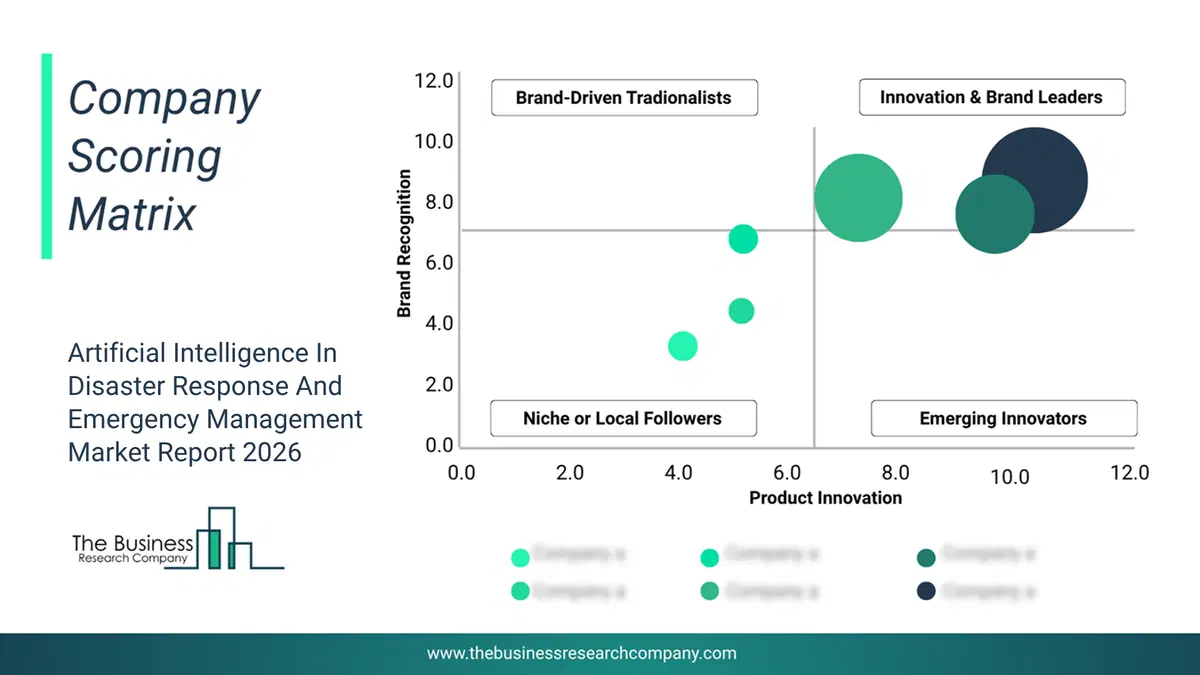
This chart maps companies by product innovation and brand strength, with bubble size indicating relative revenue, helping identify market leaders, challengers, and niche players. This is an illustrative chart; the full report provides a complete and accurate competitive analysis.
Global Artificial Intelligence In Disaster Response And Emergency Management Market Trends and Insights
Major companies operating in the AI in disaster response and emergency management markets are focusing on developing advanced solutions, such as AI damage prediction and assessment platforms, to enhance damage evaluation accuracy, expedite recovery processes, and improve overall resilience. AI damage prediction platforms are AI-powered systems that leverage machine learning and publicly available data to predict and assess damage to infrastructure and buildings caused by natural disasters, enabling faster and more informed decision-making. For instance, in April 2024, NTT Corporation, a Japan-based technology company, launched a machine-learning AI system capable of predicting damage to individual facilities in outdoor communications infrastructure during events like heavy rain or earthquakes. The solution reports accuracy rates of up to 98 % for utility poles, 90 % for bridge-attached pipelines during flooding, and 87 % for underground pipelines during earthquakes, using terrain, weather, and existing facility data without requiring on-site surveys, thereby helping authorities and companies prioritize recovery efforts and minimize downtime.What Are Latest Mergers And Acquisitions In The Artificial Intelligence In Disaster Response And Emergency Management Market?
In July 2024, Motorola Solutions, Inc., a US-based leader in public safety and mission-critical communications technology, acquired Noggin Pty Ltd for an undisclosed amount. Through this acquisition, Motorola Solutions, Inc. aims to strengthen its emergency-response ecosystem by integrating Noggin Pty Ltd’s cloud-based incident-management platform, which features real-time situational awareness dashboards, unified workflows, and resilient communication capabilities. Noggin Pty Ltd is an Australia-based company that provides cloud-native critical-event-management and operational-resilience software for enterprises and public-sector agencies.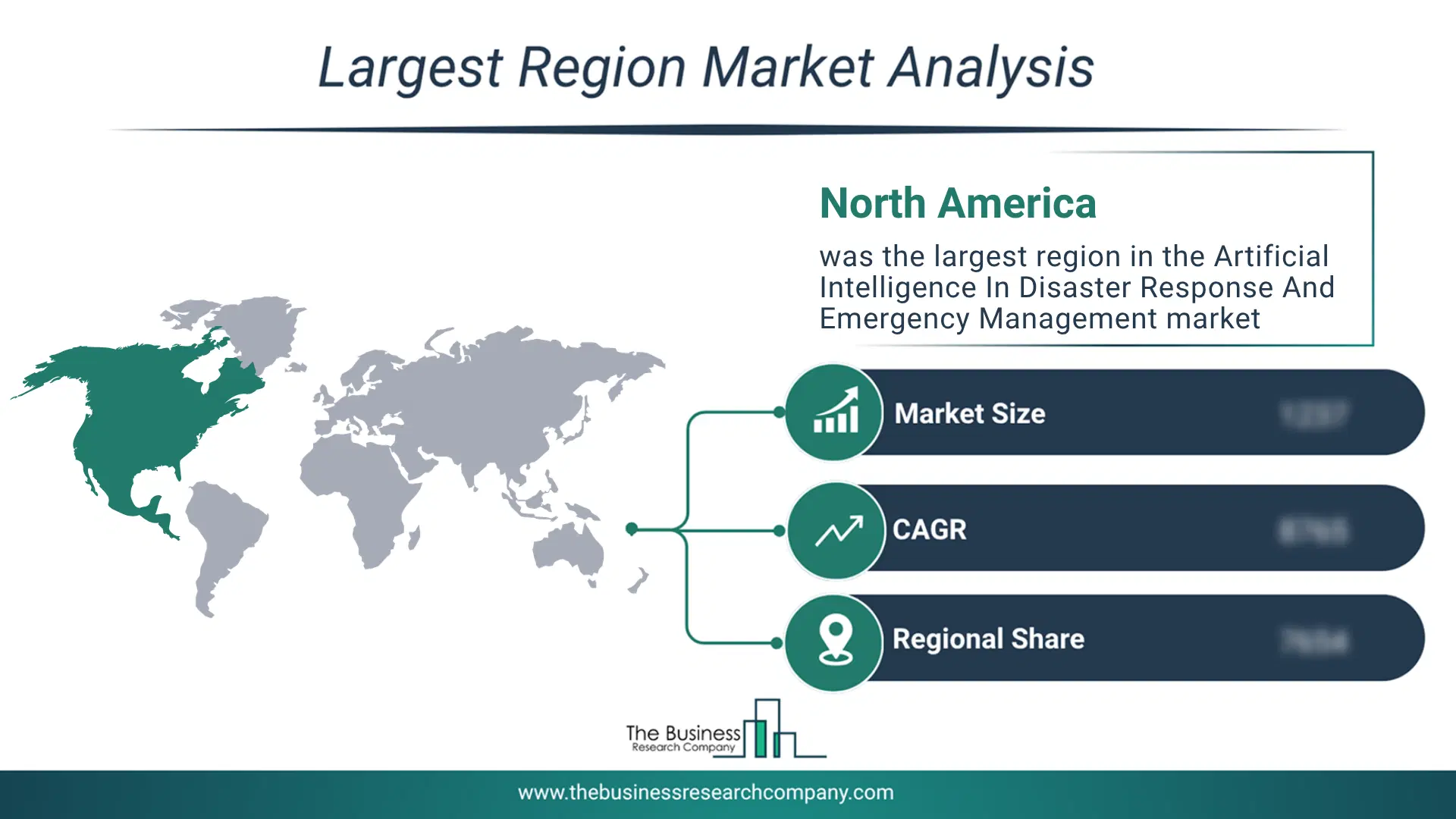
Regional Insights
North America was the largest region in the artificial intelligence in disaster response and emergency management market in 2025. The regions covered in this market report are Asia-Pacific, South East Asia, Western Europe, Eastern Europe, North America, South America, Middle East, Africa. The countries covered in this market report are Australia, Brazil, China, France, Germany, India, Indonesia, Japan, Taiwan, Russia, South Korea, UK, USA, Canada, Italy, SpainWhat Defines the Artificial Intelligence In Disaster Response And Emergency Management Market?
The artificial intelligence in disaster response and emergency management market consists of revenues earned by entities by providing services such as awareness services, natural language processing services, emergency communication, geospatial intelligence services, and risk management services. The market value includes the value of related goods sold by the service provider or included within the service offering. The artificial intelligence in disaster response and emergency management market also includes sales of disaster response robots, imaging and remote sensing devices and control systems which are used in providing the services. Values in this market are ‘factory gate’ values, that is the value of goods sold by the manufacturers or creators of the goods, whether to other entities (including downstream manufacturers, wholesalers, distributors and retailers) or directly to end customers. The value of goods in this market includes related services sold by the creators of the goods.How is Market Value Defined and Measured?
The market value is defined as the revenues that enterprises gain from the sale of goods and/or services within the specified market and geography through sales, grants, or donations in terms of the currency (in USD unless otherwise specified). The revenues for a specified geography are consumption values that are revenues generated by organizations in the specified geography within the market, irrespective of where they are produced. It does not include revenues from resales along the supply chain, either further along the supply chain or as part of other products.
This chart presents market attractiveness based on a quantitative evaluation of growth, competition, strategic alignment, and risk, offering a clear view of opportunity areas for decision-making. This chart is for illustrative purposes; the full report contains the complete analysis.

This chart highlights the Total Addressable Market (TAM) by estimating the maximum revenue opportunity using an assumption-driven approach, supporting strategic planning and opportunity sizing across markets. The chart is illustrative; the full report provides a more comprehensive analysis.
What Key Data and Analysis Are Included in the Artificial Intelligence In Disaster Response And Emergency Management Market Report 2026?
The artificial intelligence in disaster response and emergency management market research report is one of a series of new reports from The Business Research Company that provides market statistics, including industry global market size, regional shares, competitors with the market share, detailed market segments, market trends and opportunities, and any further data you may need to thrive in the artificial intelligence in disaster response and emergency management industry. The market research report delivers a complete perspective of everything you need, with an in-depth analysis of the current and future state of the industry.Artificial Intelligence In Disaster Response And Emergency Management Market Report Forecast Analysis
| Report Attribute | Details |
|---|---|
| Market Size Value In 2026 | $166.93 billion |
| Revenue Forecast In 2030 | $224.73 billion |
| Growth Rate | CAGR of 7.7% from 2026 to 2030 |
| Base Year For Estimation | 2025 |
| Actual Estimates/Historical Data | 2020-2025 |
| Forecast Period | 2026 - 2030 |
| Market Representation | Revenue in USD Billion and CAGR from 2026 to 2030 |
| Segments Covered | Type, Technology, Application, End-User |
| Regional Scope | Asia-Pacific, Western Europe, Eastern Europe, North America, South America, Middle East, Africa |
| Country Scope | The Countries Covered In This Market Report Are Australia, Brazil, China, France, Germany, India, Indonesia, Japan, Taiwan, Russia, South Korea, Uk, Usa, Canada, Italy, Spain. |
| Key Companies Profiled | Amazon Inc., Alphabet Inc., Microsoft Corporation, Huawei Technologies Co. Ltd., Deloitte Touche Tohmatsu Limited, Hitachi Ltd., Siemens AG, Raytheon Technologies Corporation, Intel Corporation, Accenture PLC, International Business Machines Corporation, Cisco Systems Inc., General Dynamics Corporation, Northrop Grumman Corporation, Honeywell International Inc., NVIDIA Corporation, BAE Systems plc, Thales Group, NEC Corporation, Leidos Holdings Inc., Booz Allen Hamilton Holding Corporation, Motorola Solutions Inc., Teledyne Technologies Incorporated, Palantir Technologies Inc |
| Customization Scope | Request for Customization |
| Pricing And Purchase Options | Explore Purchase Options |