
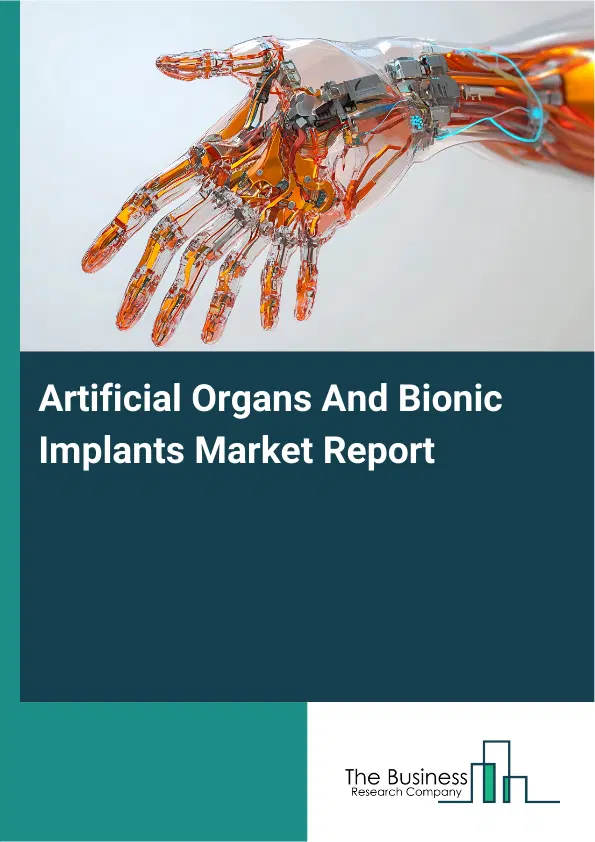
Artificial Organs And Bionic Implants Market Report 2026
Global Outlook – By Product (Artificial Organs, Artificial Bionics), By Technology (Mechanical Bionics, Electronic Bionics), By End User (Hospitals, Ambulatory Surgical Centers, Other End Users) – Market Size, Trends, Strategies, and Forecast to 2030
Artificial Organs And Bionic Implants Market Overview
• Artificial Organs And Bionic Implants market size has reached to $48.75 billion in 2025 • Expected to grow to $71.53 billion in 2030 at a compound annual growth rate (CAGR) of 7.9% • Growth Driver: Rising Organ Transplants Boost Growth In Artificial Organs And Bionic Implants Market • Market Trend: FDA Approval For Brain Implant Trials Marks A Major Step In Neurotechnology • North America was the largest region in 2025 and Asia-Pacific is the fastest growing region.What Is Covered Under Artificial Organs And Bionic Implants Market?
Artificial organs and bionic implants refer to advanced medical devices designed to replace or enhance the function of damaged or missing biological organs and limbs. These technologies aim to restore normal physiological functions or improve the quality of life for individuals with severe injuries or organ failures. The main types of products in artificial organs and bionic implants are artificial organs and artificial bionics. Artificial organs are man-made devices that replace natural organs in the body, performing the same functions as the original organs. This category encompasses technologies such as mechanical bionics and electronic bionics, serving diverse end users, including hospitals, ambulatory surgical centers, and other facilities.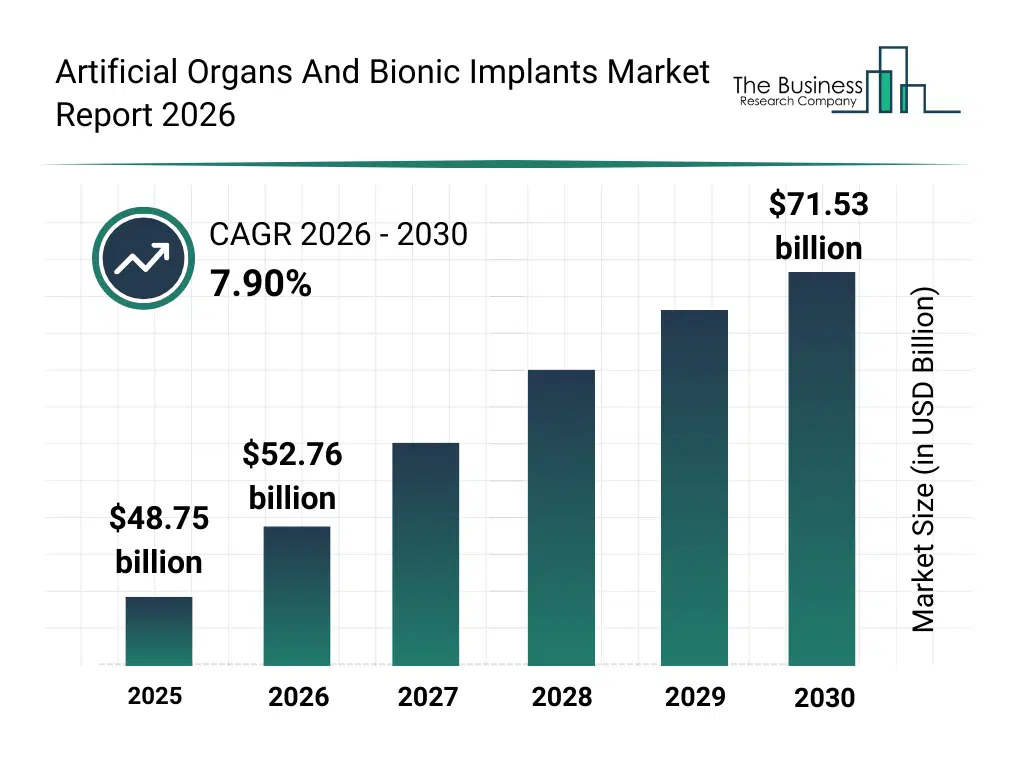
What Is The Artificial Organs And Bionic Implants Market Size and Share 2026?
The artificial organs and bionic implants market size has grown strongly in recent years. It will grow from $48.75 billion in 2025 to $52.76 billion in 2026 at a compound annual growth rate (CAGR) of 8.2%. The growth in the historic period can be attributed to limited availability of artificial organs, reliance on mechanical bionics, high cost of early bionic implants, low adoption due to lack of awareness, dependence on hospital-based implant procedures.What Is The Artificial Organs And Bionic Implants Market Growth Forecast?
The artificial organs and bionic implants market size is expected to see strong growth in the next few years. It will grow to $71.53 billion in 2030 at a compound annual growth rate (CAGR) of 7.9%. The growth in the forecast period can be attributed to advancements in electronic bionics and neural interfaces, increasing research in regenerative medicine, growing geriatric population and chronic disease prevalence, expansion of ambulatory surgical centers, rising government support and funding for medical device innovation. Major trends in the forecast period include rising adoption of advanced prosthetics and bionic limbs, increasing integration of neural implants and sensory devices, growing demand for artificial organs due to organ shortages, focus on personalized and patient-specific implants, enhanced post-surgical rehabilitation and support technologies.
Global Artificial Organs And Bionic Implants Market Segmentation
1) By Product: Artificial Organs, Artificial Bionics 2) By Technology: Mechanical Bionics, Electronic Bionics 3) By End User: Hospitals, Ambulatory Surgical Centers, Other End Users Subsegments: 1) By Artificial Organs: Artificial Heart, Artificial Kidney, Artificial Liver, Artificial Pancreas, Artificial Lungs 2) By Artificial Bionics: Bionic Limbs, Bionic Eyes, Bionic Ears, Neural Implants, Bionic SkinWhat Are The Drivers Of The Artificial Organs And Bionic Implants Market?
The increasing prevalence of organ transplants is expected to propel the growth of the artificial organs and bionic implants market going forward. Organ transplants refer to the surgical procedure in which a healthy organ from a donor is implanted into a recipient whose own organ is diseased, damaged, or non-functional. The increase in organ transplants is driven by rising incidences of chronic diseases and organ failures, along with advancements in medical technology and surgical techniques. Artificial organs and bionic implants aid organ transplantation by providing temporary solutions, reducing wait times, improving patient outcomes, and offering alternatives when donor organs are unavailable. For instance, in January 2025, according to the Organ Procurement and Transplantation Network, a US-based non-profit organization, organ transplants exceeded 48,000 in 2024, a 3.3 percent increase from the transplants performed in 2023. Therefore, the increasing prevalence of organ transplants is driving the growth of the artificial organs and bionic implants industry. The rise in elderly population is expected to drive the growth of the artificial organs and bionic implants market going forward. The elderly population comprises people aged 60 or 65 and older, needing tailored care and services due to aging-related health and lifestyle challenges. The elderly population is rising due to increasing life expectancy driven by improved healthcare and living conditions. Artificial organs and bionic implants help the elderly population by compensating for age-related organ decline and restoring essential physiological functions. For instance, in January 2024, according to a report published by Population Reference Bureau, a US-based non-profit organization responsible for collecting stats for research and academic purpose, the number of Americans aged 65 and older is expected to rise from 58 million in 2022 to 82 million by 2050, marking a 47% increase. As a result, this age group’s proportion of the total U.S. population will grow from 17% to 23% during this period. Therefore, the rise in elderly population is driving the growth of the artificial organs and bionic implants industry.Key Players In The Global Artificial Organs And Bionic Implants Market
Major companies operating in the artificial organs and bionic implants market are Medtronic plc, Asahi Kasei Medical Co. Ltd., B. Braun Melsungen AG, Terumo Medical Corp., Edwards Lifesciences Corporation, Ottobock SE and Co. KGaA, Cochlear Limited, Ossur hf., Thoratec Corporation, Berlin Heart GmbH, Jarvik Heart Inc., SynCardia Systems LLC, BiVACOR Inc., Gambro AB, Pixium Vision, ALVI Labs, WillowWood Global LLC, Nano Retina Inc., Organovo Holdings Inc., Abbott Laboratories, ABIOMED Inc., Ekso Bionics Holdings Inc., ReWalk Robotics Ltd, LivaNova PLC, Second Sight Medical Products Inc.
This chart is for illustrative purposes; the full report includes a detailed competitor analysis and comprehensive overview of the top 10 companies in the market.
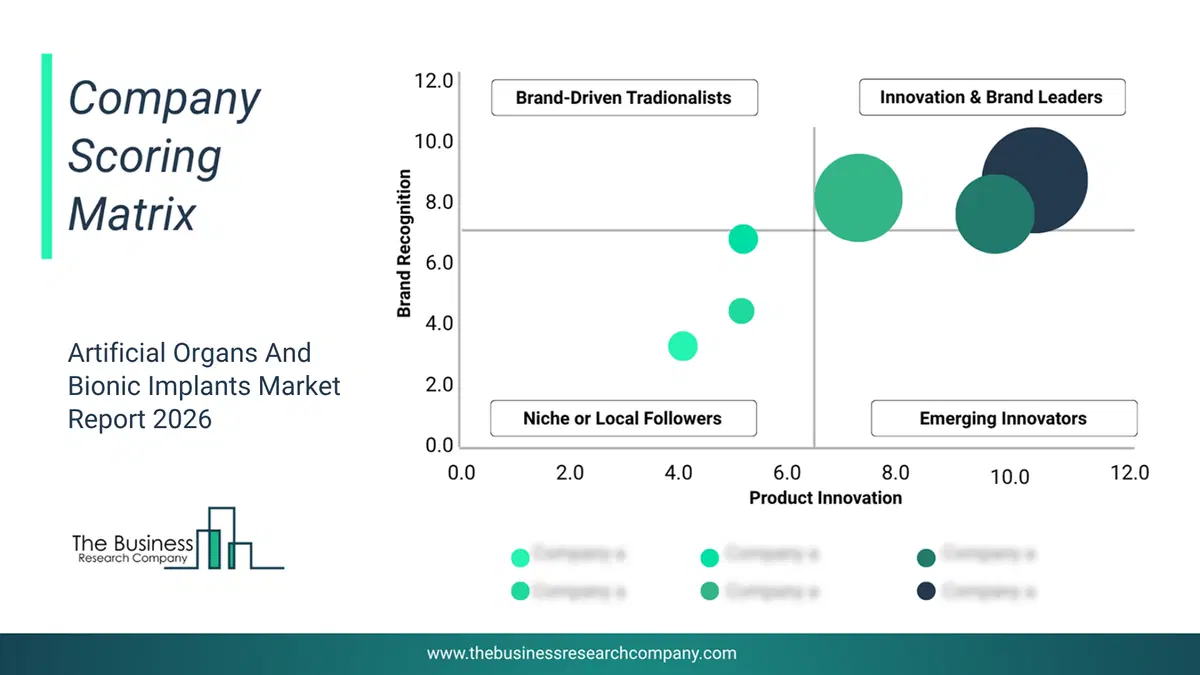
This chart maps companies by product innovation and brand strength, with bubble size indicating relative revenue, helping identify market leaders, challengers, and niche players. This is an illustrative chart; the full report provides a complete and accurate competitive analysis.
Global Artificial Organs And Bionic Implants Market Trends and Insights
Major companies operating in the artificial organs and bionic implants market are focusing on developing technologically advanced solutions, such as brain implant technology systems, to enhance cognitive function and treat neurological disorders. Brain implant technology systems involve devices that interface with the brain to monitor, stimulate, or modify neural activity for medical treatment, neuroprosthetics, or research purposes. For instance, in May 2023, Neuralink Corp., a US-based neurotechnology company, received Food and Drug Administration (FDA) approval to conduct its first human clinical trials for its brain implant technology, which aims to help individuals with severe paralysis regain the ability to communicate with and control external devices using only their thoughts. The approval marks a significant milestone for the company, which has faced challenges in the past, including a previous rejection due to safety concerns. The trial will test the device's ability to interpret neural signals and transmit them via Bluetooth to control computers and mobile devices, potentially assisting those with conditions such as amyotrophic lateral sclerosis (ALS).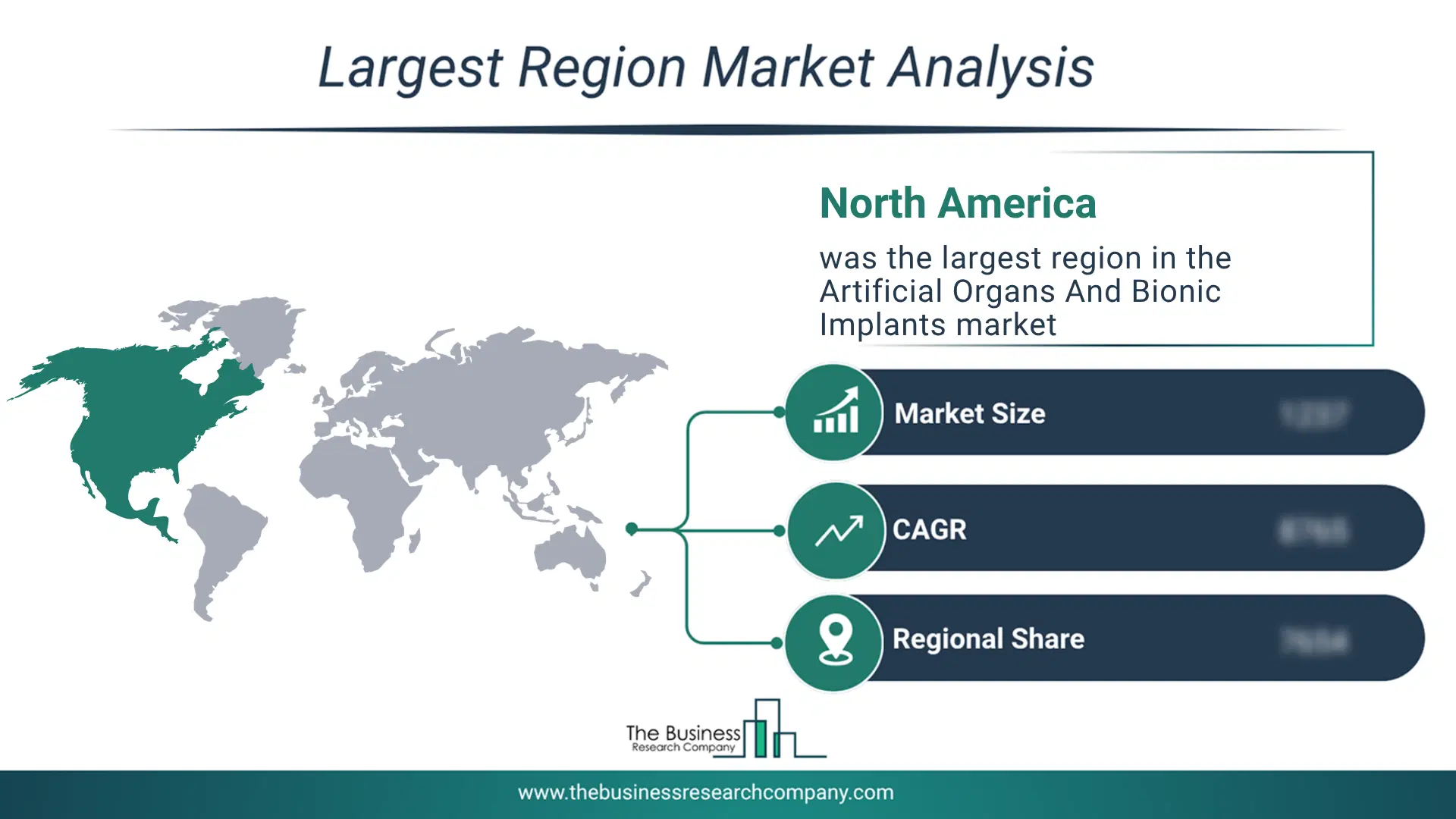
Regional Outlook
North America was the largest region in the artificial organs and bionic implants market in 2025. Asia-Pacific is expected to be the fastest-growing region in the forecast period. The regions covered in this market report are Asia-Pacific, South East Asia, Western Europe, Eastern Europe, North America, South America, Middle East, Africa. The countries covered in this market report are Australia, Brazil, China, France, Germany, India, Indonesia, Japan, Taiwan, Russia, South Korea, UK, USA, Canada, Italy, SpainWhat Defines the Artificial Organs And Bionic Implants Market?
The artificial organs and bionic implants market consists of sales of cochlear implants, neural implants, artificial bladders, and bionic arms. Values in this market are ‘factory gate’ values, that is, the value of goods sold by the manufacturers or creators of the goods, whether to other entities (including downstream manufacturers, wholesalers, distributors, and retailers) or directly to end customers. The value of goods in this market includes related services sold by the creators of the goods.How is Market Value Defined and Measured?
The market value is defined as the revenues that enterprises gain from the sale of goods and/or services within the specified market and geography through sales, grants, or donations in terms of the currency (in USD unless otherwise specified). The revenues for a specified geography are consumption values that are revenues generated by organizations in the specified geography within the market, irrespective of where they are produced. It does not include revenues from resales along the supply chain, either further along the supply chain or as part of other products.
This chart presents market attractiveness based on a quantitative evaluation of growth, competition, strategic alignment, and risk, offering a clear view of opportunity areas for decision-making. This chart is for illustrative purposes; the full report contains the complete analysis.

This chart highlights the Total Addressable Market (TAM) by estimating the maximum revenue opportunity using an assumption-driven approach, supporting strategic planning and opportunity sizing across markets. The chart is illustrative; the full report provides a more comprehensive analysis.
What Key Data and Analysis Are Included in the Artificial Organs And Bionic Implants Market Report 2026?
The artificial organs and bionic implants market research report is one of a series of new reports from The Business Research Company that provides market statistics, including industry global market size, regional shares, competitors with the market share, detailed market segments, market trends and opportunities, and any further data you may need to thrive in the artificial organs and bionic implants industry. The market research report delivers a complete perspective of everything you need, with an in-depth analysis of the current and future state of the industry.Artificial Organs And Bionic Implants Market Report Forecast Analysis
| Report Attribute | Details |
|---|---|
| Market Size Value In 2026 | $52.76 billion |
| Revenue Forecast In 2030 | $71.53 billion |
| Growth Rate | CAGR of 7.9% from 2026 to 2030 |
| Base Year For Estimation | 2025 |
| Actual Estimates/Historical Data | 2020-2025 |
| Forecast Period | 2026 - 2030 |
| Market Representation | Revenue in USD Billion and CAGR from 2026 to 2030 |
| Segments Covered | Product, Technology, End User |
| Regional Scope | Asia-Pacific, Western Europe, Eastern Europe, North America, South America, Middle East, Africa |
| Country Scope | The countries covered in the report are Australia, Brazil, China, France, Germany, India, Indonesia, Japan, Taiwan, Russia, South Korea, UK, USA, Canada, Italy, Spain. |
| Key Companies Profiled | Medtronic plc, Asahi Kasei Medical Co. Ltd., B. Braun Melsungen AG, Terumo Medical Corp., Edwards Lifesciences Corporation, Ottobock SE and Co. KGaA, Cochlear Limited, Ossur hf., Thoratec Corporation, Berlin Heart GmbH, Jarvik Heart Inc., SynCardia Systems LLC, BiVACOR Inc., Gambro AB, Pixium Vision, ALVI Labs, WillowWood Global LLC, Nano Retina Inc., Organovo Holdings Inc., Abbott Laboratories, ABIOMED Inc., Ekso Bionics Holdings Inc., ReWalk Robotics Ltd, LivaNova PLC, Second Sight Medical Products Inc. |
| Customization Scope | Request for Customization |
| Pricing And Purchase Options | Explore Purchase Options |