
ASRS For Garments On Hangers Market Report 2026
Global Outlook – By Type (Garment Rail System, Garment Conveyor), By Load (Single-Garment Load Systems, Multi-Garment Load Systems, Heavy-Duty Hanging Load Systems), By Application (Warehousing And Logistics, Retail Third-Party Logistics (3PL)) – Market Size, Trends, Strategies, and Forecast to 2030
ASRS For Garments On Hangers Market Overview
• ASRS For Garments On Hangers market size has reached to $2.05 billion in 2025 • Expected to grow to $2.95 billion in 2030 at a compound annual growth rate (CAGR) of 7.6% • Growth Driver: E-Commerce Boom Fuels Growth In ASRS For Garments On Hangers Market • Market Trend: Innovative Automated Hanger Systems Revolutionize Efficiency and Sustainability in Garment Storage and Handling • North America was the largest region in 2025.What Is Covered Under ASRS For Garments On Hangers Market?
Automated storage and retrieval system (ASRS) for garments on hangers refers to a sophisticated storage solution that utilizes automated technology to efficiently store and retrieve hanging garments in a warehouse or distribution center. This system is designed to maximize space utilization and streamline the handling of clothing items on hangers, enhancing overall efficiency in the supply chain. The main types of ASRS for garments on hangers are the garment rail system, garment conveyor, garment property storage, and others. A garment rail system is a storage and transport solution for hanging and displaying clothing items, often integrated into an automated storage and retrieval system for efficient storage and retrieval. The load types such as unit load, mid load, vertical lift module (VLM), carousel, and mini load are used for warehousing and logistics, retail third-party logistics (3PL), hotels, hospitals, institutes, and others.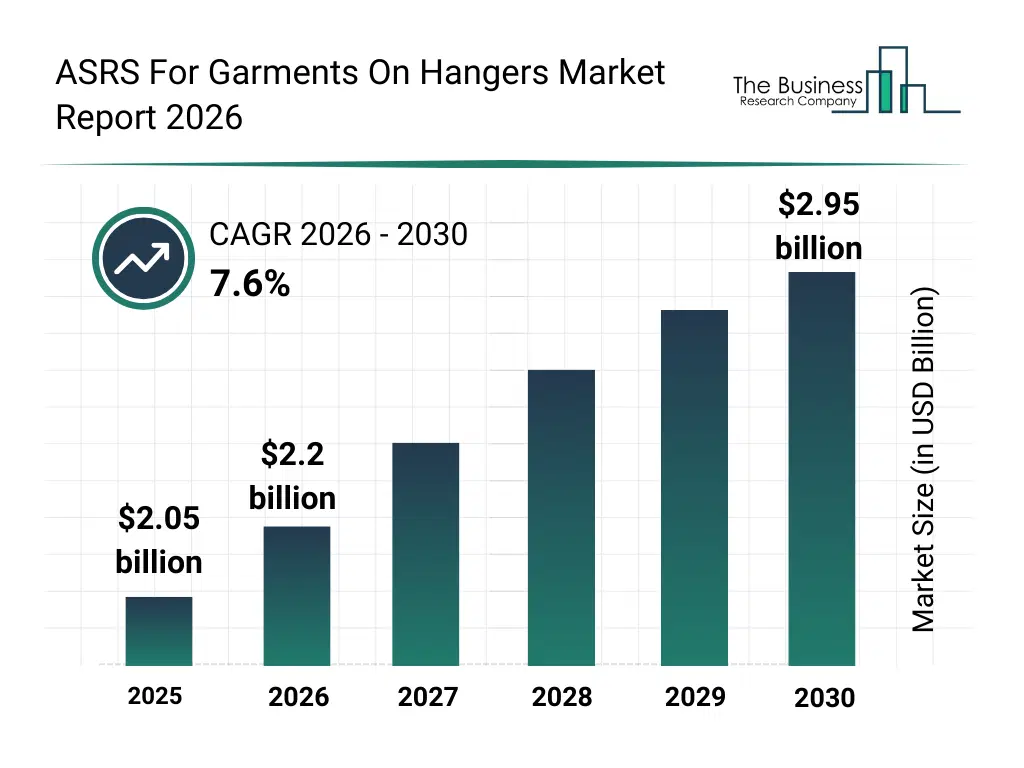
What Is The ASRS For Garments On Hangers Market Size and Share 2026?
The asrs for garments on hangers market size has grown strongly in recent years. It will grow from $2.05 billion in 2025 to $2.2 billion in 2026 at a compound annual growth rate (CAGR) of 7.5%. The growth in the historic period can be attributed to apparel industry growth, warehouse labor shortages, need for fast order processing, adoption of conveyor systems, retail logistics expansion.What Is The ASRS For Garments On Hangers Market Growth Forecast?
The asrs for garments on hangers market size is expected to see strong growth in the next few years. It will grow to $2.95 billion in 2030 at a compound annual growth rate (CAGR) of 7.6%. The growth in the forecast period can be attributed to smart warehouse investments, omni-channel retail growth, demand for real-time inventory, automation cost reduction, sustainable warehousing initiatives. Major trends in the forecast period include automation of garment warehousing, demand for space optimization solutions, integration with retail supply chains, growth of e-commerce fulfillment, adoption of smart inventory management.
Global ASRS For Garments On Hangers Market Segmentation
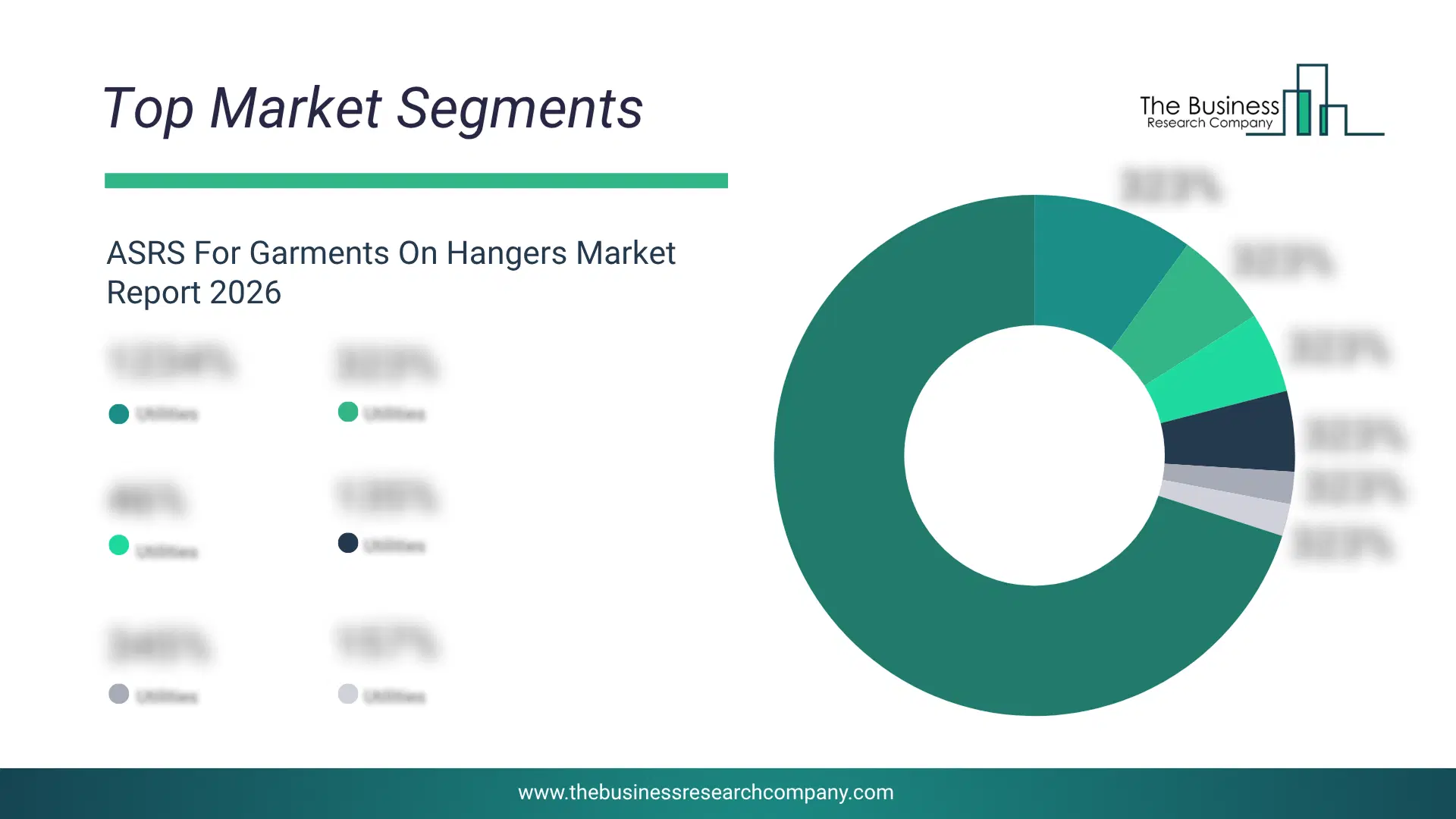
1) By Type: Garment Rail System, Garment Conveyor 2) By Load: Single-Garment Load Systems, Multi-Garment Load Systems, Heavy-Duty Hanging Load Systems 3) By Application: Warehousing And Logistics, Retail Third-Party Logistics (3PL) Subsegments: 1) By Garment Rail System: Overhead Rail Systems, Vertical Rail Systems 2) By Garment Conveyor: Automated Conveyor Belts, Shuttle ConveyorsWhat Are The Drivers Of The ASRS For Garments On Hangers Market?
The rising e-commerce industry is expected to propel the growth of the ASRS for the garments-on-hangers market going forward. The e-commerce sector refers to the online exchange of goods and services through the Internet. The E-commerce industry is driven by increased internet penetration, convenience, and changing consumer preferences favoring online shopping. ASRS for garments on hangers streamlines inventory management and boosts efficiency in e-commerce warehouses by enabling faster and more accurate processing of clothing orders. For instance, in November 2023, according to the International Trade Administration, a US-based Department of Commerce, the global B2C e-commerce revenue is expected to grow to $5.5 trillion by 2027 at a steady 14.4% compound annual growth rate. Additionally, the gross merchandise value (GMV) in 2023 was $24,453 billion up from $21,019 billion from 2022. Therefore, the rising e-commerce industry is driving ASRS for the garments-on-hangers market. The growing adoption of Industry 4.0 technologies is expected to propel the growth of the ASRS for garments on hanger’s market going forward. Industry 4.0 technologies refer to the integration of advanced digital solutions including artificial intelligence, robotics, internet of things, and automation systems that enable smart manufacturing and real-time data exchange in production environments. The rising adoption of Industry 4.0 technologies is driven by the need for operational efficiency and labor cost reduction, as manufacturers face increasing pressure to optimize production processes and reduce dependency on manual labor through intelligent automation systems that can operate continuously with minimal human intervention. Growing Industry 4.0 adoption directly supports increased implementation of automated storage and retrieval systems that use robotics, sensors, and smart software to manage hanging garment inventory, streamline warehouse operations, and reduce handling time in textile and apparel facilities. For instance, in April 2024, according to Rockwell Automation, Inc., a US-based automation company, in 2024, 95% of manufacturers are either using or evaluating smart manufacturing technology, up from 84% in 2023. Therefore, the growing adoption of Industry 4.0 technologies is driving the growth of the ASRS for garments on hanger’s market.Key Players In The Global ASRS For Garments On Hangers Market
Major companies operating in the asrs for garments on hangers market report include Dematic, Daifuku, KNAPP, TGW Logistics Group, SSI SCHAEFER, Beumer Group, Ferag, Schönenberger Systeme, Planiform, Dürkopp Fördertechnik (DFT), Metalprogetti, Railex Conveyor Corp., Conveyco Technologies Inc., ABCO Systems LLC, Element Logic, Ferretto Group (Wipro Ferretto), Mecalux, White Conveyors, DMW&H Systems, TUKU Conveyor Systems, Metalprogetti UK, Sieger/Siegerstor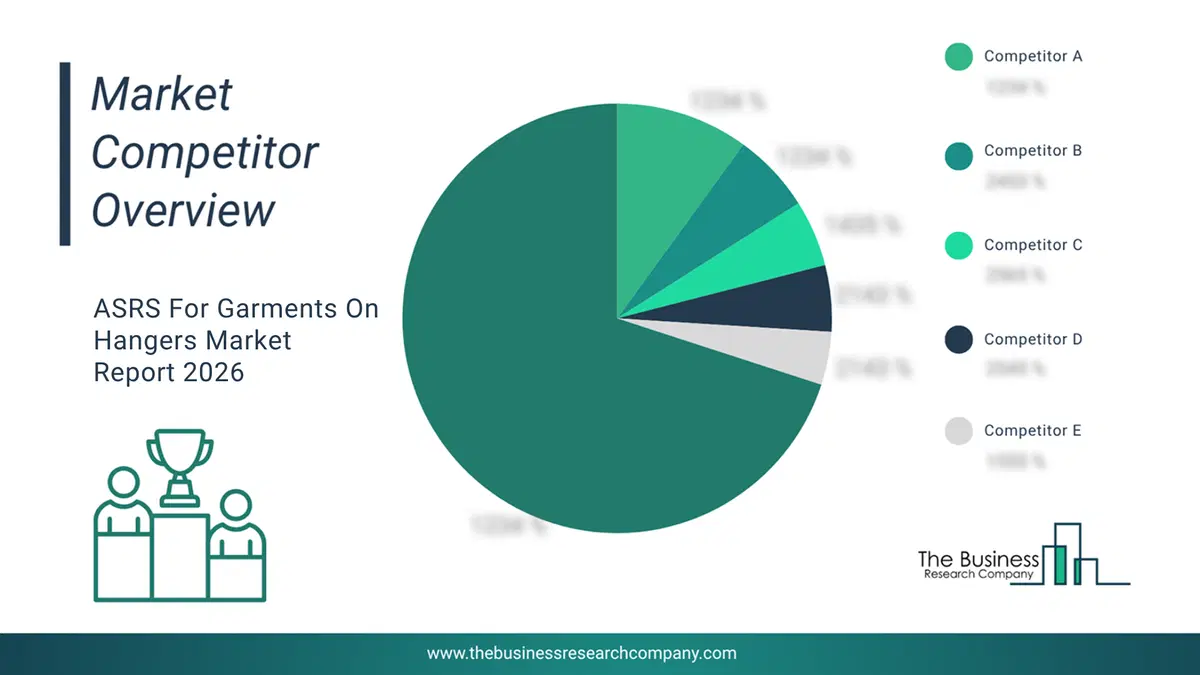
This chart is for illustrative purposes; the full report includes a detailed competitor analysis and comprehensive overview of the top 10 companies in the market.
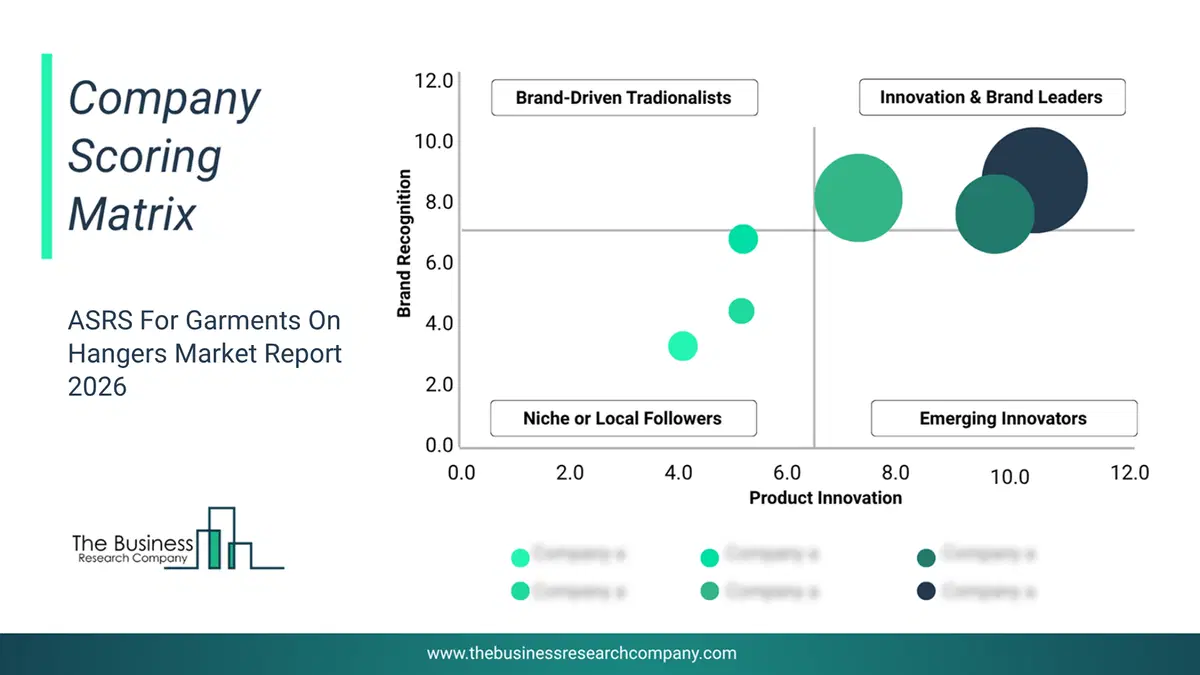
This chart maps companies by product innovation and brand strength, with bubble size indicating relative revenue, helping identify market leaders, challengers, and niche players. This is an illustrative chart; the full report provides a complete and accurate competitive analysis.
Global ASRS For Garments On Hangers Market Trends and Insights
Major companies operating in the ASRS for garments on hangers’ market are focusing on technologically advanced solutions, such as automated hangers to enhance efficiency and reduce costs. They are also prioritizing sustainable practices and IoT integration to optimize operations and improve inventory management. An automated hanger is a system that uses technology to efficiently store and retrieve garments, often employing conveyors or robotics. It enhances organization and reduces labour costs in settings like dry cleaning and laundry services. For instance, in November 2023, RT Knits Ltd., a Mauritius-based textile company, launched an Automated Hanger System (AHS). The Automated Hanger System (AHS) enhances efficiency and reduces labour costs by automating garment handling throughout the production process. It improves workflow, quality control, and sustainability, ultimately streamlining operations in the garment manufacturing industry.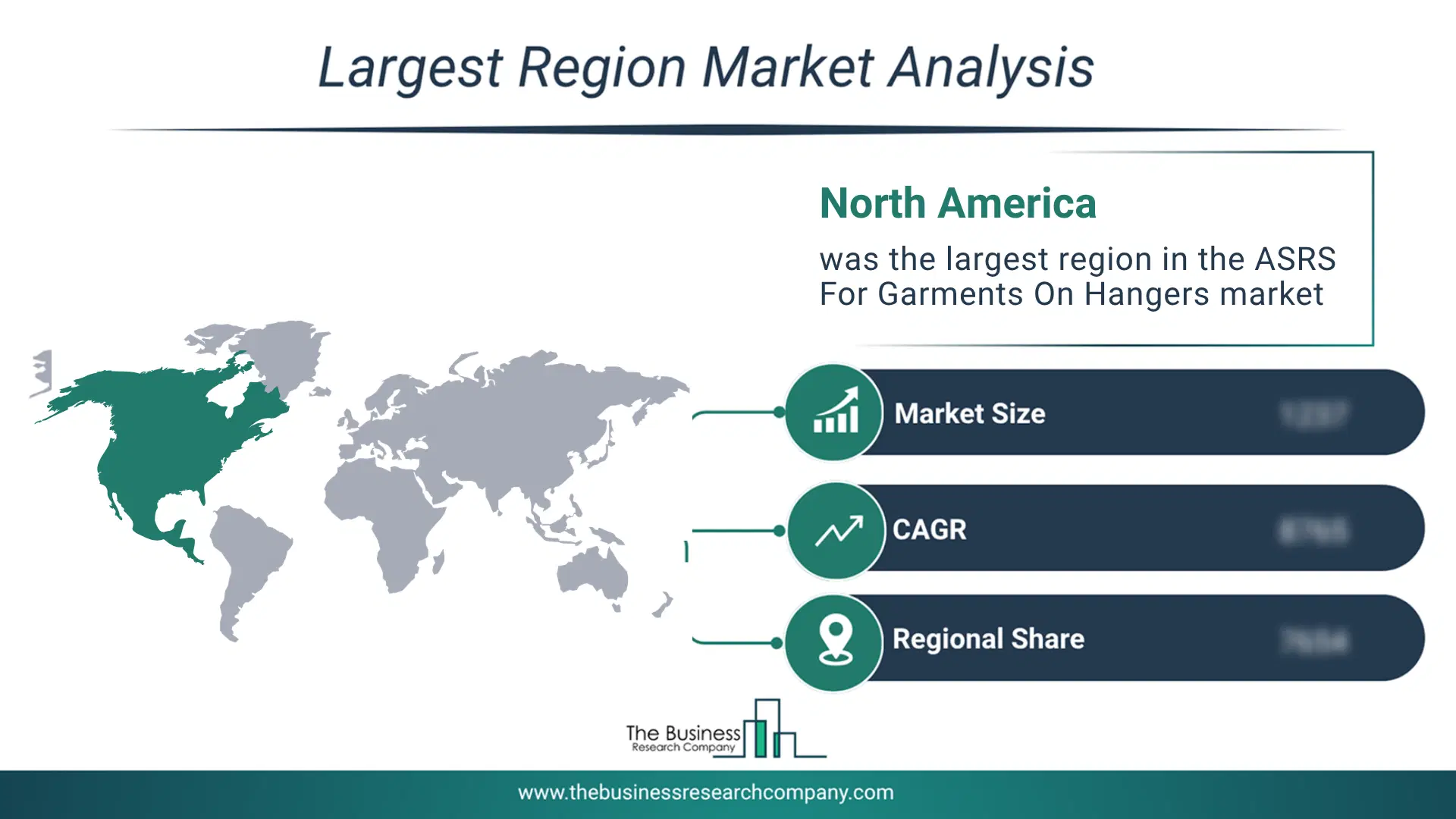
Regional Outlook
North America was the largest region in the ASRS for garments on hangers market in 2025. The regions covered in this market report include Asia-Pacific, South East Asia, Western Europe, Eastern Europe, North America, South America, Middle East, Africa. The countries covered in this market report include Australia, Brazil, China, France, Germany, India, Indonesia, Japan, Taiwan, Russia, South Korea, UK, USA, Canada, Italy, SpainWhat Defines the ASRS For Garments On Hangers Market?
The ASRS for garments on hangers market consists of sales of automated garment sorting systems and robotic garment picking systems. Values in this market are ‘factory gate’ values, that is the value of goods sold by the manufacturers or creators of the goods, whether to other entities (including downstream manufacturers, wholesalers, distributors, and retailers) or directly to end customers. The value of goods in this market includes related services sold by the creators of the goods.How is Market Value Defined and Measured?
The market value is defined as the revenues that enterprises gain from the sale of goods and/or services within the specified market and geography through sales, grants, or donations in terms of the currency (in USD unless otherwise specified). The revenues for a specified geography are consumption values that are revenues generated by organizations in the specified geography within the market, irrespective of where they are produced. It does not include revenues from resales along the supply chain, either further along the supply chain or as part of other products.
This chart presents market attractiveness based on a quantitative evaluation of growth, competition, strategic alignment, and risk, offering a clear view of opportunity areas for decision-making. This chart is for illustrative purposes; the full report contains the complete analysis.

This chart highlights the Total Addressable Market (TAM) by estimating the maximum revenue opportunity using an assumption-driven approach, supporting strategic planning and opportunity sizing across markets. The chart is illustrative; the full report provides a more comprehensive analysis.
What Key Data and Analysis Are Included in the ASRS For Garments On Hangers Market Report 2026?
The asrs for garments on hangers market research report is one of a series of new reports from The Business Research Company that provides market statistics, including industry global market size, regional shares, competitors with the market share, detailed market segments, market trends and opportunities, and any further data you may need to thrive in the asrs for garments on hangers industry. The market research report delivers a complete perspective of everything you need, with an in-depth analysis of the current and future state of the industry.ASRS For Garments On Hangers Market Report Forecast Analysis
| Report Attribute | Details |
|---|---|
| Market Size Value In 2026 | $2.2 billion |
| Revenue Forecast In 2030 | $2.95 billion |
| Growth Rate | CAGR of 7.5% from 2026 to 2030 |
| Base Year For Estimation | 2025 |
| Actual Estimates/Historical Data | 2020-2025 |
| Forecast Period | 2026 - 2030 - 2030 |
| Market Representation | Revenue in USD Billion and CAGR from 2026 to 2030 |
| Segments Covered | Type, Load, Application |
| Regional Scope | Asia-Pacific, Western Europe, Eastern Europe, North America, South America, Middle East, Africa |
| Country Scope | The countries covered in the report are Australia, Brazil, China, France, Germany, India, Indonesia, Japan, Taiwan, Russia, South Korea, UK, USA, Canada, Italy, Spain. |
| Key Companies Profiled | Dematic, Daifuku, KNAPP, TGW Logistics Group, SSI SCHAEFER, Beumer Group, Ferag, Schönenberger Systeme, Planiform, Dürkopp Fördertechnik (DFT), Metalprogetti, Railex Conveyor Corp., Conveyco Technologies Inc., ABCO Systems LLC, Element Logic, Ferretto Group (Wipro Ferretto), Mecalux, White Conveyors, DMW&H Systems, TUKU Conveyor Systems, Metalprogetti UK, Sieger/Siegerstor |
| Customization Scope | Request for Customization |
| Pricing And Purchase Options | Explore Purchase Options |