
Apparel Market Report 2026
Global Outlook – By Type (Women's Apparel, Men's Apparel), By Fiber (Man-Made Fibers, Cotton Fibers, Animal-Based Fibers, Plant-Based Fibers), By Distribution Channel (Offline Retail, Online Retail) – Market Size, Trends, Strategies, and Forecast to 2030
Apparel Market Overview
• Apparel market size has reached to $736.58 billion in 2025 • Expected to grow to $1027.17 billion in 2030 at a compound annual growth rate (CAGR) of 7% • Growth Driver: Rising Disposable Income Driving The Market Growth Due To Expansion In Discretionary Expenditures • Market Trend: Apparel Market Advances with Sensor-Embedded Smart Fabrics for Adaptive Comfort and Health Monitoring • Western Europe was the largest region in 2025 and Asia-Pacific is the fastest growing region.What Is Covered Under Apparel Market?
Apparel refers to any clothing made of textiles created by weaving, knitting, or felting, in whole or in part, that is worn on a special occasion to build culture and create an aesthetic appearance in the home and on official occasions. The main types of apparel are women’s wear, men’s wear, and kids wear. Apparel made specifically for ladies is referred to as women's clothing. The different types of fiber include man-made fibers, cotton fibers, animal-based fibers, and vegetable-based fibers and are distributed through various channels such as retail stores, and online stores.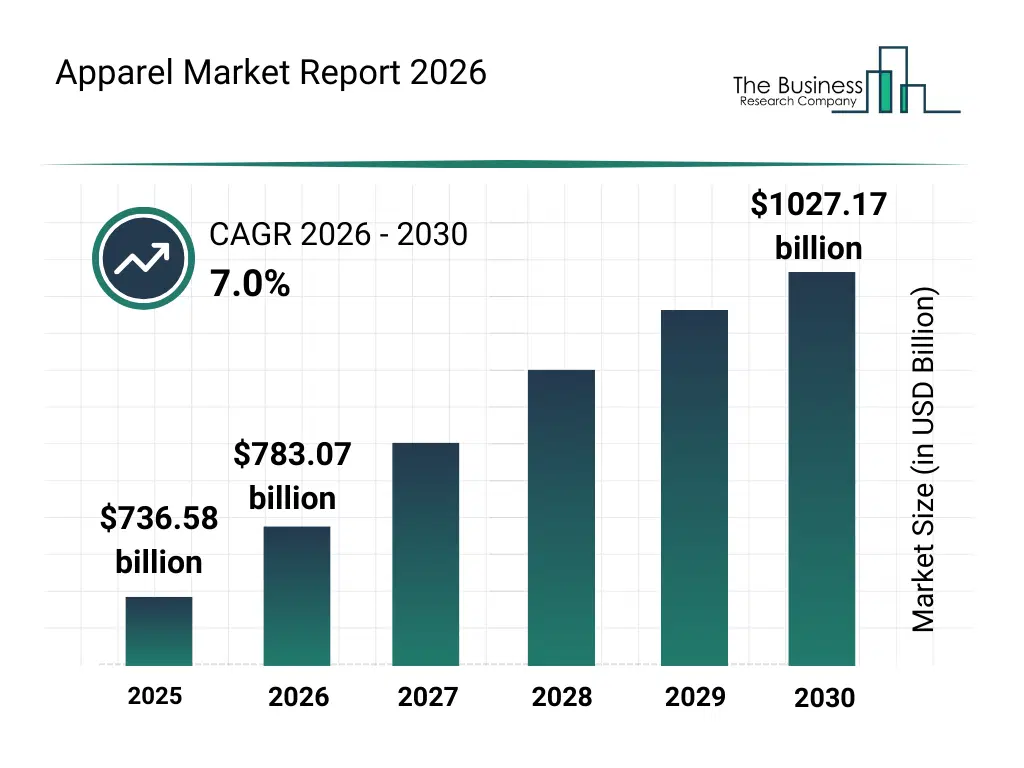
What Is The Apparel Market Size and Share 2026?
The apparel market size has grown strongly in recent years. It will grow from $736.58 billion in 2025 to $783.07 billion in 2026 at a compound annual growth rate (CAGR) of 6.3%. The growth in the historic period can be attributed to expansion of global textile manufacturing, rising disposable income levels, growth of organized retail apparel, increasing urbanization trends, availability of low-cost manufacturing hubs.What Is The Apparel Market Growth Forecast?
The apparel market size is expected to see strong growth in the next few years. It will grow to $1027.17 billion in 2030 at a compound annual growth rate (CAGR) of 7.0%. The growth in the forecast period can be attributed to growing demand for eco-friendly clothing, expansion of digital fashion platforms, rising use of data-driven design processes, increasing adoption of direct-to-consumer models, growing influence of social commerce. Major trends in the forecast period include growing demand for sustainable apparel materials, rising adoption of fast fashion production models, expansion of online apparel sales channels, increasing focus on customization and fit innovation, enhanced emphasis on brand-led collections.
Global Apparel Market Segmentation
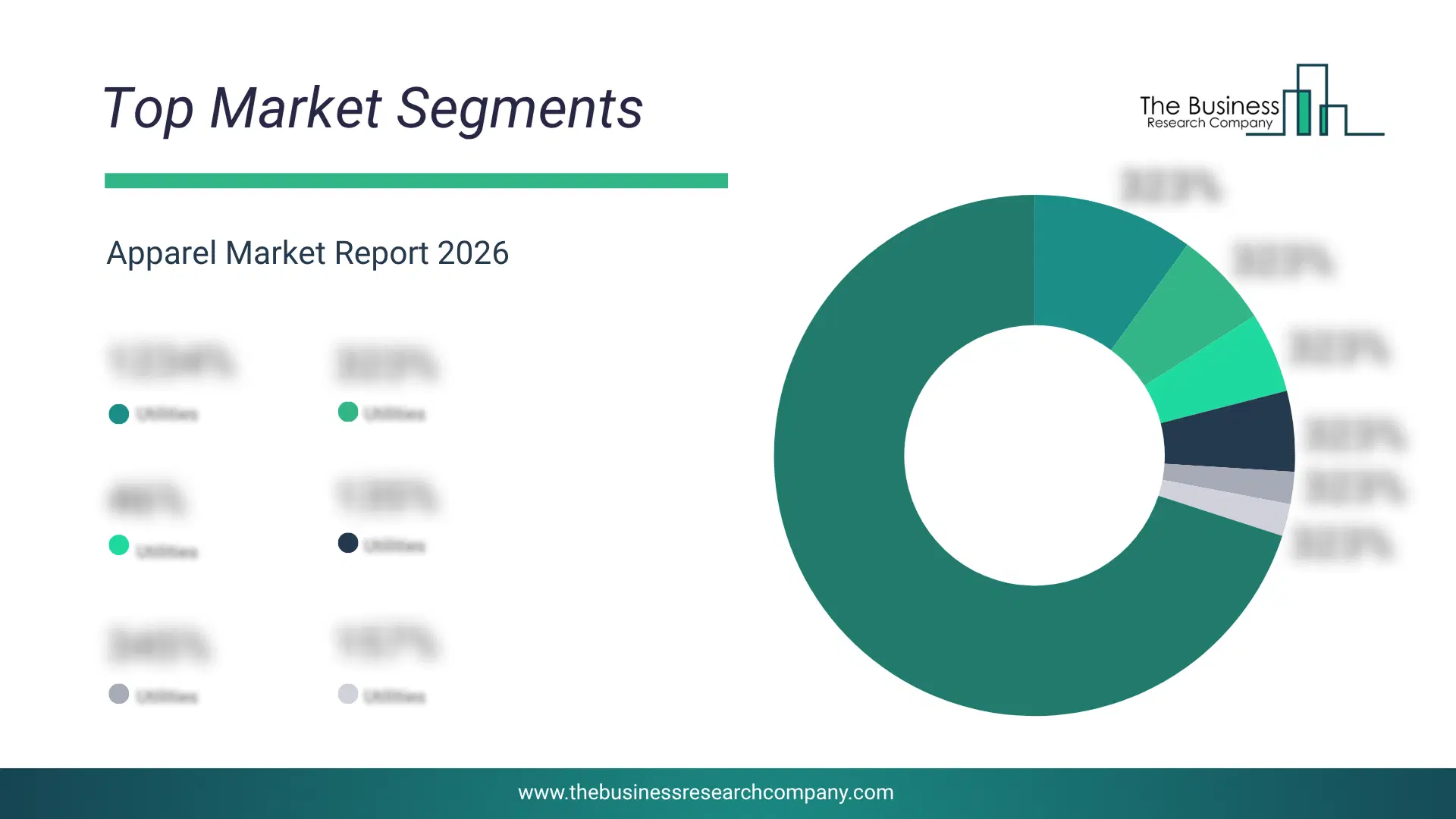
1) By Type: Women's Apparel, Men's Apparel 2) By Fiber: Man-Made Fibers, Cotton Fibers, Animal-Based Fibers, Plant-Based Fibers 3) By Distribution Channel: Offline Retail, Online Retail Subsegments: 1) By Women’s Apparel: Formal Topwear, Formal Bottomwear, Dresses & One-Piece Occasion Wear, Ethnic & Traditional Wear, Evening & Party Wear, Occasion-Specific Outerwear 2) By Men’s Apparel: Formal Shirts & Topwear, Formal Trousers & Bottomwear, Suits, Blazers & Tailored Formal Wear, Ethnic & Traditional Wear, Ceremonial & Occasion Wear, Occasion-Specific OuterwearWhat Are The Drivers Of The Apparel Market?
The rising disposable income is expected to propel the growth of the apparel market going forward. Disposable income refers to the amount of money that households have available for spending and saving after income taxes have been deducted. The growth in disposable income is being driven by economic recovery and moderate wage growth, as improving labor market conditions and easing inflation rates have enabled households to retain more purchasing power. Higher disposable income enables consumers to allocate more funds toward non-essential purchases such as clothing and fashion items. For instance, in October 2024, according to the U.S. Bureau of Economic Analysis, a US-based government agency, personal income rose by $71.6 billion, or 0.3 percent, in September. Disposable personal income (DPI), defined as personal income minus personal current taxes, grew by $57.4 billion (0.3 percent). Personal consumption expenditures (PCE) increased by $105.8 billion, a gain of 0.5 percent. Therefore, rising disposable income is driving the growth of the apparel industry. E-commerce Growth is expected to propel the growth of the apparel manufacturing market going forward. E-commerce, short for electronic commerce, refers to the buying and selling of goods and services over the Internet. It involves exchanging data or currency to process a transaction and can be conducted over computers, tablets, smartphones, and other smart devices. With the rise of e-commerce, consumers are increasingly turning to online platforms to shop for clothing and fashion items. This shift in consumer behavior has led to a surge in online apparel purchases. For instance, in February 2024, according to the United States Census Bureau, a federal statistical agency, in 2023, total e-commerce sales were estimated at $1, 118.7 billion, marking a 7.6 percent (±1.2%) increase compared to 2022. During the same period, overall retail sales grew by 2.1 percent (±0.4%) from the previous year. E-commerce accounted for 15.4 percent of total retail sales in 2023, up from 14.7 percent in 2022. Therefore, the growing trend of e-commerce is driving the growth of the apparel manufacturing market.Key Players In The Global Apparel Market
Major companies operating in the apparel market are NIKE Inc, Adidas AG, PVH Corp, Christian Dior SE, Hanesbrands Inc, VF Corporation, Levi Strauss & Co, Kering SA, Ralph Lauren Corporation, Samsung C&T Corporation, Aditya Birla Fashion and Retail Limited, Shanshan Group Co, United Arrows, Matsuoka Corp, Heilan Group, Youngor Group, Bosideng Corporation, Fujian Septwolves Industry Co Ltd, Shimamura, Uniqlo, Nishimatsuya, Allen Solly, Louis Philippe, Peter England, Van Heusen, Fabindia, Decathlon, Under Armour, H&M, Zara, Primark, Marks & Spencer, Next, Lee, Diesel, Wrangler, Guess, Tommy Hilfiger, Calvin Klein, Brooks Brothers, American Eagle Outfitters, Abercrombie & Fitch, Old Navy, Gap, Michael Kors, Coach, Gildan Activewear, Chanel, Urban Outfitters, MANGO, Truworths Group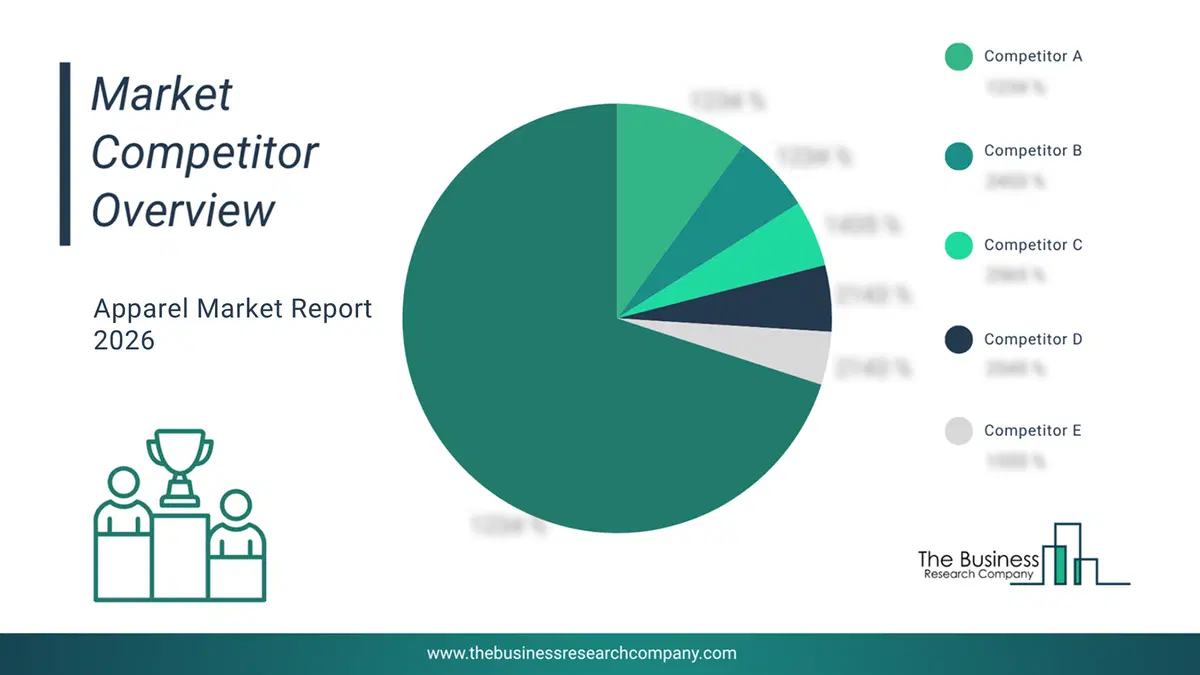
This chart is for illustrative purposes; the full report includes a detailed competitor analysis and comprehensive overview of the top 10 companies in the market.
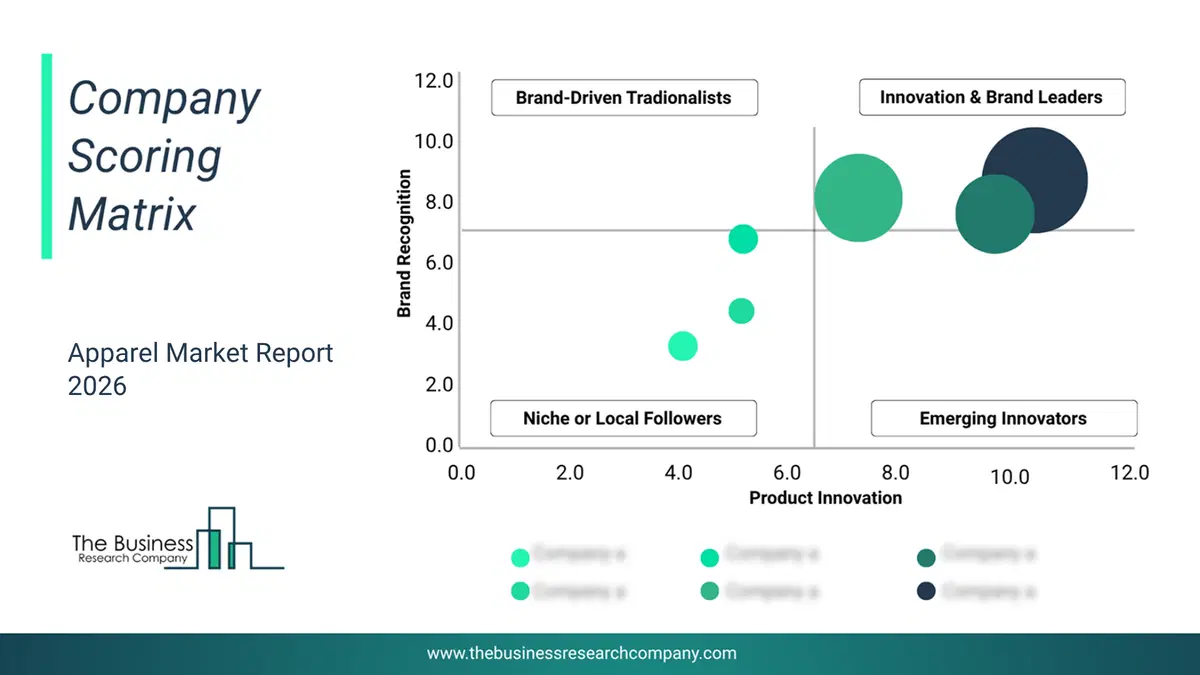
This chart maps companies by product innovation and brand strength, with bubble size indicating relative revenue, helping identify market leaders, challengers, and niche players. This is an illustrative chart; the full report provides a complete and accurate competitive analysis.
Global Apparel Market Trends and Insights
Major companies operating in the apparel market are focusing on technological advancements, such as sensor embedded smart fabrics for real time physiological and thermal monitoring, to meet the rising demand for health aware performance wear, adaptive comfort, and wearable tech that blends fashion with functionality. Smart fabric monitoring refers to textile materials woven or knitted with integrated sensors and conductive threads that continuously track physiological or environmental metrics instead of relying on separate wearables or static fabrics. For instance, in March 2025, VOORMI, a US-based outdoor clothing company, launched Mij smart tshirt, a washable biometric garment built with Mij sensor embedded textile technology that detects body thermal load in real time and maps thermal stress across the whole body. The Mij shirt integrates wireless sensors directly into the fabric, allowing it to monitor how the wearer’s body responds to heat and activity; it can alert wearers to thermal stress before it becomes dangerous, support athletes, first responders, and outdoor workers, and provide actionable data through a companion app all while feeling and looking like a regular performance T shirt. This innovation shows how the apparel market is evolving beyond simple comfort or fashion, embracing intelligent, health and performance oriented clothing to meet growing demand for adaptive wearables and data driven personal well being.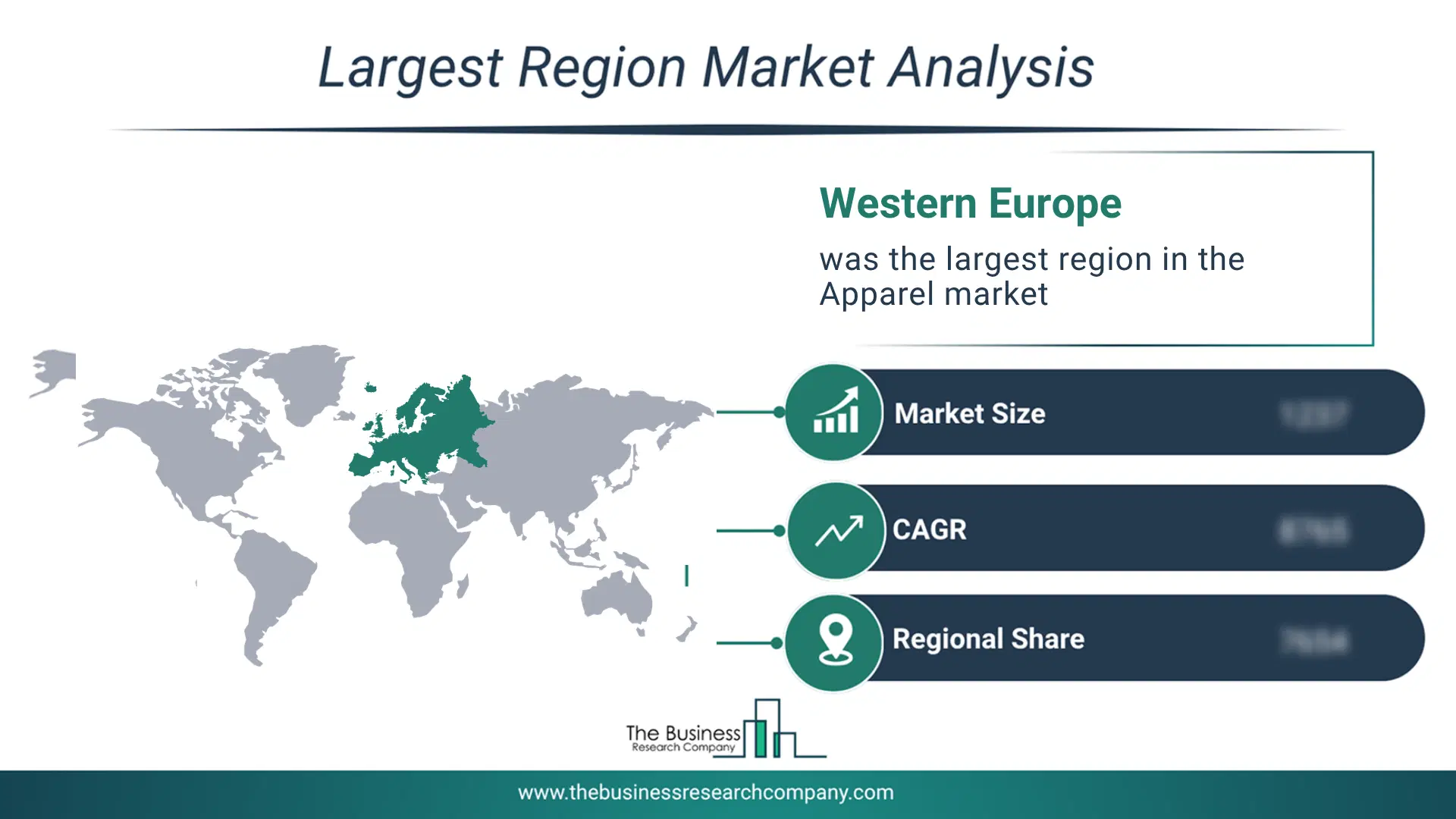
Regional Outlook
Western Europe was the largest region in the apparel market in 2025. Asia-Pacific was the second-largest region in the apparel market. The regions covered in this market report are Asia-Pacific, South East Asia, Western Europe, Eastern Europe, North America, South America, Middle East, Africa. The countries covered in this market report are China, India, Japan, Australia, Indonesia, South Korea, Bangladesh, Thailand, Vietnam, Malaysia, Singapore, Philippines, Hong Kong, Taiwan, New Zealand, UK, Germany, France, Italy, Spain, Austria, Belgium, Denmark, Finland, Ireland, Netherlands, Norway, Portugal, Sweden, Switzerland, Russia, Czech Republic, Poland, Romania, Ukraine, USA, Canada, Mexico, Brazil, Chile, Argentina, Colombia, Peru, Saudi Arabia, Israel, Iran, Turkey, UAE, Egypt, Nigeria, South Africa.What Defines the Apparel Market?
The apparel market consists of sales of formal wear, casual wear, sportswear, plant-based fiber and synthetic fiber, and others. Values in this market are ‘factory gate’ values, that is the value of goods sold by the manufacturers or creators of the goods, whether to other entities (including downstream manufacturers, wholesalers, distributors and retailers) or directly to end customers. The value of goods in this market includes related services sold by the creators of the goods.How is Market Value Defined and Measured?
The market value is defined as the revenues that enterprises gain from the sale of goods and/or services within the specified market and geography through sales, grants, or donations in terms of the currency (in USD unless otherwise specified). The revenues for a specified geography are consumption values that are revenues generated by organizations in the specified geography within the market, irrespective of where they are produced. It does not include revenues from resales along the supply chain, either further along the supply chain or as part of other products.
This chart presents market attractiveness based on a quantitative evaluation of growth, competition, strategic alignment, and risk, offering a clear view of opportunity areas for decision-making. This chart is for illustrative purposes; the full report contains the complete analysis.

This chart highlights the Total Addressable Market (TAM) by estimating the maximum revenue opportunity using an assumption-driven approach, supporting strategic planning and opportunity sizing across markets. The chart is illustrative; the full report provides a more comprehensive analysis.
What Key Data and Analysis Are Included in the Apparel Market Report 2026?
The apparel market research report is one of a series of new reports from The Business Research Company that provides market statistics, including Market Report 2026?global market size, regional shares, competitors with the market share, detailed market segments, market trends and opportunities, and any further data you may need to thrive in the apparel Market Report 2026? The market research report delivers a complete perspective of everything you need, with an in-depth analysis of the current and future state of the Market Report 2026?Apparel Market Report Forecast Analysis
| Report Attribute | Details |
|---|---|
| Market Size Value In 2026 | $783.07 billion |
| Revenue Forecast In 2030 | $1027.17 billion |
| Growth Rate | CAGR of 6.3% from 2026 to 2030 |
| Base Year For Estimation | 2025 |
| Actual Estimates/Historical Data | 2020-2025 |
| Forecast Period | 2026 - 2030 |
| Market Representation | Revenue in USD Billion and CAGR from 2026 to 2030 |
| Segments Covered | Type, Fiber, Distribution Channel |
| Regional Scope | Asia-Pacific, Western Europe, Eastern Europe, North America, South America, Middle East, Africa |
| Country Scope | The countries covered in the report are Australia, Brazil, China, France, Germany, India, Indonesia, Japan, Taiwan, Russia, South Korea, UK, USA, Canada, Italy, Spain. |
| Key Companies Profiled | NIKE Inc, Adidas AG, PVH Corp, Christian Dior SE, Hanesbrands Inc, VF Corporation, Levi Strauss & Co, Kering SA, Ralph Lauren Corporation, Samsung C&T Corporation, Aditya Birla Fashion and Retail Limited, Shanshan Group Co, United Arrows, Matsuoka Corp, Heilan Group, Youngor Group, Bosideng Corporation, Fujian Septwolves Industry Co Ltd, Shimamura, Uniqlo, Nishimatsuya, Allen Solly, Louis Philippe, Peter England, Van Heusen, Fabindia, Decathlon, Under Armour, H&M, Zara, Primark, Marks & Spencer, Next, Lee, Diesel, Wrangler, Guess, Tommy Hilfiger, Calvin Klein, Brooks Brothers, American Eagle Outfitters, Abercrombie & Fitch, Old Navy, Gap, Michael Kors, Coach, Gildan Activewear, Chanel, Urban Outfitters, MANGO, Truworths Group |
| Customization Scope | Request for Customization |
| Pricing And Purchase Options | Explore Purchase Options |