
Astrobiology Research Market Report 2026
Global Outlook – By Research Area (Planetary Science, Microbial Life, Exoplanetary Systems, Astrochemistry, Other Research Areas), By Application (Space Missions, Laboratory Research, Computational Simulations, Other Applications), By Funding Source (Government, Private Sector, Academic Institutions, Other Funding Sources) – Market Size, Trends, Strategies, and Forecast to 2030
Astrobiology Research Market Overview
• Astrobiology Research market size has reached to $4.71 billion in 2025 • Expected to grow to $8.42 billion in 2030 at a compound annual growth rate (CAGR) of 12.3% • Growth Driver: Increasing Interest In Space Exploration Fueling The Growth Of The Market Due To Expanded Opportunities For Extraterrestrial Life Detection And Planetary Analysis • Market Trend: Technological Innovations In The Establishment Of A New Research Center Fuels The Market Growth Due To Advancements In Life Detection, Interdisciplinary Collaboration, And Space Mission Support • North America was the largest region in 2025 and Asia-Pacific is the fastest growing region.What Is Covered Under Astrobiology Research Market?
Astrobiology research refers to the scientific study of the origin, evolution, distribution, and future of life in the universe. It explores the potential for life beyond Earth by examining extreme environments, biosignatures, and planetary conditions. This interdisciplinary field combines biology, chemistry, astronomy, and planetary science to understand life's possibilities in space. The main research domains in astrobiology research are planetary science, microbial life, exoplanetary systems, astrochemistry, and others. Planetary science focuses on the study of planets, moons, asteroids, comets, and their systems, exploring their formation, structure, composition, and evolution through a combination of astronomy, geology, geophysics, and atmospheric science. These studies are used for various applications such as space missions, laboratory experiments, computational modeling, and others, and are supported by varied funding sources such as government agencies, private entities, academic institutions, and others.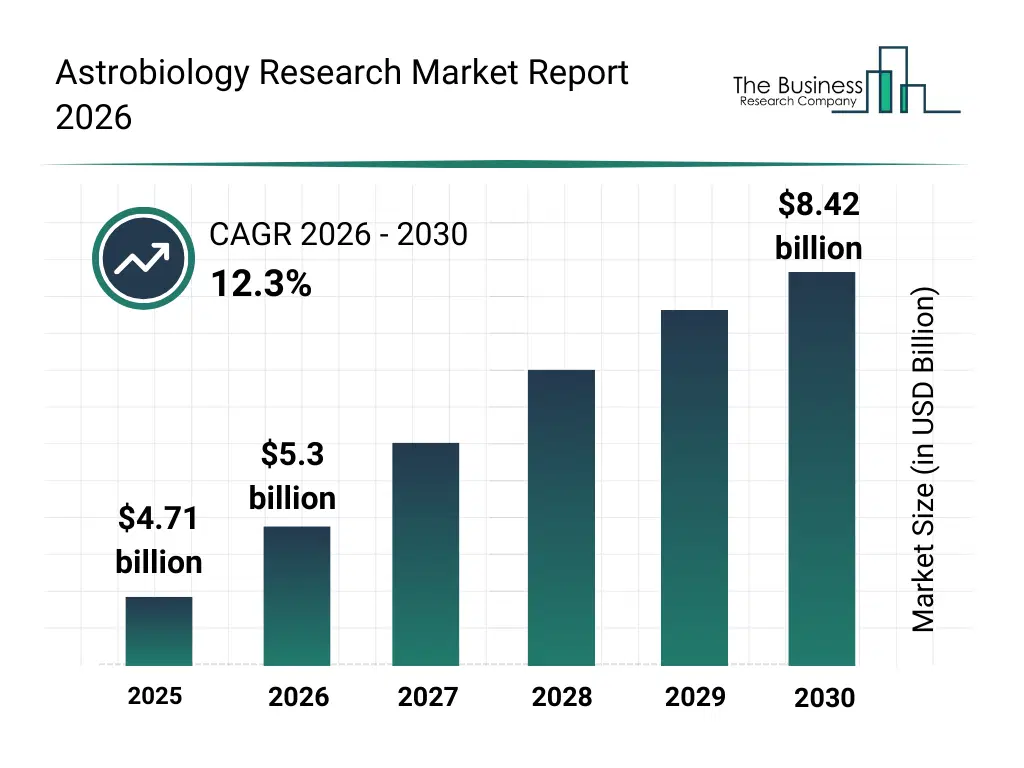
What Is The Astrobiology Research Market Size and Share 2026?
The astrobiology research market size has grown rapidly in recent years. It will grow from $4.71 billion in 2025 to $5.3 billion in 2026 at a compound annual growth rate (CAGR) of 12.5%. The growth in the historic period can be attributed to expansion of space exploration missions, growth of planetary science research, availability of government-funded research programs, advancements in space instrumentation, collaboration between academic institutions.What Is The Astrobiology Research Market Growth Forecast?
The astrobiology research market size is expected to see rapid growth in the next few years. It will grow to $8.42 billion in 2030 at a compound annual growth rate (CAGR) of 12.3%. The growth in the forecast period can be attributed to increasing investments in astrobiology missions, rising focus on life detection beyond earth, expansion of private space research funding, growing use of ai-driven research tools, increasing integration of space and biological sciences. Major trends in the forecast period include increasing use of ai in data analysis, rising deployment of advanced space instrumentation, growing focus on biosignature detection, expansion of interdisciplinary research programs, enhanced use of simulation-based modeling.
Global Astrobiology Research Market Segmentation
1) By Research Area: Planetary Science, Microbial Life, Exoplanetary Systems, Astrochemistry, Other Research Areas 2) By Application: Space Missions, Laboratory Research, Computational Simulations, Other Applications 3) By Funding Source: Government, Private Sector, Academic Institutions, Other Funding Sources Subsegments: 1) By Planetary Science: Planetary Geology, Atmosphere And Climate Studies, Surface And Subsurface Habitability, Planetary Magnetospheres, Icy Moons And Ocean Worlds 2) By Microbial Life: Extremophiles, Biosignatures In Ancient Rocks, Synthetic Biology For Space, Microbial Survival In Space, Mars Analog Microbiology 3) By Exoplanetary Systems: Exoplanet Detection Methods, Exoplanet Atmospheres, Habitability Metrics, Exomoon Studies, Stellar Influence On Habitability 4) By Astrochemistry: Prebiotic Molecules In Space, Organic Molecules In Interstellar Medium, Isotopic Analysis, Chemistry In Protoplanetary Disks, Radiation-Driven Reactions 5) By Other Research Areas: Space-Based Biotechnology, Origins Of Life Studies, Artificial Intelligence In Astrobiology, Astrobiology Data Archiving, Ethical And Philosophical Aspects Of Life DetectionWhat Is The Driver Of The Astrobiology Research Market?
The increasing interest in space exploration is expected to propel the growth of the astrobiology research market going forward. Space exploration refers to investigating and discovering outer space using astronomy, robotics, crewed missions, and spacecraft technology. The rise in space exploration is driven by advancements in launch technologies, which have significantly reduced costs and increased accessibility for government and private missions. Astrobiology research supports space exploration by helping scientists understand the potential for life beyond Earth, guiding the search for habitable environments on other planets. For instance, in November 2023, according to the US International Trade Commission, a US-based federal government agency, annual global space launches increased from 186 in 2022 to 197 in 2023. Therefore, the increasing interest in space exploration is driving the growth of the astrobiology research industry.Key Players In The Global Astrobiology Research Market
Major companies operating in the astrobiology research market report are National Aeronautics and Space Administration (NASA), European Space Agency (ESA), Japan Aerospace Exploration Agency (JAXA), Indian Space Research Organisation (ISRO), China National Space Administration (CNSA), Canadian Space Agency (CSA), UK Space Agency, Australian Space Agency, German Aerospace Center (DLR), Centre National d'Études Spatiales (CNES), Agenzia Spaziale Italiana (ASI), Planetary Science Institute (PSI), Southwest Research Institute (SwRI), Max Planck Institute for Solar System Research, SETI Institute, Space Research Institute Austrian Academy of Sciences, Spanish National Research Council (CSIC), National Institute of Astrophysics Italy, Korean Aerospace Research Institute (KARI), Brazilian Space Agency (AEB), Russian Space Research Institute (IKI)
This chart is for illustrative purposes; the full report includes a detailed competitor analysis and comprehensive overview of the top 10 companies in the market.
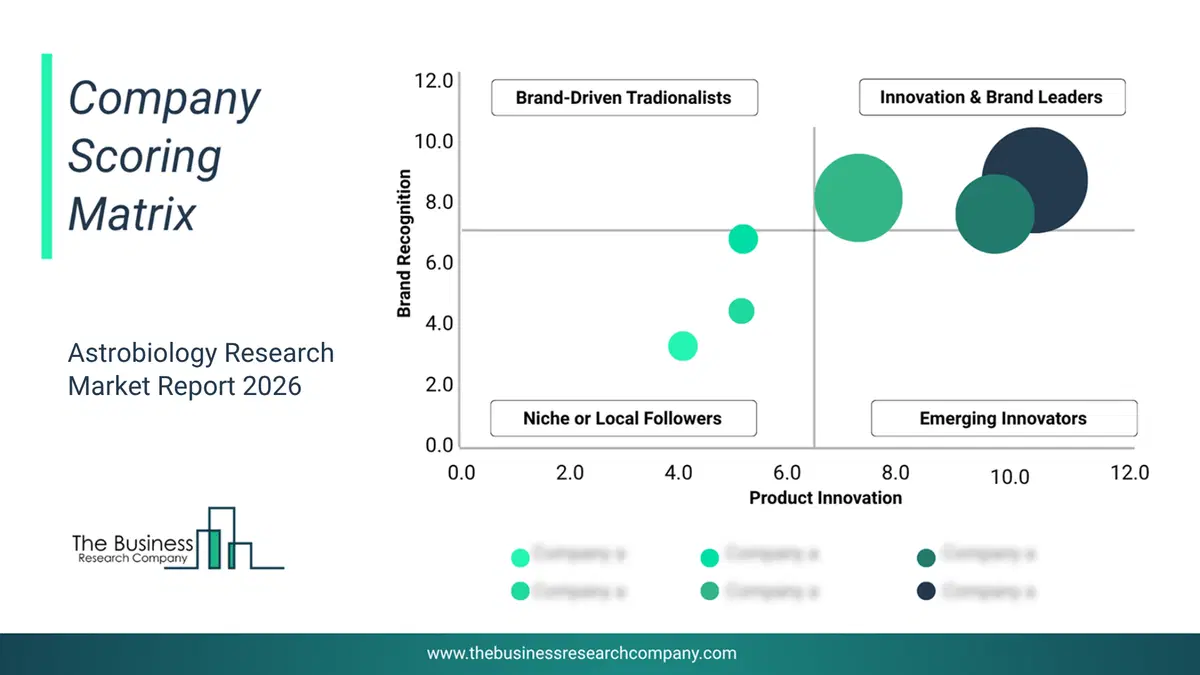
This chart maps companies by product innovation and brand strength, with bubble size indicating relative revenue, helping identify market leaders, challengers, and niche players. This is an illustrative chart; the full report provides a complete and accurate competitive analysis.
Global Astrobiology Research Market Trends and Insights
Major companies operating in the astrobiology research market are focusing on establishing innovative centers, such as new astrobiology research centers, to advance the study of life beyond Earth, enhance interdisciplinary collaboration, and accelerate discoveries related to the origins. Astrobiology research center refers to the official creation and launch of a dedicated facility or institutional unit focused on advancing scientific research in astrobiology. For instance, in October 2023, the University of Arizona, a US-based land-grant research university, inaugurated the Arizona Astrobiology Center, a research center uniting over 40 faculty members from four colleges and 13 disciplines dedicated to exploring life’s origins, existence beyond Earth, and the cultural implications of such discoveries. The center aims to integrate biology, astronomy, planetary sciences, chemistry, and humanities research to address fundamental questions about life in the universe. It supports advanced instrumentation, planetary analog studies, space mission participation, and public engagement programs. The center also facilitates interdisciplinary training for students and early-career researchers, strengthening the pipeline of future astrobiologists.What Are Latest Mergers And Acquisitions In The Astrobiology Research Market?
In February 2025, the National Aeronautics and Space Administration, a US-based independent space agency, partnered with SpaceX. This partnership aims to leverage SpaceX Starbase’s advanced launch infrastructure to deploy the Pandora satellite, enabling more precise measurements of exoplanet atmospheres and their host stars. SpaceX is a US-based aerospace company that manufactures and launches advanced rocket and spacecraft to support scientific research, including astrobiology.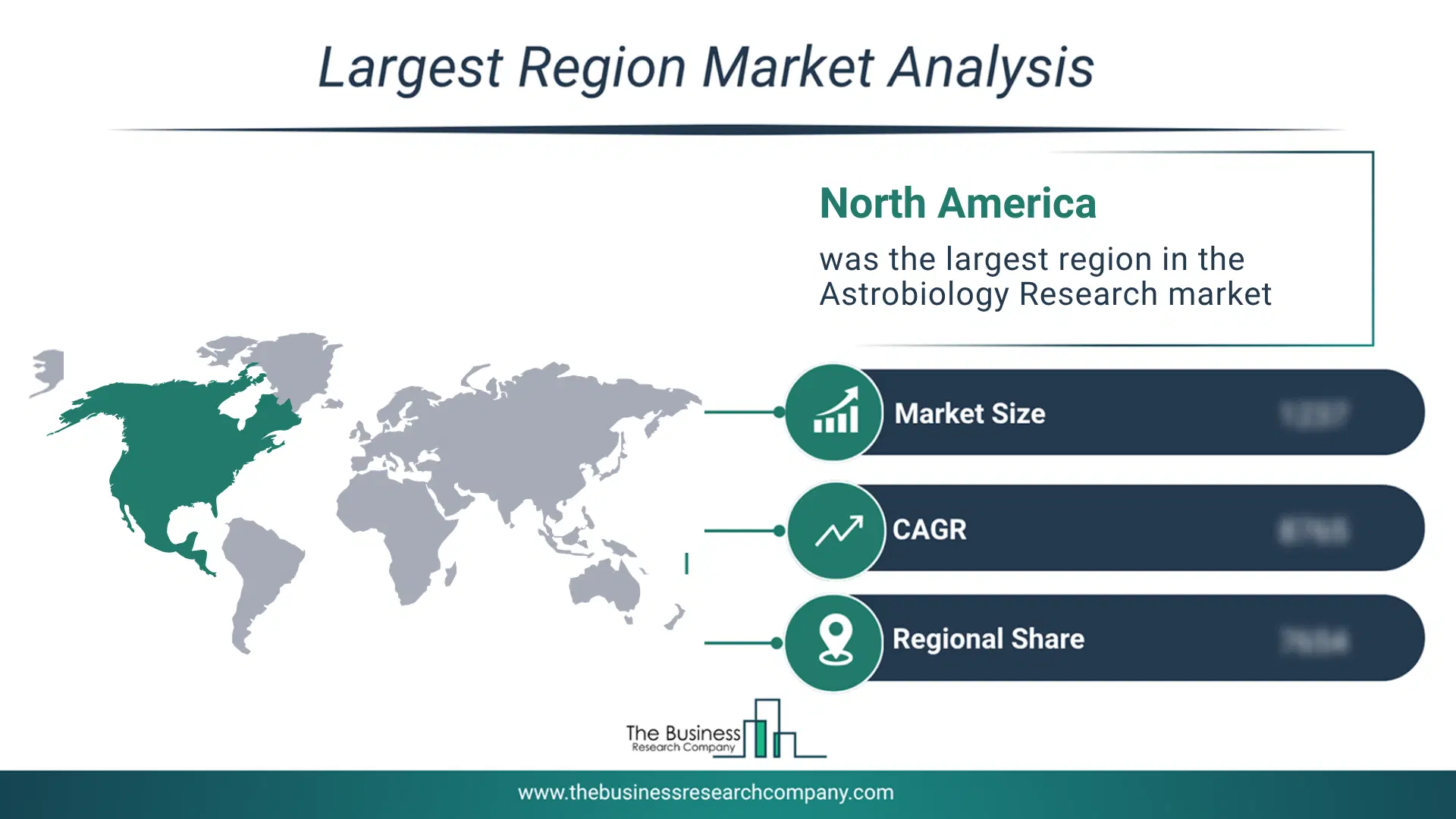
Regional Outlook
North America was the largest region in the astrobiology research market in 2025. Asia-Pacific is expected to be the fastest-growing region in the forecast period. The regions covered in this market report are Asia-Pacific, South East Asia, Western Europe, Eastern Europe, North America, South America, Middle East, Africa. The countries covered in this market report are Australia, Brazil, China, France, Germany, India, Indonesia, Japan, Taiwan, Russia, South Korea, UK, USA, Canada, Italy, SpainWhat Defines the Astrobiology Research Market?
The astrobiology research market includes revenues earned by entities through the study of the origin, evolution, distribution, and future of life in the universe, including the development of technologies and missions to detect biosignatures on other planets. The market value includes the value of related goods sold by the service provider or included within the service offering. Only goods and services traded between entities or sold to end consumers are included.How is Market Value Defined and Measured?
The market value is defined as the revenues that enterprises gain from the sale of goods and/or services within the specified market and geography through sales, grants, or donations in terms of the currency (in USD unless otherwise specified). The revenues for a specified geography are consumption values that are revenues generated by organizations in the specified geography within the market, irrespective of where they are produced. It does not include revenues from resales along the supply chain, either further along the supply chain or as part of other products.
This chart presents market attractiveness based on a quantitative evaluation of growth, competition, strategic alignment, and risk, offering a clear view of opportunity areas for decision-making. This chart is for illustrative purposes; the full report contains the complete analysis.

This chart highlights the Total Addressable Market (TAM) by estimating the maximum revenue opportunity using an assumption-driven approach, supporting strategic planning and opportunity sizing across markets. The chart is illustrative; the full report provides a more comprehensive analysis.
What Key Data and Analysis Are Included in the Astrobiology Research Market Report 2026?
The astrobiology research market research report is one of a series of new reports from The Business Research Company that provides market statistics, including industry global market size, regional shares, competitors with the market share, detailed market segments, market trends and opportunities, and any further data you may need to thrive in the astrobiology research industry. The market research report delivers a complete perspective of everything you need, with an in-depth analysis of the current and future state of the industry.Astrobiology Research Market Report Forecast Analysis
| Report Attribute | Details |
|---|---|
| Market Size Value In 2026 | $5.3 billion |
| Revenue Forecast In 2030 | $8.42 billion |
| Growth Rate | CAGR of 12.5% from 2026 to 2030 |
| Base Year For Estimation | 2025 |
| Actual Estimates/Historical Data | 2020-2025 |
| Forecast Period | 2026 - 2030 - 2030 |
| Market Representation | Revenue in USD Billion and CAGR from 2026 to 2030 |
| Segments Covered | Research Area, Application, Funding Source |
| Regional Scope | Asia-Pacific, Western Europe, Eastern Europe, North America, South America, Middle East, Africa |
| Country Scope | The countries covered in the report are Australia, Brazil, China, France, Germany, India, Indonesia, Japan, Taiwan, Russia, South Korea, UK, USA, Canada, Italy, Spain. |
| Key Companies Profiled | National Aeronautics and Space Administration (NASA), European Space Agency (ESA), Japan Aerospace Exploration Agency (JAXA), Indian Space Research Organisation (ISRO), China National Space Administration (CNSA), Canadian Space Agency (CSA), UK Space Agency, Australian Space Agency, German Aerospace Center (DLR), Centre National d'Études Spatiales (CNES), Agenzia Spaziale Italiana (ASI), Planetary Science Institute (PSI), Southwest Research Institute (SwRI), Max Planck Institute for Solar System Research, SETI Institute, Space Research Institute Austrian Academy of Sciences, Spanish National Research Council (CSIC), National Institute of Astrophysics Italy, Korean Aerospace Research Institute (KARI), Brazilian Space Agency (AEB), Russian Space Research Institute (IKI) |
| Customization Scope | Request for Customization |
| Pricing And Purchase Options | Explore Purchase Options |