
Atmospheric Satellite Market Report 2026
Global Outlook – By Type Of Satellite (Low Earth Orbit Satellites, Medium Earth Orbit Satellites, Geostationary Satellites, Sun-Synchronous Orbit Satellites), By Payload Type (Imaging Sensors, Radiometers, Lidar Systems, Sounding Instruments), By Orbit Strategy (Standalone Satellites, Satellite Constellations, Multi-Sensor Satellite Systems), By Application (Weather Forecasting, Climate Monitoring, Disaster Management, Agricultural Monitoring, Environmental Monitoring, Air Quality Monitoring), By End-User Sector (Government Agencies, Research Institutions, Commercial Enterprises, Agriculture And Forestry) – Market Size, Trends, Strategies, and Forecast to 2030
Atmospheric Satellite Market Overview
• Atmospheric Satellite market size has reached to $10.9 billion in 2025 • Expected to grow to $17.01 billion in 2030 at a compound annual growth rate (CAGR) of 9.4% • Growth Driver: Increasing Demand for Agricultural Monitoring Fueling Market Growth Due to Enhancing Crop Management • Market Trend: Advancing Atmospheric Monitoring Through Microwave Radiometry • North America was the largest region in 2025 and Asia-Pacific is the fastest growing region.Market Gains By 2030 – Top Opportunities By Segment
Market Gain identifies the most promising market opportunities by highlighting the segments or products expected to generate the highest incremental revenue growth over the next five years.
What Is Covered Under Atmospheric Satellite Market?
An atmospheric satellite is a type of Earth-observing satellite designed to monitor and collect data on the planet’s atmosphere, including clouds, aerosols, gases, and weather patterns. It helps scientists study climate change, track storms, and understand environmental processes that affect air quality and global ecosystems. The main types of satellites of the atmospheric satellite include low earth orbit satellites, medium earth orbit satellites, geostationary satellites, and sun-synchronous orbit satellites. Low earth orbit satellites are satellites that operate at altitudes typically between 160 km and 2,000 km above Earth, providing rapid revisit times and high-resolution data for atmospheric observations. Different payload types include imaging sensors, radiometers, lidar systems, and sounding instruments. The primary orbit strategies include standalone satellites, satellite constellations, and multi-sensor satellite systems. The major applications include weather forecasting, climate monitoring, disaster management, agricultural monitoring, environmental monitoring, and air quality monitoring and they are used by several end-user sectors such as government agencies, research institutions, commercial enterprises, and agriculture and forestry.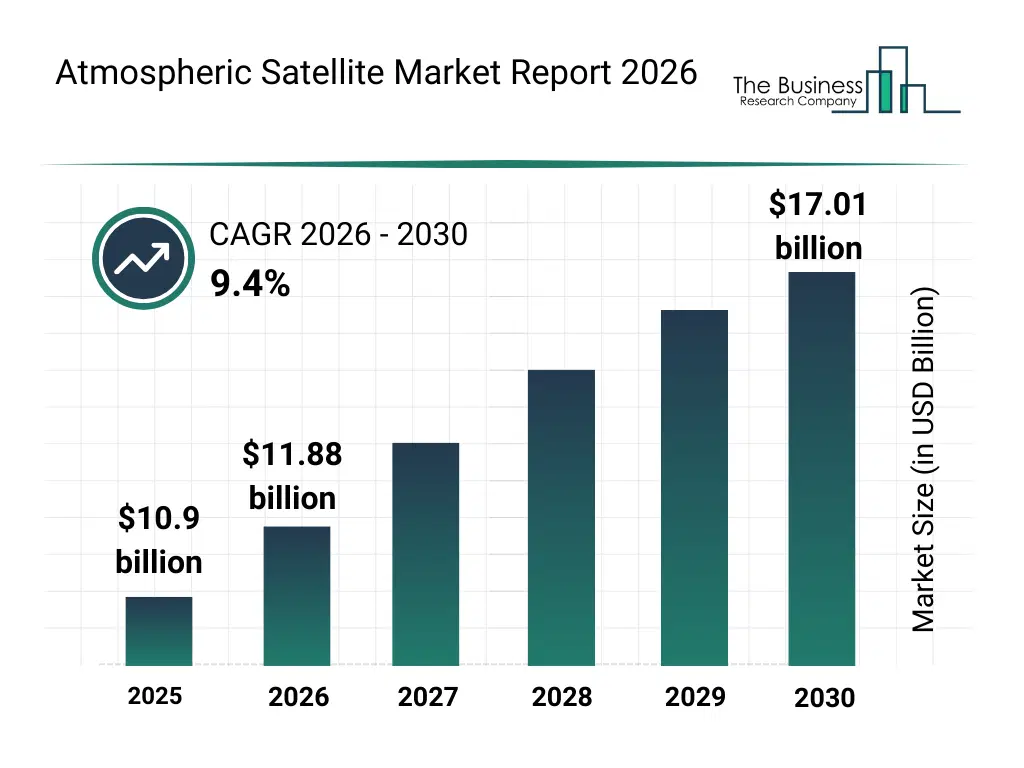
What Is The Atmospheric Satellite Market Size and Share 2026?
The atmospheric satellite market size has grown strongly in recent years. It will grow from $10.9 billion in 2025 to $11.88 billion in 2026 at a compound annual growth rate (CAGR) of 9.0%. The growth in the historic period can be attributed to deployment of early earth observation satellites, adoption of high-precision sensors, growth in climate monitoring programs, technological improvements in propulsion and stabilization, increased international collaboration in satellite mission.What Is The Atmospheric Satellite Market Growth Forecast?
The atmospheric satellite market size is expected to see strong growth in the next few years. It will grow to $17.01 billion in 2030 at a compound annual growth rate (CAGR) of 9.4%. The growth in the forecast period can be attributed to development of stratospheric platform-based satellites, adoption of miniaturized high-resolution sensor payloads, expansion in real-time atmospheric data services, integration with AI for predictive climate analytics, growth in commercial satellite weather monitoring. Major trends in the forecast period include advancement in atmospheric data modeling, rise in high-altitude persistent monitoring, growth in multi-sensor payload integration, increasing demand for climate and air quality insights, expansion of satellite-assisted disaster risk mapping.
Global Atmospheric Satellite Market Segmentation
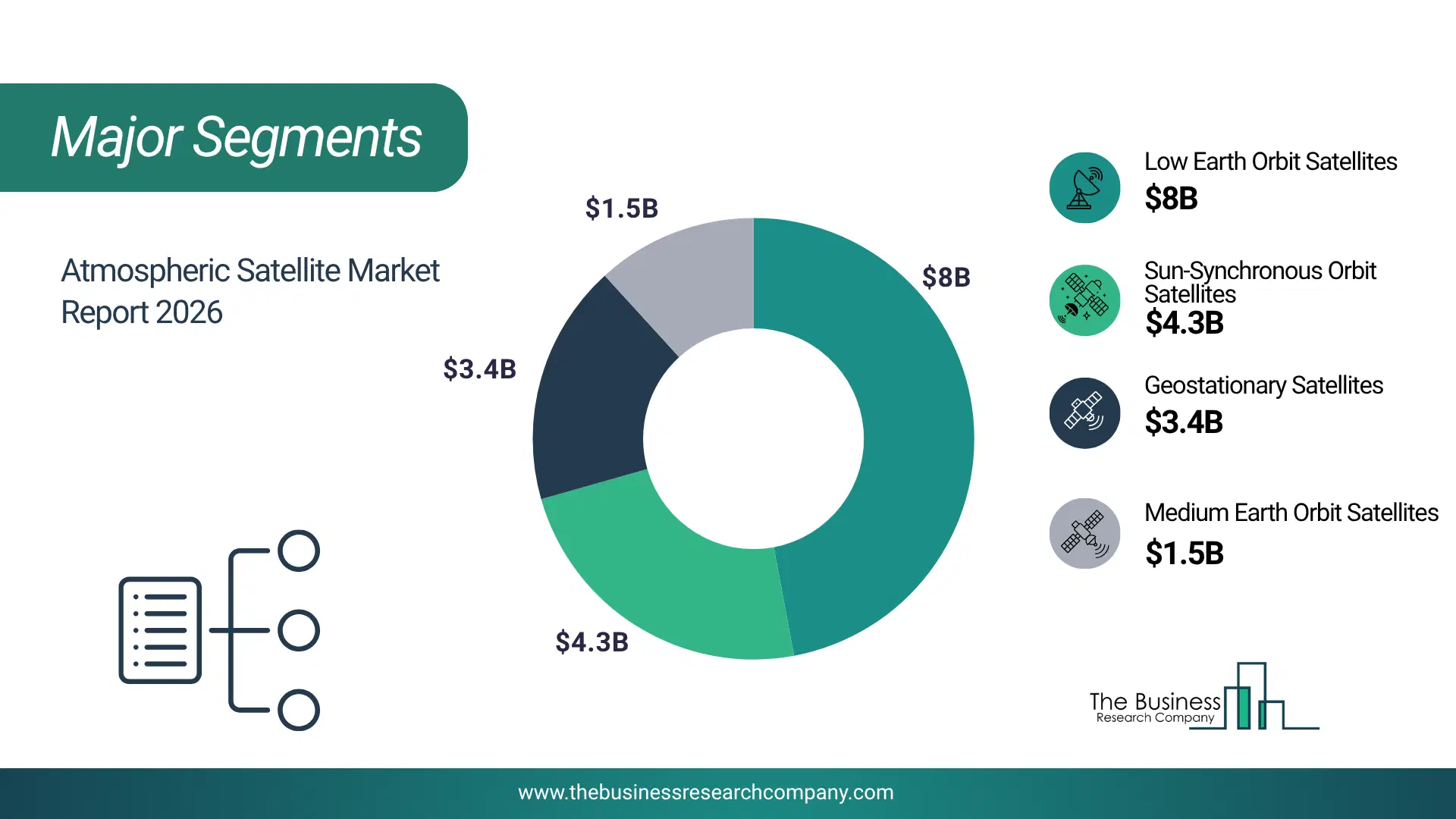
1) By Type Of Satellite: Low Earth Orbit Satellites, Medium Earth Orbit Satellites, Geostationary Satellites, Sun-Synchronous Orbit Satellites 2) By Payload Type: Imaging Sensors, Radiometers, Lidar Systems, Sounding Instruments 3) By Orbit Strategy: Standalone Satellites, Satellite Constellations, Multi-Sensor Satellite Systems 4) By Application: Weather Forecasting, Climate Monitoring, Disaster Management, Agricultural Monitoring, Environmental Monitoring, Air Quality Monitoring 5) By End-User Sector: Government Agencies, Research Institutions, Commercial Enterprises, Agriculture And Forestry Subsegments: 1) By Low Earth Orbit Satellites: Mini Satellites, Micro Satellites, Nano Satellites, Pico Satellites 2) By Medium Earth Orbit Satellites: Navigation Satellites, Remote Sensing Satellites 3) By Geostationary Satellites: Weather Satellites, Broadcast Satellite 4) By Sun-Synchronous Orbit Satellites: Earth Observation Satellites, Environmental Monitoring Satellites, Reconnaissance Satellites The top segments in the atmospheric satellite market will be: • Low Earth Orbit Satellites will reach $7.92 billion by 2030. • Sun-Synchronous Orbit Satellites will reach $4.29 billion by 2030. • Geostationary Satellites will reach $3.35 billion by 2030. • Medium Earth Orbit Satellites will reach $1.45 billion by 2030.What Is Driver Of The Atmospheric Satellite Market?
The increasing demand for agricultural monitoring is expected to propel the growth of the atmospheric satellite market going forward. Agricultural monitoring refers to the use of technology to track crop health, soil conditions, and farming activities for improved productivity and efficiency. The rising demand for agricultural monitoring is due to the need for higher crop yields, as farmers seek precise data to optimize farming practices and resources. Atmospheric satellite supports the increased demand for agricultural monitoring by providing accurate, real-time data on weather, soil, and crop conditions to enhance farm management. For instance, in September 2025, according to the U.S. Department of Agriculture’s Economic Research Service (ERS), a US-based government agency, the direct government farm program payments are projected to reach $40.5 billion in 2025, marking a substantial increase of $30.4 billion from the $10.1 billion disbursed in 2024. Therefore, the increasing demand for agricultural monitoring is driving the growth of the atmospheric satellite industry.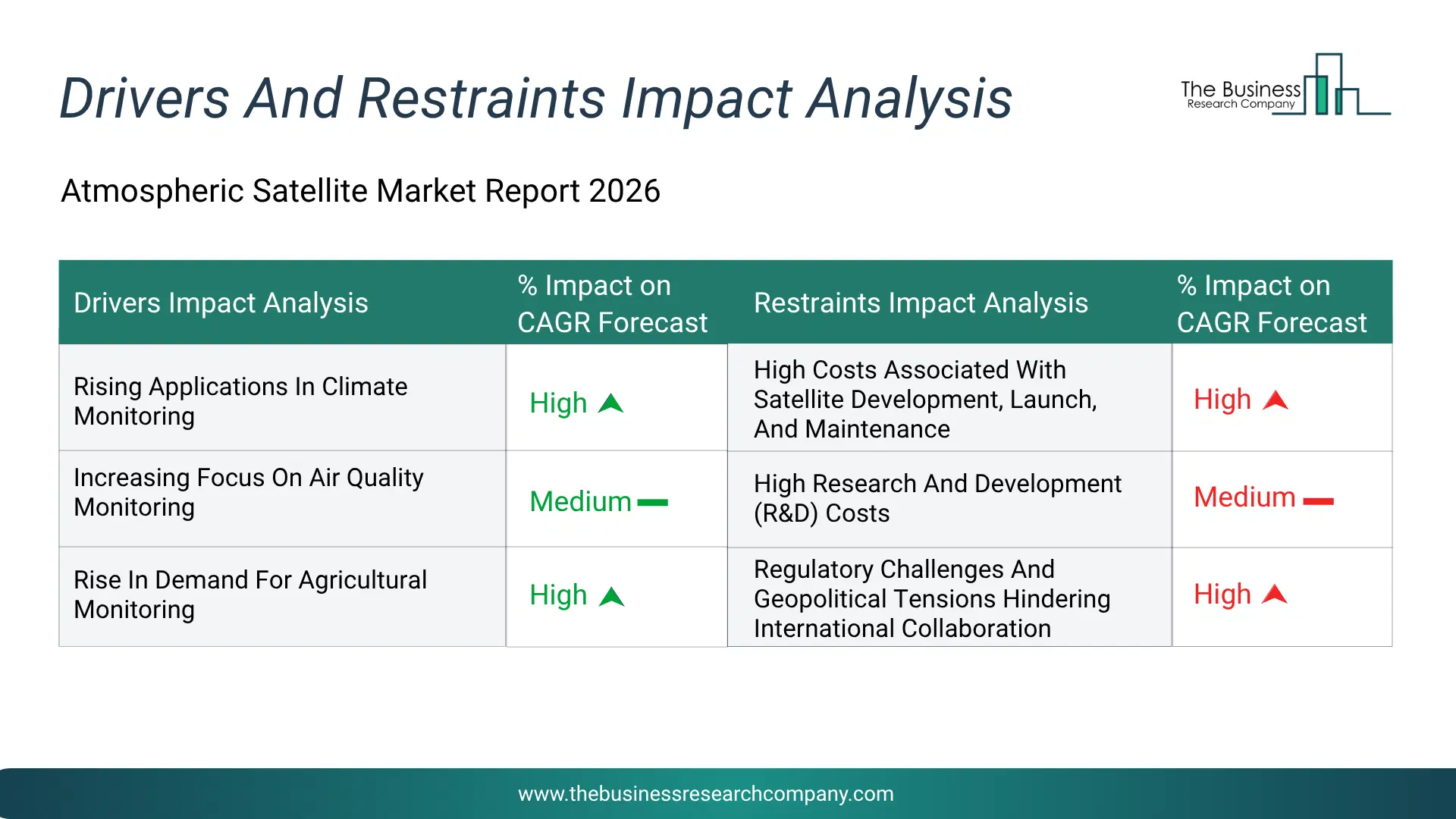
Infographic Chart Showing Key Market Drivers Analysis And Restraints For Atmospheric Satellite Market
The chart presents an impact analysis of key drivers and restraints, quantifying their relative influence on the market's growth rate and helping assess the balance between growth enablers and limiting factors. This chart offers a high-level perspective; the full report contains more detailed insights.
How Will The Drivers Impact Growth In The Global Atmospheric Satellite Market?
• Rising Applications In Climate Monitoring (High) – During the forecast period, the rising applications in climate monitoring is expected to become a key growth driver for the atmospheric satellite market by 2030. Satellites provide a global perspective that ground-based systems cannot achieve, enabling better climate modeling and prediction. Governments, research institutions, and environmental agencies invest in satellite platforms to track climate change impacts and extreme weather events. Continuous monitoring supports policy-making, disaster preparedness, and international climate agreements. • Increasing Focus On Air Quality Monitoring (Medium) – During the forecast period, the increasing focus on air quality monitoring is expected to emerge as a major factor driving the expansion of the atmospheric satellite market by 2030. Increasing focus on air quality monitoring drives the atmospheric satellite market by creating demand for precise observation of pollutants, aerosols, and greenhouse gases in the atmosphere. Satellites can cover large regions and provide continuous, real -time data that ground stations alone cannot capture. Governments and environmental agencies rely on this data to enforce regulations, track pollution sources, and issue public health warnings. Rising urbanization and industrialization have heightened the need for air quality surveillance, boosting investments in satellite technologies. Consequently, atmospheric satellites play a key role in supporting air quality management and policy decisions worldwide. • Rise In Demand For Agricultural Monitoring (High) – During the forecast period, the rise in demand for agricultural monitoring is expected to act as a key growth catalyst for the atmospheric satellite market by 2030. Satellites provide large -scale, real -time observations that help optimize crop planning, irrigation, and yield forecasting. Governments and agribusinesses use this information to improve food security and manage resources efficiently. Extreme weather events and climate variability further highlight the importance of continuous atmospheric monitoring for agriculture.How Will The Restraints Impact Growth In The Global Atmospheric Satellite Market?
• High Costs Associated With Satellite Development, Launch, And Maintenance (High) – During the forecast period, the high costs associated with satellite development, launch, and maintenance act as a significant restraint for the atmospheric satellite market by limiting investment in new satellite projects. Designing and manufacturing advanced satellites with precise sensors and propulsion systems requires substantial capital. Launching satellites into orbit adds further expenses, while ongoing maintenance and ground support increase operational costs. These high financial barriers make it challenging for smaller companies and developing countries to participate in the market. As a result, the overall growth and expansion of atmospheric satellite initiatives are slowed by the burden of these costs. • High Research And Development (R&D) Costs (Medium) – During the forecast period, the regulatory and geopolitical barriers act as significant restraints for the atmospheric satellite market by slowing down project approvals and international collaborations. Strict compliance requirements and complex legal frameworks increase the time and cost of satellite development and deployment. Geopolitical tensions between countries can limit technology sharing, joint missions, and cross-border partnerships. These restrictions hinder market expansion, especially for new entrants and smaller companies. Consequently, companies face higher operational risks and uncertainty, which can delay innovation and adoption of atmospheric satellite technologies. • Regulatory Challenges And Geopolitical Tensions Hindering International Collaboration (High) – During the forecast period, the supply chain and talent constraints act as major restraints for the atmospheric satellite market by slowing down the production and delivery of critical components such as sensor payloads, propulsion systems, and high-precision antennas. Limited availability of specialized materials and parts can cause project delays and increase overall costs. Additionally, there is a shortage of highly skilled engineers and technicians needed for satellite design, testing, and operations, which hampers innovation and timely deployment. Fluctuations in supplier reliability further exacerbate these challenges, making scheduling and budgeting difficult. Together, these factors restrict market growth by limiting the pace and scale at which new atmospheric satellites can be developed and launched.Key Players In The Global Atmospheric Satellite Market
Major companies operating in the atmospheric satellite market are Airbus SE, Maxar Technologies Holdings Inc., Lockheed Martin Corp., Northrop Grumman Corp., L3Harris Technologies Inc., Thales Group, Raytheon Technologies, General Dynamics Corp., Honeywell International, Israel Aerospace Industries, Elbit Systems, Planet Labs PBC, Saab AB, OHB System AG, SES S.A., Echostar Corporation, QinetiQ Group, Viasat, Virgin Orbit, Blue Canyon Technologies LLC, Loral Space & Communications, Thuraya Telecommunications Co., National Aeronautics and Space Administration (NASA), Telesat Corp., Oxford Space Systems, Astroscale, UAVOS, Ball Aerospace Corp., Mitsubishi Electric Corp., Boeing Company, BAE Systems plc.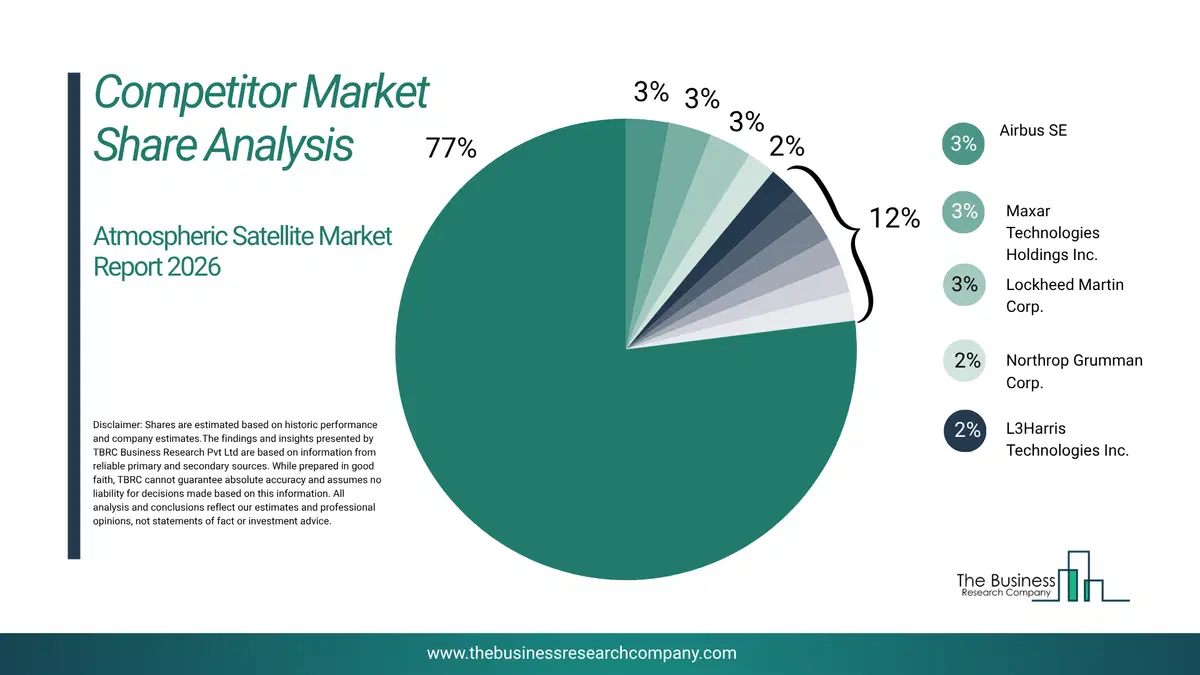
This chart is for illustrative purposes; the full report includes a detailed competitor analysis and comprehensive overview of the top 10 companies in the market.
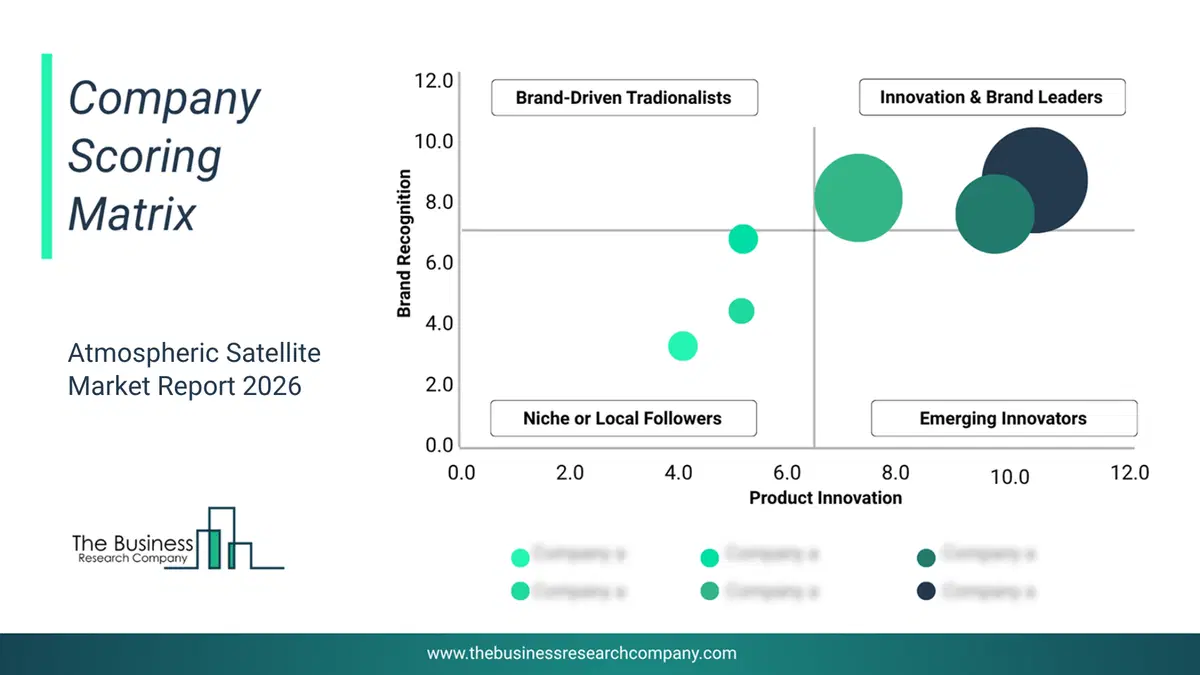
This chart maps companies by product innovation and brand strength, with bubble size indicating relative revenue, helping identify market leaders, challengers, and niche players. This is an illustrative chart; the full report provides a complete and accurate competitive analysis.
Global Atmospheric Satellite Market Trends and Insights
Major companies operating in the atmospheric satellite market are prioritizing the development of novel observation technologies, such as microwave radiometry, to improve atmospheric observation and enhance the accuracy of climate and weather analysis. Microwave radiometry is an advanced remote sensing technique that measures naturally emitted microwave radiation from the Earth’s surface and atmosphere to infer key atmospheric parameters, such as water vapor, precipitation, and cloud liquid water, even under cloudy or adverse weather conditions. For instance, in June 2025, the Japan Aerospace Exploration Agency (JAXA), a Japan-based space agency, launched the Greenhouse Gases and Water Cycle Observation Satellite (GOSAT-GW), an advanced atmospheric observation satellite equipped with the Advanced Microwave Scanning Radiometer (AMSR3). AMSR3 is a next-generation microwave radiometer designed to provide precise estimates of atmospheric water vapor, precipitation, and cloud properties. With this capability, GOSAT-GW contributes to monitoring the water cycle, supports weather and climate modeling, advances climate change research, and enables more comprehensive analysis of atmospheric dynamics and interactions.What Are Latest Mergers And Acquisitions In The Atmospheric Satellite Market? BAE Systems Inc. Completes Acquisition Of Ball Aerospace To Expand Space Capabilities
In February 2024, BAE Systems plc, a UK-based aerospace company, acquired Ball Aerospace & Technologies Corp for an undisclosed amount. Through this acquisition, BAE Systems aims to enhance its space, science, and defense capabilities by integrating Ball Aerospace’s expertise in satellite systems, instruments, and mission services. Ball Aerospace & Technologies Corp. is a US-based company that manufactures spacecraft, instruments, and sensors, and produces instruments for atmospheric satellites.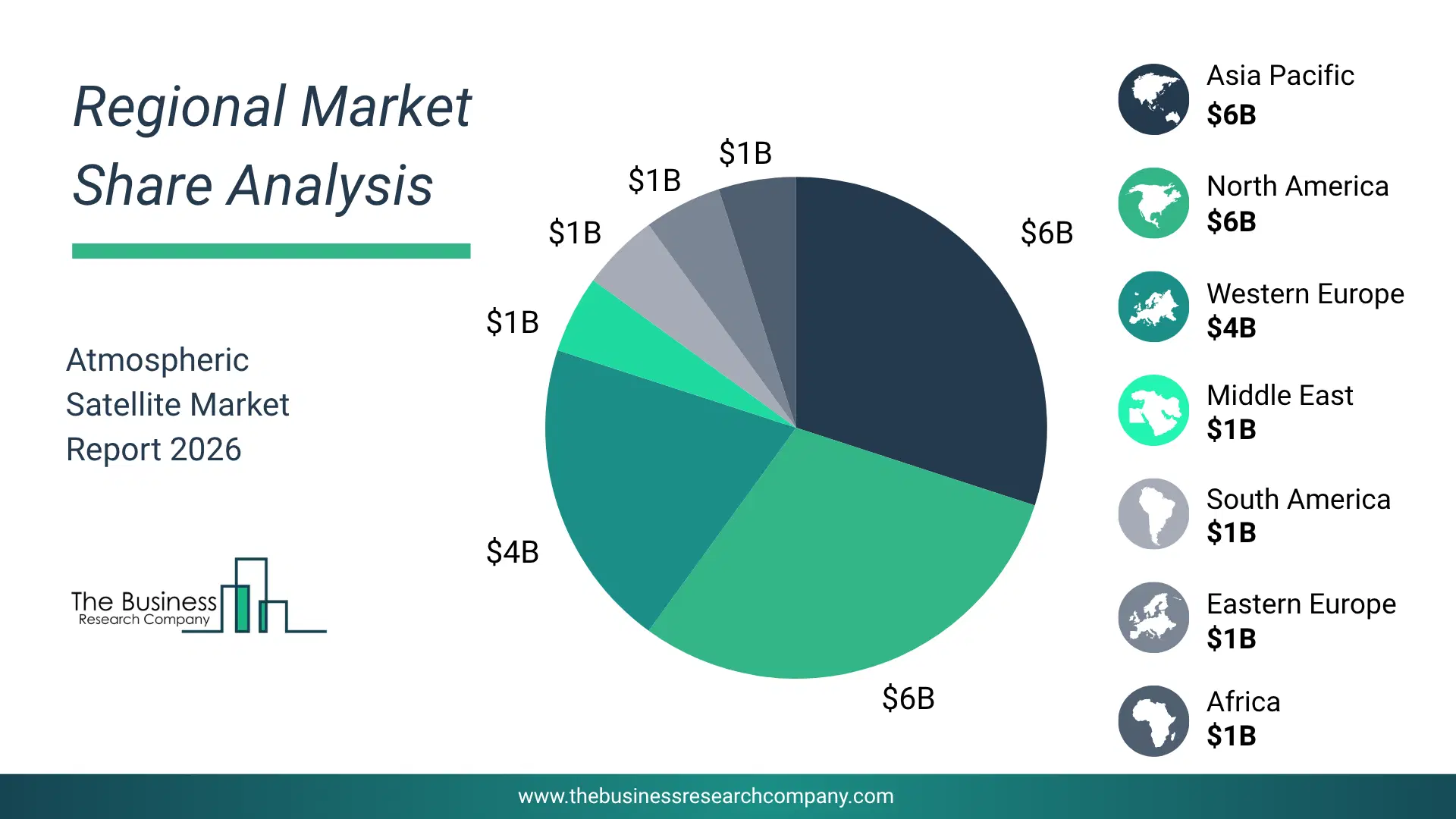
Regional Insights
North America was the largest region in the atmospheric satellite market in 2025. Asia-Pacific is expected to be the fastest-growing region in the forecast period. The regions covered in this market report are Asia-Pacific, South East Asia, Western Europe, Eastern Europe, North America, South America, Middle East, Africa. The countries covered in this market report are Australia, Brazil, China, France, Germany, India, Indonesia, Japan, Taiwan, Russia, South Korea, UK, USA, Canada, Italy, SpainWhat Defines the Atmospheric Satellite Market?
The atmospheric satellite market consists of sales of high-altitude balloons, stratospheric platforms, sensor payloads, antennas, and propulsion systems. Values in this market are ‘factory gate’ values, that is the value of goods sold by the manufacturers or creators of the goods, whether to other entities (including downstream manufacturers, wholesalers, distributors and retailers) or directly to end customers. The value of goods in this market includes related services sold by the creators of the goods.How is Market Value Defined and Measured?
The market value is defined as the revenues that enterprises gain from the sale of goods and/or services within the specified market and geography through sales, grants, or donations in terms of the currency (in USD unless otherwise specified). The revenues for a specified geography are consumption values that are revenues generated by organizations in the specified geography within the market, irrespective of where they are produced. It does not include revenues from resales along the supply chain, either further along the supply chain or as part of other products.
This chart presents market attractiveness based on a quantitative evaluation of growth, competition, strategic alignment, and risk, offering a clear view of opportunity areas for decision-making. This chart is for illustrative purposes; the full report contains the complete analysis.

This chart highlights the Total Addressable Market (TAM) by estimating the maximum revenue opportunity using an assumption-driven approach, supporting strategic planning and opportunity sizing across markets. The chart is illustrative; the full report provides a more comprehensive analysis.
What Key Data and Analysis Are Included in the Atmospheric Satellite Market Report 2026?
The atmospheric satellite market research report is one of a series of new reports from The Business Research Company that provides market statistics, including industry global market size, regional shares, competitors with the market share, detailed market segments, market trends and opportunities, and any further data you may need to thrive in the atmospheric satellite industry. The market research report delivers a complete perspective of everything you need, with an in-depth analysis of the current and future state of the industry.Atmospheric Satellite Market Report Forecast Analysis
| Report Attribute | Details |
|---|---|
| Market Size Value In 2026 | $11.88 billion |
| Revenue Forecast In 2030 | $17.01 billion |
| Growth Rate | CAGR of 9.4% from 2026 to 2030 |
| Base Year For Estimation | 2025 |
| Actual Estimates/Historical Data | 2020-2025 |
| Forecast Period | 2026 - 2030 |
| Market Representation | Revenue in USD Billion and CAGR from 2026 to 2030 |
| Segments Covered | Type Of Satellite, Payload Type, Orbit Strategy, Application, End-User Sector |
| Regional Scope | Asia-Pacific, Western Europe, Eastern Europe, North America, South America, Middle East, Africa |
| Country Scope | The countries covered in the report are Australia, Brazil, China, France, Germany, India, ... |
| Key Companies Profiled | Airbus SE, Maxar Technologies Holdings Inc., Lockheed Martin Corp., Northrop Grumman Corp., L3Harris Technologies Inc., Thales Group, Raytheon Technologies, General Dynamics Corp., Honeywell International, Israel Aerospace Industries, Elbit Systems, Planet Labs PBC, Saab AB, OHB System AG, SES S.A., Echostar Corporation, QinetiQ Group, Viasat, Virgin Orbit, Blue Canyon Technologies LLC, Loral Space & Communications, Thuraya Telecommunications Co., National Aeronautics and Space Administration (NASA), Telesat Corp., Oxford Space Systems, Astroscale, UAVOS, Ball Aerospace Corp., Mitsubishi Electric Corp., Boeing Company, BAE Systems plc. |
| Customization Scope | Request for Customization |
| Pricing And Purchase Options | Explore Purchase Options |