

Atrial Flutter Market Report 2026
Global Outlook – By Type (Typical Atrial Flutter, Atypical Atrial Flutter, Left Atrial Flutter, Reverse Typical Atrial Flutter, Incisional Atrial Re-Entry), By Treatment (Antiarrhythmics, Beta-Blockers, Anticoagulants, Cardioversion, Catheter Ablation, Surgery, Other Treatments), By Diagnosis (Holter Monitoring, Blood Tests, Electrocardiography (ECG), Event Monitoring, Other Diagnosis), By Route Of Administration (Oral, Intravenous, Other Routes Of Administration), By End Users (Clinic, Hospital, Other End Users) - Market Size, Trends, Strategies, and Forecast to 2030
Atrial Flutter Market Overview
• Atrial Flutter market size has reached to $22.99 billion in 2025 • Expected to grow to $46.47 billion in 2030 at a compound annual growth rate (CAGR) of 15% • Growth Driver: Rising Cardiovascular Disease Rates Drive Growth In Atrial Flutter • Market Trend: Innovative Cardiac Monitoring Solution Enhances Atrial Flutter Diagnosis And Patient Management • North America was the largest region in 2025 and Asia-Pacific is the fastest growing region.What Is Covered Under Atrial Flutter Market?
Atrial flutter refers to a type of abnormal heart rhythm characterized by rapid, irregular electrical signals in the atria (the heart's upper chambers), leading to a fast and often irregular heartbeat. This condition can cause symptoms such as palpitations, shortness of breath, and fatigue, and may increase the risk of stroke and other heart-related complications. The main types of atrial flutter are typical atrial flutter, atypical atrial flutter, left atrial flutter, reverse typical atrial flutter, and incisional atrial re-entry. Typical atrial flutter is a common form of arrhythmia where the electrical signals in the right atrium of the heart circle in a specific pattern, leading to a rapid and regular heartbeat. The various treatments include antiarrhythmics, beta-blockers, anticoagulants, cardioversion, catheter ablation, surgery, and others. The different diagnoses are heart monitoring, blood tests, electrocardiography (ECG), event monitoring, and others. The varying routes of administration are oral, intravenous, and others provided to many end users, such as clinics, hospitals, and others.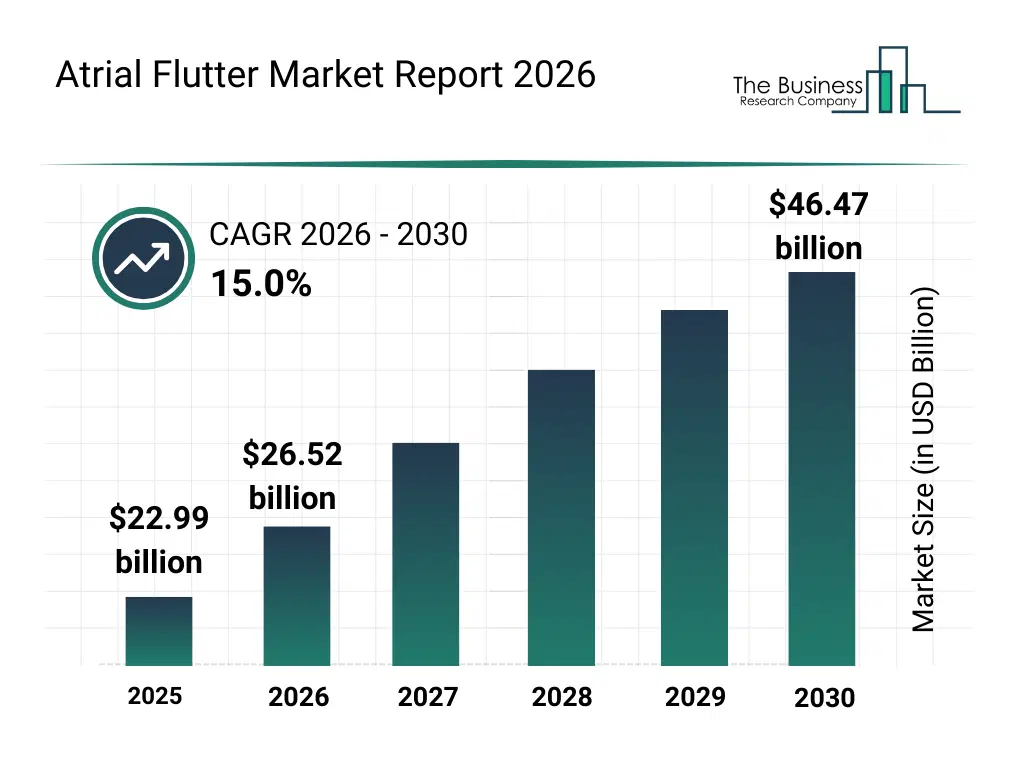
What Is The Atrial Flutter Market Size and Share 2026?
The atrial flutter market size has grown rapidly in recent years. It will grow from $22.99 billion in 2025 to $26.52 billion in 2026 at a compound annual growth rate (CAGR) of 15.4%. The growth in the historic period can be attributed to increasing prevalence of cardiac arrhythmias, rising aging population, expansion of cardiology specialty clinics, adoption of ecg-based diagnostic tools, availability of pharmacological rhythm control therapies.What Is The Atrial Flutter Market Growth Forecast?
The atrial flutter market size is expected to see rapid growth in the next few years. It will grow to $46.47 billion in 2030 at a compound annual growth rate (CAGR) of 15.0%. The growth in the forecast period can be attributed to increasing demand for minimally invasive cardiac procedures, rising adoption of digital cardiac monitoring, expansion of personalized arrhythmia treatment approaches, growing investments in electrophysiology technologies, increasing focus on stroke prevention strategies. Major trends in the forecast period include increasing adoption of advanced cardiac mapping technologies, rising use of catheter ablation procedures, growing integration of wearable cardiac monitoring devices, expansion of early diagnosis and screening programs, enhanced focus on minimally invasive treatments.

Global Atrial Flutter Market Segmentation
1) By Type: Typical Atrial Flutter, Atypical Atrial Flutter, Left Atrial Flutter, Reverse Typical Atrial Flutter, Incisional Atrial Re-Entry 2) By Treatment: Antiarrhythmics, Beta-Blockers, Anticoagulants, Cardioversion, Catheter Ablation, Surgery, Other Treatments 3) By Diagnosis: Holter Monitoring, Blood Tests, Electrocardiography (ECG), Event Monitoring, Other Diagnosis 4) By Route Of Administration: Oral, Intravenous, Other Routes Of Administration 5) By End Users: Clinic, Hospital, Other End Users Subsegments: 1) By Typical Atrial Flutter: Type I Atrial Flutter (Caval Tricuspid Isthmus Dependent), Type II Atrial Flutter (Right Atrial Macro-Reentry), Focal Typical Atrial Flutter, Post-Surgical Typical Atrial Flutter 2) By Atypical Atrial Flutter: Left Atrial Atypical Flutter, Right Atrial Atypical Flutter, Focal Atypical Flutter, Multifocal Atypical Flutter 3) By Left Atrial Flutter: Left Atrial Macro-Reentry Flutter, Left Atrial Focal Flutter, Left Atrial Flutter Post-Surgery 4) By Reverse Typical Atrial Flutter: Reverse Typical Flutter With Counterclockwise Rotation, Reverse Typical Flutter With Clockwise Rotation, Post-Cardiac Surgery Reverse Typical Flutter 5) By Incisional Atrial Re-Entry: Post-Surgical Atrial Flutter (Incisional Flutter), Incisional Re-Entry Flutter After Cardiac Procedures, Incisional Flutter Due To Atrial Scar TissueWhat Is The Driver Of The Atrial Flutter Market?
The rising prevalence of cardiovascular diseases is expected to propel the growth of the atrial flutter market going forward. Cardiovascular diseases (CVDs) are a broad category of health conditions that involve the heart and blood vessels. The increase in cardiovascular diseases is largely due to aging demographics, sedentary lifestyles, poor dietary habits, higher obesity rates, and stress-related factors. With cardiovascular diseases becoming more common, the number of individuals at risk for atrial flutter grows, leading to higher demand for diagnostic and treatment options. For instance, in September 2024, according to the British Heart Foundation, a UK-based cardiovascular research charity, in the UK, approximately 7.6 million individuals are currently affected by heart and circulatory diseases, comprising 4 million men and 3.6 million women. By 2030, this number could increase by 1 million, and by 2040, it may rise to 2 million more than the current figures. Therefore, the rising prevalence of cardiovascular diseases is driving the growth of the atrial flutter industry.Key Players In The Global Atrial Flutter Market
Major companies operating in the atrial flutter market are Pfizer Inc., Johnson & Johnson, Siemens AG, Bristol-Myers Squibb Company, Abbott Laboratories, Novartis AG, Medtronic PLC, Boehringer Ingelheim GmbH, Stryker Corporation, GE HealthCare Technologies Inc., Boston Scientific Corporation, Astellas Pharma Inc., Zoll Medical Corporation, St. Jude Medical Inc., Biotronik SE & Co., iRhythm Technologies Inc., AtriCure Inc., Adagio Medical Inc., Acutus Medical Inc., Abbott Vascular
This chart is for illustrative purposes; the full report includes a detailed competitor analysis and comprehensive overview of the top 10 companies in the market.

This chart maps companies by product innovation and brand strength, with bubble size indicating relative revenue, helping identify market leaders, challengers, and niche players. This is an illustrative chart; the full report provides a complete and accurate competitive analysis.
Global Atrial Flutter Market Trends and Insights
Major companies operating in the atrial flutter market are focusing on integration of monitoring technologies, such as arrhythmia detection algorithms, to enhance diagnostic accuracy, improve treatment outcomes, and optimize patient management. Arrhythmia detection algorithms are specialized software tools that analyze data from electrocardiograms (ECGs) or wearable heart monitors to identify irregularities in heart rhythm and detect abnormal patterns indicative of arrhythmias, such as atrial flutter. For instance, in May 2024, Vivalink, Inc., a US-based connected health technology company, launched a turnkey ambulatory cardiac monitoring solution for mobile cardiac telemetry (MCT) and Holter monitoring to enhance remote patient care. This solution employs state-of-the-art software to continuously analyze data from electrocardiograms (ECGs) and wearable heart monitors, providing real-time identification of irregular heart rhythms such as atrial flutter. The solution features a reusable electrocardiogram (ECG) patch with a 14-day rechargeable battery and up to 30 days of data storage. It also includes a mobile gateway integrated with a patient app for seamless data transmission, an advanced algorithm that detects over 15 arrhythmias, and a clinician portal for in-depth analysis and report customization.What Are Latest Mergers And Acquisitions In The Atrial Flutter Market?
In July 2024, Stereotaxis Inc., a US-based provider of robotic systems for minimally invasive endovascular and cardiac electrophysiology procedures, acquired Access Point Technologies EP (APT) for approximately USD 15.1 million. With this acquisition, Stereotaxis, Inc. gains access to APT’s electrophysiology catheter design, development, and manufacturing capabilities, thereby enhancing its in-house catheter portfolio and strengthening its integrated robotic-guided cardiac ablation solutions while improving its product breadth and customer reach across electrophysiology laboratories. Access Point Technologies EP Inc. is a US-based provider of diagnostic electrophysiology catheters and related devices for cardiac mapping and ablation procedures, known for its high-performance, clinician-informed catheter designs.
Regional Outlook
North America was the largest region in the atrial flutter market in 2025. Asia-Pacific is expected to be the fastest-growing region in the forecast period. The regions covered in this market report are Asia-Pacific, South East Asia, Western Europe, Eastern Europe, North America, South America, Middle East, Africa. The countries covered in this market report are Australia, Brazil, China, France, Germany, India, Indonesia, Japan, Taiwan, Russia, South Korea, UK, USA, Canada, Italy, Spain.What Defines the Atrial Flutter Market?
The atrial flutter market consists of revenues earned by entities by providing services such as treatment services, diagnostic testing, and consultation services. The market value includes the value of related goods sold by the service provider or included within the service offering. The atrial flutter market also includes sales of cardioversion devices, catheter ablation equipment, and monitoring devices. Values in this market are ‘factory gate’ values, that is, the value of goods sold by the manufacturers or creators of the goods, whether to other entities (including downstream manufacturers, wholesalers, distributors, and retailers) or directly to end customers. The value of goods in this market includes related services sold by the creators of the goods.How is Market Value Defined and Measured?
The market value is defined as the revenues that enterprises gain from the sale of goods and/or services within the specified market and geography through sales, grants, or donations in terms of the currency (in USD unless otherwise specified). The revenues for a specified geography are consumption values that are revenues generated by organizations in the specified geography within the market, irrespective of where they are produced. It does not include revenues from resales along the supply chain, either further along the supply chain or as part of other products.
This chart presents market attractiveness based on a quantitative evaluation of growth, competition, strategic alignment, and risk, offering a clear view of opportunity areas for decision-making. This chart is for illustrative purposes; the full report contains the complete analysis.

This chart highlights the Total Addressable Market (TAM) by estimating the maximum revenue opportunity using an assumption-driven approach, supporting strategic planning and opportunity sizing across markets. The chart is illustrative; the full report provides a more comprehensive analysis.
What Key Data and Analysis Are Included in the Atrial Flutter Market Report 2026?
The atrial flutter market research report is one of a series of new reports from The Business Research Company that provides market statistics, including industry global market size, regional shares, competitors with the market share, detailed market segments, market trends and opportunities, and any further data you may need to thrive in the atrial flutter industry. The market research report delivers a complete perspective of everything you need, with an in-depth analysis of the current and future state of the industry.Atrial Flutter Market Report Forecast Analysis
| Report Attribute | Details |
|---|---|
| Market Size Value In 2026 | $26.52 billion |
| Revenue Forecast In 2030 | $46.47 billion |
| Growth Rate | CAGR of 15% from 2026 to 2030 |
| Base Year For Estimation | 2025 |
| Actual Estimates/Historical Data | 2020-2025 |
| Forecast Period | 2026 - 2030 |
| Market Representation | Revenue in USD Billion and CAGR from 2026 to 2030 |
| Segments Covered | Type, Treatment, Diagnosis, Route Of Administration, End Users |
| Regional Scope | Asia-Pacific, Western Europe, Eastern Europe, North America, South America, Middle East, Africa |
| Country Scope | The countries covered in the report are Australia, Brazil, China, France, Germany, India, Indonesia, Japan, Taiwan, Russia, South Korea, UK, USA, Canada, Italy, Spain |
| Key Companies Profiled | Pfizer Inc., Johnson & Johnson, Siemens AG, Bristol-Myers Squibb Company, Abbott Laboratories, Novartis AG, Medtronic PLC, Boehringer Ingelheim GmbH, Stryker Corporation, GE HealthCare Technologies Inc., Boston Scientific Corporation, Astellas Pharma Inc., Zoll Medical Corporation, St. Jude Medical Inc., Biotronik SE & Co., iRhythm Technologies Inc., AtriCure Inc., Adagio Medical Inc., Acutus Medical Inc., Abbott Vascular |
| Customization Scope | Request for Customization |
| Pricing And Purchase Options | Explore Purchase Options |