

Arrhythmia Market Report 2026
Global Outlook – By Type (Supraventricular Tachycardias, Ventricular Arrhythmias, Bradyarrhythmias, Other Types), By Test Equipment (Electrocardiogram (ECG), Holter Monitor), By Hearth Blocks (First Degree Heart Block, Second Degree Heart Block, Third Degree Heart Block), By Distribution Channel (Hospitals Pharmacies, Retail Pharmacies, Online Pharmacies) – Market Size, Trends, Strategies, and Forecast to 2030
Arrhythmia Market Overview
• Arrhythmia market size has reached to $8.28 billion in 2025 • Expected to grow to $12.65 billion in 2030 at a compound annual growth rate (CAGR) of 8.8% • Growth Driver: Cardiac Disease Epidemic Fuels The Growth Of The Arrhythmia Market • Market Trend: Product Innovation Transforming The Arrythmia Market • North America was the largest region in 2025.What Is Covered Under Arrhythmia Market?
Arrhythmia refers to a heart disorder caused by an abnormality in the normal sequence of electrical impulses, which changes the rate or rhythm at which the heart beats. Electrical impulses can be too fast, too slow, or erratically occurring, resulting in irregular heartbeats. The main types of arrhythmia are supraventricular tachycardias, ventricular arrhythmias, bradyarrhythmias, and others. Supraventricular tachycardias refer to a condition that causes the heart to suddenly beat much faster, which can then slow down abruptly. This can be tested by various equipment such as an electrocardiogram (ECG) and holter monitor and detect first-degree, second-degree, and third-degree heart blocks and provide services through various distribution channels such as hospital pharmacies, retail pharmacies, and online pharmacies.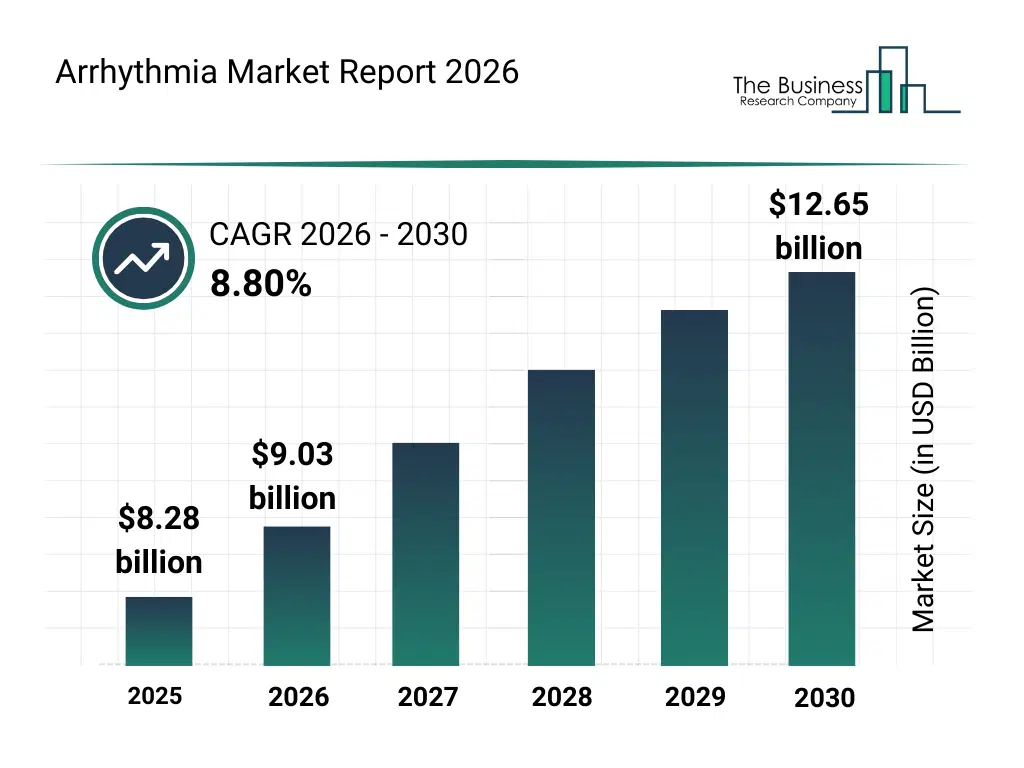
What Is The Arrhythmia Market Size and Share 2026?
The arrhythmia market size has grown strongly in recent years. It will grow from $8.28 billion in 2025 to $9.03 billion in 2026 at a compound annual growth rate (CAGR) of 9.0%. The growth in the historic period can be attributed to increasing prevalence of cardiovascular diseases, rising aging population, improved availability of diagnostic cardiac devices, growing awareness of heart rhythm disorders, expansion of hospital cardiology departments.What Is The Arrhythmia Market Growth Forecast?
The arrhythmia market size is expected to see strong growth in the next few years. It will grow to $12.65 billion in 2030 at a compound annual growth rate (CAGR) of 8.8%. The growth in the forecast period can be attributed to increasing adoption of remote patient monitoring solutions, rising investments in digital cardiology platforms, growing demand for early-stage arrhythmia detection, expansion of home-based cardiac care, technological advancements in cardiac diagnostics. Major trends in the forecast period include increasing adoption of ai-based arrhythmia detection tools, rising use of wearable and remote cardiac monitoring devices, growing integration of digital ecg and holter technologies, expansion of personalized arrhythmia treatment approaches, enhanced focus on early diagnosis and continuous monitoring.
Global Arrhythmia Market Segmentation
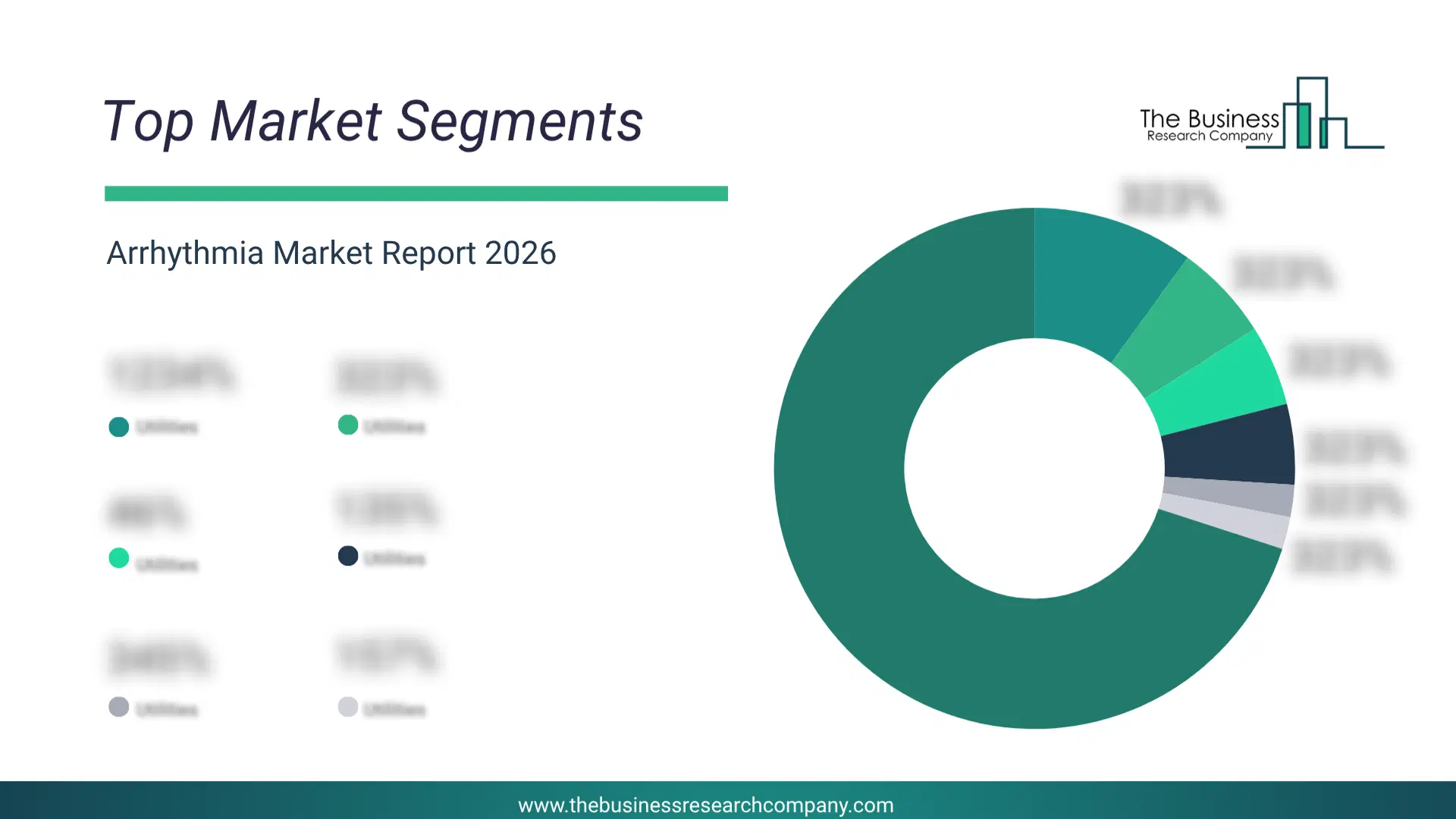
1) By Type: Supraventricular Tachycardias, Ventricular Arrhythmias, Bradyarrhythmias, Other Types 2) By Test Equipment: Electrocardiogram (ECG), Holter Monitor 3) By Hearth Blocks: First Degree Heart Block, Second Degree Heart Block, Third Degree Heart Block 4) By Distribution Channel: Hospitals Pharmacies, Retail Pharmacies, Online Pharmacies Subsegments: 1) By Supraventricular Tachycardias: Atrial Fibrillation, Atrial Flutter, Paroxysmal Supraventricular Tachycardia (PSVT) 2) By Ventricular Arrhythmias: Ventricular Fibrillation, Ventricular Tachycardia, Premature Ventricular Contractions (PVCs) 3) By Bradyarrhythmias: Sinus Bradycardia, Heart Block 4) By Other Types: Long QT Syndrome, Wolff-Parkinson-White Syndrome, Torsades de PointesWhat Is The Driver Of The Arrhythmia Market?
The rising prevalence of cardiac disease and other heart problems is expected to propel the growth of the arrhythmia market going forward. Cardiac disease or cardiovascular disease refers to a collection of heart and blood vessel conditions, including several conditions such as atherosclerosis, heart attack, stroke, and arrhythmia, among others. Both functional defects, including diastolic and systolic dysfunction, and electrical defects, including the development of arrhythmias, can result in a high prevalence of heart failure, atrial fibrillation, and other cardiovascular diseases. For instance, in October 2024, according to the Centers for Disease Control and Prevention, a US-based government agency, in 2023, cardiovascular disease claimed 919,032 lives, accounting for one in every three deaths. Coronary heart disease remained the most prevalent form of heart disease, and notably, about one in six deaths from cardiovascular diseases occurred among adults younger than 65 years. Thus, the rising prevalence of cardiac disease and other heart problems is driving the growth of the arrhythmia industry.Key Players In The Global Arrhythmia Market
Major companies operating in the arrhythmia market are Medtronic PLC, Abbott Laboratories, Boston Scientific Corporation, AliveCor Inc., Biotronik SE & Co. KG, Biotricity Inc., GE Healthcare, Koninklijke Philips N.V., Nihon Kohden Corporation, Spacelabs Healthcare, Welch Allyn Inc., Mylan N.V., Lepu Medical Technology Co. Ltd., iRhythm Technologies Inc., BioTelemetry Inc., Fukuda Denshi Co. Ltd., Smart Solutions Technologies Inc., Biosense Webster Inc., Cardiac Science Corporation, CardioComm Solutions Inc., CardioNet LLC, NUUBO SMART SOLUTIONS S.L., Cardiva Medical Inc., Osypka AG, Johnson & Johnson Services Inc., Pfizer Inc, Teva Pharmaceutical Industries Ltd, Applied Cardiac Systems, Acutus Medical, EP Solutions SA
This chart is for illustrative purposes; the full report includes a detailed competitor analysis and comprehensive overview of the top 10 companies in the market.
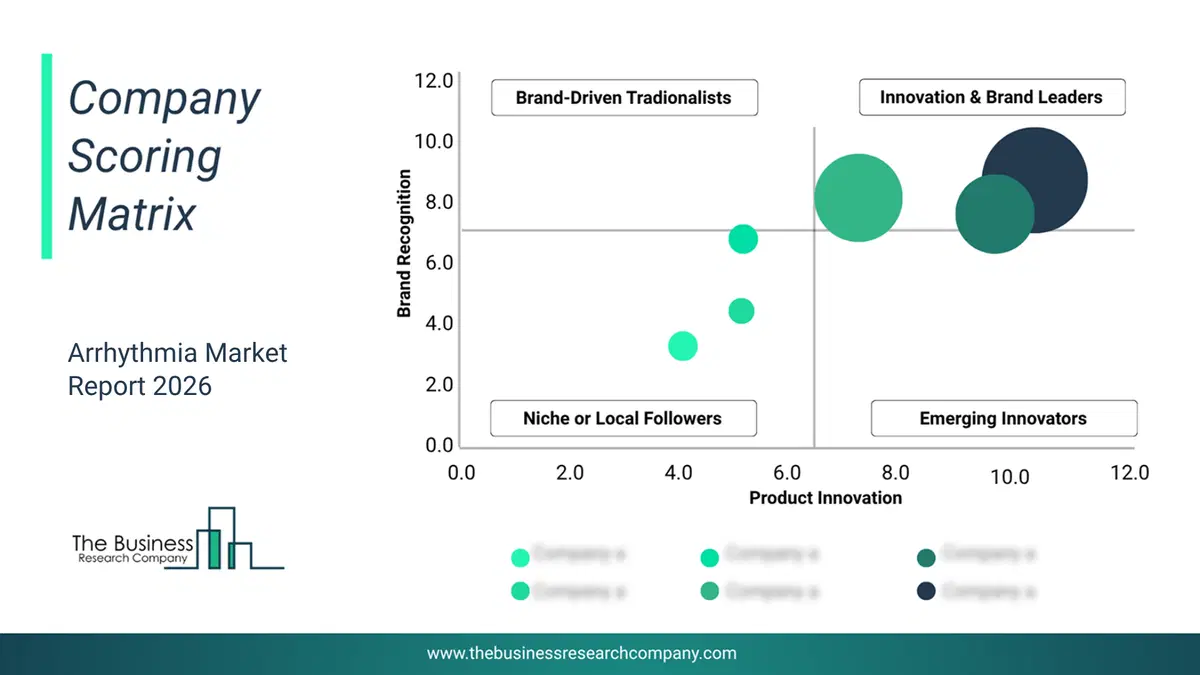
This chart maps companies by product innovation and brand strength, with bubble size indicating relative revenue, helping identify market leaders, challengers, and niche players. This is an illustrative chart; the full report provides a complete and accurate competitive analysis.
Global Arrhythmia Market Trends and Insights
Major companies operating in the arrythmia market are developing new catheters to sustain their position in the market. Catheter is a thin, flexible tube-like medical device that is inserted into the body to either remove fluids from a body cavity, deliver fluids or medications into the body, or to measure various parameters within the body. For instance, in July 2023, Biosense Webster, Inc., a US-based medical equipment manufacturing company, launched Optrell Mapping Catheter with TrueRef Technology to aid electrophysiologists in mapping complex cardiac arrhythmias. It features a fixed array of small electrodes for high-definition mapping of conditions like atrial fibrillation and tachycardia. Designed for use with the Carto 3 system by Biosense Webster, it helps identify ablation targets more quickly and effectively. This catheter provides improved diagnostic insight, boosting confidence in detecting ablation targets in even the most complex cases, making it a significant advancement in cardiac electrophysiology.What Are Latest Mergers And Acquisitions In The Arrhythmia Market?
In November 2024, Boston Scientific Corporation, a US-based healthcare technology company, acquired Cortex Inc. for an undisclosed amount. With this acquisition, Boston Scientific aims to enhance its neurovascular device portfolio and strengthen its capabilities in minimally invasive treatments for cerebrovascular diseases. Cortex Inc. is a US-based healthcare technology company that specializes in developing advanced neurovascular medical devices, including stents and delivery systems, for the treatment of complex brain aneurysms and vascular conditions.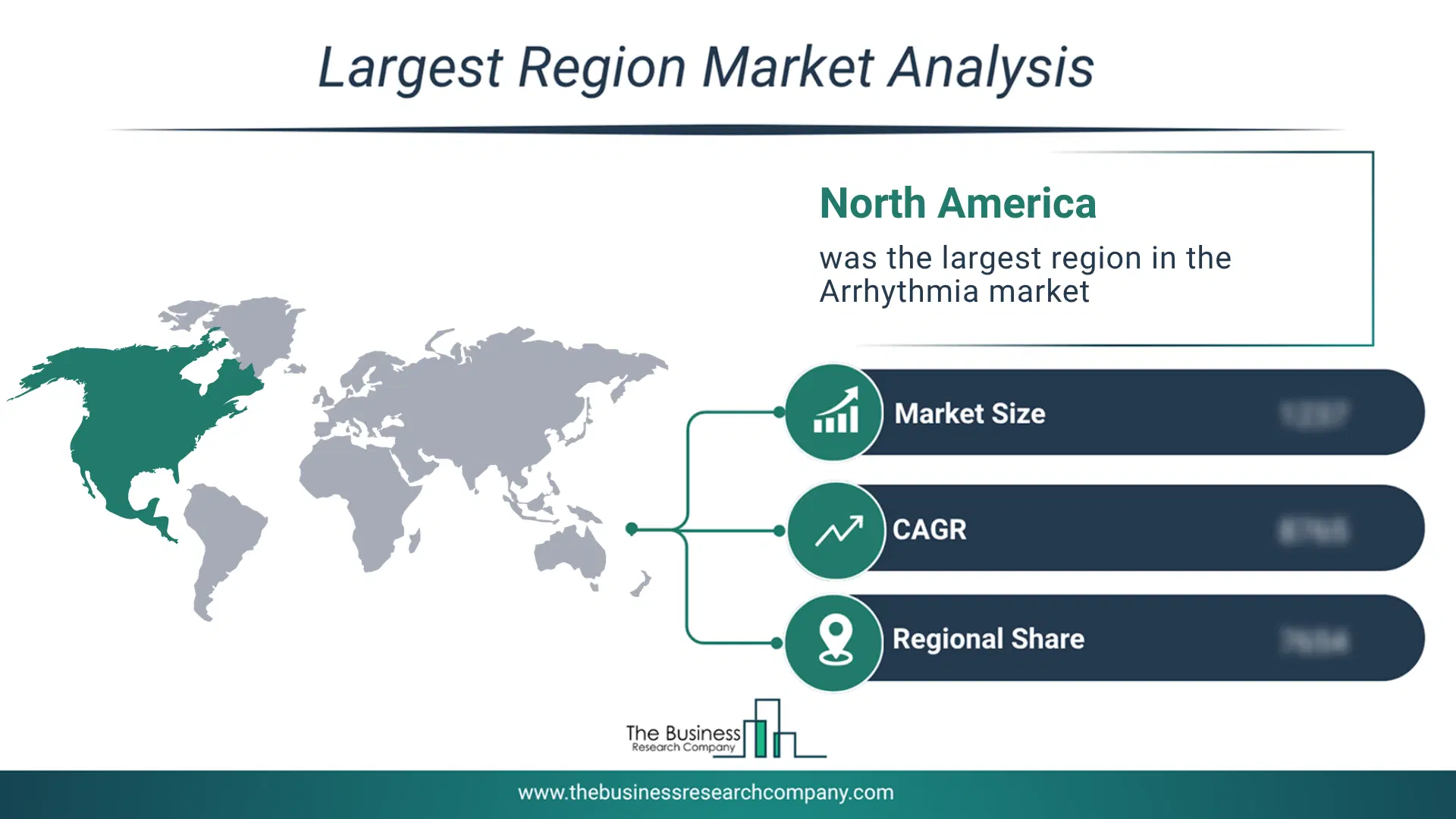
Regional Outlook
North America was the largest region in the arrhythmia market in 2025. The regions covered in this market report are Asia-Pacific, South East Asia, Western Europe, Eastern Europe, North America, South America, Middle East, Africa. The countries covered in this market report are Australia, Brazil, China, France, Germany, India, Indonesia, Japan, Taiwan, Russia, South Korea, UK, USA, Canada, Italy, SpainWhat Defines the Arrhythmia Market?
The arrhythmia market includes revenues earned by entities from sinus bradycardia, premature atrial contractions (PACS), wandering atrial pacemakers, atrial tachycardia, multifocal atrial tachycardia, atrial flutter, and atrial fibrillation (AFIB). The market value includes the value of related goods sold by the service provider or included within the service offering. Only goods and services traded between entities or sold to end consumers are included.How is Market Value Defined and Measured?
The market value is defined as the revenues that enterprises gain from the sale of goods and/or services within the specified market and geography through sales, grants, or donations in terms of the currency (in USD unless otherwise specified). The revenues for a specified geography are consumption values that are revenues generated by organizations in the specified geography within the market, irrespective of where they are produced. It does not include revenues from resales along the supply chain, either further along the supply chain or as part of other products.
This chart presents market attractiveness based on a quantitative evaluation of growth, competition, strategic alignment, and risk, offering a clear view of opportunity areas for decision-making. This chart is for illustrative purposes; the full report contains the complete analysis.

This chart highlights the Total Addressable Market (TAM) by estimating the maximum revenue opportunity using an assumption-driven approach, supporting strategic planning and opportunity sizing across markets. The chart is illustrative; the full report provides a more comprehensive analysis.
What Key Data and Analysis Are Included in the Arrhythmia Market Report 2026?
The arrhythmia market research report is one of a series of new reports from The Business Research Company that provides market statistics, including industry global market size, regional shares, competitors with the market share, detailed market segments, market trends and opportunities, and any further data you may need to thrive in the arrhythmia industry. The market research report delivers a complete perspective of everything you need, with an in-depth analysis of the current and future state of the industry.Arrhythmia Market Report Forecast Analysis
| Report Attribute | Details |
|---|---|
| Market Size Value In 2026 | $9.03 billion |
| Revenue Forecast In 2030 | $12.65 billion |
| Growth Rate | CAGR of 8.8% from 2026 to 2030 |
| Base Year For Estimation | 2025 |
| Actual Estimates/Historical Data | 2020-2025 |
| Forecast Period | 2026 - 2030 |
| Market Representation | Revenue in USD Billion and CAGR from 2026 to 2030 |
| Segments Covered | Type, Test Equipment, Hearth Blocks, Distribution Channel |
| Regional Scope | Asia-Pacific, Western Europe, Eastern Europe, North America, South America, Middle East, Africa |
| Country Scope | The countries covered in the report are Australia, Brazil, China, France, Germany, India, Indonesia, Japan, Taiwan, Russia, South Korea, UK, USA, Canada, Italy, Spain. |
| Key Companies Profiled | Medtronic PLC, Abbott Laboratories, Boston Scientific Corporation, AliveCor Inc., Biotronik SE & Co. KG, Biotricity Inc., GE Healthcare, Koninklijke Philips N.V., Nihon Kohden Corporation, Spacelabs Healthcare, Welch Allyn Inc., Mylan N.V., Lepu Medical Technology Co. Ltd., iRhythm Technologies Inc., BioTelemetry Inc., Fukuda Denshi Co. Ltd., Smart Solutions Technologies Inc., Biosense Webster Inc., Cardiac Science Corporation, CardioComm Solutions Inc., CardioNet LLC, NUUBO SMART SOLUTIONS S.L., Cardiva Medical Inc., Osypka AG, Johnson & Johnson Services Inc., Pfizer Inc, Teva Pharmaceutical Industries Ltd, Applied Cardiac Systems, Acutus Medical, EP Solutions SA |
| Customization Scope | Request for Customization |
| Pricing And Purchase Options | Explore Purchase Options |