
Augmented Reality (AR) For Ramp Operations Market Report 2026
Global Outlook – By Component (Hardware, Software, Services), By Device Type (Smart Glasses or Head-Mounted Displays, Mobile or Tablet Interfaces, Mixed Reality Devices), By Deployment Mode (On-Premises, Cloud), By Application (Aircraft Marshalling, Baggage Handling, Maintenance And Inspection, Training And Simulation, Safety And Security, Other Applications), By End User (Commercial Airports, Ground Handling Agencies, Cargo Operators, Military And Defense) – Market Size, Trends, Strategies, and Forecast to 2035
Augmented Reality (AR) For Ramp Operations Market Overview
• Augmented Reality (AR) For Ramp Operations market size has reached to $10.4 billion in 2025 • Expected to grow to $34.42 billion in 2030 at a compound annual growth rate (CAGR) of 27.1% • Growth Driver: Rising Air Traffic Fueling The Growth Of The Market Due To Increasing Operational Pressures And Need For Efficient Ramp Management • North America was the largest region in 2025 and Asia-Pacific is the fastest growing region.What Is Covered Under Augmented Reality (AR) For Ramp Operations Market?
Augmented reality (AR) for ramp operations refers to the use of augmented reality (AR) technology to overlay real-time digital information onto the physical airport ramp environment, enhancing situational awareness and task execution. It integrates with ground operation systems to provide real-time, context-aware assistance to ramp agents. It helps to improve ramp safety, reduce turnaround time, and increase operational efficiency by enabling workers to access hands-free, accurate information during aircraft loading, unloading, refueling, and maintenance activities. The main components of augmented reality (AR) for ramp operations include hardware, software, and services. Hardware refers to physical AR devices such as smart glasses and head-mounted displays used to enhance operational efficiency and situational awareness on airport ramps. These systems are categorized by device type including smart glasses or head-mounted displays, mobile or tablet interfaces, and mixed reality devices and are deployed through on-premises and cloud modes. They find application in aircraft marshalling, baggage handling, maintenance and inspection, training and simulation, safety and security, and others, serving end users including commercial airports, ground handling agencies, cargo operators, and military and defense.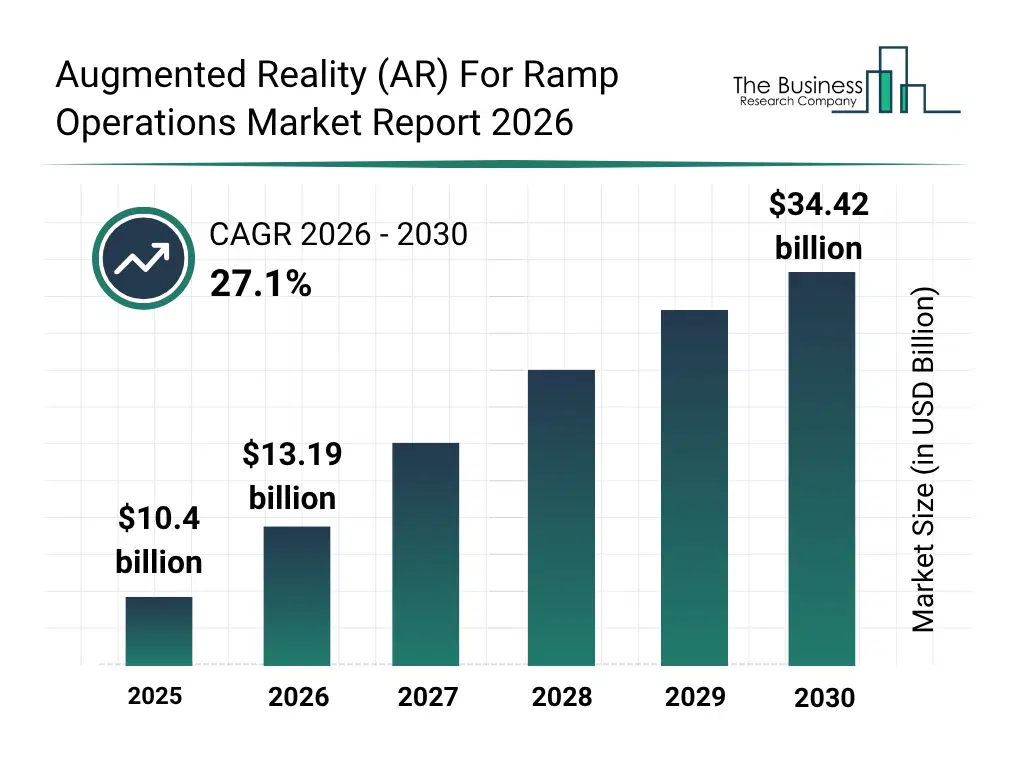
What Is The Augmented Reality (AR) For Ramp Operations Market Size and Share 2026?
The augmented reality (AR) for ramp operations market size has grown exponentially in recent years.It will grow from $10.4 billion in 2025 to $13.19 billion in 2026 at a compound annual growth rate (CAGR) of 26.9%. The growth in the historic period can be attributed to increasing airport modernization initiatives, growing adoption of digital aviation tools, rising focus on reducing aircraft turnaround time, early use of wearable devices in ground handling, expansion of commercial aviation infrastructure.What Is The Augmented Reality (AR) For Ramp Operations Market Growth Forecast?
The augmented reality (AR) for ramp operations market size is expected to see exponential growth in the next few years.It will grow to $34.42 billion by 2030 at a compound annual growth rate (CAGR) of 27.1%. The growth in the forecast period can be attributed to rising demand for real time airport operational efficiency, increasing integration of AR with AI powered airport systems, expansion of smart airport and digital twin ecosystems, growing investment in automated ground handling technologies, rising need for enhanced safety and situational awareness in ramp operations.Major trends in the forecast period include rising adoption of ar enabled real-time ramp coordination systems, integration of wearable ar devices for hands-free aircraft handling operations, expansion of remote assistance and digital twin solutions in airport ground operations, increasing deployment of ar based training and simulation for ramp agents, growth of cloud-based ar platforms for airport operational monitoring and analytics.
Global Augmented Reality (AR) For Ramp Operations Market Segmentation
1) By Component: Hardware, Software, Services 2) By Device Type: Smart Glasses or Head-Mounted Displays, Mobile or Tablet Interfaces, Mixed Reality Devices 3) By Deployment Mode: On-Premises, Cloud 4) By Application: Aircraft Marshalling, Baggage Handling, Maintenance And Inspection, Training And Simulation, Safety And Security, Other Applications 5) By End User: Commercial Airports, Ground Handling Agencies, Cargo Operators, Military And Defense Subsegments: 1) By Hardware: Head-Mounted Displays, Smart Glasses, Tablets And Mobile Devices, Sensors And Cameras, Projection Systems, Wearable Devices, Tracking Systems 2) By Software: Augmented Reality Visualization Software, Remote Assistance Software, Workflow Management Software, Simulation And Training Software, Data Integration Software, Navigation And Guidance Software, Maintenance Support Software 3) By Services: Consulting Services, System Integration Services, Deployment And Implementation Services, Support And Maintenance Services, Training And Education Services, Managed ServicesWhat Are The Drivers Of The Augmented Reality (AR) For Ramp Operations Market?
The rising air traffic is expected to propel the growth of the augmented reality (AR) for ramp operations industry going forward.Air traffic refers to the movement of aircraft and passengers globally, while airport expansion involves the development and enlargement of airport infrastructure to handle increasing demand.The rise in air traffic is due to growing passenger volumes and higher flight frequencies, which increase operational pressures on airports.The augmented reality (AR) for ramp operations supports air traffic by enhancing ground handling efficiency through real-time visual guidance, improving coordination of aircraft turnaround processes, reducing delays, and increasing overall airport capacity utilization.For instance, in July 2025, according to the Airports Council International (ACI), a Canada-based trade association of airport operators, the passenger traffic reached 9.4 billion travellers in 2024, up 8.4% from 2023 and exceeding pre-pandemic levels.Therefore, the rising air traffic is driving the growth of the augmented reality (AR) for ramp operations industry. The growing digital transformation and smart airport initiatives is expected to propel the growth of the augmented reality (AR) for ramp operations industry going forward.Digital transformation and smart airport initiatives refer to the adoption of advanced digital technologies such as artificial intelligence (AI), internet of things (IoT), automation, and data analytics to modernize airport operations, improve efficiency, enhance passenger experience.The growth in digital transformation and smart airport initiatives is due to the increasing need for operational efficiency, enhanced passenger experience, improved safety and security, real-time data-driven decision-making, and the integration of advanced technologies.The augmented reality (AR) for ramp operations supports digital transformation and smart airport initiatives by enabling real-time, data-driven visual guidance, improving ground handling efficiency, enhancing safety, and integrating digital workflows into airport operations.For instance, in April 2023, according to Airports Council International (ACI) World, a Canada-based airport trade association, around 93% of airports worldwide maintained or increased their IT spending in 2023 compared to 2022, with total IT investment reaching an estimated USD 6.8 billion to accelerate digitalization and streamline operations.Therefore, growing digital transformation and smart airport initiatives is driving the growth in the augmented reality (AR) for ramp operations industry.Key Players In The Global Augmented Reality (AR) For Ramp Operations Market
Major companies operating in the augmented reality (ar) for ramp operations market are The Boeing Company, Airbus SE, Lockheed Martin Corporation, Honeywell International Inc, Thales Group, Qatar Airways Group, Zebra Technologies Corporation, SATS Ltd., Swissport International AG, Zoho Corporation (Zoho Lens), PTC Inc., Société Internationale de Télécommunications Aéronautiques, Air India SATS Airport Services Pvt. Ltd., EON Reality Inc., Scope AR Inc., AeroGround Flughafen München GmbH, Vuzix Corporation, Aeroport Handling, Atheer Inc.What Are Latest Mergers And Acquisitions In The Augmented Reality (AR) For Ramp Operations Market?
In March 2024, JFK International Airport, a US-based international airport, partnered with LogiPix International Corp. to install its AI and AR-enabled Virtual Ramp Control System at the renewed Terminal 6. Through this partnership, JFK Millennium Partners and Logipix are deploying AI‑and AR‑enabled ramp control systems to enhance situational awareness, improve operational efficiency, and increase safety during aircraft ground handling. LogiPix International Corp. is a US-based technology provider specializing in AI-and AR-enabled solutions for ramp operations, offering systems that enhance situational awareness, safety, and efficiency on airport tarmacs.Regional Insights
North America was the largest region in the augmented reality (AR) for ramp operations market in 2025. Asia-Pacific is expected to be the fastest-growing region in the forecast period. The regions covered in this market report are Asia-Pacific, South East Asia, Western Europe, Eastern Europe, North America, South America, Middle East and Africa. The countries covered in this market report are Australia, Brazil, China, France, Germany, India, Indonesia, Japan, Taiwan, Russia, South Korea, UK, USA, Canada, Italy, Spain.What Defines the Augmented Reality (AR) For Ramp Operations Market?
The augmented Reality (AR) for ramp operations market consists of revenues earned by entities by providing services such as system integration, deployment and implementation, training and simulation, software customization, data integration, remote assistance, real-time monitoring, and cloud management services. The market value includes the value of related goods sold by the service provider or included within the service offering. The augmented reality (AR) for ramp operations market also includes sales of head-mounted displays, rugged tablets, handheld devices, wearable sensors, depth cameras, lidar scanners, edge computing devices, industrial smartphones, and tracking beacons. Values in this market are ‘factory gate’ values, that is the value of goods sold by the manufacturers or creators of the goods, whether to other entities (including downstream manufacturers, wholesalers, distributors and retailers) or directly to end customers. The value of goods in this market includes related services sold by the creators of the goods.What is the Market Assessment and Strategic Outlook for the Augmented Reality (AR) For Ramp Operations Industry?
The augmented reality (ar) for ramp operations market research report is one of a series of new reports from The Business Research Company that provides market statistics, including industry global market size, regional shares, competitors with the market share, detailed market segments, market trends and opportunities, and any further data you may need to thrive in the augmented reality (ar) for ramp operations industry. The market research report delivers a complete perspective of everything you need, with an in-depth analysis of the current and future state of the industry.What is the Market Assessment and Strategic Outlook for the Augmented Reality (AR) For Ramp Operations Market Report 2026?
The augmented reality (AR) for ramp operations market research report is one of a series of new reports from The Business Research Company that provides augmented reality (AR) for ramp operations market statistics, including augmented reality (AR) for ramp operations industry global market size, regional shares, competitors with a augmented reality (AR) for ramp operations market share, detailed augmented reality (AR) for ramp operations market segments, market trends and opportunities, and any further data you may need to thrive in the augmented reality (AR) for ramp operations industry. This augmented reality (AR) for ramp operations market research report delivers a complete perspective of everything you need, with an in-depth analysis of the current and future scenario of the industry.Augmented Reality (AR) For Ramp Operations Market Report Forecast Analysis
| Report Attribute | Details |
|---|---|
| Market Size Value In 2026 | $13.19 billion |
| Revenue Forecast In 2035 | $34.42 billion |
| Growth Rate | CAGR of 27.1% from 2026 to 2035 |
| Base Year For Estimation | 2025 |
| Actual Estimates/Historical Data | 2020-2025 |
| Forecast Period | 2026 - 2030 - 2035 |
| Market Representation | Revenue in USD Billion and CAGR from 2026 to 2035 |
| Segments Covered | Component, Device Type, Deployment Mode, Application, End User |
| Regional Scope | Asia-Pacific, Western Europe, Eastern Europe, North America, South America, Middle East, Africa |
| Country Scope | The countries covered in the report are Australia, Brazil, China, France, Germany, India, Indonesia, Japan, Taiwan, Russia, South Korea, UK, USA, Canada, Italy, Spain. |
| Key Companies Profiled | The Boeing Company, Airbus SE, Lockheed Martin Corporation, Honeywell International Inc, Thales Group, Qatar Airways Group, Zebra Technologies Corporation, SATS Ltd., Swissport International AG, Zoho Corporation (Zoho Lens), PTC Inc., Société Internationale de Télécommunications Aéronautiques, Air India SATS Airport Services Pvt. Ltd., EON Reality Inc., Scope AR Inc., AeroGround Flughafen München GmbH, Vuzix Corporation, Aeroport Handling, Atheer Inc. |
| Customization Scope | Request for Customization |
| Pricing And Purchase Options | Explore Purchase Options |