
Automated Recovery Vehicle Market Report 2026
Global Outlook – By Vehicle Type (Light-Duty, Medium-Duty, Heavy-Duty), By Technology (Semi-Autonomous, Fully Autonomous), By Propulsion (Electric, Diesel, Hybrid), By Application (Roadside Assistance, Emergency Services, Commercial Towing, Municipal Services, Other Applications), By End-User (Automotive, Insurance, Government And Municipal, Logistics And Transportation, Other End-Users) – Market Size, Trends, Strategies, and Forecast to 2030
Automated Recovery Vehicle Market Overview
• Automated Recovery Vehicle market size has reached to $2.15 billion in 2025 • Expected to grow to $4.23 billion in 2030 at a compound annual growth rate (CAGR) of 14.4% • Growth Driver: Rising Adoption Of Autonomous Vehicles Driving The Growth Of The Market Due To The Need For Specialized Recovery Solutions • Market Trend: Autonomous Heavy-Towing Solutions For Modern Industry • North America was the largest region in 2025 and Asia-Pacific is the fastest growing region.What Is Covered Under Automated Recovery Vehicle Market?
An automated recovery vehicle is a specialized vehicle designed to assist in the recovery, towing, or repair of disabled, stalled, or accident-affected vehicles with minimal human intervention. These vehicles use advanced automation technologies, such as sensors, robotics, and navigation systems, to safely and efficiently handle roadside assistance tasks. An automated recovery vehicles enhance operational safety, reduce response time, and improve efficiency in vehicle recovery operations, particularly in busy or hazardous environments. The main types of automated recovery vehicles are light-duty, medium-duty, and heavy-duty. Light-duty refers to smaller automated recovery vehicles designed to tow or recover passenger cars and lightweight vans in urban or roadside conditions. It can be both semi-autonomous and fully autonomous and uses various propulsion types such as electric, diesel, and hybrid. It is applied for roadside assistance, emergency services, commercial towing, municipal services, and others and is used by several end-users, including automotive, insurance, government and municipal, logistics and transportation, and others.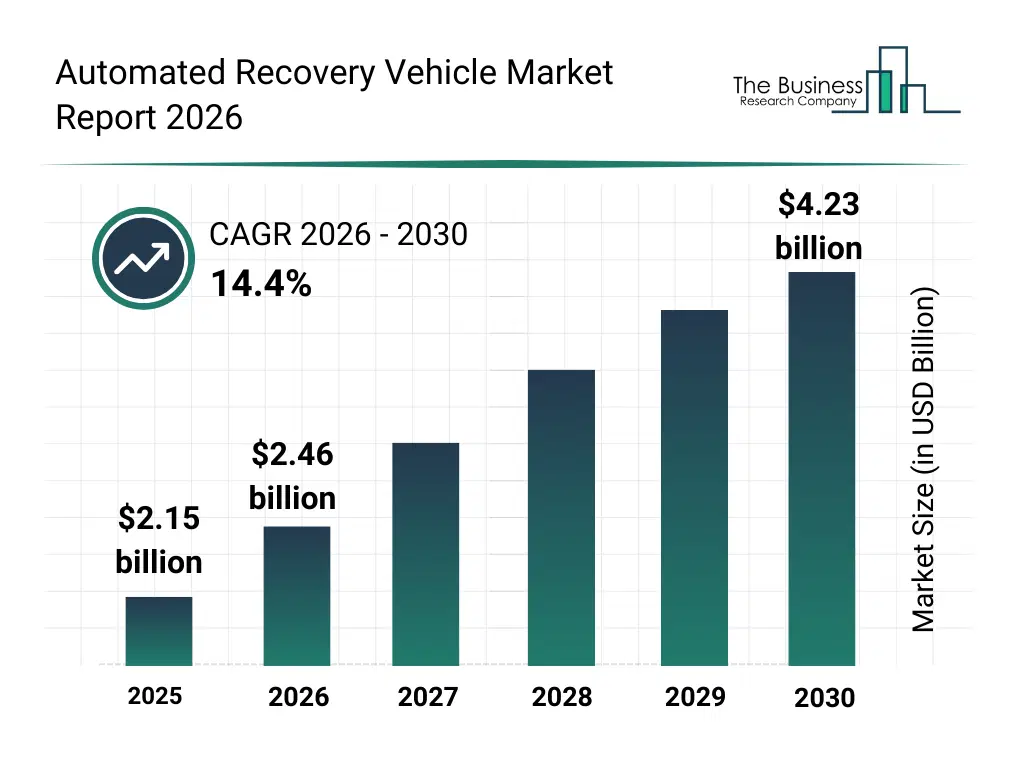
What Is The Automated Recovery Vehicle Market Size and Share 2026?
The automated recovery vehicle market size has grown rapidly in recent years. It will grow from $2.15 billion in 2025 to $2.46 billion in 2026 at a compound annual growth rate (CAGR) of 14.7%. The growth in the historic period can be attributed to rising vehicle parc, growth of roadside assistance services, demand for faster recovery response, highway safety concerns, expansion of commercial towing fleets.What Is The Automated Recovery Vehicle Market Growth Forecast?
The automated recovery vehicle market size is expected to see rapid growth in the next few years. It will grow to $4.23 billion in 2030 at a compound annual growth rate (CAGR) of 14.4%. The growth in the forecast period can be attributed to increase in autonomous vehicle incidents, smart mobility investments, adoption of AI-based recovery systems, demand for reduced human intervention, electrification of service fleets. Major trends in the forecast period include integration of autonomous navigation systems, adoption of robotic towing arms, use of real-time telematics, growth of electric recovery vehicles, demand for safer roadside operations.
Global Automated Recovery Vehicle Market Segmentation
1) By Vehicle Type: Light-Duty, Medium-Duty, Heavy-Duty 2) By Technology: Semi-Autonomous, Fully Autonomous 3) By Propulsion: Electric, Diesel, Hybrid 4) By Application: Roadside Assistance, Emergency Services, Commercial Towing, Municipal Services, Other Applications 5) By End-User: Automotive, Insurance, Government And Municipal, Logistics And Transportation, Other End-Users Subsegments: 1) By Light-Duty: Flatbed Recovery Trucks, Tilt Bed Recovery Trucks, Small Wrecker Trucks, Mini Rotators, Pickup-Based Recovery Vehicles 2) By Medium-Duty: Standard Wrecker Trucks, Medium Rotators, Hook And Chain Recovery Vehicles, Integrated Crane Recovery Vehicles, Heavy Flatbed Recovery Trucks 3) By Heavy-Duty: Armored Recovery Vehicles (Military), Heavy Rotators, Boom And Winch Recovery Trucks, Multi-Axle Heavy Recovery Trucks, Tactical Recovery VehiclesWhat Is The Driver Of The Automated Recovery Vehicle Market?
The increasing autonomous vehicles adoption is expected to propel the growth of the automated recovery vehicle market going forward. Autonomous vehicles are vehicles that can operate and navigate on their own using advanced sensors, artificial intelligence, and control systems without direct human control. Autonomous vehicles are rising due to advancements in artificial intelligence and sensor technologies, enabling safer, more efficient, and convenient transportation solutions. The adoption of autonomous vehicles increases the need for automated recovery vehicles as self-driving systems require specialized, unmanned recovery solutions to safely handle breakdowns or accidents without human intervention. For instance, according to a report published by the Insurance Institute for Highway Safety, a US-based non-profit organization, the number of autonomous vehicles on American roads are expected to increase from 3.5 million in 2025 to 4.5 million autonomous vehicles by 2030. Therefore, the increasing autonomous vehicles adoption is driving the growth of the automated recovery vehicle industry.Key Players In The Global Automated Recovery Vehicle Market
Major companies operating in the automated recovery vehicle market report include Rheinmetall AG, ST Engineering Ltd., Ashok Leyland Ltd., Hanwha Defense International, Miller Industries Inc., Torc Robotics Inc., Flensburger Fahrzeugbau Gesellschaft (FFG), IVECO Defence Vehicles, AiMotive, Mack Defense LLC, Boniface Engineering Ltd., OMARS S.p.A., Jerr-Dan Corporation, MVTRAC LLC, EasTract, Indhu Hydraulics Inc., CLW Group Automobile Co. Ltd., Hubei Chusheng Vehicle Imp. & Exp. Co. Ltd., Hubei Changheng Special Vehicle Co. Ltd., TowTrack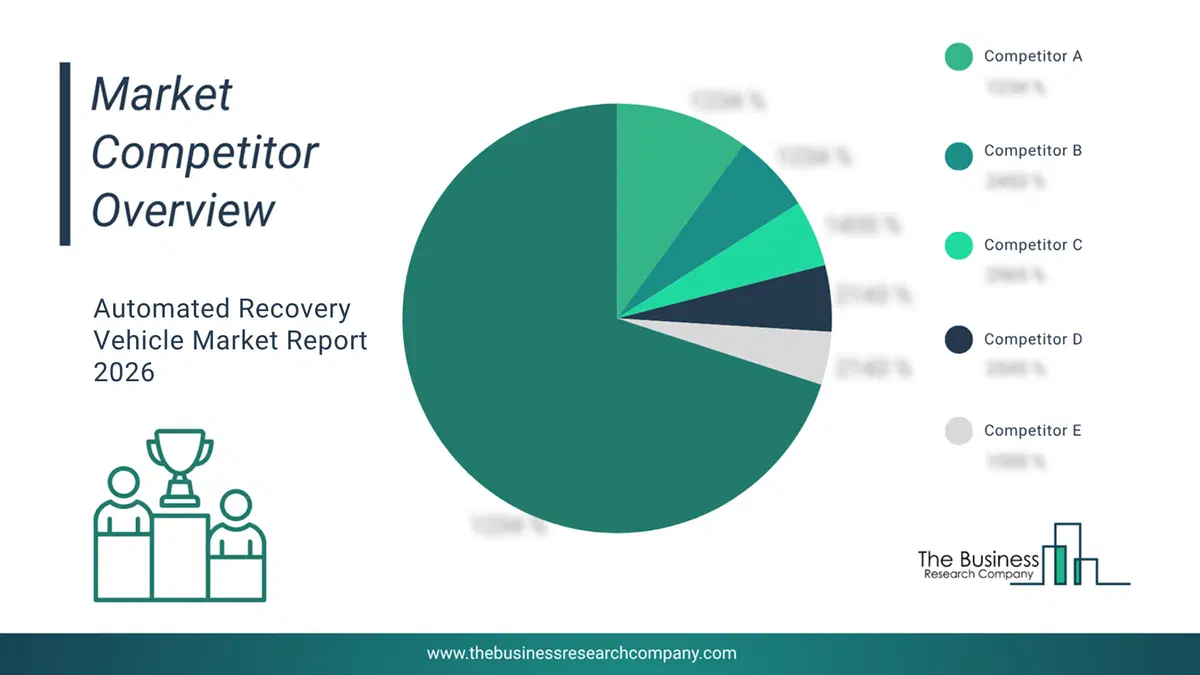
This chart is for illustrative purposes; the full report includes a detailed competitor analysis and comprehensive overview of the top 10 companies in the market.
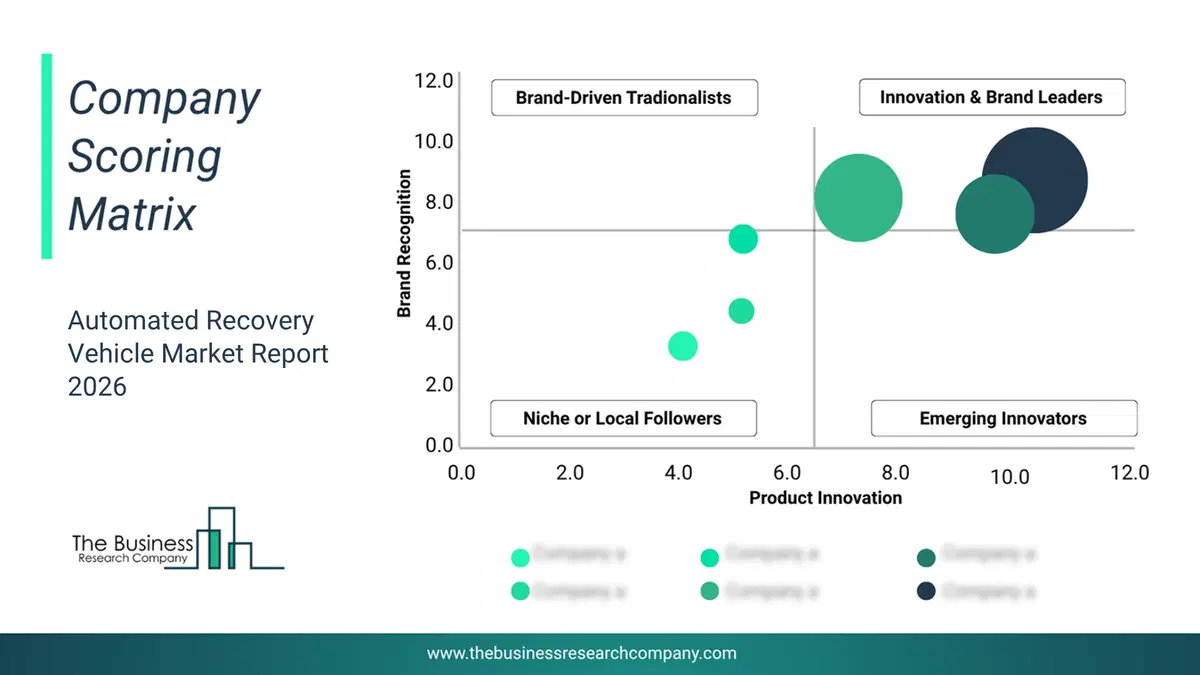
This chart maps companies by product innovation and brand strength, with bubble size indicating relative revenue, helping identify market leaders, challengers, and niche players. This is an illustrative chart; the full report provides a complete and accurate competitive analysis.
Global Automated Recovery Vehicle Market Trends and Insights
Major companies operating in the automated recovery vehicle market are focusing on developing advanced solutions, such as smart robots, to provide valuable data insights that enable predictive maintenance and continuous optimization of processes. A smart robot is an autonomous machine that can perceive its environment, process information, and take actions to achieve specific goals through a combination of sensors, artificial intelligence, and advanced programming. For instance, in October 2024, EXEDY Corporation, a Japan-based manufacturer of drivetrain components, launched the Neibo smart robot. Its unique feature is a powerful 600kg towing capacity, which is a rare specification in the market. The robot operates in both autonomous and follow modes, enabling it to move vehicles and heavy machinery without human intervention, ideal for industrial recovery tasks. A key advantage is its ability to tow existing carts and equipment, eliminating the need for specialized assets. This functionality is supported by enhanced navigation systems and centimeter-precise localization.What Are Latest Mergers And Acquisitions In The Automated Recovery Vehicle Market?
In March 2024, John Deere, a US-based manufacturer of agricultural, construction, and forestry machinery, partnered with TractEasy for the provision of the EZTow autonomous tow-tractor. The collaboration led John Deere to strengthen its focus on adopting advanced automation technologies. This was proven when the EZTow autonomously transported combine harvester cabs from staging areas to the assembly line at John Deere Harvester Works in East Moline, Illinois, performing effectively even in difficult traffic and winter conditions. TractEasy is a France-based autonomous towing services provider.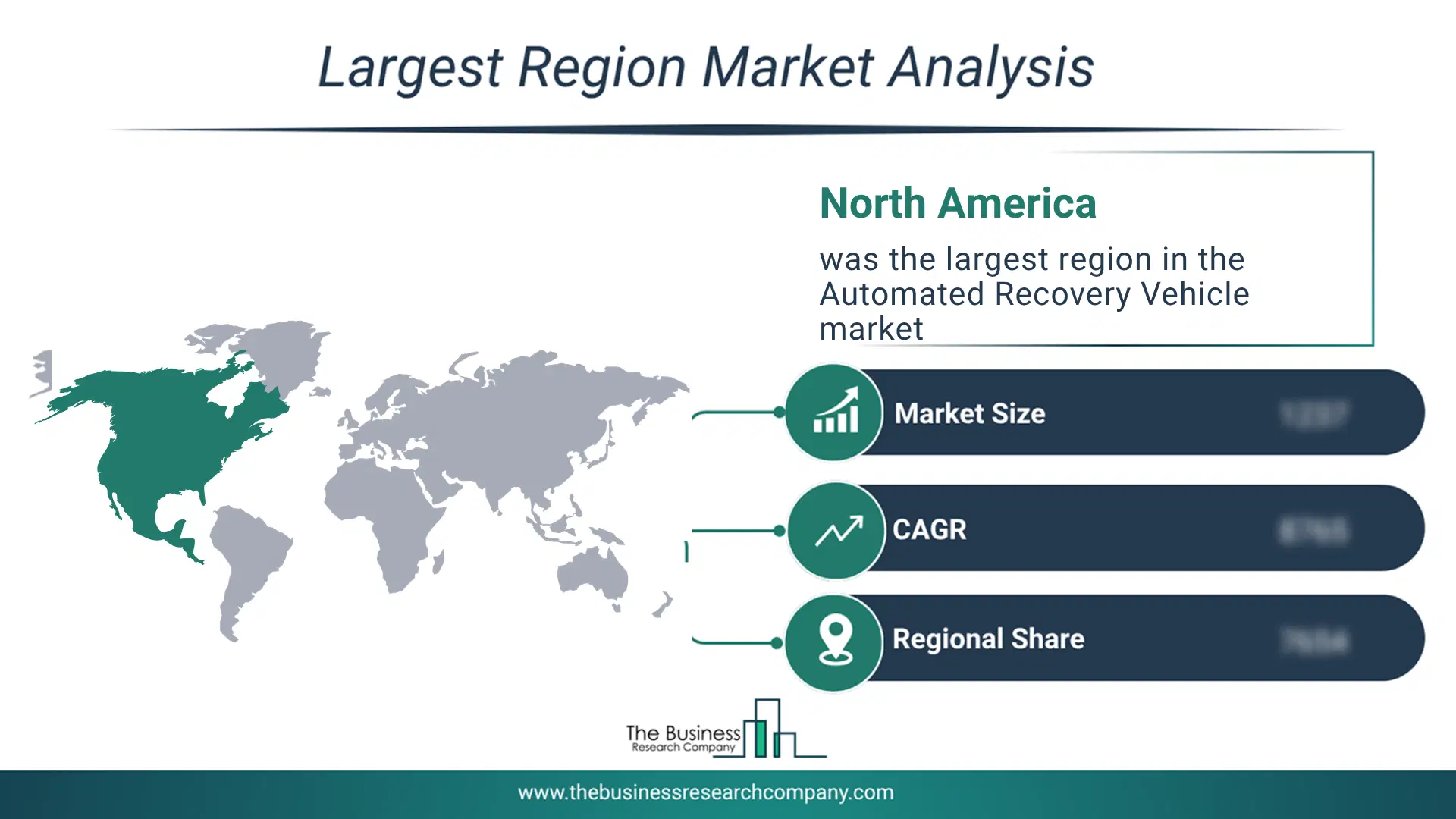
Regional Outlook
North America was the largest region in the automated recovery vehicle market in 2025. Asia-Pacific is expected to be the fastest-growing region in the forecast period. The regions covered in this market report include Asia-Pacific, South East Asia, Western Europe, Eastern Europe, North America, South America, Middle East, Africa. The countries covered in this market report include Australia, Brazil, China, France, Germany, India, Indonesia, Japan, Taiwan, Russia, South Korea, UK, USA, Canada, Italy, SpainWhat Defines the Automated Recovery Vehicle Market?
The automated recovery vehicle market consists of sales of integrated winch recovery vehicles, robotic arm recovery vehicles, self-driving recovery vehicles, and hybrid or electric automated recovery vehicles. Values in this market are ‘factory gate’ values, that is, the value of goods sold by the manufacturers or creators of the goods, whether to other entities (including downstream manufacturers, wholesalers, distributors, and retailers) or directly to end customers. The value of goods in this market includes related services sold by the creators of the goods.How is Market Value Defined and Measured?
The market value is defined as the revenues that enterprises gain from the sale of goods and/or services within the specified market and geography through sales, grants, or donations in terms of the currency (in USD unless otherwise specified). The revenues for a specified geography are consumption values that are revenues generated by organizations in the specified geography within the market, irrespective of where they are produced. It does not include revenues from resales along the supply chain, either further along the supply chain or as part of other products.
This chart presents market attractiveness based on a quantitative evaluation of growth, competition, strategic alignment, and risk, offering a clear view of opportunity areas for decision-making. This chart is for illustrative purposes; the full report contains the complete analysis.

This chart highlights the Total Addressable Market (TAM) by estimating the maximum revenue opportunity using an assumption-driven approach, supporting strategic planning and opportunity sizing across markets. The chart is illustrative; the full report provides a more comprehensive analysis.
What Key Data and Analysis Are Included in the Automated Recovery Vehicle Market Report 2026?
The automated recovery vehicle market research report is one of a series of new reports from The Business Research Company that provides market statistics, including industry global market size, regional shares, competitors with the market share, detailed market segments, market trends and opportunities, and any further data you may need to thrive in the automated recovery vehicle industry. The market research report delivers a complete perspective of everything you need, with an in-depth analysis of the current and future state of the industry.Automated Recovery Vehicle Market Report Forecast Analysis
| Report Attribute | Details |
|---|---|
| Market Size Value In 2026 | $2.46 billion |
| Revenue Forecast In 2030 | $4.23 billion |
| Growth Rate | CAGR of 14.7% from 2026 to 2030 |
| Base Year For Estimation | 2025 |
| Actual Estimates/Historical Data | 2020-2025 |
| Forecast Period | 2026 - 2030 - 2030 |
| Market Representation | Revenue in USD Billion and CAGR from 2026 to 2030 |
| Segments Covered | Vehicle Type, Technology, Propulsion, Application, End-User |
| Regional Scope | Asia-Pacific, Western Europe, Eastern Europe, North America, South America, Middle East, Africa |
| Country Scope | The countries covered in the report are Australia, Brazil, China, France, Germany, India, Indonesia, Japan, Taiwan, Russia, South Korea, UK, USA, Canada, Italy, Spain. |
| Key Companies Profiled | Rheinmetall AG, ST Engineering Ltd., Ashok Leyland Ltd., Hanwha Defense International, Miller Industries Inc., Torc Robotics Inc., Flensburger Fahrzeugbau Gesellschaft (FFG), IVECO Defence Vehicles, AiMotive, Mack Defense LLC, Boniface Engineering Ltd., OMARS S.p.A., Jerr-Dan Corporation, MVTRAC LLC, EasTract, Indhu Hydraulics Inc., CLW Group Automobile Co. Ltd., Hubei Chusheng Vehicle Imp. & Exp. Co. Ltd., Hubei Changheng Special Vehicle Co. Ltd., TowTrack |
| Customization Scope | Request for Customization |
| Pricing And Purchase Options | Explore Purchase Options |