

Automotive LiDAR Market Report 2026
Global Outlook – By Product (Aerial, Mobile, Terrestrial Or Static, Short-Range), By Technology (Solid-State LiDAR, Mechanical Or Scanning LiDAR), By Vehicle Type (IC Engine Vehicles, Hybrid Electric Vehicles (HEVS), Plug-In Hybrid Electric Vehicles (PHEVS), Battery Electric Vehicles (BEVS)), By Components (Laser, GPS Or GNSS Receiver, Camera, Inertial Navigation System, Micro Electro Mechanical System), By Application (Semi-Autonomous, Autonomous) – Market Size, Trends, Strategies, and Forecast to 2030
Automotive LiDAR Market Overview
• Automotive LiDAR market size has reached to $1.08 billion in 2025 • Expected to grow to $4.26 billion in 2030 at a compound annual growth rate (CAGR) of 31.4% • Growth Driver: Surging Demand For Semi-Autonomous And Fully Autonomous Vehicles Fuels Automotive Lidar Market Growth • Market Trend: Advancements In High-Resolution 4D Sensing Technology For Enhanced Accuracy And Real-Time Decision-Making • Asia-Pacific was the largest region in 2025.What Is Covered Under Automotive LiDAR Market?
Automotive LiDAR is a technique for sensing that locates objects and gauges their distances. The method involves illuminating a target with an optical pulse and analyzing the properties of the returned signal that is reflected. The optical pulse's width can be anything between a few nanoseconds and many microseconds. The main types of automotive LiDAR products are aerial, mobile, terrestrial, or static, and short-range. Aerial LiDAR refers to an airborne mapping system that uses calibrated laser returns from the surface of the earth reflected by an overflying GPS-monitored aircraft outfitted with onboard positioning and IMU sensors. Its components are laser, GPS/GNSS receiver, camera, inertial navigation system, micro electromechanical system with various technology including solid-state LiDAR and mechanical or scanning LiDAR for vehicles such as IC engine vehicles, hybrid electric vehicles (HEVs), plug-in hybrid electric vehicles (PHEVs), and battery electric vehicles (BEVs). They are used in ADAS and autonomous cars.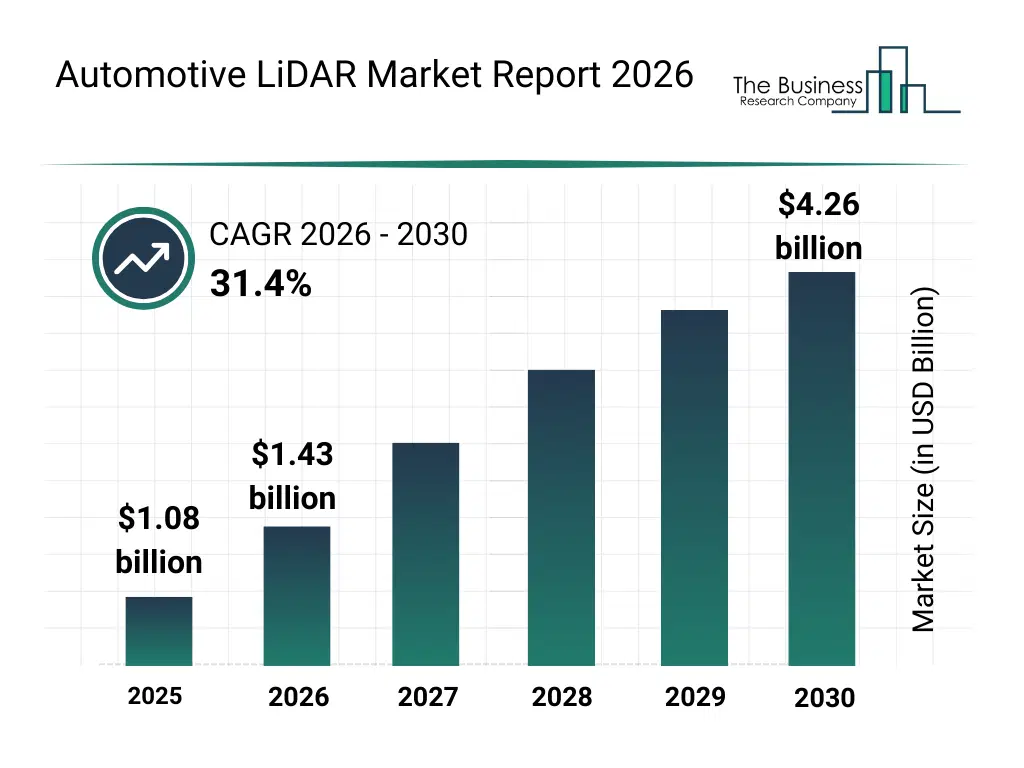
What Is The Automotive LiDAR Market Size and Share 2026?
The automotive lidar market size has grown exponentially in recent years. It will grow from $1.08 billion in 2025 to $1.43 billion in 2026 at a compound annual growth rate (CAGR) of 32.9%. The growth in the historic period can be attributed to increasing development of advanced driver assistance systems, rising investments in autonomous vehicle research, early adoption of mechanical lidar systems, growth in automotive sensor integration, increasing safety feature requirements.What Is The Automotive LiDAR Market Growth Forecast?
The automotive lidar market size is expected to see exponential growth in the next few years. It will grow to $4.26 billion in 2030 at a compound annual growth rate (CAGR) of 31.4%. The growth in the forecast period can be attributed to increasing commercialization of autonomous vehicles, rising demand for solid-state lidar solutions, expansion of smart mobility ecosystems, growing focus on vehicle safety automation, continuous reduction in lidar manufacturing costs. Major trends in the forecast period include increasing integration of solid-state lidar sensors, rising adoption of lidar in adas applications, growing demand for high-resolution long-range lidar, expansion of lidar deployment in electric vehicles, enhanced focus on cost reduction and miniaturization.
Global Automotive LiDAR Market Segmentation
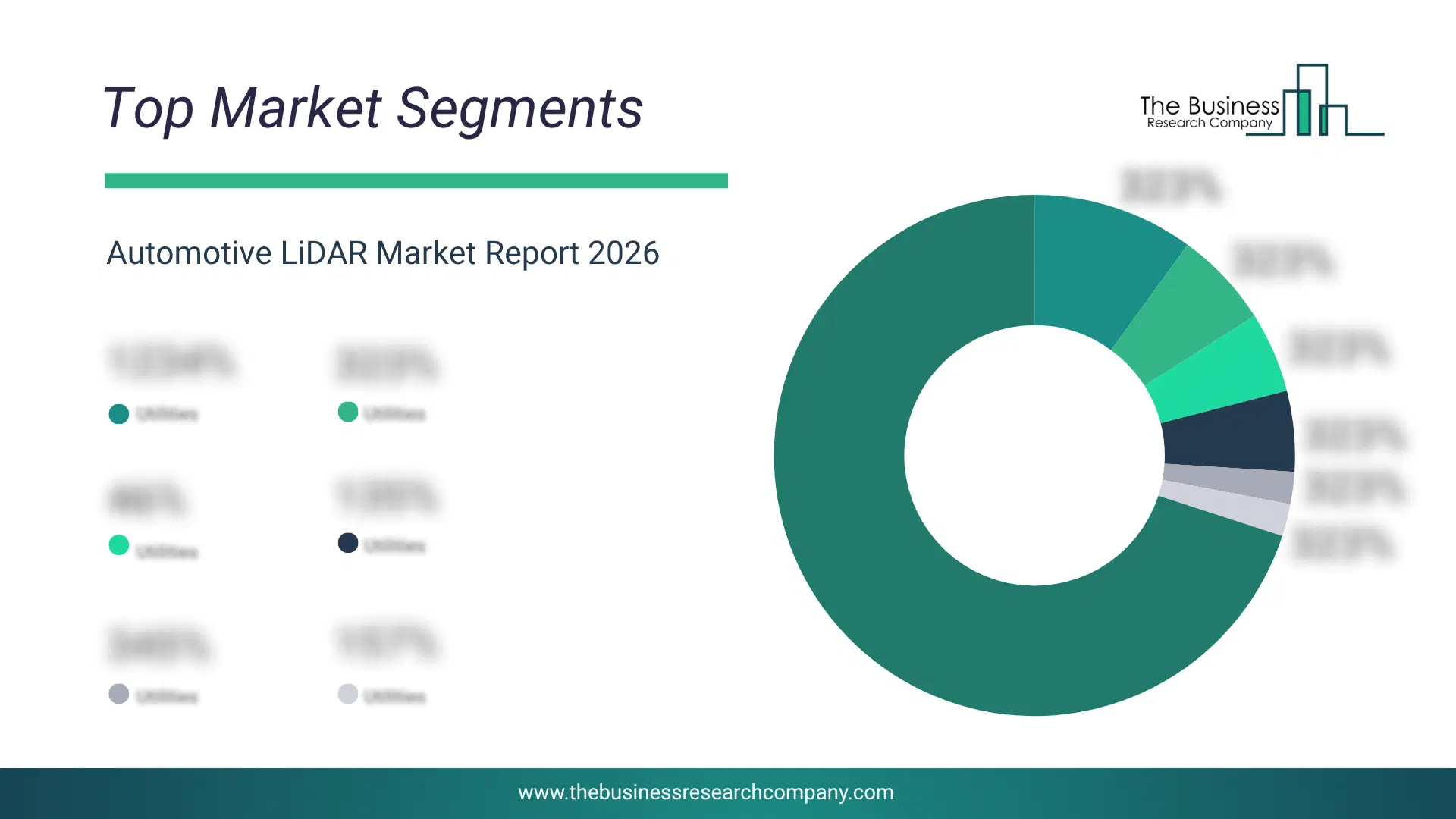
1) By Product: Aerial, Mobile, Terrestrial Or Static, Short-Range 2) By Technology: Solid-State LiDAR, Mechanical Or Scanning LiDAR 3) By Vehicle Type: IC Engine Vehicles, Hybrid Electric Vehicles (HEVS), Plug-In Hybrid Electric Vehicles (PHEVS), Battery Electric Vehicles (BEVS) 4) By Components: Laser, GPS Or GNSS Receiver, Camera, Inertial Navigation System, Micro Electro Mechanical System 5) By Application: Semi-Autonomous, Autonomous Subsegments: 1) By Aerial: Drone-Mounted LiDAR, Helicopter-Mounted LiDAR 2) By Mobile: Vehicle-Mounted LiDAR Systems, Portable LiDAR Units For Mapping 3) By Terrestrial Or Static: Ground-Based LiDAR Systems, Fixed Installation LiDAR Systems 4) By Short-Range: LiDAR For Obstacle Detection, LiDAR For Close-Range MappingWhat Is The Driver Of The Automotive LiDAR Market?
The increasing demand for semi-autonomous and fully autonomous vehicles is significantly contributing to the growth of the automotive LiDAR market going forward. An autonomous or self-driving vehicle refers to a vehicle with environmental sensing capabilities and autonomous operation. An autonomous vehicle can sense its surroundings and operate without human intervention. LiDAR sensors are being used by self-driving cars to create extensive 3D maps for 360-degree vision and accurate data to aid with self-navigation and object detection. Further, in December 2024, according to the National Association of Insurance Commissioners, a US-based non-profit organization the Insurance Institute for Highway Safety anticipates that 4.5 million self-driving vehicles will be on U.S. roads by 2030. Therefore, the increasing demand for semi-autonomous and fully autonomous vehicles drives the automotive LiDAR industry.Key Players In The Global Automotive LiDAR Market
Major companies operating in the automotive lidar market are Continental AG; Ibeo Automotive Systems GmbH; Innoviz Technologies Ltd.; LeddarTech Inc.; Luminar Technologies Inc.; Ouster Inc.; Robert Bosch GmbH; Velodyne Lidar Inc.; Denso Corporation; Argo AI LLC; ZF Friedrichshafen AG; Quanergy Systems Inc.; AEye Inc.; Blackmore Sensors and Analytics Inc.; Cepton Technologies Inc.; HesAI Technology Co. Ltd.; Blickfeld GmbH; Innovusion Inc.; Aeva Technologies Inc.; Baraja Pty Ltd; XenomatiX NV; Benewake Co. Ltd.; HoloMatic Technologies Co. Ltd.; LeiShen Intelligent Systems Co. Ltd.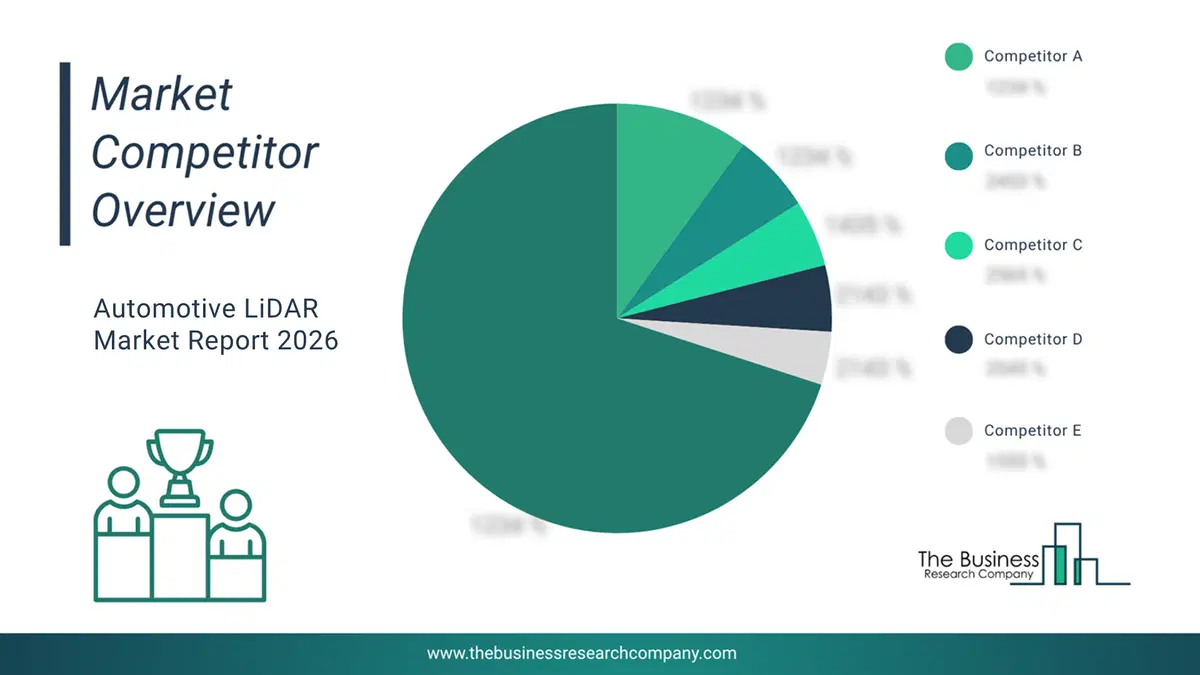
This chart is for illustrative purposes; the full report includes a detailed competitor analysis and comprehensive overview of the top 10 companies in the market.
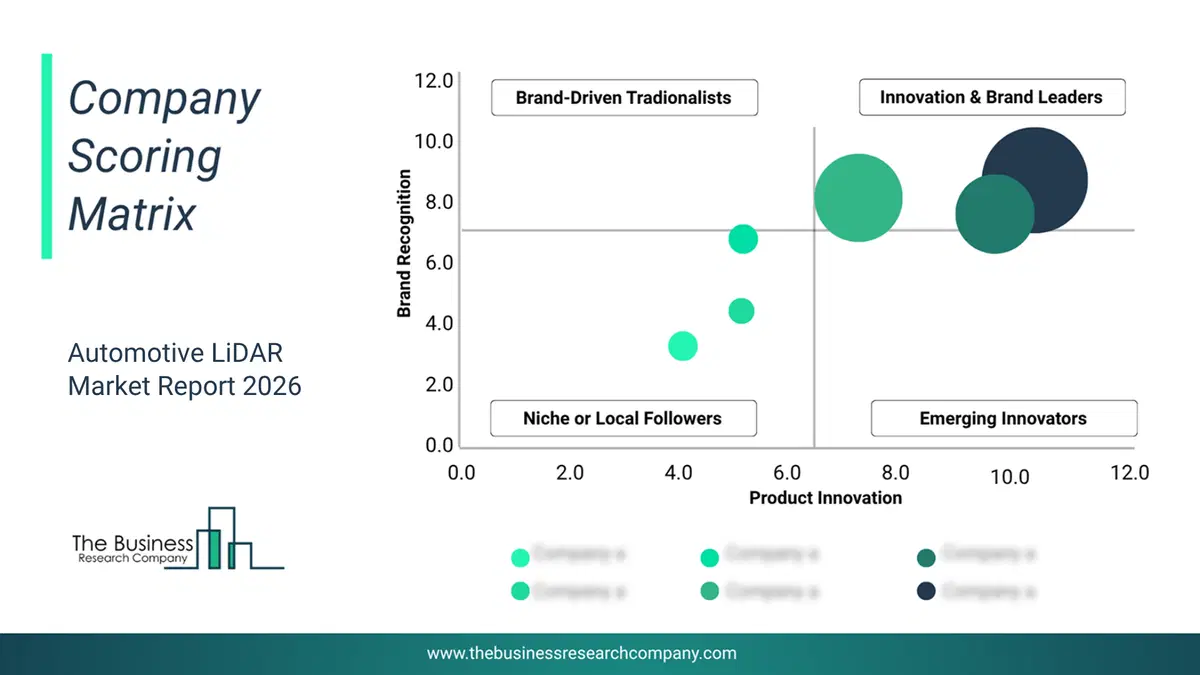
This chart maps companies by product innovation and brand strength, with bubble size indicating relative revenue, helping identify market leaders, challengers, and niche players. This is an illustrative chart; the full report provides a complete and accurate competitive analysis.
Global Automotive LiDAR Market Trends and Insights
Major companies operating in the automotive LiDAR market are focusing on leveraging innovative technologies, such as high-resolution 4D LiDAR, to meet the rising demand for highway-speed automated driving and enhanced perception in passenger and commercial vehicles. High-resolution 4D LiDAR uses Frequency-Modulated Continuous Wave (FMCW) technology and silicon-photonic integration to detect both object position and velocity, offering far greater spatial accuracy and real-time movement tracking than traditional time-of-flight 3D LiDAR systems. For instance, in January 2025, Aeva Technologies Inc., a US-based sensing and perception company, launched its “Atlas Ultra” sensor, a slim, high-resolution 4D LiDAR module built for advanced driving systems with up to 3× the resolution of its predecessor, up to 500 m detection range, a 35% slimmer profile for seamless automotive integration, and on-sensor AI-based perception and localization capabilities. The Atlas Ultra is geared for deployment in OEM passenger and commercial vehicle platforms, enabling precise detection of small and dynamically emerging obstacles, lane- and drivable-region segmentation, and real-time velocity tracking, all of which help improve safety and automation in demanding driving environments.What Are Latest Mergers And Acquisitions In The Automotive LiDAR Market?
In February 2023, Ouster Inc., a US-based manufacturing company, merged with Velodyne Lidar, Inc. to strengthen their lidar offerings and accelerate market adoption. With this merger, Ouster and Velodyne aim to offer a comprehensive portfolio of lidar hardware and software solutions, expand their customer base across automotive, industrial, robotics, and smart infrastructure industries, and drive growth through an innovative digital lidar roadmap. The merger also allows the combined company to achieve significant cost synergies, strengthen its financial position, and enhance shareholder value. Velodyne Lidar Inc. is a US-based company specializing in lidar sensors and solutions.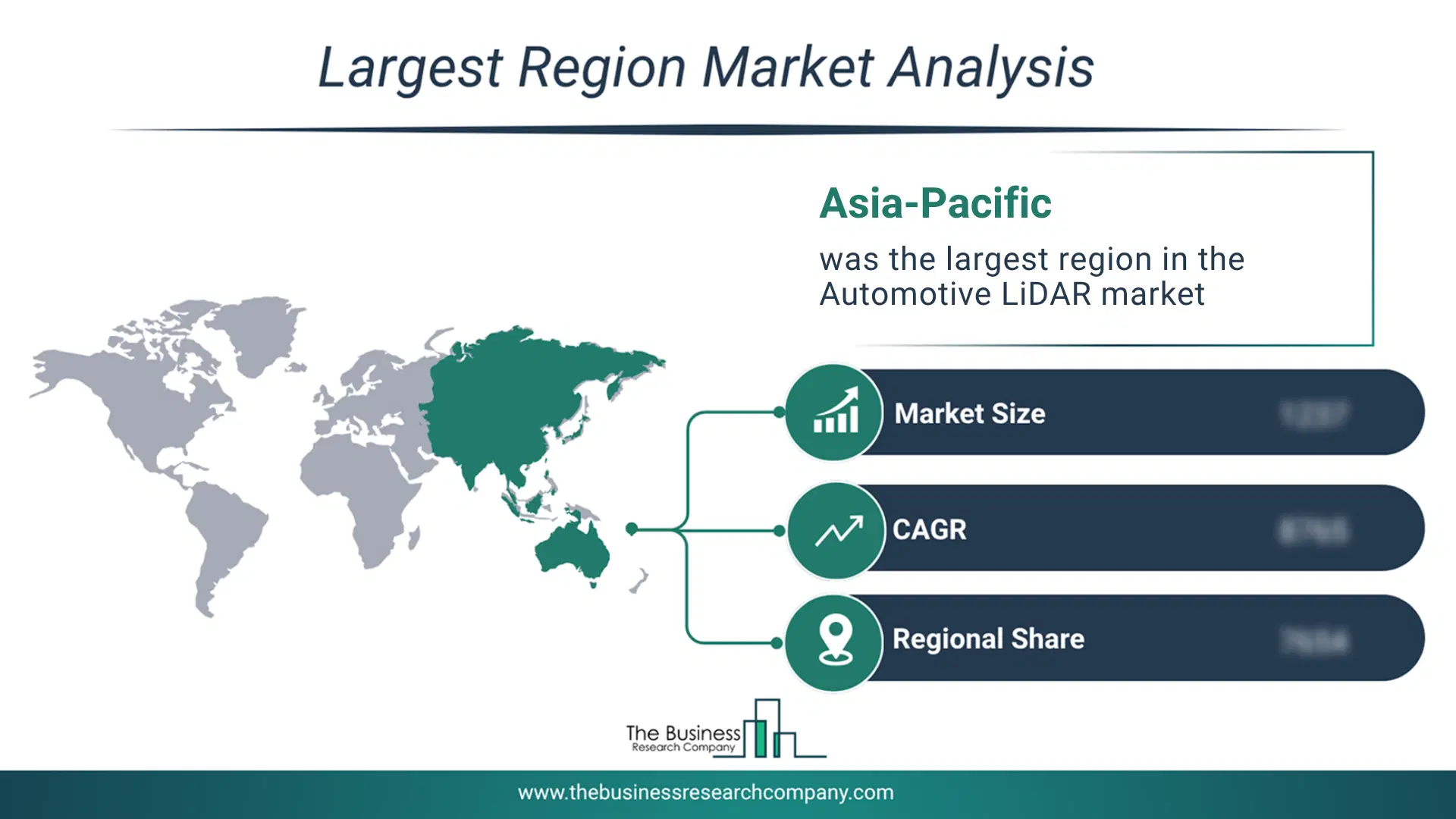
Regional Insights
Asia-Pacific was the largest region in the automotive LiDAR market share in 2025. The regions covered in this market report are Asia-Pacific, South East Asia, Western Europe, Eastern Europe, North America, South America, Middle East, Africa. The countries covered in this market report are Australia, Brazil, China, France, Germany, India, Indonesia, Japan, Taiwan, Russia, South Korea, UK, USA, Canada, Italy, SpainWhat Defines the Automotive LiDAR Market?
The automotive LiDAR market consists of revenues earned by entities by providing 2D automotive LiDAR and 3D automotive LiDAR and related annotation technological services. The market value includes the value of related goods sold by the service provider or included within the service offering. The automotive LiDAR market also includes sales of automotive components such as automotive gimbaling systems and strap-down systems. Values in this market are ‘factory gate’ values, that is the value of goods sold by the manufacturers or creators of the goods, whether to other entities (including downstream manufacturers, wholesalers, distributors, and retailers) or directly to end customers. The value of goods in this market includes related services sold by the creators of the goods.How is Market Value Defined and Measured?
The market value is defined as the revenues that enterprises gain from the sale of goods and/or services within the specified market and geography through sales, grants, or donations in terms of the currency (in USD unless otherwise specified). The revenues for a specified geography are consumption values that are revenues generated by organizations in the specified geography within the market, irrespective of where they are produced. It does not include revenues from resales along the supply chain, either further along the supply chain or as part of other products.
This chart presents market attractiveness based on a quantitative evaluation of growth, competition, strategic alignment, and risk, offering a clear view of opportunity areas for decision-making. This chart is for illustrative purposes; the full report contains the complete analysis.

This chart highlights the Total Addressable Market (TAM) by estimating the maximum revenue opportunity using an assumption-driven approach, supporting strategic planning and opportunity sizing across markets. The chart is illustrative; the full report provides a more comprehensive analysis.
What Key Data and Analysis Are Included in the Automotive LiDAR Market Report 2026?
The automotive lidar market research report is one of a series of new reports from The Business Research Company that provides market statistics, including industry global market size, regional shares, competitors with the market share, detailed market segments, market trends and opportunities, and any further data you may need to thrive in the automotive lidar industry. The market research report delivers a complete perspective of everything you need, with an in-depth analysis of the current and future state of the industry.Automotive LiDAR Market Report Forecast Analysis
| Report Attribute | Details |
|---|---|
| Market Size Value In 2026 | $1.43 billion |
| Revenue Forecast In 2030 | $4.26 billion |
| Growth Rate | CAGR of 31.4% from 2026 to 2030 |
| Base Year For Estimation | 2025 |
| Actual Estimates/Historical Data | 2020-2025 |
| Forecast Period | 2026 - 2030 |
| Market Representation | Revenue in USD Billion and CAGR from 2026 to 2030 |
| Segments Covered | Product, Technology, Vehicle Type, Components, Application |
| Regional Scope | Asia-Pacific, Western Europe, Eastern Europe, North America, South America, Middle East, Africa |
| Country Scope | The Countries Covered In This Market Report Are Australia, Brazil, China, France, Germany, India, Indonesia, Japan, Taiwan, Russia, South Korea, Uk, Usa, Canada, Italy, Spain. |
| Key Companies Profiled | Continental AG, Ibeo Automotive Systems GmbH, Innoviz Technologies Ltd., LeddarTech Inc., Luminar Technologies Inc., Ouster Inc., Robert Bosch GmbH, Velodyne Lidar Inc., Denso Corporation, Argo AI LLC, ZF Friedrichshafen AG, Quanergy Systems Inc., AEye Inc., Blackmore Sensors and Analytics Inc., Cepton Technologies Inc., HesAI Technology Co. Ltd., Blickfeld GmbH, Innovusion Inc., Aeva Technologies Inc., Baraja Pty Ltd, XenomatiX NV, Benewake Co. Ltd., HoloMatic Technologies Co. Ltd., LeiShen Intelligent Systems Co. Ltd. |
| Customization Scope | Request for Customization |
| Pricing And Purchase Options | Explore Purchase Options |